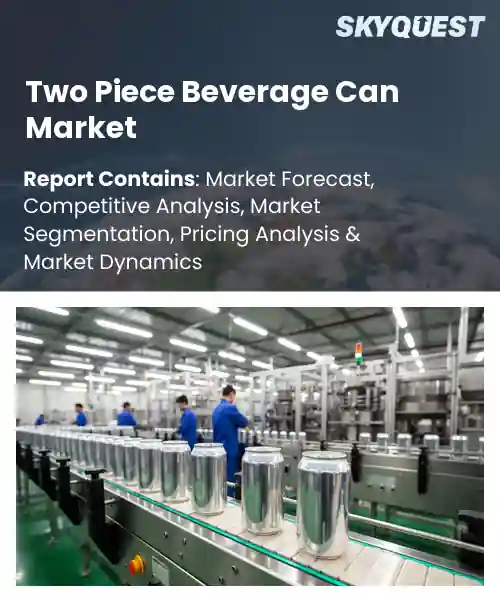
Two Piece Beverage Can Market
Report ID: SQMIG15G2195
Report ID: SQMIG15G2195
[email protected]
USA +1 351-333-4748
Report ID:
SQMIG15G2195 |
Region:
Global |
Published Date: July, 2026
Pages:
157
|Tables:
143
|Figures:
78


Global Two Piece Beverage Can Market size was valued at USD 68.4 Billion in 2024 and is poised to grow from USD 71.61 Billion in 2025 to USD 103.41 Billion by 2033, growing at a CAGR of 4.7% during the forecast period (2026-2033).
Environmental regulation now acts as the key catalyst driving the global two‑piece can market toward rapid growth. Stricter recycling mandates in the EU and North America force brands to adopt aluminum cans, which can be reclaimed up to ninety‑five percent with minimal energy. As a result, manufacturers build closed‑loop facilities, lowering raw‑material costs and creating a pricing advantage for shoppers. For instance, PepsiCo’s partnership with Alcoa to source 100 percent recycled aluminum for its Mountain Dew line boosted U.S. market share by three percent. This policy‑cost synergy opens opportunities in emerging economies where similar waste‑reduction laws are taking shape for investors. The two‑piece beverage can comprised of a body and a separate end‑seal lid has become the industry standard for carbonated soft drinks, energy drinks, and ready‑to‑drink teas. Its primary driver is the superior shelf life it offers compared to older three‑piece or glass containers, as the hermetic seal prevents oxygen ingress and preserves flavor. Historically, manufacturers transitioned from steel to aluminum in the 1970s, reducing weight and enabling high‑speed filling lines. For example, Coca‑Cola’s shift to recyclable aluminum cans cut transportation costs by 30 percent. This evolution has expanded the market globally, making the product a cornerstone of modern packaging logistics supply chain.
How is AI-driven automation reshaping the two-piece beverage can production market?
AI driven automation is redefining two piece beverage can production by embedding intelligent vision systems into stamping presses, allowing machines to detect defects in real time and adjust parameters without human intervention. Predictive analytics guide maintenance schedules, reducing unexpected downtime and extending equipment life. Machine learning optimizes material flow, matching cup and body production to demand spikes, which smooths inventory and cuts waste. Collaborative robots handle the transfer of bodies to seaming stations, freeing operators for higher‑value tasks and improving overall line safety. These technologies together create a more responsive, cost‑effective manufacturing environment that aligns with the growing emphasis on sustainability and speed to market.In April 2024, a leading industry player announced the deployment of an AI‑powered seaming line, boosting throughput while maintaining strict quality standards, a move that illustrates how automation fuels efficiency and supports market expansion.
Market snapshot - (2026-2033)
Global Market Size
USD 68.4 Billion
Largest Segment
Aluminum
Fastest Growth
Steel
Growth Rate
4.7% CAGR
To get more insights on this market click here to Request a Free Sample Report
Global two piece beverage can market is segmented by material, can size, beverage type, end user, production process and region. Based on material, the market is segmented into Aluminum and Steel. Based on can size, the market is segmented into Below 250 mL, 250–500 mL and Above 500 mL. Based on beverage type, the market is segmented into Carbonated Soft Drinks, Beer, Energy Drinks, Juices and Ready-to-Drink Beverages. Based on end user, the market is segmented into Beverage Manufacturers and Contract Packaging Companies. Based on production process, the market is segmented into Draw and Wall Ironing (DWI) and Draw Redraw (DRD). Based on region, the market is segmented into North America, Europe, Asia Pacific, Latin America and Middle East & Africa.
Aluminum segment dominates because it provides an optimal balance of lightweight construction, corrosion resistance, and high recyclability that resonates with sustainability priorities in the beverage sector. Producers choose aluminum for its structural strength, which accommodates rapid filling processes and preserves product integrity, while the material’s premium scrap value lowers overall cost pressures. Additionally, consumer perception of aluminum as a premium packaging choice reinforces brand positioning, driving widespread adoption across beverage categories.
However, Steel segment is witnessing the strongest growth momentum as manufacturers seek cost effective alternatives for high volume non premium lines, leveraging its durability and lower raw material expense. Emerging coating innovations broaden steel’s applicability, enabling lighter walls and wider use in budget focused beverage formats, propelling market expansion.
Carbonated Soft Drinks segment dominates because it remains the cornerstone of global beverage consumption, driving demand for reliable high pressure can solutions that preserve carbonation and flavor. Producers prioritize cans that ensure consistent seal integrity and rapid cooling, attributes closely tied to carbonated product performance. The entrenched brand ecosystems and extensive distribution networks further cement the need for proven two piece can formats, sustaining its leadership across the market.
However, Energy Drinks segment is emerging as the high growth area as consumers seek beverages that provide stimulation, prompting manufacturers to use lightweight cans for on the go consumption. Formulation innovation and marketing are expanding the category, driving producers to adopt two piece can technologies that improve portability and shelf appeal.
To get detailed segments analysis, Request a Free Sample Report
Asia Pacific leverages a combination of advanced manufacturing infrastructure, deep consumer affinity for convenience beverages, and a cultural emphasis on technological innovation that together reinforce its market leadership. The region benefits from a dense network of suppliers and converters that deliver high‑quality can solutions at scale, while sustainability initiatives encourage the adoption of recyclable two‑piece formats. Strong branding and premium product launches in fast‑growing urban centers drive demand, and collaborative ecosystems between beverage makers and packaging firms accelerate product development. This synergy of production capability, consumer preferences, and environmental stewardship creates a resilient advantage that positions Asia Pacific at the forefront of the global two‑piece beverage can landscape.
Two Piece Beverage Can Market in Japan thrives on a tradition of precision engineering and a consumer base that values both convenience and environmental responsibility. Local manufacturers emphasize lightweight designs and high‑performance coatings, while beverage brands prioritize innovative flavor offerings packaged in recyclable formats. The synergy between advanced material science and a market that embraces sustainable consumption reinforces Japan’s role as a key influencer in the regional supply chain.
Two Piece Beverage Can Market in South Korea is driven by rapid urbanization and a youthful demographic that seeks on‑the‑go beverage solutions. Domestic producers focus on cutting‑edge printing technologies that enable vibrant branding, while regulatory encouragement of recyclable packaging fuels market adoption. Collaborative efforts between innovators and retailers accelerate the introduction of novel beverage concepts, cementing South Korea’s contribution to the dynamic growth of the two‑piece can segment.
North America’s expansion is propelled by a confluence of consumer demand for convenient, premium beverages and a robust distribution network that supports rapid market penetration. Leading beverage brands prioritize sustainability, turning to two‑piece cans as a recyclable alternative that aligns with eco‑conscious purchasing trends. Innovation in design and printing technology enables striking visual identities, enhancing shelf appeal across diverse retail channels. Additionally, strong partnerships between converters and end‑users streamline supply chains, ensuring consistent product availability and fostering an environment where new beverage launches can quickly gain traction.
Two Piece Beverage Can Market in the United States reflects a culture of innovation and strong branding, with producers leveraging cutting‑edge graphics to differentiate products on crowded shelves. Consumer emphasis on sustainability drives widespread acceptance of recyclable cans, while extensive retail coverage from national chains to specialty stores ensures deep market penetration. Collaborative ecosystems among brewers, soft‑drink makers, and packaging manufacturers accelerate product development cycles, reinforcing the United States as a pivotal arena for two‑piece can growth.
Two Piece Beverage Can Market in Canada benefits from a consumer base that places high value on environmental stewardship and convenience. Beverage companies adopt recyclable can solutions to meet regulatory expectations and consumer preferences, while regional converters focus on high‑quality finishes that maintain product integrity in diverse climatic conditions. The interplay of sustainable packaging initiatives and a well‑established distribution framework supports steady expansion of two‑piece cans across the Canadian market.
Europe advances its position through a strong regulatory focus on circular economies, encouraging widespread adoption of recyclable two‑piece cans. The region’s beverage sector emphasizes premium branding and artisanal product lines, which are complemented by sophisticated printing capabilities that enhance visual appeal. Collaborative networks among manufacturers, converters, and recyclers create efficient loops that reduce waste and improve material reuse. Moreover, consumer awareness of sustainability drives demand for environmentally responsible packaging, fostering a market environment where innovative two‑piece solutions flourish and reinforce Europe’s strategic significance.
Two Piece Beverage Can Market in Germany is characterized by precision engineering and a rigorous commitment to sustainability. Producers integrate advanced coating technologies that extend shelf life while maintaining recyclability, aligning with stringent environmental standards. Beverage brands leverage high‑resolution graphics to cater to discerning consumers, and strong logistics infrastructure ensures timely delivery across the market, solidifying Germany’s role as a hub for premium two‑piece can offerings.
Two Piece Beverage Can Market in the United Kingdom reflects a blend of heritage beverage brands and emerging craft producers who prioritize distinctive packaging. The market embraces recyclable can formats that satisfy consumer expectations for eco‑friendly solutions, while innovative printing techniques enable striking branding that resonates with a style‑conscious audience. Collaborative efforts between converters and brands streamline product launches, reinforcing the United Kingdom’s dynamic presence in the sector.
Two Piece Beverage Can Market in France is driven by a strong culinary culture that extends to beverage consumption, emphasizing both aesthetic appeal and sustainability. French producers focus on elegant design and high‑quality finishes that complement premium beverage experiences, while regulatory encouragement of recyclable packaging fuels market adoption. Integrated supply chains and creative collaborations between artists and manufacturers enhance the visual storytelling of products, positioning France as a vibrant contributor to the two‑piece can landscape.
To know more about the market opportunities by region and country, click here to
Buy The Complete Report
Sustainability driven Consumer Preference
Advancements in Can Manufacturing Technology
Higher Costs of Aluminum Raw Materials
Regulatory Pressure on Recycling Standards
Request Free Customization of this report to help us to meet your business objectives.
The two‑piece beverage can market is shaped by intense rivalry among aluminium packagers, with sustainability and cost efficiency driving competition; firms are leveraging strategic capital raises and investor partnerships to accelerate innovation, exemplified by BrewDog’s recent $83 million financing to expand its eco‑focused beverage line and DEFI’s seed round in early 2026 aimed at supporting new can‑technology startups.
Top Player’s Company Profile
Recent Developments
SkyQuest’s ABIRAW (Advanced Business Intelligence, Research & Analysis Wing) is our Business Information Services team that Collects, Collates, Correlates, and Analyses the Data collected by means of Primary Exploratory Research backed by robust Secondary Desk research. As per SkyQuest analysis the global two‑piece beverage can market is propelled primarily by sustainability driven consumer preference for recyclable cans, a driver that lifts demand across all beverage categories while the region leading growth is Asia Pacific, where advanced manufacturing capacity and strong eco‑consciousness converge. A second catalyst comes from advancements in manufacturing technology and AI‑driven automation that streamline production, cut waste and enhance speed to market. The aluminum segment dominates the market thanks to its lightweight, corrosion‑resistant and highly recyclable properties, but higher aluminum raw‑material costs pose a restraint that could temper expansion if price pressures persist for industry participants.
| Report Metric | Details |
|---|---|
| Market size value in 2024 | USD 68.4 Billion |
| Market size value in 2033 | USD 103.41 Billion |
| Growth Rate | 4.7% |
| Base year | 2024 |
| Forecast period | (2026-2033) |
| Forecast Unit (Value) | USD Billion |
| Segments covered |
|
| Regions covered | North America (US, Canada), Europe (Germany, France, United Kingdom, Italy, Spain, Rest of Europe), Asia Pacific (China, India, Japan, Rest of Asia-Pacific), Latin America (Brazil, Rest of Latin America), Middle East & Africa (South Africa, GCC Countries, Rest of MEA) |
| Companies covered |
|
| Customization scope | Free report customization with purchase. Customization includes:-
|
To get a free trial access to our platform which is a one stop solution for all your data requirements for quicker decision making. This platform allows you to compare markets, competitors who are prominent in the market, and mega trends that are influencing the dynamics in the market. Also, get access to detailed SkyQuest exclusive matrix.
Table Of Content
Executive Summary
Market overview
Parent Market Analysis
Market overview
Market size
KEY MARKET INSIGHTS
COVID IMPACT
MARKET DYNAMICS & OUTLOOK
Market Size by Region
KEY COMPANY PROFILES
Methodology
For the Two Piece Beverage Can Market, our research methodology involved a mixture of primary and secondary data sources. Key steps involved in the research process are listed below:
1. Information Procurement: This stage involved the procurement of Market data or related information via primary and secondary sources. The various secondary sources used included various company websites, annual reports, trade databases, and paid databases such as Hoover's, Bloomberg Business, Factiva, and Avention. Our team did 45 primary interactions Globally which included several stakeholders such as manufacturers, customers, key opinion leaders, etc. Overall, information procurement was one of the most extensive stages in our research process.
2. Information Analysis: This step involved triangulation of data through bottom-up and top-down approaches to estimate and validate the total size and future estimate of the Two Piece Beverage Can Market.
3. Report Formulation: The final step entailed the placement of data points in appropriate Market spaces in an attempt to deduce viable conclusions.
4. Validation & Publishing: Validation is the most important step in the process. Validation & re-validation via an intricately designed process helped us finalize data points to be used for final calculations. The final Market estimates and forecasts were then aligned and sent to our panel of industry experts for validation of data. Once the validation was done the report was sent to our Quality Assurance team to ensure adherence to style guides, consistency & design.
Analyst Support
Customization Options
With the given market data, our dedicated team of analysts can offer you the following customization options are available for the Two Piece Beverage Can Market:
Product Analysis: Product matrix, which offers a detailed comparison of the product portfolio of companies.
Regional Analysis: Further analysis of the Two Piece Beverage Can Market for additional countries.
Competitive Analysis: Detailed analysis and profiling of additional Market players & comparative analysis of competitive products.
Go to Market Strategy: Find the high-growth channels to invest your marketing efforts and increase your customer base.
Innovation Mapping: Identify racial solutions and innovation, connected to deep ecosystems of innovators, start-ups, academics, and strategic partners.
Category Intelligence: Customized intelligence that is relevant to their supply Markets will enable them to make smarter sourcing decisions and improve their category management.
Public Company Transcript Analysis: To improve the investment performance by generating new alpha and making better-informed decisions.
Social Media Listening: To analyze the conversations and trends happening not just around your brand, but around your industry as a whole, and use those insights to make better Marketing decisions.
REQUEST FOR SAMPLE
 REQUEST FREE CUSTOMIZATION


Want to customize this report? This report can be personalized according to your needs. Our analysts and industry experts will work directly with you to understand your requirements and provide you with customized data in a short amount of time. We offer $1000 worth of FREE customization at the time of purchase.
Feedback From Our Clients


 USA (+1) 351-333-4748

