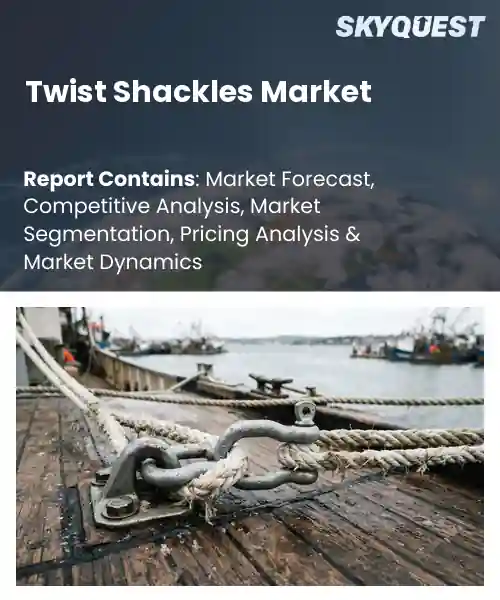
Twist Shackles Market
Report ID: SQMIG20I3772
Report ID: SQMIG20I3772
[email protected]
USA +1 351-333-4748
Report ID:
SQMIG20I3772 |
Region:
Global |
Published Date: August, 2026
Pages:
157
|Tables:
175
|Figures:
79


Global Twist Shackles Market size was valued at USD 487.3 Million in 2024 and is poised to grow from USD 514.59 Million in 2025 to USD 795.75 Million by 2033, growing at a CAGR of 5.6% during the forecast period (2026-2033).
The twist shackle market revolves around a class of hardware designed to secure rigging and lifting assemblies through a helical tightening mechanism. Its significance stems from the device’s ability to provide repeatable connections while maintaining safety margins in environments such as offshore oil platforms, construction cranes, and aerospace maintenance. Over the past two decades the market has evolved from niche marine applications toward adoption, driven by advances in alloy engineering that deliver higher tensile strength without added weight. For instance, the 2015 introduction of carbon‑steel twist shackles enabled shipyards to replace bulky traditional shackles, cutting installation time by nearly half. The primary growth catalyst for the twist shackle sector is the expanding need for lightweight, high‑capacity fasteners in offshore wind installations. Larger turbine rotors increase line loads, prompting engineers to select twist shackles whose reduced mass and fatigue resistance meet rigorous Class III standards. This adoption triggers investment in advanced alloys, which subsequently lowers operational expenses by shrinking deck space and simplifying maintenance routines. A recent Danish wind‑farm project demonstrated that swapping traditional shackles for modern twist models reduced rigging weight by 30 percent, accelerating turbine assembly and delivering measurable cost advantages globally for both developers and service contractors across the sector.
How is IoT-enabled monitoring reshaping safety and performance standards in the Twist Shackles market?
IoT‑enabled monitoring is transforming twist shackles by embedding sensors that capture load, tension and temperature in real time. The data streams to cloud platforms where analytics flag anomalies and predict wear before failure occurs. This shift moves safety checks from periodic manual inspections to continuous digital oversight, reducing downtime and preventing accidents. Operators can integrate shackle health dashboards with broader asset management systems, creating a unified view of equipment performance. Real‑time alerts enable crews to react instantly, while historical trends support optimized replacement schedules. The result is higher reliability, tighter compliance with safety standards and more efficient use of inventory.OpenPR July 2024, introduced an IoT sensor tag for twist shackles that streams load data to cloud dashboards, allowing operators to detect overloads instantly and schedule maintenance, boosting safety and efficiency.
Market snapshot - (2026-2033)
Global Market Size
USD 487.3 Million
Largest Segment
Carbon Steel
Fastest Growth
Stainless Steel
Growth Rate
5.6% CAGR
To get more insights on this market click here to Request a Free Sample Report
Global twist shackles market is segmented by material, pin type, application, load capacity, end user, distribution channel and region. Based on material, the market is segmented into Carbon Steel, Stainless Steel, Alloy Steel and Others. Based on pin type, the market is segmented into Screw Pin, Bolt-Type Pin, Safety Pin and Others. Based on application, the market is segmented into Marine, Lifting & Rigging, Construction and Others. Based on load capacity, the market is segmented into Up to 5 Tons, 5–20 Tons and Above 20 Tons. Based on end user, the market is segmented into Marine Industry, Construction Companies, Industrial Facilities and Others. Based on distribution channel, the market is segmented into Direct Sales, Industrial Distributors and Others. Based on region, the market is segmented into North America, Europe, Asia Pacific, Latin America and Middle East & Africa.
Carbon steel segment dominates because it delivers a proven balance of strength and cost efficiency that aligns directly with the load bearing demands of twist shackles. Manufacturers favor it for its predictable mechanical properties, ease of fabrication, and widespread availability, which together reduce production lead times and lower inventory expenses. This reliability cultivates strong supplier buyer confidence, reinforcing its preferential selection across diverse rigging projects and sustaining market leadership ongoing industry relevance.
However, stainless steel segment experiences the fastest growth as corrosion resistant alloys gain favor in moisture and salt exposed environments. Alloy improvements boost tensile performance while keeping appeal, prompting designers to select stainless options for marine and offshore installations. This preference widens the market and fuels opportunities for finishes and certifications.
Marine segment dominates because twist shackles are integral to vessel rigging, offshore platforms, and subsea operations where reliable load control is non negotiable. The harsh saline environment demands components that maintain integrity under cyclic stress, and manufacturers prioritize marine grade products to meet stringent safety standards. This essential role drives consistent demand, encourages specialized engineering, and locks marine users into long term supplier relationships, cementing its leadership within the market.
Meanwhile, construction segment emerges as the fastest growing application as urban infrastructure projects increasingly adopt modular erection methods that rely on quick, secure connections. Twist shackles simplify crane lifts and temporary support systems, reducing assembly time and labor costs. This shift expands the addressable user base and stimulates demand for versatile shackles designed for varied load profiles, accelerating market expansion beyond traditional marine uses.
To get detailed segments analysis, Request a Free Sample Report
North America leads the global Twist Shackles market due to a mature offshore oil and gas sector, extensive heavy‑industry infrastructure, and deep engineering expertise. The United States offers a broad network of manufacturers that integrate advanced metallurgy with rigorous quality standards, while Canada contributes specialized capabilities in cold‑climate equipment and a strong focus on safety compliance. Both nations benefit from well‑developed logistics corridors, reliable financing mechanisms, and regulatory frameworks that emphasize reliability and traceability. The convergence of these strengths creates a competitive ecosystem that attracts original equipment manufacturers and end‑users alike, reinforcing North America’s position as the market’s primary hub.
Twist Shackles Market in the United States is driven by a large offshore drilling fleet and a high concentration of engineering firms that prioritize innovative alloy development. The country’s extensive certification bodies enforce strict performance criteria, encouraging continuous product improvement. Close proximity to major ports and rail networks streamlines distribution to domestic and export customers, while strong collaboration between manufacturers and end‑users accelerates customization to meet complex load‑bearing requirements.
Twist Shackles Market in Canada benefits from expertise in extreme‑temperature applications and a robust safety culture within the energy sector. Local producers emphasize corrosion‑resistant materials suited for northern environments, supporting projects in offshore wind and remote oil extraction. The country’s integrated supply chain links specialized steel mills with precision machining centers, facilitating rapid response to niche demand. Collaborative research initiatives with universities further enhance material performance, reinforcing Canada’s reputation for dependable, high‑specification shackles.
The Asia Pacific region is experiencing rapid expansion of the Twist Shackles market as renewable energy projects and offshore infrastructure intensify across coastal economies. Japan and South Korea invest heavily in offshore wind farms and deep‑water port upgrades, creating a heightened need for high‑strength, corrosion‑resistant shackles. Growing emphasis on safety standards and adoption of international certification schemes drive manufacturers to upgrade material quality and testing protocols. Additionally, expanding petrochemical complexes and shipbuilding activities generate steady demand for reliable load‑handling solutions. Strong governmental support for advanced manufacturing, coupled with increasing collaboration between local firms and global suppliers, positions Asia Pacific as an emerging hub for sophisticated twist shackle technologies.
Twist Shackles Market benefits from a sophisticated manufacturing base that merges precision engineering with stringent quality controls. Domestic producers focus on high‑grade alloy compositions to meet the demanding conditions of offshore wind turbines and deep‑sea vessels. Close ties between equipment manufacturers and research institutions foster continuous innovation in fatigue resistance and load‑capacity verification. Well‑established logistics networks ensure timely delivery to ports and industrial sites, while adherence to international safety certifications reinforces confidence among end‑users.
Twist Shackles Market leverages the nation’s renowned shipbuilding and heavy‑industry expertise to serve a broad spectrum of offshore and onshore applications. Local manufacturers prioritize streamlined production processes that incorporate advanced forging and heat‑treatment techniques, delivering consistent performance under high‑stress conditions. Collaboration with offshore wind developers accelerates the adaptation of shackles to turbine installation requirements. Robust export channels and participation in global standards committees enhance the market’s credibility, positioning South Korea as a key supplier within the region.
The European region is strengthening its position in the Twist Shackles market through a combination of stringent safety regulations, a mature offshore wind sector, and a legacy of high‑precision metalworking. Germany, the United Kingdom, and France host extensive offshore installations and sophisticated shipyards that demand reliable, high‑performance shackles. Harmonized European standards drive manufacturers toward uniform testing and certification, fostering cross‑border confidence. Investment in green energy infrastructure, particularly floating wind platforms, expands the application base for robust shackle solutions. Collaborative research programs among universities and industry leaders promote material innovation, while deep‑rooted supply chains ensure rapid fulfillment of customized orders, reinforcing Europe’s role as a leader in quality‑centric twist shackle provision.
Twist Shackles Market is anchored by world‑class steel producers and a strong engineering culture that emphasizes durability and precision. Local manufacturers specialize in high‑strength alloy forging, targeting offshore wind turbine foundations and heavy lifting equipment. Integration with certified testing facilities guarantees compliance with rigorous European load‑bearing norms. Close cooperation with renewable energy developers accelerates product adaptation for floating wind projects, while dense logistics networks facilitate efficient distribution to domestic and continental customers. Continuous investment in material science research sustains Germany’s reputation for delivering reliable, high‑specification shackles.
Twist Shackles Market draws on a historic shipbuilding heritage and a rapidly growing offshore wind industry to fuel demand for robust load‑handling hardware. British firms combine traditional forging expertise with modern quality‑assurance processes, ensuring compliance with stringent maritime safety standards. Proximity to major ports and offshore construction sites shortens lead times for critical projects. Engagement with European standard‑setting bodies and participation in collaborative research initiatives enhance the development of fatigue‑resistant alloys, reinforcing the United Kingdom’s standing as a trusted source of premium twist shackles.
Twist Shackles Market benefits from a diversified industrial landscape that includes offshore oil platforms, renewable energy farms, and heavy construction sectors. French manufacturers emphasize corrosion‑resistant treatments to suit marine environments and prioritize rigorous certification aligned with EU safety directives. Strong ties with engineering consultants enable tailored shackle designs for complex load scenarios. Access to well‑developed transport corridors ensures timely delivery to coastal and inland projects, while ongoing research partnerships with national laboratories drive advances in material performance, consolidating France’s competitive edge in the European market.
To know more about the market opportunities by region and country, click here to
Buy The Complete Report
Increasing Demand for Versatile Fixtures
Advancements In High‑Strength Materials
High Initial Capital Expenditure
Stringent Regulatory Compliance Requirements
Request Free Customization of this report to help us to meet your business objectives.
The competitive landscape of the global Twist Shackles market is shaped by multinational manufacturers and regional leaders that are actively pursuing mergers, strategic partnerships, and technology‑driven product innovations to enhance load‑capacity performance and reduce weight. Recent examples include cross‑border acquisitions aimed at expanding geographic reach and joint ventures that integrate advanced alloy processing, while firms are also investing in digital design tools to accelerate new model roll‑outs.
Top Player’s Company Profile
Recent Developments
SkyQuest’s ABIRAW (Advanced Business Intelligence, Research & Analysis Wing) is our Business Information Services team that Collects, Collates, Correlates, and Analyses the Data collected by means of Primary Exploratory Research backed by robust Secondary Desk research. As per SkyQuest analysis, the global twist shackles market is being propelled primarily by the rising demand for versatile fixtures that can handle varied load angles across construction, industrial and entertainment projects, while a second driver comes from rapid advances in high‑strength alloys and IoT‑enabled monitoring that boost load capacity and safety. The carbon‑steel material segment remains the dominant share because of its proven strength‑to‑cost balance, and North America leads the market thanks to its mature offshore oil, gas and heavy‑industry base. However, high upfront capital costs for premium alloy shackles act as a restraint, slowing adoption among smaller contractors.
| Report Metric | Details |
|---|---|
| Market size value in 2024 | USD 487.3 Million |
| Market size value in 2033 | USD 795.75 Million |
| Growth Rate | 5.6% |
| Base year | 2024 |
| Forecast period | (2026-2033) |
| Forecast Unit (Value) | USD Million |
| Segments covered |
|
| Regions covered | North America (US, Canada), Europe (Germany, France, United Kingdom, Italy, Spain, Rest of Europe), Asia Pacific (China, India, Japan, Rest of Asia-Pacific), Latin America (Brazil, Rest of Latin America), Middle East & Africa (South Africa, GCC Countries, Rest of MEA) |
| Companies covered |
|
| Customization scope | Free report customization with purchase. Customization includes:-
|
To get a free trial access to our platform which is a one stop solution for all your data requirements for quicker decision making. This platform allows you to compare markets, competitors who are prominent in the market, and mega trends that are influencing the dynamics in the market. Also, get access to detailed SkyQuest exclusive matrix.
Table Of Content
Executive Summary
Market overview
Parent Market Analysis
Market overview
Market size
KEY MARKET INSIGHTS
COVID IMPACT
MARKET DYNAMICS & OUTLOOK
Market Size by Region
KEY COMPANY PROFILES
Methodology
For the Twist Shackles Market, our research methodology involved a mixture of primary and secondary data sources. Key steps involved in the research process are listed below:
1. Information Procurement: This stage involved the procurement of Market data or related information via primary and secondary sources. The various secondary sources used included various company websites, annual reports, trade databases, and paid databases such as Hoover's, Bloomberg Business, Factiva, and Avention. Our team did 45 primary interactions Globally which included several stakeholders such as manufacturers, customers, key opinion leaders, etc. Overall, information procurement was one of the most extensive stages in our research process.
2. Information Analysis: This step involved triangulation of data through bottom-up and top-down approaches to estimate and validate the total size and future estimate of the Twist Shackles Market.
3. Report Formulation: The final step entailed the placement of data points in appropriate Market spaces in an attempt to deduce viable conclusions.
4. Validation & Publishing: Validation is the most important step in the process. Validation & re-validation via an intricately designed process helped us finalize data points to be used for final calculations. The final Market estimates and forecasts were then aligned and sent to our panel of industry experts for validation of data. Once the validation was done the report was sent to our Quality Assurance team to ensure adherence to style guides, consistency & design.
Analyst Support
Customization Options
With the given market data, our dedicated team of analysts can offer you the following customization options are available for the Twist Shackles Market:
Product Analysis: Product matrix, which offers a detailed comparison of the product portfolio of companies.
Regional Analysis: Further analysis of the Twist Shackles Market for additional countries.
Competitive Analysis: Detailed analysis and profiling of additional Market players & comparative analysis of competitive products.
Go to Market Strategy: Find the high-growth channels to invest your marketing efforts and increase your customer base.
Innovation Mapping: Identify racial solutions and innovation, connected to deep ecosystems of innovators, start-ups, academics, and strategic partners.
Category Intelligence: Customized intelligence that is relevant to their supply Markets will enable them to make smarter sourcing decisions and improve their category management.
Public Company Transcript Analysis: To improve the investment performance by generating new alpha and making better-informed decisions.
Social Media Listening: To analyze the conversations and trends happening not just around your brand, but around your industry as a whole, and use those insights to make better Marketing decisions.
REQUEST FOR SAMPLE
 REQUEST FREE CUSTOMIZATION


Want to customize this report? This report can be personalized according to your needs. Our analysts and industry experts will work directly with you to understand your requirements and provide you with customized data in a short amount of time. We offer $1000 worth of FREE customization at the time of purchase.
Feedback From Our Clients


 USA (+1) 351-333-4748

