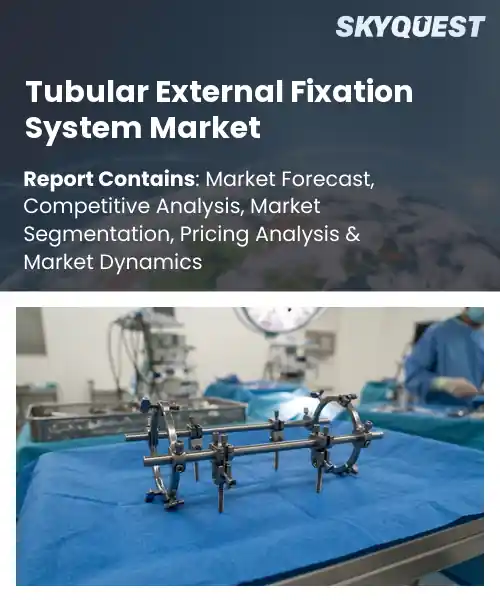
Tubular External Fixation System Market
Report ID: SQMIG35A4397
Report ID: SQMIG35A4397
[email protected]
USA +1 351-333-4748
Report ID:
SQMIG35A4397 |
Region:
Global |
Published Date: August, 2026
Pages:
157
|Tables:
118
|Figures:
77


Global Tubular External Fixation System Market size was valued at USD 1.28 Billion in 2024 and is poised to grow from USD 1.37 Billion in 2025 to USD 2.42 Billion by 2033, growing at a CAGR of 7.3% during the forecast period (2026-2033).
The tubular external fixation system market encompasses devices that stabilize bone fragments using circular rings connected by rods, enabling surgeons to treat complex fractures and limb deformities without invasive internal hardware. Its significance lies in offering stabilization, reduced infection risk, which are crucial in trauma care and orthopedic reconstructive procedures. Historically, the market emerged in the 1970s when Ilizarov techniques proved effective for tibial lengthening; adoption by Western hospitals accelerated demand. Over the past decade, advances in alloys and modular designs have broadened applications from pediatric scoliosis correction to injury management, cementing the market’s role in orthopedics globally and regionally. The primary growth catalyst for the global tubular external fixation system market is the rising incidence of trauma combined with an aging population that demands orthopedic solutions. As motor‑vehicle accidents and fall‑related fractures increase, hospitals adopt tubular fixators to shorten operative time and enable weight‑bearing, thereby lowering rehabilitation costs. Concurrently, emerging economies invest in trauma centers, creating demand for modular kits that can be sterilized and reused. This convergence of clinical need and fiscal pressure spurs manufacturers to innovate carbon‑fiber components and alignment software, opening revenue streams through service contracts and training programs that enhance surgeon proficiency worldwide, globally today.
How is AI-driven automation influencing the Tubular external fixation system market?
AI‑driven automation is reshaping the tubular external fixation segment by streamlining design, production and surgical planning. Machine‑learning algorithms analyse fracture patterns from imaging and suggest optimal fixator configurations, cutting clinician iteration time. In manufacturing, robotics guided by AI ensure precise tube bending and consistent component tolerances, reducing waste and accelerating batch turnover. These digital tools also enable real‑time monitoring of frame stability, feeding data back to surgeons for proactive adjustments. The combined effect is faster case turnaround, lower inventory costs and improved patient outcomes, making the technology a strategic lever for providers seeking efficiency in a market that is expanding rapidly.In February 2026, Stryker introduced an AI‑integrated tubular fixator system, demonstrating how intelligent automation can shorten surgical setup and enhance frame precision, thereby supporting market growth.
Market snapshot - (2026-2033)
Global Market Size
USD 1.28 Billion
Largest Segment
Unilateral External Fixators
Fastest Growth
Circular External Fixators
Growth Rate
7.3% CAGR
To get more insights on this market click here to Request a Free Sample Report
Global tubular external fixation system market is segmented by product type, material, application, end user and region. Based on product type, the market is segmented into Unilateral External Fixators, Bilateral External Fixators, Circular External Fixators and Hybrid External Fixators. Based on material, the market is segmented into Stainless Steel, Titanium and Carbon Fiber. Based on application, the market is segmented into Trauma Fixation, Limb Reconstruction and Deformity Correction. Based on end user, the market is segmented into Hospitals, Orthopedic Clinics and Ambulatory Surgical Centers. Based on region, the market is segmented into North America, Europe, Asia Pacific, Latin America and Middle East & Africa.
Unilateral External Fixators segment dominates because it offers a simple, cost‑effective solution that aligns with the majority of acute fracture treatments. Surgeons favor its ease of application and minimal learning curve, which accelerates operative turnover and reduces inventory complexity. This practicality drives widespread adoption across diverse clinical settings, cementing its central role in the Tubular External Fixation System Market and improves patient throughput while maintaining comparable clinical outcomes and safety.
However, Bilateral External Fixators segment emerges as the most rapidly expanding area because simultaneous bilateral stabilization addresses complex injuries and multi‑site reconstructions, prompting surgeons to adopt it for comprehensive limb management. Innovations in modular design and enhanced ergonomic interfaces are spurring uptake, positioning this segment as a catalyst for broader market growth.
Titanium segment dominates because its high strength‑to‑weight ratio provides robust fixation while minimizing patient discomfort and radiographic artifact. Clinicians value its biocompatibility, which reduces infection risk and facilitates long‑term implantation. These attributes, combined with its compatibility with advanced imaging, make titanium the preferred material for demanding orthopedic procedures, securing its leadership in the Tubular External Fixation System Market across a wide range of fracture complexities and patient demographics and clinical.
Meanwhile, Carbon Fiber segment emerges as the fastest growing area because its ultra‑lightweight construction enables unprecedented mobility for patients during recovery, encouraging early weight‑bearing protocols. Ongoing research into reinforced composites and cost‑reduction strategies is expanding adoption, fuelling market momentum and opening new opportunities for innovative fixation solutions in orthopedic care.
To get detailed segments analysis, Request a Free Sample Report
The dominance of North America stems from a mature healthcare ecosystem that prioritizes advanced orthopedic solutions and invests heavily in clinical research. Robust reimbursement frameworks encourage hospitals and surgeons to adopt high‑performance fixation technologies. The presence of leading medical device manufacturers fuels continuous innovation and rapid product rollout. A well‑established network of trauma centers and specialized orthopedic clinics ensures consistent demand, while a highly skilled surgical workforce drives confidence in complex fracture management. Collaborative partnerships between academic institutions and industry further accelerate knowledge transfer, reinforcing the region’s position as a benchmark for clinical outcomes and product excellence.
Tubular External Fixation System Market in the United States benefits from a deep integration of cutting‑edge technology within major trauma networks and a culture of early adoption among orthopedic specialists. Strong collaboration between research hospitals and device innovators supports rapid translation of novel designs into clinical practice. Reimbursement environments that favor value‑based care reinforce the preference for modular, adjustable fixation solutions, while extensive training programs maintain high procedural proficiency across a broad spectrum of healthcare settings.
Tubular External Fixation System Market in Canada is shaped by a publicly funded system that emphasizes cost‑effective yet clinically robust solutions for complex fractures. Provincial health authorities prioritize technologies that demonstrate clear benefits in patient recovery and reduced hospital stay, creating a favorable climate for tubular fixation devices. Close ties between teaching hospitals and biomedical research centers foster continuous evaluation of emerging products, while national guidelines promote standardized treatment pathways that incorporate external fixation techniques for both civilian and remote communities.
Europe’s rapid expansion is propelled by strong regulatory frameworks that streamline market entry for innovative orthopedic devices, paired with a commitment to high‑quality patient care across both public and private sectors. Collaborative research initiatives among leading universities and industry accelerate product refinement and clinical validation. Growing emphasis on minimally invasive surgery fuels demand for versatile fixation systems that support early mobilization. Additionally, demographic shifts toward an active aging population increase the incidence of complex fractures, prompting healthcare providers to adopt adaptable solutions that align with long‑term rehabilitation goals and sustainability mandates.
Tubular External Fixation System Market in Germany is anchored by a dense concentration of orthopedic research hubs and a network of specialized trauma centers that champion advanced fixation methodologies. Strong reimbursement policies that reward functional outcomes encourage hospitals to select modular systems with proven track records. Close collaboration between device manufacturers and clinical experts drives iterative improvements, ensuring that German practitioners have access to the latest innovations for managing high‑energy injuries.
Tubular External Fixation System Market in the United Kingdom experiences accelerated growth through integrated clinical pathways that prioritize early weight‑bearing and reduced complication rates. National health services support evidence‑based adoption of fixation technologies that demonstrate clear patient‑centred benefits. Partnerships between leading universities and medical device firms facilitate continuous education and training, empowering surgeons to implement sophisticated external fixation techniques across both urban hospitals and regional trauma units.
Tubular External Fixation System Market in France benefits from a proactive health authority that encourages adoption of innovative orthopedic solutions within its extensive network of university hospitals. Emphasis on multidisciplinary care models promotes the use of fixation systems that align with comprehensive rehabilitation programs. Collaborative clinical trials conducted by French research institutions contribute to a robust evidence base, supporting broader acceptance of tubular devices for complex fracture management.
Asia Pacific is strengthening its position through a combination of expanding healthcare infrastructure and a rising focus on modern orthopedic care across both emerging and established markets. Investment in state‑of‑the‑art surgical facilities and training programs equips surgeons with the skills required for sophisticated external fixation procedures. Growing awareness of the benefits of early mobilization drives preference for adaptable tubular systems that suit diverse fracture patterns. Regional collaborations among manufacturers, academic centers, and government health agencies foster technology transfer and localized product development, enhancing accessibility and fostering confidence in advanced fixation solutions throughout the region.
Tubular External Fixation System Market in Japan is propelled by a strong culture of precision engineering and a healthcare system that values high‑quality surgical outcomes. Leading academic hospitals serve as early adopters, integrating tubular fixation devices into trauma protocols that emphasize rapid recovery. Government initiatives that support advanced medical technologies encourage continuous improvement and widespread dissemination of best practices across both metropolitan and regional care facilities.
Tubular External Fixation System Market in South Korea advances through aggressive adoption of innovative orthopedic approaches within its modern hospital network. Emphasis on rapid patient turnover and functional restoration aligns with the capabilities of modular external fixation systems. Close cooperation between biotech firms and clinical specialists accelerates product customization, ensuring that Korean surgeons have access to solutions tailored to the specific demands of high‑impact injuries and complex fracture scenarios.
To know more about the market opportunities by region and country, click here to
Buy The Complete Report
Increasing Orthopedic Surgery Demand
Advancements in Fixation Technology
High Cost of Devices
Regulatory Approval Complexity
Request Free Customization of this report to help us to meet your business objectives.
The tubular external fixation system market is characterized by intense competition among established orthopedic manufacturers and agile newcomers, driving rapid product differentiation. Companies such as Metric Medical Devices, Inc. are leveraging recent technological advancements to broaden their fixator portfolios, while BlueOcean Global’s launch of the Excelsior system underscores a strategic focus on modular, surgeon‑centric designs that aim to capture niche clinical segments.
Top Player’s Company Profile
Recent Developments
THE MARKET IS BEING RESHAPED BY A GROWING PREFERENCE FOR MINIMALLY INVASIVE ORTHOPEDIC PROCEDURES, PROMPTING MANUFACTURERS TO DEVELOP LIGHTER, MODULAR TUBULAR EXTERNAL FIXATION SYSTEMS THAT CAN BE ASSEMBLED AND ADJUSTED THROUGH SMALLER INCISIONS. SURGEONS VALUE REDUCED OPERATIVE TIME, LOWER INFECTION RISK, AND ENHANCED PATIENT COMFORT, DRIVING DEMAND FOR DEVICES THAT COMBINE STRENGTH WITH PROFILES. THIS TREND ENCOURAGES COLLABORATIONS WITH INSTRUMENT MAKERS TO INTEGRATE ERGONOMIC HANDLES AND QUICKER LOCKING MECHANISMS, ACCELERATING PRODUCT CYCLES AND EXPANDING USE BEYOND TRAUMA INTO FRACTURE MANAGEMENT.
SkyQuest’s ABIRAW (Advanced Business Intelligence, Research & Analysis Wing) is our Business Information Services team that Collects, Collates, Correlates, and Analyses the Data collected by means of Primary Exploratory Research backed by robust Secondary Desk research. As per SkyQuest analysis the global tubular external fixation system market is expanding rapidly, driven primarily by rising orthopedic surgery demand as fractures and deformities increase, while advancements in fixation technology and AI‑driven automation further accelerate adoption by shortening operative times and improving outcomes. The market is led by North America where mature reimbursement systems and strong R&D support widespread uptake. Unilateral external fixators dominate the segment landscape because of their cost‑effective simplicity and ease of use across hospitals and clinics. However, high device cost remains a restraint limiting penetration in price‑sensitive regions and smaller providers. Manufacturers are also investing in modular carbon‑fiber designs and digital monitoring to capture market share, reinforcing the growth trajectory.
| Report Metric | Details |
|---|---|
| Market size value in 2024 | USD 1.28 Billion |
| Market size value in 2033 | USD 2.42 Billion |
| Growth Rate | 7.3% |
| Base year | 2024 |
| Forecast period | (2026-2033) |
| Forecast Unit (Value) | USD Billion |
| Segments covered |
|
| Regions covered | North America (US, Canada), Europe (Germany, France, United Kingdom, Italy, Spain, Rest of Europe), Asia Pacific (China, India, Japan, Rest of Asia-Pacific), Latin America (Brazil, Rest of Latin America), Middle East & Africa (South Africa, GCC Countries, Rest of MEA) |
| Companies covered |
|
| Customization scope | Free report customization with purchase. Customization includes:-
|
To get a free trial access to our platform which is a one stop solution for all your data requirements for quicker decision making. This platform allows you to compare markets, competitors who are prominent in the market, and mega trends that are influencing the dynamics in the market. Also, get access to detailed SkyQuest exclusive matrix.
Table Of Content
Executive Summary
Market overview
Parent Market Analysis
Market overview
Market size
KEY MARKET INSIGHTS
COVID IMPACT
MARKET DYNAMICS & OUTLOOK
Market Size by Region
KEY COMPANY PROFILES
Methodology
For the Tubular External Fixation System Market, our research methodology involved a mixture of primary and secondary data sources. Key steps involved in the research process are listed below:
1. Information Procurement: This stage involved the procurement of Market data or related information via primary and secondary sources. The various secondary sources used included various company websites, annual reports, trade databases, and paid databases such as Hoover's, Bloomberg Business, Factiva, and Avention. Our team did 45 primary interactions Globally which included several stakeholders such as manufacturers, customers, key opinion leaders, etc. Overall, information procurement was one of the most extensive stages in our research process.
2. Information Analysis: This step involved triangulation of data through bottom-up and top-down approaches to estimate and validate the total size and future estimate of the Tubular External Fixation System Market.
3. Report Formulation: The final step entailed the placement of data points in appropriate Market spaces in an attempt to deduce viable conclusions.
4. Validation & Publishing: Validation is the most important step in the process. Validation & re-validation via an intricately designed process helped us finalize data points to be used for final calculations. The final Market estimates and forecasts were then aligned and sent to our panel of industry experts for validation of data. Once the validation was done the report was sent to our Quality Assurance team to ensure adherence to style guides, consistency & design.
Analyst Support
Customization Options
With the given market data, our dedicated team of analysts can offer you the following customization options are available for the Tubular External Fixation System Market:
Product Analysis: Product matrix, which offers a detailed comparison of the product portfolio of companies.
Regional Analysis: Further analysis of the Tubular External Fixation System Market for additional countries.
Competitive Analysis: Detailed analysis and profiling of additional Market players & comparative analysis of competitive products.
Go to Market Strategy: Find the high-growth channels to invest your marketing efforts and increase your customer base.
Innovation Mapping: Identify racial solutions and innovation, connected to deep ecosystems of innovators, start-ups, academics, and strategic partners.
Category Intelligence: Customized intelligence that is relevant to their supply Markets will enable them to make smarter sourcing decisions and improve their category management.
Public Company Transcript Analysis: To improve the investment performance by generating new alpha and making better-informed decisions.
Social Media Listening: To analyze the conversations and trends happening not just around your brand, but around your industry as a whole, and use those insights to make better Marketing decisions.
REQUEST FOR SAMPLE
 REQUEST FREE CUSTOMIZATION


Want to customize this report? This report can be personalized according to your needs. Our analysts and industry experts will work directly with you to understand your requirements and provide you with customized data in a short amount of time. We offer $1000 worth of FREE customization at the time of purchase.
Feedback From Our Clients


 USA (+1) 351-333-4748

