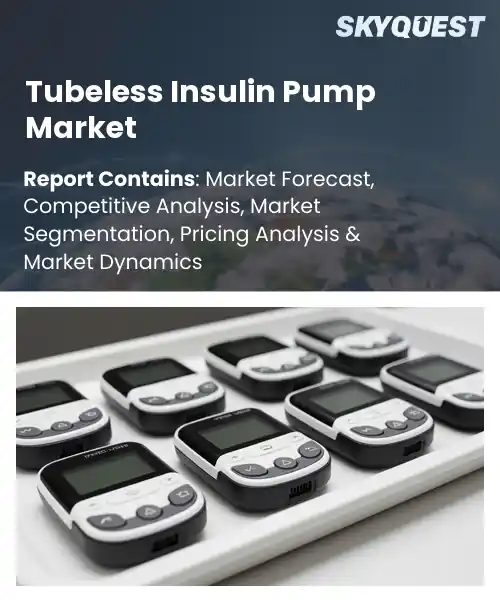
Tubeless Insulin Pump Market
Report ID: SQMIG35A3735
Report ID: SQMIG35A3735
[email protected]
USA +1 351-333-4748
Report ID:
SQMIG35A3735 |
Region:
Global |
Published Date: June, 2026
Pages:
157
|Tables:
89
|Figures:
76


Global Tubeless Insulin Pump Market size was valued at USD 1.42 Billion in 2024 and is poised to grow from USD 1.77 Billion in 2025 to USD 10.28 Billion by 2033, growing at a CAGR of 24.6% during the forecast period (2026-2033).
The main catalyst behind the market for tubeless insulin pumps is the coming together of the need from the patient's side for discreetness and flexibility in insulin delivery, combined with advancements in automation technology that makes it easier and safer to manage their sugar levels. The market for tubeless insulin pumps includes patch-type wearable pumps that dispense insulin without the use of tubes, integrated platforms that connect with the help of continuous glucose monitors and smartphone applications, among others.
In the last ten years, the industry progressed from initial designs of patches to commercial products like the Omnipod device. The growing trend of using sensors for blood glucose levels, as well as algorithms for determining insulin doses, makes tube-less insulin pumps more desirable since wireless connectivity allows for automation in adjusting basal rates for both users and practitioners. This means that manufacturers that use CGMs in closed-loop systems are adopted more by young active people and shift workers who appreciate discretion when participating in physical activity or overnight insulin therapy. Reimbursement in all markets makes pump devices affordable for patients, which increases the likelihood of prescriptions of such devices from health practitioners. Therefore, potential areas include strategic alliances, subscription services, and expanding geographically into developing countries.
How is AI Enhancing Patient Adherence in the Tubeless Insulin Pump Market?
In terms of adherence improvements in the tubeless insulin pump segment, AI enhances the process through its incorporation with continuous insulin delivery, predictive analytics, and simplified human interactions. Important elements in this regard would be the provision of real-time dosing adjustments based on glucose levels, alerts for predicting and acting on problems, and coaching to lower decision fatigue. Market trends at the moment favor tubeless insulin pumps because of their simplicity and lower stigmatization. With the introduction of AI, such devices transform into care partners for people with diabetes. Insulet announced in June 2026 the launch of an improved Omnipod 5 algorithm together with its integration with Abbott’s Libre 3 Plus sensor, illustrating the potential of AI to simplify routine and increase adherence and adoption rates.
Market snapshot - (2026-2033)
Global Market Size
USD 1.42 Billion
Largest Segment
Pod/Pump
Fastest Growth
Remote/Controller
Growth Rate
24.6% CAGR
To get more insights on this market click here to Request a Free Sample Report
Global tubeless insulin pump market is segmented by component, distribution channel, end-user and region. Based on components, the market is segmented into Pod/Pump and Remote/Controller. Based on distribution channels, the market is segmented into Hospital Pharmacy, Retail Pharmacy and Online Pharmacy. Based on end-user, the market is segmented into Hospitals and Clinics, Home Care Settings and Others. Based on the region, the market is segmented into North America, Europe, Asia Pacific, Latin America and Middle East & Africa.
The Pod/Pump category is leading since it essentially embodies the key element of delivering insulin and serves as the focal area for reliability and safety. Device companies are focused on making sturdy pods to improve compliance and minimize treatment disruptions, thus driving research and development efforts as well as sourcing strategies. Consequently, product innovation, product life cycle management, and safety innovations define the decision-making process and create loyalty in favor of market leaders.
Nonetheless, Remote/Controller has been experiencing the most significant momentum in growth due to the increasing desire for interfaces that can easily be operated, remote monitoring capability, and integration with smartphones. The continuous development of software, data sharing on cloud, and modularity in controllers have significantly contributed to the expansion of applications for the product line.
The Hospital Pharmacy is leading the segment because hospitals tend to consolidate their purchasing activities, standardize their device selection criteria, and impact the development of protocols which encourage the use of tubeless insulin pump systems. Due to standardized purchasing institutional settings, vendors tend to develop their products according to such needs as well as educate clinicians accordingly. This results in the fact that hospital settings have become the major route for system certification and clinician education.
On the other hand, an important high growth area in terms of sales is Online Pharmacy because online purchases provide a much more convenient way for users of insulin pumps. Advanced capabilities of online pharmacies, home delivery of insulin pumps, and patient support can result in better penetration and adoption of continuous treatment practices among customers.
To get detailed segments analysis, Request a Free Sample Report
North America continues to lead owing to a confluence of supportive healthcare infrastructure, strong innovation hubs, and efficient reimbursement processes. Market leadership is driven by clinical research efforts in concentrated areas along with rapid uptake by specialized diabetes clinics. Well-established medical technology firms and pharmaceutical companies with strong commercial networks make it easier for products to get into the hands of users and facilitate education for professionals. Demand from patient advocates and awareness among doctors creates incentives for more non-invasive approaches for diabetes. Synergies with digital health applications and telemedicine further strengthen the value proposition. Strong logistical support and an enabling regulatory landscape create an environment conducive for dominance in the region.
Insulin Pump without Tube Market of the United States boasts excellent clinical acceptance by doctors in the endocrine and diabetic networks, engagement of both private and public payers, and financial support from leading med-tech firms. The clinical practice guideline along with specialty training drives acceptance by doctors; technology integration allows remote monitoring and patient care coordination. Extensive distribution and marketing networks help ensure quick entry into the market for innovative products.
Market for Tubeless Insulin Pump in Canada exists in a publicly funded healthcare system that focuses on equality and efficiency. Adoption of paths and reimbursement of products through public procurement and health technology assessment processes have a certain level of regional variation. Centers of Excellence for specialists’ training and diabetes programs play an important role here as well. Manufacturers and government entities collaborate to develop pilots and conduct studies as the basis for future reimbursement. Remote care delivery and community-based services become particularly important here.
There are fast developments taking place in Europe due to coordinated initiatives for the healthcare system, growing importance on patients with diabetes, involvement of existing and new medical device companies, and other factors. Value-basedcare approaches are being investigated by national health bodies and payers where minimally invasive devices play a more important part. Clinical societies and patient bodies raise awareness and implement guidelines regarding the issue, while cross-border cooperation, centralized distribution network, and common regulations facilitate the process of market entry. Companies invest in the development of digital solutions and clinical proof of their efficacy via multi-center trials, thus helping physicians feel comfortable with their use.
The German market for tubeless insulin pumps is facilitated by robust healthcare technology infrastructure, extensive specialist networks, and a well-developed system of hospitals and ambulatory centers, which help drive adoption. Reimbursement policies and health economics assessments create a structured process for market entry of new diabetes technologies. The presence of clinical expertise and academic institutions contributes to the creation of evidence as well as training specialists, while strong local manufacturing and distribution networks ensure a reliable supply chain.
The UK Tubeless Insulin Pump Market features rapid uptake driven by country-wide strategic programs and commissioning efforts that are pro-scalable technologies. Collaboration with the digital health framework, as well as inclusion in the primary care pathway, enhances access for community-based diabetes management. The implementation of pilot programs and regional procurement processes allows for quick assessment and implementation, while education for professionals and guideline compliance drive adoption rates among physicians. The centralized health care system streamlines the process of negotiating and aligning value propositions.
Emergence of Tubeless Insulin Pump Market in France is occurring via strategic activities in specialist centers, as well as discussion on issues of payment and care pathway inclusion. Advocacy from both clinical opinion leaders and patient groups is playing an important role in influencing acceptance, while regulatory procedures determine product market access. Collaboration between international suppliers and clinicians helps to develop evidence for and train clinicians about products. Importance of quality and accessibility influences efforts for making products available in non-urban areas as well as integrating them into existing diabetes management programs.
Market positioning for Asia Pacific has become a result of utilizing technologies along with regulations and strategic alliances that leverage global expertise to meet regional needs. Clinical awareness of the available advanced solutions for managing diabetes is combined with domestic manufacturing capabilities and collaboration, providing opportunities for adapting products to the regional requirements. Healthcare providers have increasingly incorporated digital health initiatives along with other remote care services that serve as an effective addition to tubeless devices. Market entry approaches include pilot programs and collaborations along with regional service models that take into account complex reimbursement structures and healthcare delivery channels.
Japanese Tubeless Insulin Pump Market is impacted by strict regulatory policies, sophisticated clinical practices, and high penetration rates of cutting-edge medical devices. Strong relationships between local suppliers and research centers help to improve products and collect data. Connection with healthcare institutions and at-home care services ensures consistency of care delivery, while targeted training increases competence. Attention to patients' results over time and integration with digital technology helps to ensure growth in professional circles of diabetes treatment specialists.
South Korea Market for Tubeless Insulin Pumps is propelled by the fact that there is an existing technology-oriented healthcare landscape and cooperation between equipment manufacturers and IT organizations. Patient interaction with connected health systems and robust manufacturing capabilities make it easy to develop and implement prototypes quickly. There are also reimbursement tests and public-private partnerships that allow companies to prove their value proposition. Clinical facilities offer training and evidence through real-world use cases, and there are urban healthcare infrastructure and digital integration in place.
To know more about the market opportunities by region and country, click here to
Buy The Complete Report
Rising Adoption of Patch Pumps
The growing popularity of patch insulin pumps due to the convenience and discreetness of use among consumers and health professionals is behind the growing market trend, as these tools facilitate insulin administration and can help increase compliance and improve people’s quality of life. Patients’ positive experience with this innovative solution encourages recommendations among peers and health care professionals, prompting the companies to develop new products and distribute them more widely. With the rising trust in patch pump systems, there is an increased demand for complementary accessories.
Technological Advancements in Sensors
Advances in sensors and their integration continue to drive the demand for the tubeless insulin pump system by providing accuracy in monitoring of the levels of glucose in patients and improving coordination in the delivery of insulin. Improved reliability and integration of sensors with software applications such as smartphones and decision-making algorithms have enabled closer collaboration among software and device manufacturers, leading to innovations and better products. This encourages the involvement of clinicians in search of safe treatment alternatives, thus expanding the market and its adoption..
High Device and Consumable Costs
High cost of the equipment of a tubeless insulin pump along with its continuous requirement is an issue that limits the growth of the market because expensive purchase costs coupled with continued expense for supplies make it unaffordable for many people. Lack of insurance reimbursement makes physicians and other health care providers wary of promoting the product. Such financial issues could delay purchasing institutions like hospitals and clinics, especially in countries where resources are more limited.
Regulatory Approval Complexity
The different and dynamic regulations across the various geographic locations pose challenges for the tubeless insulin pump market as far as the process of product approval is concerned. This is due to the amount of time taken to meet the safety and efficacy requirements set out by different regions, as well as the amount of effort required by producers to meet all regulatory standards. Different rules governing how devices are categorized and classified, alongside different expectations on clinical evidence and software verification, make it difficult for manufacturers to launch their products in multiple markets simultaneously.
Request Free Customization of this report to help us to meet your business objectives.
The competitive dynamics in the global market for tubeless insulin pumps revolve around incumbent versus entrant competition, as well as approvals and CGM integration which determine the competitive positioning of firms. Some examples include the acquisition of AMF Medical by Tandem, pump integration with Dexcom and Abbott by Insulet, Modular Medical's FDA approval initiatives for a patch pump, and Sequel Med Tech's advancement in twiist insulin delivery systems.
Personalized Therapy Integration: The current trend among manufacturers is towards personalizing therapy by integrating glucose monitoring feedback, advanced algorithms for insulin dosing, and personalized preferences into a seamless package. The design of device systems is such that they can interact with personal health data and care teams, which will help healthcare professionals personalize therapies without interfering with their routines. Personalization of interfaces and updating firmware in modular ways are important trends in designing these devices, and partnerships with digital companies are speeding up product development and clinical validation.
Remote Care Enablement: Advancement in capabilities for remote care management is contributing to the rise of usage of tubeless pumps by virtue of the product becoming capable of managing virtual start-up, remote monitoring, and management of such pumps. The manufacturers focus on secure data sharing, ease of onboarding, and educating the patients about the benefits of using the pump for ensuring easy adoption. Through their integration with telehealth platforms, adjustments can be made proactively without compromising the performance of the device.
SkyQuest’s ABIRAW (Advanced Business Intelligence, Research & Analysis Wing) is our Business Information Services team that Collects, Collates, Correlates, and Analyses the Data collected by means of Primary Exploratory Research backed by robust Secondary Desk research.
As per SkyQuest analysis, the global market for tubeless insulin pumps is driven mainly by the increasing demand from patients for convenient and discrete insulin administration coupled with advancements in continuous glucose monitoring technology combined with algorithm-based insulin administration. Another factor driving growth in the market is rapid advancements in sensors and AI-based automation technologies. The main challenges facing growth in the market include high costs associated with devices and consumables. North America leads the market owing to the strong presence of innovation networks, reimbursement, and clinical adoption. The market is further segmented into a pod or pump category which is the largest segment in terms of revenue generation.
| Report Metric | Details |
|---|---|
| Market size value in 2024 | USD 1.42 Billion |
| Market size value in 2033 | USD 10.28 Billion |
| Growth Rate | 24.6% |
| Base year | 2024 |
| Forecast period | (2026-2033) |
| Forecast Unit (Value) | USD Billion |
| Segments covered |
|
| Regions covered | North America (US, Canada), Europe (Germany, France, United Kingdom, Italy, Spain, Rest of Europe), Asia Pacific (China, India, Japan, Rest of Asia-Pacific), Latin America (Brazil, Rest of Latin America), Middle East & Africa (South Africa, GCC Countries, Rest of MEA) |
| Companies covered |
|
| Customization scope | Free report customization with purchase. Customization includes:-
|
To get a free trial access to our platform which is a one stop solution for all your data requirements for quicker decision making. This platform allows you to compare markets, competitors who are prominent in the market, and mega trends that are influencing the dynamics in the market. Also, get access to detailed SkyQuest exclusive matrix.
Table Of Content
Executive Summary
Market overview
Parent Market Analysis
Market overview
Market size
KEY MARKET INSIGHTS
COVID IMPACT
MARKET DYNAMICS & OUTLOOK
Market Size by Region
KEY COMPANY PROFILES
Methodology
For the Tubeless Insulin Pump Market, our research methodology involved a mixture of primary and secondary data sources. Key steps involved in the research process are listed below:
1. Information Procurement: This stage involved the procurement of Market data or related information via primary and secondary sources. The various secondary sources used included various company websites, annual reports, trade databases, and paid databases such as Hoover's, Bloomberg Business, Factiva, and Avention. Our team did 45 primary interactions Globally which included several stakeholders such as manufacturers, customers, key opinion leaders, etc. Overall, information procurement was one of the most extensive stages in our research process.
2. Information Analysis: This step involved triangulation of data through bottom-up and top-down approaches to estimate and validate the total size and future estimate of the Tubeless Insulin Pump Market.
3. Report Formulation: The final step entailed the placement of data points in appropriate Market spaces in an attempt to deduce viable conclusions.
4. Validation & Publishing: Validation is the most important step in the process. Validation & re-validation via an intricately designed process helped us finalize data points to be used for final calculations. The final Market estimates and forecasts were then aligned and sent to our panel of industry experts for validation of data. Once the validation was done the report was sent to our Quality Assurance team to ensure adherence to style guides, consistency & design.
Analyst Support
Customization Options
With the given market data, our dedicated team of analysts can offer you the following customization options are available for the Tubeless Insulin Pump Market:
Product Analysis: Product matrix, which offers a detailed comparison of the product portfolio of companies.
Regional Analysis: Further analysis of the Tubeless Insulin Pump Market for additional countries.
Competitive Analysis: Detailed analysis and profiling of additional Market players & comparative analysis of competitive products.
Go to Market Strategy: Find the high-growth channels to invest your marketing efforts and increase your customer base.
Innovation Mapping: Identify racial solutions and innovation, connected to deep ecosystems of innovators, start-ups, academics, and strategic partners.
Category Intelligence: Customized intelligence that is relevant to their supply Markets will enable them to make smarter sourcing decisions and improve their category management.
Public Company Transcript Analysis: To improve the investment performance by generating new alpha and making better-informed decisions.
Social Media Listening: To analyze the conversations and trends happening not just around your brand, but around your industry as a whole, and use those insights to make better Marketing decisions.
REQUEST FOR SAMPLE
 REQUEST FREE CUSTOMIZATION
Global Tubeless Insulin Pump Market size was valued at USD 1.42 Billion in 2024 and is poised to grow from USD 1.77 Billion in 2025 to USD 10.28 Billion by 2033, growing at a CAGR of 24.6% during the forecast period (2026-2033).
Competitive dynamics in the global tubeless insulin pump market are defined by incumbent-entrant clashes, regulatory clearances and device-CGM integrations that directly shape competitive positioning. Recent concrete moves include Tandem’s acquisition of AMF Medical, Insulet’s pump integrations with Dexcom and Abbott, Modular Medical’s FDA clearance activity for a patch pump, and Sequel Med Tech progressing its twiist automated insulin delivery platform. 'Insulet Corporation', 'Medtronic', 'Roche Holding', 'Tandem Diabetes Care', 'Ypsomed Holding', 'Terumo Corporation', 'Eli Lilly and Company', 'Novo Nordisk', 'Wuxi Apex Medical', 'EOFlow', 'Valeritas', 'ViCentra', 'Soylent', 'SFC Energy', 'PharmaSens', 'Sooil Development', 'MannKind Corporation', 'Medtrum Technologies', 'MicroTech Medical', 'Sinomedical'
The increasing adoption of tubeless patch insulin pumps by patients and healthcare providers is driving market growth because these devices offer greater convenience, discreet wearability and simplified insulin delivery that can improve adherence and quality of life. Favorable patient experiences encourage word of mouth and clinician recommendations, prompting manufacturers to invest in product development and expand distribution. As confidence in patch pump technology grows, broader acceptance across care settings leads to higher demand for supportive services and accessories, reinforcing market expansion and competitive innovation.
Personalized Therapy Integration: Manufacturers are prioritizing individualized therapy through seamless integration of continuous glucose sensor feedback, adaptive dosing algorithms, and user preferences to tailor insulin delivery and enhance adherence. Device ecosystems are being designed to connect with personal health records and care teams, enabling clinicians to refine therapy without disrupting workflows. Emphasis on customizable user interfaces and modular firmware updates supports diverse patient needs and encourages long term engagement, while collaborations with digital health firms accelerate feature development and regulatory-ready clinical validation pathways.
Why does North America Dominate the Global Tubeless Insulin Pump Market? |@12


Want to customize this report? This report can be personalized according to your needs. Our analysts and industry experts will work directly with you to understand your requirements and provide you with customized data in a short amount of time. We offer $1000 worth of FREE customization at the time of purchase.
Feedback From Our Clients


 USA (+1) 351-333-4748

