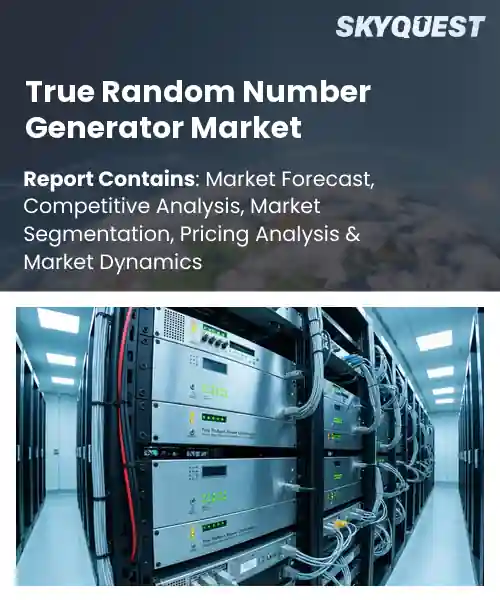
True Random Number Generator Market
Report ID: SQMIG45K2315
Report ID: SQMIG45K2315
[email protected]
USA +1 351-333-4748
Report ID:
SQMIG45K2315 |
Region:
Global |
Published Date: June, 2026
Pages:
157
|Tables:
142
|Figures:
78


Global True Random Number Generator Market size was valued at USD 282.5 Million in 2024 and is poised to grow from USD 306.29 Million in 2025 to USD 585.4 Million by 2033, growing at a CAGR of 8.42% during the forecast period (2026-2033).
True random number generators (TRNGs) convert physical entropy sources such as quantum fluctuations, thermal noise, or atmospheric radiation to unpredictable bits, distinguishing them from algorithmic pseudo‑random counterparts. The market revolves around the need for cryptographic security, high‑stakes simulations, and regulatory compliance, especially as data breaches and quantum‑computing threats intensify. Historically, early hardware dice and radioactive‑decay devices gave way to semiconductor‑based quantum‑dot and photonic chips, reducing size and cost while boosting throughput. Today, manufacturers like ID Quantique and Intel dominate, supplying modules for cloud providers, financial exchanges, and defense contractors, reinforcing the sector’s strategic relevance for emerging AI workloads and secure IoT deployments globally. The accelerating adoption of zero‑trust architectures serves as the principal catalyst propelling TRNG demand, because each authentication handshake now requires truly unpredictable keys to thwart replay attacks. Consequently, cloud providers integrate TRNG chips into hyper‑scale data centers, enabling encrypted traffic to sustain latency‑sensitive services as video streaming and real‑time gaming. Simultaneously, regulatory mandates in the EU and United States compel financial institutions to employ hardware‑based randomness for high‑frequency trading algorithms, reducing bias and enhancing market fairness. These drivers generate a fertile market for OEMs to expand into automotive safety systems, where autonomous vehicles rely on random seeds for sensor fusion and decision‑making.
How is AI enhancing entropy extraction in the true random number generator market?
True random number generators rely on physical entropy sources such as electronic noise, photon detection or chaotic circuits. AI is being layered on top of these sources to filter out bias, predict drift and maximize usable entropy. Machine learning models trained on large streams of raw data can identify subtle patterns that traditional statistical tests miss, allowing the system to discard correlated bits in real time. This results in higher quality random streams without increasing hardware complexity. Vendors are integrating AI modules directly into ASICs and firmware, making entropy extraction more adaptive to temperature changes and supply variations. The approach is driving broader adoption in security and cloud services.ID Quantique announced in April 2025 an AI enhanced entropy extraction engine that runs on its quantum random number generator hardware, boosting the purity of the output while keeping power consumption low. The launch illustrates how AI is accelerating performance and market confidence.
Market snapshot - (2026-2033)
Global Market Size
USD 282.5 Million
Largest Segment
Hardware TRNG (Integrated)
Fastest Growth
Standalone TRNG Devices
Growth Rate
8.42% CAGR
To get more insights on this market click here to Request a Free Sample Report
Global true random number generator market is segmented by type, technology, application, end-use, distribution and region. Based on type, the market is segmented into Hardware TRNG (Integrated) and Standalone TRNG Devices. Based on technology, the market is segmented into Thermal Noise-Based, Photon-Based (Quantum) and Oscillator-Based. Based on application, the market is segmented into Cryptography & Security, Simulations and Gaming & Lotteries. Based on end-use, the market is segmented into Cybersecurity, Financial Services and Defense. Based on distribution, the market is segmented into Direct and Distributors. Based on region, the market is segmented into North America, Europe, Asia Pacific, Latin America and Middle East & Africa.
Photon-based (quantum) segment dominates because it leverages fundamental quantum phenomena that produce entropy inherently unpredictable, satisfying the highest standards of randomness required for critical encryption tasks. Its ability to generate true randomness at chip level integrates seamlessly into modern processors, enabling manufacturers to embed security directly into hardware. This intrinsic trustworthiness and ease of integration drive strong preference among designers seeking robust cryptographic foundations throughout the product lifecycle and beyond.
Meanwhile, oscillator-based segment emerges as the key high growth area in the random number generator market as advancements in power design enable its deployment in a wide range of edge devices. Expanding demand for affordable entropy sources in IoT ecosystems fuels rapid adoption and opens new opportunities for scalable security solutions.
Hardware TRNG (integrated) segment dominates because it offers manufacturers the ability to embed true randomness directly within silicon, eliminating the need for external components and reducing overall system complexity. This integration aligns with the industry trend toward compact, power efficient designs, providing immediate security benefits without compromising performance, which makes it the preferred choice for next generation platforms across diverse application domains such as automotive, consumer electronics, and cloud infrastructure.
On the other hand, standalone TRNG devices segment is witnessing the strongest growth momentum as enterprises seek flexible, plug and play randomness solutions for legacy systems. Their ability to retrofit existing hardware without redesign accelerates security upgrades and meets regulatory pressures, driving rapid market expansion and stimulating innovation in modular security architectures.
To get detailed segments analysis, Request a Free Sample Report
North America benefits from a deeply integrated ecosystem where advanced research institutions, leading technology firms and a robust venture capital landscape intersect to drive relentless innovation in randomness generation. The region’s strong emphasis on cybersecurity and defense creates sustained demand for high‑entropy sources that meet stringent compliance standards. A mature semiconductor supply chain coupled with extensive cloud infrastructure accelerates product rollout and adoption. Collaborative initiatives between academia and industry foster rapid prototyping, while regulatory frameworks encourage responsible deployment of cryptographic solutions. This confluence of technical expertise, market readiness and strategic investment positions North America as the pre‑eminent hub for true random number generator development and commercialization.
True Random Number Generator Market in United States thrives on a confluence of high‑performance computing demands, extensive cloud service networks and sophisticated defense contracts that prioritize unbreakable encryption. Innovation clusters in major technology corridors provide a steady pipeline of talent and patents, while strong intellectual property protection reinforces commercial confidence. The financial sector’s emphasis on fraud mitigation and secure transactions further amplifies usage, creating a virtuous cycle of research investment and product refinement across both hardware and software domains.
True Random Number Generator Market in Canada draws strength from vibrant research universities and government‑backed programs focused on quantum technologies and secure communications. Strategic partnerships with American firms facilitate technology transfer and market access, while domestic enterprises leverage strong data privacy norms to differentiate offerings. Emerging startups benefit from supportive innovation hubs that nurture interdisciplinary collaboration, positioning Canada as a niche yet influential player in the broader North American landscape.
Europe’s rapid expansion is propelled by rigorous data protection regulations that elevate the importance of cryptographic integrity across all digital services. Strong governmental support for research in quantum security and advanced cryptography fuels continuous development of high‑quality entropy sources. The region’s diversified industrial base, particularly in automotive, fintech and telecommunications, creates cross‑sector demand for reliable randomness. Collaborative frameworks among EU member states encourage standardisation and shared expertise, while thriving innovation clusters in key economies accelerate commercialization. Together these factors generate a fertile environment where true random number generators become indispensable components of emerging digital infrastructure.
True Random Number Generator Market in Germany benefits from a deep engineering tradition and a concentration of precision manufacturing firms that integrate high‑entropy modules into industrial automation and automotive safety systems. Robust research institutions collaborate closely with established hardware producers, ensuring a pipeline of cutting‑edge solutions. Strong emphasis on reliability and certification aligns with stringent European standards, reinforcing Germany’s position as a dominant supplier within the continental ecosystem.
True Random Number Generator Market in United Kingdom experiences accelerated growth driven by a vibrant fintech sector and a dynamic cybersecurity community that prioritize sophisticated encryption techniques. Leading academic centers and tech incubators nurture talent and foster rapid prototype development, while regulatory focus on digital resilience fuels market uptake. Strategic alliances with global cloud providers further extend the reach of UK‑originated randomness technologies across diverse industry verticals.
True Random Number Generator Market in France is emerging through concerted efforts in governmental research programs and a growing number of startups targeting secure digital identity and e‑government services. Collaborative projects between national labs and private enterprises encourage innovative approaches to entropy generation, while a strong cultural emphasis on data privacy drives early adoption in banking and health sectors, positioning France as an ascending contributor to Europe’s overall market momentum.
Asia Pacific is strengthening its position by leveraging dense electronics manufacturing networks and the rapid proliferation of consumer devices that require secure random number generation. The region’s focus on next‑generation computing, including artificial intelligence and IoT ecosystems, intensifies the need for robust cryptographic primitives. Government initiatives that promote digital sovereignty and cybersecurity resilience encourage domestic development of high‑quality entropy solutions. Competitive pressures among leading semiconductor firms stimulate continuous innovation, while close collaboration between academic research centers and industry accelerates technology transfer. This synergy enables Asia Pacific to expand its influence in both hardware‑centric and software‑centric applications worldwide.
True Random Number Generator Market in Japan is reinforced by a legacy of precision electronics expertise and a strong commitment to cybersecurity within critical infrastructure. Leading chipset manufacturers integrate advanced randomness modules into consumer electronics, automotive systems and industrial robotics, reflecting a holistic approach to secure design. Collaborative research programs between universities and major corporations drive continuous improvement of entropy quality, while government policies supporting digital resilience further cement Japan’s role as a key contributor to regional market growth.
True Random Number Generator Market in South Korea thrives on a highly connected mobile ecosystem and aggressive investment in semiconductor fabrication capabilities. The country’s prominent gaming, fintech and telecommunications sectors demand sophisticated random number generation to protect user data and transaction integrity. Close ties between research institutes and leading chip makers accelerate the development of next‑generation random number generators, while national initiatives emphasizing cybersecurity readiness boost adoption across public and private domains.
To know more about the market opportunities by region and country, click here to
Buy The Complete Report
Rising Need For Cryptographic Security
Adoption Of Quantum Resistant Protocols
High Cost Of Hardware Implementation
Regulatory Uncertainty Around Standards
Request Free Customization of this report to help us to meet your business objectives.
The competitive landscape is shaped by intensified rivalry as incumbents chase higher entropy sources and faster integration, driving a surge in M&A, strategic partnerships, and accelerated technology rollouts; for example, a leading hardware supplier acquired a niche FPGA firm to embed true‑random modules, while another major player forged a joint‑development pact with a cloud‑services giant to embed quantum‑grade randomness into AI pipelines, reflecting a clear shift toward ecosystem‑wide solutions.
Top Player’s Company Profile
Recent Developments
SkyQuest’s ABIRAW (Advanced Business Intelligence, Research & Analysis Wing) is our Business Information Services team that Collects, Collates, Correlates, and Analyses the Data collected by means of Primary Exploratory Research backed by robust Secondary Desk research. As per SkyQuest analysis the true random number generator market is expanding rapidly, propelled primarily by the rising need for cryptographic security across cloud, finance and defense sectors, while a second driver comes from growing adoption of quantum‑resistant protocols that demand high‑quality entropy. A notable restraint is the high cost of hardware implementation, which can slow uptake among smaller firms. North America dominates the market thanks to its strong research ecosystem, venture capital and defense spending. Within the product mix the photon‑based quantum technology segment leads, offering intrinsic unpredictability that meets the strict randomness standards required for modern encryption and blockchain applications.
| Report Metric | Details |
|---|---|
| Market size value in 2024 | USD 282.5 Million |
| Market size value in 2033 | USD 585.4 Million |
| Growth Rate | 8.42% |
| Base year | 2024 |
| Forecast period | (2026-2033) |
| Forecast Unit (Value) | USD Million |
| Segments covered |
|
| Regions covered | North America (US, Canada), Europe (Germany, France, United Kingdom, Italy, Spain, Rest of Europe), Asia Pacific (China, India, Japan, Rest of Asia-Pacific), Latin America (Brazil, Rest of Latin America), Middle East & Africa (South Africa, GCC Countries, Rest of MEA) |
| Companies covered |
|
| Customization scope | Free report customization with purchase. Customization includes:-
|
To get a free trial access to our platform which is a one stop solution for all your data requirements for quicker decision making. This platform allows you to compare markets, competitors who are prominent in the market, and mega trends that are influencing the dynamics in the market. Also, get access to detailed SkyQuest exclusive matrix.
Table Of Content
Executive Summary
Market overview
Parent Market Analysis
Market overview
Market size
KEY MARKET INSIGHTS
COVID IMPACT
MARKET DYNAMICS & OUTLOOK
Market Size by Region
KEY COMPANY PROFILES
Methodology
For the True Random Number Generator Market, our research methodology involved a mixture of primary and secondary data sources. Key steps involved in the research process are listed below:
1. Information Procurement: This stage involved the procurement of Market data or related information via primary and secondary sources. The various secondary sources used included various company websites, annual reports, trade databases, and paid databases such as Hoover's, Bloomberg Business, Factiva, and Avention. Our team did 45 primary interactions Globally which included several stakeholders such as manufacturers, customers, key opinion leaders, etc. Overall, information procurement was one of the most extensive stages in our research process.
2. Information Analysis: This step involved triangulation of data through bottom-up and top-down approaches to estimate and validate the total size and future estimate of the True Random Number Generator Market.
3. Report Formulation: The final step entailed the placement of data points in appropriate Market spaces in an attempt to deduce viable conclusions.
4. Validation & Publishing: Validation is the most important step in the process. Validation & re-validation via an intricately designed process helped us finalize data points to be used for final calculations. The final Market estimates and forecasts were then aligned and sent to our panel of industry experts for validation of data. Once the validation was done the report was sent to our Quality Assurance team to ensure adherence to style guides, consistency & design.
Analyst Support
Customization Options
With the given market data, our dedicated team of analysts can offer you the following customization options are available for the True Random Number Generator Market:
Product Analysis: Product matrix, which offers a detailed comparison of the product portfolio of companies.
Regional Analysis: Further analysis of the True Random Number Generator Market for additional countries.
Competitive Analysis: Detailed analysis and profiling of additional Market players & comparative analysis of competitive products.
Go to Market Strategy: Find the high-growth channels to invest your marketing efforts and increase your customer base.
Innovation Mapping: Identify racial solutions and innovation, connected to deep ecosystems of innovators, start-ups, academics, and strategic partners.
Category Intelligence: Customized intelligence that is relevant to their supply Markets will enable them to make smarter sourcing decisions and improve their category management.
Public Company Transcript Analysis: To improve the investment performance by generating new alpha and making better-informed decisions.
Social Media Listening: To analyze the conversations and trends happening not just around your brand, but around your industry as a whole, and use those insights to make better Marketing decisions.
REQUEST FOR SAMPLE
 REQUEST FREE CUSTOMIZATION


Want to customize this report? This report can be personalized according to your needs. Our analysts and industry experts will work directly with you to understand your requirements and provide you with customized data in a short amount of time. We offer $1000 worth of FREE customization at the time of purchase.
Feedback From Our Clients


 USA (+1) 351-333-4748

