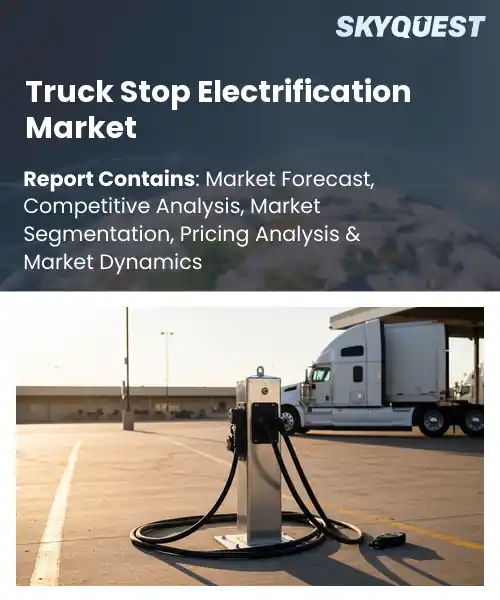
Truck Stop Electrification Market
Report ID: SQMIG20X2023
Report ID: SQMIG20X2023
[email protected]
USA +1 351-333-4748
Report ID:
SQMIG20X2023 |
Region:
Global |
Published Date: March, 2026
Pages:
157
|Tables:
119
|Figures:
77


Global Truck Stop Electrification Market size was valued at USD 1.5 Billion in 2024 and is poised to grow from USD 1.64 Billion in 2025 to USD 3.39 Billion by 2033, growing at a CAGR of 9.5% during the forecast period (2026-2033).
The primary driver that is shaping the truck stop electrification market is regulatory pressure to reduce diesel idling and greenhouse gas emissions. This has changed freight rest facilities into locations for low emission alternatives. Truck stop electrification consists of shore power, plug in HVAC, cabin conditioning and charging infrastructure that will take the place of an engine idling while a driver is resting. This is important because both fleets and regulators want to achieve health benefits, fuel savings and compliance.
The market has transitioned from pilot isolated services to broader deployments due to decreasing technology costs and the introduction of grant programs. Both the California Air Resources Board rules and earlier providers such as IdleAir are examples of demonstrating nationwide demand and benefits today.
Moving forward from this momentum, the critical factor for growth of truck stop electrification is aligning fleet electrification with charging economics. As fleets incorporate electric tractors and purchase shore power compatible sleeper units, their utilization of truck stop electrification will increase and justify their initial capital investment. Increased utilization of truck stop electrification decreases the average cost for a driver thus attracting private investment, as well as accelerating standardization of areas such as connector types, billing and reservation systems. The market is gaining significant global truck stop electrification market share due to increasing investments in electrified freight corridors, supportive environmental regulations, and the rising transition of fleet operators toward zero-emission transportation solutions.
How is IoT Enabling Smarter Truck Stop Electrification Deployments?
By using IoT to connect multiple charging stations, meters, energy storage devices, and site systems into one long-term managed solution or service, instead of being treated as independent offering of charge points. There are four important elements real time telemetry to ensure up time, predictive maintenance provided by sensors, load management through smart load management to flatten peak loads and integration with microgrids and renewable resources.
There is a shift from the use of “on-premise” vs. “cloud” based solutions (such as SaaS), the shift is toward cloud hosted solutions using edge analytic services to pull pertinent data from the load requesting entity and using this data to proactively communicate back to the charging station provider when to expect vehicle needs for charging. These solutions will improve reliability, provide a better experience for truck drivers, help reduce costly grid expansion and provide greater operational efficiencies by enabling remote monitoring/automated workflow of the electric truck charging process.
Pilot Travel Centers LLC and Tesla announced plans to collaborate on January 26, 2026, to install Tesla branded semi-truck chargers at certain pilot travel centers/diesel staging locations to further demonstrate how managed Mega-watt charging with IoT Telemetry and Scheduling can successfully manage power delivery.
Market snapshot - (2026-2033)
Global Market Size
USD 1.5 Billion
Largest Segment
Single System Electrification
Fastest Growth
Hybrid Electrification
Growth Rate
9.5% CAGR
To get more insights on this market click here to Request a Free Sample Report
Global truck stop electrification market is segmented into type, component, application, end-user and region. Based on type, the market is segmented into single system electrification, dual system electrification and hybrid electrification. Based on component, the market is segmented into hardware, software and services. Based on application, the market is segmented into idle reduction, power supply, HVAC and others. Based on end-user, the market is segmented into light-duty vehicles, heavy-duty vehicles, commercial fleets and others. Based on region, the market is segmented into North America, Europe, Asia Pacific, Latin America and Middle East & Africa.
The hardware segment is dominant because the physical charging stations, power distribution equipment, and ancillary electrical infrastructure, represent the core of the asset necessary for truck stop electrification. Both operators and owners of truck stop sites look for strong, standardized hardware to ensure uptime and compatibility with the power requirements of heavy-duty vehicles, which drives their procurement of durable components and trusted suppliers. Hardware is the physical manifestation of the throughput, reliability and maintenance demand of the site; therefore, hardware determines the sequencing of deployment and the prioritization of investments made by all service providers or station operators.
As per global truck stop electrification market forecast, software continues to grow at the fastest pace; by providing intelligent control platforms, reservation and billing systems, and predictive maintenance, the software provides the ability to introduce operational efficiencies and new revenue streams. Software's ability to manage loads dynamically, integrate with fleets and provide remote technical diagnostics reduces the operating costs associated with the use of these systems as well as optimizes the use of these systems, further driving the adoption of these systems.
As per global truck stop electrification market outlook, the hybrid electrification segment dominates the market because of its ability to blend grid connected charging with local power storage options and on-site power generation systems. This will allow fleet operators the ability to manage variable demands of their fleet while providing on-going uninterrupted service. Additionally, this system provides a consistent smoothing of peak loads, reduces limitations on what the grid can provide, and allows for improved integration of renewable energy sources.
These advantages help create reliable operation and ultimately lead to reduced operation costs over the life of the station. As a result, hybrid systems provide a level of operational resilience that drive site design decisions and attract investments from facility owners wanting to ensure the long-term performance of their fueling stations.
As per global truck stop electrification market analysis, dual system electrification is the fastest growing approach because supporting both shore power and direct vehicle connection enables incremental upgrades at existing facilities. This method, which provides the capability of charging via both a shore power connection as well as an immediate connection to the vehicle through a direct connection will enable facility owners to make incremental upgrades at existing facilities as needed. Furthermore, this capability of providing both a shore power and a direct vehicle connection provides a seamless transition for site operators as they implement fleet transition plans while creating immediate installation opportunities and driving wide-scale adoption across all types of fleets.
To get detailed segments analysis, Request a Free Sample Report
As per global truck stop electrification market regional outlook, large investments from the private sector, and coordinated planning between utilities, fleet operators, and charging companies, North America dominates the market. Commercial experimentation with charging models and well-capitalized service station operators has created a strong market for electrification. Additionally, supportive government policies and incentives aimed at reducing transportation emissions are accelerating infrastructure deployment and encouraging wider adoption among fleet operators.
The U.S. truck stop electrification market has a well-developed highway network, substantial private funding, and a collaboration model between truck stop chains, fleet operators, and charging providers. Fleet operators place importance on fast turnaround times, payment integration and scalable charging solutions to accommodate their long-haul fleet's operational profile.
The Canadian truck stop electrification market has developed around strong regional connections between intercity routes and strong municipal engagement through collaborative pilot projects between utilities and private operators. The major focus areas for stakeholders are resilient connections to the grid, cold weather capabilities for the electrification systems and integration of renewable energy from the grid. Other priority areas include coverage of travel corridors, depot electrification and unified payment methods. Public funding mechanisms at the provincial level have facilitated the deployment of truck-stop electrification while ensuring that long-haul fleets have reliable truck-stop experiences.
As per global truck stop electrification market regional forecast, the rapid expansion of the European market is being fueled by harmonised technical standards, dense logistics corridors, and proactive cross-border planning. Harmonization of standards and a focus on interoperability have lowered barriers to entry for operators crossing national borders; coordinated investments in infrastructure by public and private entities will encourage diverse commercial models for depot and enroute charging. The ports, intermodal hubs, and urban distribution centres will serve as strategic locations for initial deployment and will facilitate connecting with renewable energy sources and grid flexibility measures.
The truck stop electrification industry is growing strongly in Germany, as this country pushes for decarbonizing transport and fast adoption of electric commercial vehicles. Increased investments in high power charging infrastructures, like megawatt charging stations on major freight corridors, have changed truck stops from simply places to rest and refuel into hubs of electrified long-haul operations. The growth of advanced logistics networks, supportive government policies and energy providers working with fleet operators is also helping to speed up deployment of truck stop electrification. Germany remains one of the leaders in this area because of its early adoption of electrification technologies and its strong industrial base as well as its position as a leader in sustainable transportation initiatives.
As per global truck stop electrification industry analysis, United Kingdom is being driven by cutting-edge regulatory strategies, innovative commercial pricing structures, and a high level of involvement from the private sector. Stakeholders have emphasised the need for flexible charging options, integration with freight terminals, and placement of facilities in close proximity to logistics clusters. New initiatives related to the adoption of reservations systems, the ability to make interoperable payments, and fleet-centric solutions will take place. Through collaboration between highway operators, utility companies, and service providers; the deployment of these types of facilities will be accelerated while providing operational resilience and alignment with decarbonisation goals for the entire country’s intercity corridors.
In France, truck stop electrification is developing quickly due to regional pilot projects, coordinated planning in the port and hinterland areas, as well as targeted support for converting fleets to electric power. Stakeholders are focusing on integrating electrification into existing urban logistics nodes, creating a resilient electrical grid for charging, and providing electrification options on all types of terrain.
The Asia Pacific region is focused on technological advancements to increase competitiveness through public-private partnerships for logistical solutions and an understanding of regional freight movements through infrastructure planning. By being able to use both advanced battery and power electronics to integrate energy storage with other electrification activities, carriers can reliably operate their entire fleet at high duty cycles while minimizing the impact on the local grid. To achieve this, national champions/industrial conglomerates collaborate with third-party logistics companies to showcase the effectiveness of corridor charging infrastructure, depot electrification, and port hinterland solutions.
In Japan, the truck stop electrification market draws on cutting-edge vehicle technology, precision engineering, and close cooperation among manufacturers, utility providers, and transportation operators. Reliable, compact charging nodes will ultimately be developed to facilitate the integration of logistics terminals with chargers located near ports. There is an emphasis on smart, efficient, and resilient grides to perform through different temporalities or circumstantial due to the need for consistently dependable electric service.
South Korea has embraced the truck stop electrification market through substantial levels of coordination among key industrial partners, high levels of advanced battery power electronics expertise, and coordinated engagement by the utility sector to develop the infrastructure necessary to meet user requirements. There is an emphasis in the market on having electric charging solutions located along dense corridors, integration with major port and other industrial terminals, and modular charging equipment to accommodate the operating patterns of the users' fleets. Discussion among stakeholders has focused on ensuring that equipment is interoperable and on developing a digital platform that enables the user to make reservations and settle accounts digitally, as well as developing collaborative maintenance services. To support these developments, all market stakeholders actively advocate and develop policies and incentive programs that promote participation in pilot programs or ultimately accelerate market acceptance of truck stop electrification.
To know more about the market opportunities by region and country, click here to
Buy The Complete Report
Expansion of Charging Infrastructure
By providing charging infrastructure along highways and at truck stops, range anxiety can be alleviated, enabling long-haul electric trucks to operate using predictable charging locations. This helps facilitate fleet electrification plans. There are both private and public efforts to install high-power chargers and create energy management solutions for service areas that provide logistics companies with certainty about their operations and lower their perceived operational risk. Continuous improvements in charging networks provide more route coverage and make them interoperable, making it easier for fleets and owners of charging stations to adopt electric vehicles as an alternative to diesel-powered vehicles.
Government Incentives and Policies
Government program incentives and policies have a positive effect on removing financial barriers and create signals of long-term support for the decarbonisation of freight transport, therefore stimulating investment into the electrification of truck stop infrastructures. Grants, tax credits and expedited permitting go a long way toward streamlining projects and making them attractive from an economics perspective to operators of stations and utilities. As a result of clear regulatory direction, there is reduced uncertainty for developers and fleet managers which allows for more coordinated planning among all key stakeholders involved in the project. The overall result of this policy-driven integration of renewables and upgrades to existing transmission grids reinforces the overall business case for investing in electrified truck service areas, thereby promoting a more significant adoption rate.
High Capital Investment Requirements
Truck stop owners and investors face a large initial cost burden due to the significant capital investment needed for numerous elements affecting projects. This could lead to delays or potentially deter project development. Coordination with utilities and securing financing will add further complexity to development timelines, which will increase how risky these projects are perceived to be by the stakeholders involved. The affordability of capital is limited to small operators and, therefore, the cautious approach of investors towards investing in electrification projects will hinder the expansion of networks. As such, stakeholders may focus their efforts on incremental upgrades rather than pursuing complete electrification projects as quickly as desired.
Challenges Related to Grid Capacity & Interconnections
A lack of local grid capacity and complex interconnection procedures can inhibit the rapid rollout of high-capacity chargers at truck stops, as utilities will need to evaluate load impacts & upgrade electrical infrastructures. This will add further delays to the projects and make them more complex, leading some truck stop owners/operators to consider discontinuing electrification as an option because approval cycles and technical criteria imposed by utilities n are lengthy in duration. Uncertainties of the timing of grid upgrades is likely to decrease the predictability of developing electrified truck stops, particularly as there are numerous parties involved. The aforementioned limitations will necessitate careful project planning and therefore, result in the focus being placed upon lower power and/or phased deployment, reducing the pace and scale of electrification installation as such.
Request Free Customization of this report to help us to meet your business objectives.
The competition for truck stop electrification is heating up as three major constituents (operators of travel centers, OEMs, and charging networks) are aggressively pursuing partnerships, acquisitions (mergers and acquisitions) and pilots of innovative high-power technologies. For instance, TravelCenters of America has signed a deal with Electrify America to deploy large multi-site electrification across its travel centers; Pilot Company and GM have partnered with EVgo on multiple joint deployments; BP Pulse is integrating the hardware from Tesla into their b charging networks and will primarily use those hardware components to secure charging coverage (corridor) and operational reliability.
SkyQuest’s ABIRAW (Advanced Business Intelligence, Research & Analysis Wing) is our Business Information Services team that Collects, Collates, Correlates, and Analyses the Data collected by means of Primary Exploratory Research backed by robust Secondary Desk research.
As per SkyQuest analysis, the global truck stop electrification industry is being driven primarily by regulatory pressure to cut diesel idling and greenhouse gas emissions, encouraging shore power, plug-in HVAC and charging alternatives. Global truck stop electrification market growth is restrained by high capital investment requirements for high power chargers, grid upgrades and facility retrofits that raise project risk and delay deployments. North America currently dominates the market due to established freight corridors, strong private investment and coordinated utility and operator planning. Hardware remains the dominant segment because physical charging units and power distribution equipment determine throughput and reliability. A second important driver is alignment of fleet electrification with charging economics, where higher utilization and predictable energy costs attract private capital. The market is witnessing a strong global truck stop electrification market trend toward the adoption of Charging-as-a-Service (CaaS) models and high-power charging infrastructure, driven by the need to reduce diesel idling, lower emissions.
| Report Metric | Details |
|---|---|
| Market size value in 2024 | USD 1.5 Billion |
| Market size value in 2033 | USD 3.39 Billion |
| Growth Rate | 9.5% |
| Base year | 2024 |
| Forecast period | (2026-2033) |
| Forecast Unit (Value) | USD Billion |
| Segments covered |
|
| Regions covered | North America (US, Canada), Europe (Germany, France, United Kingdom, Italy, Spain, Rest of Europe), Asia Pacific (China, India, Japan, Rest of Asia-Pacific), Latin America (Brazil, Rest of Latin America), Middle East & Africa (South Africa, GCC Countries, Rest of MEA) |
| Companies covered |
|
| Customization scope | Free report customization with purchase. Customization includes:-
|
To get a free trial access to our platform which is a one stop solution for all your data requirements for quicker decision making. This platform allows you to compare markets, competitors who are prominent in the market, and mega trends that are influencing the dynamics in the market. Also, get access to detailed SkyQuest exclusive matrix.
Table Of Content
Executive Summary
Market overview
Parent Market Analysis
Market overview
Market size
KEY MARKET INSIGHTS
COVID IMPACT
MARKET DYNAMICS & OUTLOOK
Market Size by Region
KEY COMPANY PROFILES
Methodology
For the Truck Stop Electrification Market, our research methodology involved a mixture of primary and secondary data sources. Key steps involved in the research process are listed below:
1. Information Procurement: This stage involved the procurement of Market data or related information via primary and secondary sources. The various secondary sources used included various company websites, annual reports, trade databases, and paid databases such as Hoover's, Bloomberg Business, Factiva, and Avention. Our team did 45 primary interactions Globally which included several stakeholders such as manufacturers, customers, key opinion leaders, etc. Overall, information procurement was one of the most extensive stages in our research process.
2. Information Analysis: This step involved triangulation of data through bottom-up and top-down approaches to estimate and validate the total size and future estimate of the Truck Stop Electrification Market.
3. Report Formulation: The final step entailed the placement of data points in appropriate Market spaces in an attempt to deduce viable conclusions.
4. Validation & Publishing: Validation is the most important step in the process. Validation & re-validation via an intricately designed process helped us finalize data points to be used for final calculations. The final Market estimates and forecasts were then aligned and sent to our panel of industry experts for validation of data. Once the validation was done the report was sent to our Quality Assurance team to ensure adherence to style guides, consistency & design.
Analyst Support
Customization Options
With the given market data, our dedicated team of analysts can offer you the following customization options are available for the Truck Stop Electrification Market:
Product Analysis: Product matrix, which offers a detailed comparison of the product portfolio of companies.
Regional Analysis: Further analysis of the Truck Stop Electrification Market for additional countries.
Competitive Analysis: Detailed analysis and profiling of additional Market players & comparative analysis of competitive products.
Go to Market Strategy: Find the high-growth channels to invest your marketing efforts and increase your customer base.
Innovation Mapping: Identify racial solutions and innovation, connected to deep ecosystems of innovators, start-ups, academics, and strategic partners.
Category Intelligence: Customized intelligence that is relevant to their supply Markets will enable them to make smarter sourcing decisions and improve their category management.
Public Company Transcript Analysis: To improve the investment performance by generating new alpha and making better-informed decisions.
Social Media Listening: To analyze the conversations and trends happening not just around your brand, but around your industry as a whole, and use those insights to make better Marketing decisions.
REQUEST FOR SAMPLE
 REQUEST FREE CUSTOMIZATION
Global Truck Stop Electrification Market size was valued at USD 1.5 Billion in 2024 and is poised to grow from USD 1.64 Billion in 2025 to USD 3.39 Billion by 2033, growing at a CAGR of 9.5% during the forecast period (2026-2033).
Competition in truck stop electrification centers on travel center operators, OEMs and charging networks pursuing partnerships, acquisitions and high power technology pilots. Examples include TravelCenters of America’s deal with Electrify America for large multisite deployments, Pilot Company’s joint deployments with GM and EVgo, and BP Pulse’s integration of Tesla hardware, strategies aimed at securing corridor coverage and operational reliability. 'Schneider Electric', 'Thermo King', 'Clean Energy Fuels', 'Ecolab', 'Proterra', 'ChargePoint', 'Electrify America', 'Volvo Trucks', 'BYD', 'Greenlots', 'Enel X', 'ABB', 'Amp Americas', 'Rivian', 'Siemens', 'Blink Charging', 'Tesla', 'TransPower', 'SemaConnect', 'Nuvve Corporation'
Investment in charging infrastructure across highways and truck stops reduces range anxiety and enables long haul electric trucks to operate with predictable charging access, which supports fleet electrification decisions. Public and private initiatives to deploy high power chargers and integrate energy management at service areas create operational certainty for logistics providers, lowering perceived operational risk. Continued expansion of route coverage and interoperability among charging networks makes electrification a viable alternative to diesel for heavy duty transport, thereby encouraging adoption by fleet operators and station owners alike.
Charging As A Service: Charging as a Service models are emerging as operators bundle charging hardware, operations, maintenance and customer access into offerings that reduce complexity for fleets. These models enable truck stop owners to outsource technical management, create predictable operating expenses, and scale infrastructure through third-party arrangements. By aligning incentives across service providers, energy partners and fleet customers, such offerings can accelerate deployment, improve utilization, and open recurring revenue opportunities while lowering adoption barriers for smaller sites through turnkey solutions and contractual certainty.
Why does North America Dominate the Global Truck Stop Electrification Market? |@12


Want to customize this report? This report can be personalized according to your needs. Our analysts and industry experts will work directly with you to understand your requirements and provide you with customized data in a short amount of time. We offer $1000 worth of FREE customization at the time of purchase.
Feedback From Our Clients


 USA (+1) 351-333-4748

