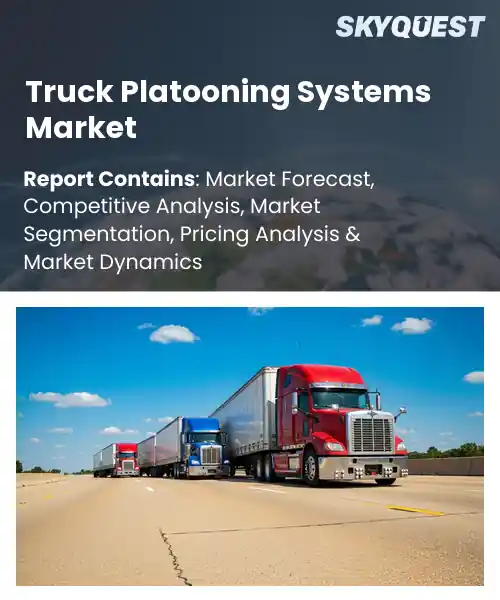
Truck Platooning Systems Market
Report ID: SQMIG25A2807
Report ID: SQMIG25A2807
[email protected]
USA +1 351-333-4748
Report ID:
SQMIG25A2807 |
Region:
Global |
Published Date: July, 2026
Pages:
157
|Tables:
139
|Figures:
78


Global Truck Platooning Systems Market size was valued at USD 3.52 Billion in 2024 and is poised to grow from USD 3.95 Billion in 2025 to USD 9.85 Billion by 2033, growing at a CAGR of 12.12% during the forecast period (2026-2033).
High demand for fuel-efficient freight transportation, increasing adoption of connected and autonomous vehicle technologies, stringent emission regulations, rising logistics automation, and advancements in vehicle-to-vehicle communication are driving sales of truck platooning systems.
Growing need to reduce transportation costs and improve fleet efficiency, coupled with increasing adoption of connected mobility technologies, is expected to primarily drive truck platooning systems market growth. The rising implementation of truck platooning systems in long haul freight transport and logistics fleets is fueling the market growth. Growing spending on autonomous driving systems, vehicle-to-vehicle communications, 5G connectivity, and intelligent transport systems is further driving the market. Constant improvements in cooperative driving technology, fleet management systems, AI driving assistance, and fuel-saving technology are enhancing the operational efficiency and safety of driving on the roads. Additionally, the growing involvement of governments in favor of connected transport and green logistics is creating growth opportunities for the market around the world.
On the contrary, high implementation costs, inadequate connected road infrastructure, cybersecurity concerns, regulatory uncertainty, and limited interoperability between vehicle platforms are anticipated to slow down truck platooning systems market penetration in the future.
How is AI and IoT Driving Efficiency In Truck Platooning Systems?
AI and IoT technologies are contributing significantly to the development of truck platooning systems by allowing trucks to operate in formation efficiently and safely. The sensors constantly monitor speed, distance, road conditions, and performance of vehicles. The AI technology uses such information for instant adjustments in acceleration, braking, and steering. The Internet of Things technology allows every truck to interact with the leading truck and fleet management software, increasing efficiency, reducing fuel usage and emission levels.
Market snapshot - (2026-2033)
Global Market Size
USD 3.52 Billion
Largest Segment
Fastest Growth
Growth Rate
12.12% CAGR
To get more insights on this market click here to Request a Free Sample Report
Global truck platooning systems market is segmented by technology, connectivity, truck type, application, end-user, and region. Based on technology, the market is segmented into fully automated platooning and partially automated. Based on connectivity, the market is segmented into V2V (Vehicle-to-Vehicle) and V2I (Vehicle-to-Infrastructure). Based on truck type, the market is segmented into heavy-duty trucks and medium-duty trucks. Based on application, the market is segmented into long-haul freight and port/logistics hubs. Based on end-user, the market is segmented into fleet operators and logistics companies. Based on region, the market is segmented into North America, Europe, Asia Pacific, Latin America, and Middle East & Africa.
The fully automated platooning segment is predicted to lead the global truck platooning systems market revenue generation over the coming years. It removes human latency and makes it possible to have accurate inter-vehicle spacing and acceleration synchronization. This allows for efficient fuel utilization and improved safety standards, which are the goals of the industry. Advanced technologies like sensors and artificial intelligence are incorporated by companies into a strong control system, which gives confidence to fleet owners. As a result, funds are allocated for fully autonomous truck platoons.
However, partially automated segment is witnessing the strongest growth momentum as per this truck platooning systems industry analysis, since it provides a realistic way out for fleets to employ platooning without requiring autonomy. Gradual enhancement of sensors and assistance technologies will ensure that costs become low enough to make adoption faster. Rapid adoption increases the reach of the market and creates use-case scenarios.
The V2V connectivity segment is forecasted to account for the highest global truck platooning systems market share going forward. This technology is responsible for providing the critical real-time data transmission necessary for the synchronization of the platoon movements. Vehicle-to-vehicle communication makes it possible for quick coordination of brakes, speeds, and gaps to be achieved and thus solving the major safety issues that have been preventing their adoption. Automakers install short-range communication technologies within vehicles, which creates a solid base for efficient operation.
Meanwhile, V2I connectivity emerges as the key high‑growth subsegment because smart infrastructure integration will help to enable predictive routing of vehicles as well as road grade optimization for platoons. With emerging government-led IoT corridors and real-time road sensor data feed, trucks can change their speed to save fuel and eliminate congestion, hence market penetration.
To get detailed segments analysis, Request a Free Sample Report
Advanced research ecosystems, robust freight corridors, and proactive policy frameworks that encourage cooperative vehicle technologies help North America lead adoption of truck platooning systems. Collaboration between car manufacturers, technology companies, and logistics providers leads to fast implementation and testing of platooning ideas. The region is favored by the abundance of highways that are suitable for communication systems, and this makes it possible to conduct practical tests and implementations. Moreover, spending on high-definition sensors and vehicle-to-infrastructure communication adds to fleet owners’ trust. Furthermore, legislation concerning safety and liability helps reduce barriers to adoption. In addition, the availability of large universities and test tracks creates a favorable environment for innovation and training.
Truck platooning systems market in United States benefits from a network of interstate highways that support high‑speed coordinated travel. Industry leaders leverage extensive R&D capabilities and capital ecosystems to advance sensor integration and autonomous driving algorithms. Collaborative pilots between carriers and technology firms demonstrate tangible fuel savings and safety improvements, fostering wider acceptance among logistics decision makers. Ongoing dialogue with regulators ensures that standards evolve in step with technological progress.
Demand for truck platooning systems in Canada is shaped by an emphasis on sustainability and freight efficiency. Collaborative efforts by transport organizations in various provinces together with truck manufacturers concentrate on standardizing communications to be compatible with those used by neighboring countries such as the United States. The vast network of roads in the country under varying climatic conditions can be utilized to test adaptive platooning technology.
Ambitious environmental targets combined with a cohesive regulatory environment that encourages collaborative vehicle technologies are creating new opportunities. EU member governments have integrated platooning incentives into their overall decarbonization strategy, thus laying an excellent foundation for investments. Well-connected international highways facilitate cross-border activities and make platooning appealing to logistics companies in search of cost savings. Well-established scientific and research institutes in key nations offer advanced sensor fusion and connectivity technologies, while industry associations promote the standardization of communication protocols. The public financing system enables extensive pilot programs to prove the economic and safety advantages of platooning, thus increasing the confidence of fleet managers. EU efforts to adopt the same vehicle-to-infrastructure communication standards to minimize technical issues, allowing the implementation of viable systems in several countries at once. The collaboration of testing grounds placed at the strategic borderlines boosts confidence on both sides.
Truck platooning system adoption in Germany is anchored by a robust automotive engineering base and proactive federal transportation policies. Leading manufacturers collaborate with technology firms to integrate high-precision lidar and V2X communication into commercial fleets. National corridors linking major industrial hubs serve as testbeds for large-scale platooning demonstrations that highlight fuel efficiency and emissions reduction. Incentive programs and standardized regulatory frameworks promote swift adoption among logistics providers seeking competitive advantage.
Truck platooning systems market in United Kingdom is experiencing accelerated growth driven by ambitious carbon‑neutral road transport objectives. Government road‑to‑vehicle initiatives support the rollout of dedicated platooning lanes on motorways, encouraging commercial trials. Partnerships between leading logistics firms and autonomous technology startups focus on integrating AI‑based convoy management systems that enhance safety and operational efficiency. Funding schemes aimed at SMEs stimulate innovation, while collaboration with neighboring markets broadens market potential.
Truck platooning systems demand in France is emerging as a focal point for sustainable freight initiatives supported by green logistics programs. Cooperative R&D laboratories help coordinate the efforts of automotive engineers and telecommunication service providers to design interoperable V2V communications systems that suit the nature of French highways. Corridors between ports and industrial areas become trial routes for energy-efficient convoy movements. Frameworks for incentives and campaigns for awareness foster market confidence.
Advanced manufacturing capabilities, strategic infrastructure investments, and supportive policy environments that prioritize intelligent transport solutions drive sustained demand for truck platooning systems. Advanced economies are allocating funds for high-definition sensors and vehicular-to-infrastructure communication systems that will allow for convoy operation in diverse conditions. Increased density of urban freight corridors and rising demand from e-commerce form an ideal business case for efficient fuel utilization through platooning. Joint ventures of car companies and tech startups are speeding up the research on algorithms that would be applicable in local driving environments. Road safety programs undertaken by governments encourage the use of platooning technology to cut down traffic and pollution, thus increasing industry adoption of the technology. All these factors put Asia Pacific in the position of the emerging center for next-generation truck platooning technologies.
Truck platooning systems market in Japan is driven by an emphasis on automation and engineering within its automotive sector. National research institutes partner with truck manufacturers to integrate lidar and adaptive cruise control tailored to Japan’s mountainous and urban routes. Government initiatives promote the creation of platooning test lanes on major expressways, facilitating validation. Incentive schemes encourage logistics firms to adopt convoy technologies that promise reduced fuel consumption and emissions.
Truck platooning system demand in South Korea benefits from an electronics industry that supplies communication modules for vehicle networking. Collaborations between car manufacturers and technology companies aim at designing V2X systems that suit the country’s highway infrastructure. Road safety strategies adopted by the government favor platooning as a way of enhancing vehicle flow and reducing carbon emission levels, thus encouraging trucking companies to embrace the concept. Financial assistance during trials speeds up the process to commercialization.
To know more about the market opportunities by region and country, click here to
Buy The Complete Report
Enhanced Fuel Efficiency Benefits
Regulatory Support Accelerates Integration
High Initial Investment Costs
Cybersecurity Concerns Limit Trust
Request Free Customization of this report to help us to meet your business objectives.
The competitive landscape is shaped by intense rivalry among technology‑focused firms leveraging strategic M&A, cross‑industry partnerships, and rapid tech innovation to capture market share in autonomous freight. Companies are racing to integrate advanced V2V communication, AI‑driven convoy control, and battery‑electric powertrains, with collaborations such as OEM‑software alliances and acquisitions of niche sensor startups accelerating deployment of scalable platooning solutions.
SkyQuest’s ABIRAW (Advanced Business Intelligence, Research & Analysis Wing) is our Business Information Services team that Collects, Collates, Correlates, and Analyses the Data collected by means of Primary Exploratory Research backed by robust Secondary Desk research.
As per SkyQuest analysis, increasing adoption of connected and autonomous vehicle technologies, stringent emission regulations, and rising logistics automation are anticipated to drive the demand for truck platooning systems going forward. However, high implementation costs and inadequate connected road infrastructure are slated to slow down the adoption of truck platooning systems in the future. North America is slated to spearhead the demand for truck platooning systems owing to strong investments in autonomous transportation technologies, advanced highway infrastructure, supportive regulatory initiatives, and the presence of leading commercial vehicle and technology companies. AI-powered vehicle coordination and IoT-enabled fleet connectivity are anticipated to be key trends driving the truck platooning systems industry across the study period.
| Report Metric | Details |
|---|---|
| Market size value in 2024 | USD 3.52 Billion |
| Market size value in 2033 | USD 9.85 Billion |
| Growth Rate | 12.12% |
| Base year | 2024 |
| Forecast period | (2026-2033) |
| Forecast Unit (Value) | USD Billion |
| Segments covered |
|
| Regions covered | North America (US, Canada), Europe (Germany, France, United Kingdom, Italy, Spain, Rest of Europe), Asia Pacific (China, India, Japan, Rest of Asia-Pacific), Latin America (Brazil, Rest of Latin America), Middle East & Africa (South Africa, GCC Countries, Rest of MEA) |
| Companies covered |
|
| Customization scope | Free report customization with purchase. Customization includes:-
|
To get a free trial access to our platform which is a one stop solution for all your data requirements for quicker decision making. This platform allows you to compare markets, competitors who are prominent in the market, and mega trends that are influencing the dynamics in the market. Also, get access to detailed SkyQuest exclusive matrix.
Table Of Content
Executive Summary
Market overview
Parent Market Analysis
Market overview
Market size
KEY MARKET INSIGHTS
COVID IMPACT
MARKET DYNAMICS & OUTLOOK
Market Size by Region
KEY COMPANY PROFILES
Methodology
For the Truck Platooning Systems Market, our research methodology involved a mixture of primary and secondary data sources. Key steps involved in the research process are listed below:
1. Information Procurement: This stage involved the procurement of Market data or related information via primary and secondary sources. The various secondary sources used included various company websites, annual reports, trade databases, and paid databases such as Hoover's, Bloomberg Business, Factiva, and Avention. Our team did 45 primary interactions Globally which included several stakeholders such as manufacturers, customers, key opinion leaders, etc. Overall, information procurement was one of the most extensive stages in our research process.
2. Information Analysis: This step involved triangulation of data through bottom-up and top-down approaches to estimate and validate the total size and future estimate of the Truck Platooning Systems Market.
3. Report Formulation: The final step entailed the placement of data points in appropriate Market spaces in an attempt to deduce viable conclusions.
4. Validation & Publishing: Validation is the most important step in the process. Validation & re-validation via an intricately designed process helped us finalize data points to be used for final calculations. The final Market estimates and forecasts were then aligned and sent to our panel of industry experts for validation of data. Once the validation was done the report was sent to our Quality Assurance team to ensure adherence to style guides, consistency & design.
Analyst Support
Customization Options
With the given market data, our dedicated team of analysts can offer you the following customization options are available for the Truck Platooning Systems Market:
Product Analysis: Product matrix, which offers a detailed comparison of the product portfolio of companies.
Regional Analysis: Further analysis of the Truck Platooning Systems Market for additional countries.
Competitive Analysis: Detailed analysis and profiling of additional Market players & comparative analysis of competitive products.
Go to Market Strategy: Find the high-growth channels to invest your marketing efforts and increase your customer base.
Innovation Mapping: Identify racial solutions and innovation, connected to deep ecosystems of innovators, start-ups, academics, and strategic partners.
Category Intelligence: Customized intelligence that is relevant to their supply Markets will enable them to make smarter sourcing decisions and improve their category management.
Public Company Transcript Analysis: To improve the investment performance by generating new alpha and making better-informed decisions.
Social Media Listening: To analyze the conversations and trends happening not just around your brand, but around your industry as a whole, and use those insights to make better Marketing decisions.
REQUEST FOR SAMPLE
 REQUEST FREE CUSTOMIZATION
Global Truck Platooning Systems Market size was valued at USD 3.52 Billion in 2024 and is poised to grow from USD 3.95 Billion in 2025 to USD 9.85 Billion by 2033, growing at a CAGR of 12.12% during the forecast period (2026-2033).
The competitive landscape is shaped by intense rivalry among technology‑focused firms leveraging strategic M&A, cross‑industry partnerships, and rapid tech innovation to capture market share in autonomous freight. Companies are racing to integrate advanced V2V communication, AI‑driven convoy control, and battery‑electric powertrains, with collaborations such as OEM‑software alliances and acquisitions of niche sensor startups accelerating deployment of scalable platooning solutions. 'Peloton Technology', 'Volvo Group (SARTRE)', 'Daimler Truck AG', 'DAF Trucks (PACCAR)', 'Scania AB (Volkswagen)', 'MAN Truck & Bus', 'TuSimple Holdings', 'Plus.ai', 'Waymo Via', 'Aurora Innovation', 'Kodiak Robotics', 'Embark Trucks', 'Locomation', 'Continental AG', 'Robert Bosch GmbH', 'Aptiv plc', 'NVIDIA Corporation (Drive)', 'HERE Technologies', 'HERE WeGo', 'PACCAR Inc.'
Manufacturers and fleet operators recognize that platooning allows trucks to travel closely together, reducing aerodynamic drag and consequently lowering fuel consumption. This operational advantage translates into significant cost savings over long hauls, encouraging companies to replace conventional fleets with platoon‑capable vehicles. The perceived environmental benefit further aligns with corporate sustainability goals, reinforcing strategic decisions to invest in the technology. As a result, demand for integrated platooning systems grows, propelling market expansion and stimulating broader adoption across diverse logistics networks globally.
Regulatory Alignment Accelerating Adoption: Governments across major corridors are harmonizing policies to support cooperative driving, creating a unified framework that reduces legal ambiguity for fleet operators. By standardizing vehicle classification, data sharing protocols, and liability guidelines, regulators enable smoother cross‑border deployments and foster confidence among manufacturers and logistics firms. This regulatory convergence is prompting early pilots to scale, as companies anticipate fewer compliance hurdles and smoother integration of platooning technologies into existing transport networks and contribute to broader sustainability targets across the industry globally.
Why does North America Dominate the Global Truck Platooning Systems Market? |@12


Want to customize this report? This report can be personalized according to your needs. Our analysts and industry experts will work directly with you to understand your requirements and provide you with customized data in a short amount of time. We offer $1000 worth of FREE customization at the time of purchase.
Feedback From Our Clients


 USA (+1) 351-333-4748

