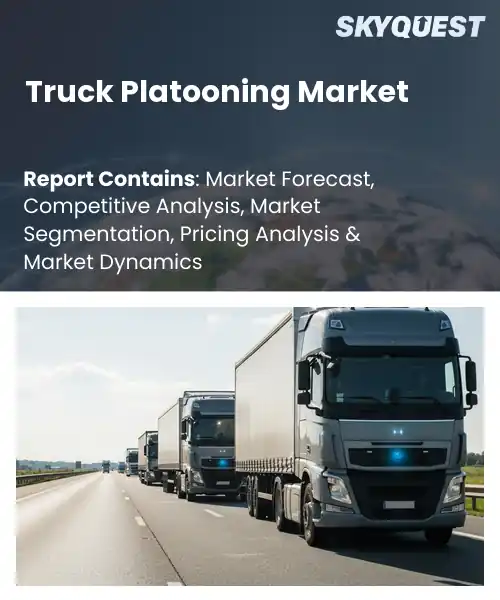
Truck Platooning Market
Report ID: SQMIG25A2849
Report ID: SQMIG25A2849
[email protected]
USA +1 351-333-4748
Report ID:
SQMIG25A2849 |
Region:
Global |
Published Date: July, 2026
Pages:
157
|Tables:
171
|Figures:
79


Global Truck Platooning Market size was valued at USD 1.4 Billion in 2024 and is poised to grow from USD 1.63 Billion in 2025 to USD 5.53 Billion by 2033, growing at a CAGR of 16.5% during the forecast period (2026-2033).
The international market for truck platooning is based on a system in which a lead truck will send its signals of acceleration, deceleration, and steering to other trucks in line behind it to keep them spaced. The driving force behind this is the aim to reduce fuel use and CO2 emissions in long haul logistics, where small increases in efficiency mean big savings on an annual basis. Following some tests, the European Union introduced a legal mandate for cruise control in 2015. Test programs in Sweden, the United States, and China showed a potential for up to 15 % fuel savings, inspiring car manufacturers like Volvo and Scania to make their models compatible with platoons.
Based on this premise of efficiency, one of the most crucial factors driving the growth of the market is the synchronization of incentives for regulation and V2X communication to ensure coordination of platoons. The governments of European countries as well as those in the United States provide incentives like tax credits and dedicated lanes that drive the carriers to adopt technology upgrades that will help them benefit from it. At the same time, the implementation of 5G makes sure that the delays in messages are limited to only a few milliseconds and helps in achieving convoys and integration, reducing the cost of each truck and enticing shippers who seek openings.
How is AI and IoT Integration Advancing Safety and Efficiency in the Truck Platooning Market?
Integration of AI and Internet of Things (IoT) in truck platooning is revolutionizing the world market for truck platoons as far as safety, fuel economy, and fleet management are concerned. The use of AI in adaptive driving involves real-time analysis of traffic conditions, road conditions, and car movement to facilitate optimal acceleration, braking, and steering. On the other hand, V2V communication in the Internet of Things ensures that all the vehicles move in unison and maintain optimaldistance from each other. Predictive maintenance, facilitated by artificial intelligence and sensor technology in IoT, helps predict equipment failure even before it happens, thus avoiding costs of downtime and repairs. Fleet management in real time helps in route optimization and cargo tracking. The use of AI in autonomous operation ensures lane change and obstacle avoidance and facilitates emergency braking.
Market snapshot - (2026-2033)
Global Market Size
USD 1.4 Billion
Largest Segment
Driver-Assisted Platooning
Fastest Growth
Autonomous Platooning
Growth Rate
16.5% CAGR
To get more insights on this market click here to Request a Free Sample Report
Global truck platooning market is segmented by platooning type, communication technology, platoon size, propulsion type, component, end user and region. Based on platooning type, the market is segmented into Driver-Assisted Platooning and Autonomous Platooning. Based on communication technology, the market is segmented into Vehicle-to-Vehicle (V2V) and Vehicle-to-Everything (V2X). Based on platoon size, the market is segmented into Two-Truck Platoon and Multi-Truck Platoon (Three or More Trucks). Based on propulsion type, the market is segmented into Diesel Trucks, Natural Gas Trucks, Electric Trucks and Hydrogen Fuel Cell Trucks. Based on component, the market is segmented into Hardware, Software and Services. Based on end user, the market is segmented into Fleet Operators, Logistics & Transportation Companies, Mining & Construction Companies, Government & Defense Organizations and Others. Based on region, the market is segmented into North America, Europe, Asia Pacific, Latin America and Middle East & Africa.
The segment of Driver Assisted Platooning is the largest one due to the utilization of the experience of the drivers and introduction of automation. Such a combination makes deployment of platooning technology easier for operators. It does not go beyond regulatory compliance and lowers investment risks. As a result, fleet operators are motivated to start testing platooning solutions. In such a way, it becomes possible to build trust between people and technology, train employees faster, and earn money sooner. Therefore, Driver Assisted Platooning is seen as the main reason for market traction.
Despite that, the fastest-growing segment is the one of Autonomous Platooning due to the progress in the field of AI perception and edge computing. It helps to overcome the problems that have been significant before. Due to the development of sensors and open standards, confidence of early adopters grows and creates new opportunities for profitability.
The Vehicle to Everything (V2E) segment leads due to its offering a single communication architecture that facilitates integration of trucks with infrastructure, pedestrians, and cloud services to facilitate real-time communication for enhanced safety and coordination. The benefits of reduced latency, predictive maintenance, and compliance with new traffic regulations as a result of this comprehensive connectivity make this segment the most viable option for operators looking for a solution that is both scalable and future proof due to the potential for exchanging information through heterogeneous networks.
On the other hand, the Vehicle to Vehicle (V2V) segment enjoys the highest growth due to new capabilities in low latency direct messaging that can help create tight convoys and reduce fuel consumption. Automakers are incorporating DSRC in their new models, and logistics companies are testing out dense platoons.
To get detailed segments analysis, Request a Free Sample Report
The advanced position of Europe in regard to truck platooning can be attributed to several factors such as visionary regulatory frameworks, experienced manufacturing of vehicles, and efficient logistics industry with an inclination towards sustainable practices. Regulators in various major markets in Europe have developed regulations that not only encourage automation of convoy systems but also guarantee their safety, thus establishing a conducive environment for investments. Existing manufacturers apply their experience in electric vehicles manufacturing and installation of sensors to introduce platooning technologies in new vehicles. Research clusters and collaborations between governments and businesses speed up the process of testing on intercontinental highways and demonstrate the positive impact on freight companies. Additionally, the existence of high-speed highways in Europe provides conditions for effective coordination between convoys and communication between them, adding to the status of Europe as a test ground of platoon technology.
The Truck Platooning Market in Germany receives impetus through the presence of a well-knit network of research institutes, manufacturing facilities, and favorable policies that foster the adoption of automation in transport. The partnership among the Original Equipment Manufacturers and the logistics players expedite testing of the technologies, while financial incentives help roll out pilots along important routes. Germany has thus created a dynamic ecosystem for platooning in Europe in the long run.
The Truck Platooning Market in the United Kingdom is based on well-developed highway infrastructure and a regulatory environment which promotes cooperative transportation solutions. The government cooperates with IT companies to conduct convoy tests on the country’s main motorways, with special attention being paid to safety and emission savings. Universities provide sophisticated simulation technologies, while logistics providers use platooning to enhance their routes.
Truck Platooning Market in France benefits from strong commitment on the part of the government towards de-carbonizing the transport system and an extensive automotive supply chain. The national policies emphasize the use of interconnected platoons on autoroutes that foster collaboration and information exchange between truck owners. Research labs work together with the fleet of companies to fine-tune sensor fusion and communication techniques, whereas the incentives help retrofit the existing trucks.
The North American environment for truck platooning is driven by the synergy between favorable regulatory guidance, significant investments in the industry, and a logistics system prioritizing speed and cost-effectiveness. The governmental and regional bodies have established guidelines ensuring safe mixed traffic platooning trials, thus creating an environment conducive for commercial deployment. Major manufacturers collaborate with technology firms to integrate state-of-the-artdriver assistance systems and vehicle-to-vehicle communication into newly developed trucks, while the major carriers see platooning as an instrument for reducing the amount of fuel used and preventing driver fatigue. Road infrastructure suppliers are working on enhancing their roads with connectivity options, and cross-border projects between the countries adjacent to help to enable smooth platooning operations on important freight corridors. Collaboration between universities and startups ensures faster development of algorithms and real-time data processing.
Truck Platooning Market in the United States flourishes in an innovative technological ecosystem consisting of innovative technology providers, huge transport companies, and inter-state highways prepared for handling large amounts of traffic. The federal government advocates collaboration and testing, and the state organizations invest in the creation of special lanes and communication networks. Automakers implement platooning technology in their range of trucks, whereas the research consortiums concentrate on autonomous decision-making.
Market for Truck Platooning in Canada is driven by robust cross-border trade, reduction of greenhouse gases, and cooperation between the government and industries through pilot projects. National standards focus on interoperability, and thus convoying will be seamless on national and international roads. Canadian research institutions bring in their skills in sensor integration and operation in low temperature environments, while logistics companies see the benefits of platooning in improving reliability during long-distance transport.
Asia Pacific is increasingly taking the lead in the implementation of truck platooning owing to several factors such as innovation in technology, government policies and incentives, and sustainability in transportation. The region makes huge investments in artificial intelligence and high precision sensors, thus making vehicle-to-vehicle coordination possible. Governments promote the implementation of platooning systems in highly congested areas and on long-distance highways to combine efficiency and sustainability goals. Cooperation of automobile companies, telecommunication companies, and logistics firms leads to the development of platforms capable of data exchange. Besides, the region's trade agreements help in implementing truck platooning across borders and sharing knowledge gained from one country in another.
Truck Platooning in Japan is driven by high levels of technological development, collaboration in research and development, and an overarching national agenda to alleviate congestion. The government issues well-defined policies that facilitate the testing of fleet platoons on highways, and car manufacturers introduce perception systems into commercial vehicles. Academic institutions develop state-of-the-art algorithms for platooning control, and logistics firms incorporate platooning technology to increase the accuracy of deliveries in congested urban centers.
South Korean Truck Platooning Market is greatly supported by governmental initiatives that promote intelligent transportation and reduced emissions. The leading car manufacturers equip their vehicles with lidar sensors and V2X communication modules mounted on the top of advanced platform vehicles. Telecommunication companies provide specific infrastructure for reliable data exchange. Pilot projects performed on logistics tracks showcase great results, thus making more freight operators adopt such solutions. Universities pay special attention to artificial intelligence-based decision-making systems.
To know more about the market opportunities by region and country, click here to
Buy The Complete Report
Policy Support Accelerating Deployment
With the advent of holistic policy initiatives, clear direction and financial inducements ensure that manufacturers and logistics companies incorporate platooning systems into their business models. With the elimination of regulatory uncertainties through policies, a predictable atmosphere is created, which builds confidence among investors. Through methods like tax breaks and subsidies, along with creation of lanes, obstacles are removed from the way, thus making adoption quicker. This results in market adoption being accelerated by stakeholders aligning themselves with government policies.
Adopting Connected Vehicle Technology
With the introduction of advanced communication technology in vehicles, the use of platooning becomes very efficient in terms of performance and makes a very good choice for management. The data flow ensures efficient distance maintenance, synchronization of accelerating and braking, as well as adaptation to traffic situations. Technological interaction helps save fuel and driver energy, which compensates for any difficulties in its application. As companies become aware of the above benefits, they start developing platforms and thus build important market dynamics.
Regulatory Uncertainty Hindering Implementation
The ambiguities present in the legal framework led to uncertainty among fleet owners that may not want to risk facing penalties for non-compliance. Differences in requirements and standards between the different states make it difficult to conduct cross-border operations since more administrative work will be involved, which makes it harder to scale up the use of platooning. Furthermore, there is no clear guidance concerning safety certification, privacy of data, and automation, thus deterring potential investors from investing due to unclear laws.
High Initial Investment Costs
The high cost of implementing technology retrofits and buying new technology serves as a monetary barrier for most transport businesses. Initial costs for buying equipment, software, and training may prove costly for most small and medium-sized businesses. The benefits of long-term ROI are not certain as no sufficient data has been collected in this regard. Hence, transport businesses are likely to delay implementation by adopting a gradual implementation approach, which is likely to slow down the development of platooning systems in developing countries around the globe.
Request Free Customization of this report to help us to meet your business objectives.
The competitive structure within the international truck platooning market is defined by technological innovation and cooperation. In 2023, for example, Daimler Trucks worked with Bosch on V2V communication technology modules, while Volvo Group included ZF control systems in its 2022 models. The purchase of Plus in 2021 by Paccar has enhanced the latter’s autonomous platooning technology.
Autonomous Coordination Scaling: The evolution of sensor fusion, high-definition maps, and inter-vehicle communication technology is helping trucks platoon at greater distances and in an adaptive fashion without the need for constant human supervision. The industry is integrating higher levels of autonomy where trucks can join and leave platoons easily, minimizing spacing and maximizing traffic flow. This autonomous coordination will help decrease fuel use, increase safety, and promote wide deployment on different highway systems, making platooning an integral part of future freight transportation.
Data‑Driven Fleet Optimization: The advent of big data analysis and artificial intelligence-based systems is revolutionizing the way platooning is managed by fleet managers. Telematics, predictive maintenance, and demand forecasting techniques can facilitate the scheduling of convoys in a dynamic manner, allowing for effective management of fuel consumption and preventing any unnecessary delays. The incorporation of such systems into logistics operations ensures that cargo loads, driver schedules, and routes can be aligned in an efficient manner, maximizing asset usage.
SkyQuest’s ABIRAW (Advanced Business Intelligence, Research & Analysis Wing) is our Business Information Services team that Collects, Collates, Correlates, and Analyses the Data collected by means of Primary Exploratory Research backed by robust Secondary Desk research.
As per SkyQuest analysis, the global market for truck platooning is driven mainly by favorable policies which provide tax breaks, incentives and dedicated lanes in order to motivate players to implement convoy system, as well as the swift implementation of connected vehicle technologies, particularly V2X communications, which act as another driver by improving safety, fuel efficiency and coordination. Europe turns out to be the dominant region due to uniform policies and high level of automotive technology, and driver-assisted platooning becomes the dominating segment because it combines drivers' abilities with partial automation. However, uncertain policies remain the main obstacle for further development of the market.
| Report Metric | Details |
|---|---|
| Market size value in 2024 | USD 1.4 Billion |
| Market size value in 2033 | USD 5.53 Billion |
| Growth Rate | 16.5% |
| Base year | 2024 |
| Forecast period | (2026-2033) |
| Forecast Unit (Value) | USD Billion |
| Segments covered |
|
| Regions covered | North America (US, Canada), Europe (Germany, France, United Kingdom, Italy, Spain, Rest of Europe), Asia Pacific (China, India, Japan, Rest of Asia-Pacific), Latin America (Brazil, Rest of Latin America), Middle East & Africa (South Africa, GCC Countries, Rest of MEA) |
| Companies covered |
|
| Customization scope | Free report customization with purchase. Customization includes:-
|
To get a free trial access to our platform which is a one stop solution for all your data requirements for quicker decision making. This platform allows you to compare markets, competitors who are prominent in the market, and mega trends that are influencing the dynamics in the market. Also, get access to detailed SkyQuest exclusive matrix.
Table Of Content
Executive Summary
Market overview
Parent Market Analysis
Market overview
Market size
KEY MARKET INSIGHTS
COVID IMPACT
MARKET DYNAMICS & OUTLOOK
Market Size by Region
KEY COMPANY PROFILES
Methodology
For the Truck Platooning Market, our research methodology involved a mixture of primary and secondary data sources. Key steps involved in the research process are listed below:
1. Information Procurement: This stage involved the procurement of Market data or related information via primary and secondary sources. The various secondary sources used included various company websites, annual reports, trade databases, and paid databases such as Hoover's, Bloomberg Business, Factiva, and Avention. Our team did 45 primary interactions Globally which included several stakeholders such as manufacturers, customers, key opinion leaders, etc. Overall, information procurement was one of the most extensive stages in our research process.
2. Information Analysis: This step involved triangulation of data through bottom-up and top-down approaches to estimate and validate the total size and future estimate of the Truck Platooning Market.
3. Report Formulation: The final step entailed the placement of data points in appropriate Market spaces in an attempt to deduce viable conclusions.
4. Validation & Publishing: Validation is the most important step in the process. Validation & re-validation via an intricately designed process helped us finalize data points to be used for final calculations. The final Market estimates and forecasts were then aligned and sent to our panel of industry experts for validation of data. Once the validation was done the report was sent to our Quality Assurance team to ensure adherence to style guides, consistency & design.
Analyst Support
Customization Options
With the given market data, our dedicated team of analysts can offer you the following customization options are available for the Truck Platooning Market:
Product Analysis: Product matrix, which offers a detailed comparison of the product portfolio of companies.
Regional Analysis: Further analysis of the Truck Platooning Market for additional countries.
Competitive Analysis: Detailed analysis and profiling of additional Market players & comparative analysis of competitive products.
Go to Market Strategy: Find the high-growth channels to invest your marketing efforts and increase your customer base.
Innovation Mapping: Identify racial solutions and innovation, connected to deep ecosystems of innovators, start-ups, academics, and strategic partners.
Category Intelligence: Customized intelligence that is relevant to their supply Markets will enable them to make smarter sourcing decisions and improve their category management.
Public Company Transcript Analysis: To improve the investment performance by generating new alpha and making better-informed decisions.
Social Media Listening: To analyze the conversations and trends happening not just around your brand, but around your industry as a whole, and use those insights to make better Marketing decisions.
REQUEST FOR SAMPLE
 REQUEST FREE CUSTOMIZATION
Global Truck Platooning Market size was valued at USD 1.4 Billion in 2024 and is poised to grow from USD 1.63 Billion in 2025 to USD 5.53 Billion by 2033, growing at a CAGR of 16.5% during the forecast period (2026-2033).
Competitive dynamics in the global truck platooning market are driven by rapid technology adoption and strategic collaborations. Daimler Trucks partnered with Bosch in 2023 to co‑develop V2V communication modules, while Volvo Group integrated ZF’s advanced control systems into its 2022 model line. Paccar’s acquisition of Plus in 2021 accelerated its autonomous platooning capabilities, intensifying rivalry among OEMs to secure early market share. 'Daimler Truck AG', 'AB Volvo', 'PACCAR Inc', 'Volkswagen Group', 'Hyundai Motor Company', 'Scania AB', 'MAN Truck & Bus SE', 'Iveco Group N V', 'Isuzu Motors Limited', 'Hino Motors Ltd', 'Tata Motors Limited', 'Dongfeng Motor Corporation', 'Peloton Technology Inc', 'PlusAI Inc', 'TuSimple Holdings Inc', 'Knorr-Bremse AG', 'Robert Bosch GmbH', 'ZF Friedrichshafen AG', 'Wabco Holdings Inc', 'Continental AG'
The emergence of comprehensive policy frameworks provides clear guidance and financial incentives that encourage manufacturers and logistics firms to integrate platooning technologies. By reducing regulatory ambiguity, these policies create a predictable environment that fosters investment confidence. Support mechanisms such as tax credits, subsidies, and dedicated lanes lower operational barriers, enabling faster adoption across freight corridors. Consequently, the market experiences accelerated deployment as stakeholders align their strategies with supportive governmental agendas, driving sustained growth and expanding the ecosystem of collaborative vehicle operations.
Autonomous Coordination Scaling: Advances in sensor fusion, high‑definition mapping, and vehicle‑to‑vehicle communication are enabling trucks to operate in larger, more flexible platoons without constant human oversight. Manufacturers are embedding higher‑level autonomous functions that allow seamless joining and leaving of convoys, reducing gaps and improving road capacity. This scaling of autonomous coordination lowers fuel consumption, enhances safety margins, and supports broader adoption across diverse highway networks, positioning platooning as a cornerstone of next‑generation freight mobility for carriers seeking efficiency and reliability across all routes.
Why does Europe Dominate the Global Truck Platooning Market? |@12


Want to customize this report? This report can be personalized according to your needs. Our analysts and industry experts will work directly with you to understand your requirements and provide you with customized data in a short amount of time. We offer $1000 worth of FREE customization at the time of purchase.
Feedback From Our Clients


 USA (+1) 351-333-4748

