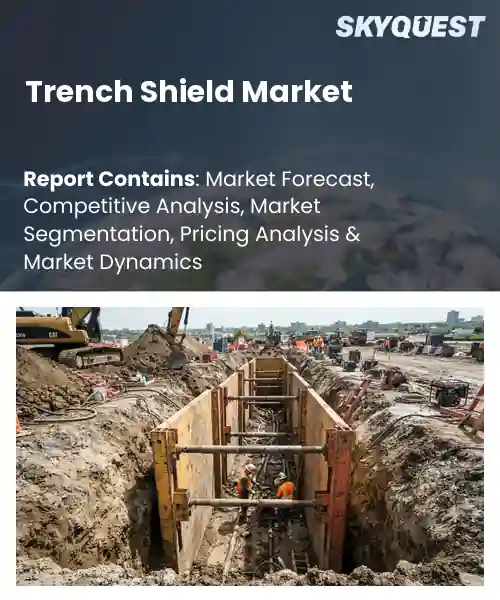
Trench Shield Market
Report ID: SQMIG20B2319
Report ID: SQMIG20B2319
[email protected]
USA +1 351-333-4748
Report ID:
SQMIG20B2319 |
Region:
Global |
Published Date: August, 2026
Pages:
157
|Tables:
117
|Figures:
77


Global Trench Shield Market size was valued at USD 689.0 Million in 2024 and is poised to grow from USD 731.03 Million in 2025 to USD 1173.98 Million by 2033, growing at a CAGR of 6.1% during the forecast period (2026-2033).
The trench shield market supplies metal composite panels used to safeguard workers during underground utility installation. Its importance stems from heightened safety regulations and the rising cost of labor accidents, which push contractors to adopt shielding solutions. Historically, the market emerged in the 2000s as cities expanded subway networks and required safer excavation methods. Over the past decade, adoption accelerated in North America and Europe, driven by projects such as the London Crossrail and the Los Angeles Metro expansion, which demonstrated reductions in injury rates and schedule delays. Consequently, demand for shields has become a crucial metric for project viability. Building on this foundational demand, the principal growth driver for the global trench shield market is the expansion of renewable‑energy infrastructure, which requires underground cabling and pipe networks. As governments incentivize wind‑farm and solar‑park projects, contractors must tunnel beneath sensitive terrains, prompting adoption of shields that reduce collapse risk and accelerate installation timelines. For example, the wind developments off Denmark’s coast have integrated modular shield systems, cutting excavation time by 30 percent and lowering project costs. This cause‑and‑effect dynamic fuels investment in materials such as aluminum‑alloy composites, creating opportunities for manufacturers to capture market share while delivering safer, more efficient solutions.
How is AI-driven automation impacting efficiency and safety in the trench shield market?
AI‑driven automation is reshaping trench shield operations by embedding sensors, real‑time data analytics and predictive algorithms into shield systems. These technologies continuously monitor ground pressure, worker proximity and equipment status, allowing instant adjustments that prevent collapses and streamline setup. Operators benefit from reduced manual inspections, faster cycle times and higher confidence in safety protocols. The integration of machine‑learning models also enables maintenance teams to anticipate component wear, cutting downtime and extending product life. As projects demand tighter schedules and stricter safety standards, AI automation becomes a core differentiator that boosts overall efficiency while safeguarding crews on site.April 2025, National Trench Safety partnered with MGF, a move that introduces AI‑enabled monitoring to its shield offerings, improving response times and reducing accidents, thereby supporting market growth through enhanced safety and operational efficiency.
Market snapshot - (2026-2033)
Global Market Size
USD 689.0 Million
Largest Segment
Steel
Fastest Growth
Aluminum
Growth Rate
6.1% CAGR
To get more insights on this market click here to Request a Free Sample Report
Global trench shield market is segmented by material, product type, application, end user and region. Based on material, the market is segmented into Steel and Aluminum. Based on product type, the market is segmented into Single Wall, Double Wall and Modular Shields. Based on application, the market is segmented into Utility Installation, Pipeline Construction, Road Construction and General Excavation. Based on end user, the market is segmented into Construction Contractors, Utility Companies and Municipal Authorities. Based on region, the market is segmented into North America, Europe, Asia Pacific, Latin America and Middle East & Africa.
Steel segment dominates because its unmatched strength and durability meet the rigorous safety standards demanded by trench excavation projects, ensuring collapse resistance and long service life. The material’s proven performance under heavy loads fosters confidence among contractors dealing with deep utility installations and road construction, leading to widespread preference over alternative alloys. Furthermore, its compatibility with a range of shield designs simplifies inventory management and reduces fabrication complexity, reinforcing its market leadership.
However, aluminum segment is witnessing the fastest growth as manufacturers capitalize on its lightweight nature to create easier handling and quicker installation cycles. Its resistance to corrosion expands applicability in moist soil environments, prompting utility firms to adopt it for long term projects and prompting innovative modular designs that further accelerate market expansion.
Modular shields segment stands out because its flexible configuration enables rapid adaptation to varied trench widths and depths, reducing changeover times on complex utility routes. This adaptability lowers labor costs and minimizes downtime, delivering tangible efficiency gains for contractors handling multi phase projects where speed and precision are paramount. Integration with prefabricated support systems further streamlines deployment, making modular solutions attractive for large scale infrastructure undertakings where operational efficiency is critical.
Meanwhile, double wall segment emerges as the fastest expanding area because its enhanced structural rigidity offers superior protection against ground pressures, appealing to pipeline construction firms seeking additional safety margins. Growing regulatory emphasis on worker protection fuels demand for this sturdier construction, prompting manufacturers to invest in advanced fabrication techniques that broaden market opportunities.
To get detailed segments analysis, Request a Free Sample Report
North America dominates the global Trench Shield Market due to a convergence of advanced engineering capabilities, rigorous safety regulations, and a deep infrastructure pipeline. The United States and Canada host a network of seasoned manufacturers that invest heavily in research and development, delivering high‑performance shielding solutions tailored to diverse project requirements. Strong construction activity across transportation, utilities, and commercial sectors sustains steady demand, while stringent occupational health standards compel early adoption of protective systems. Integrated supply chains and proximity to major project hubs enable rapid deployment and after‑sales support, reinforcing market leadership. Collaborative industry‑academic partnerships further accelerate material innovations, ensuring that North American providers remain at the forefront of safety technology.
United States Trench Shield Market
Trench Shield Market benefits from a mature construction ecosystem that emphasizes safety compliance and innovative engineering solutions. Domestic manufacturers leverage sophisticated production capabilities to deliver high‑performance shielding products. The presence of large‑scale infrastructure programs drives consistent demand, while collaborative research initiatives accelerate material enhancements. End‑users value the reliability of locally sourced products, fostering strong supplier‑buyer relationships that reinforce market stability and growth prospects across multiple sectors and support long‑term resilience.
Canada Trench Shield Market
Trench Shield Market in Canada is shaped by stringent occupational health regulations that prioritize worker protection in excavation activities. Local producers emphasize sustainable manufacturing practices, aligning with national environmental goals. Collaborative networks among engineering firms and equipment suppliers enable rapid adoption of advanced shielding technologies. The market benefits from a steady pipeline of public and private construction initiatives, encouraging continuous investment in high‑quality trench protection solutions for diverse project types.
Europe’s rapid expansion in the Trench Shield Market stems from tight regulatory frameworks, a strong sustainability agenda, and a culture of engineering excellence. The bloc’s emphasis on worker protection drives mandatory use of advanced shielding in both legacy upgrades and new construction. National initiatives promoting green building practices encourage adoption of lightweight, recyclable trench solutions, while collaborative research hubs across the continent accelerate material breakthroughs. Access to integrated transportation networks and a diversified construction base creates resilient demand across residential, industrial, and infrastructural projects. Together, these elements position Europe as a dynamic hub where safety, innovation, and environmental responsibility intersect to fuel market growth.
Germany Trench Shield Market
Trench Shield Market in Germany benefits from a well‑established engineering tradition that stresses precision and safety. Domestic manufacturers integrate cutting‑edge materials science to enhance durability and reduce installation time. Robust construction codes compel consistent use of protective shielding, especially in urban redevelopment projects. Collaborative research clusters involving universities and industry accelerate product innovation, while a strong export orientation elevates Germany reputation for high‑quality trench protection solutions in global markets today.
United Kingdom Trench Shield Market
Trench Shield Market in United Kingdom experiences rapid adoption driven by ambitious infrastructure agendas and heightened focus on worker safety. Leading firms blend British design expertise with innovative polymer technologies to produce lightweight yet robust shields. The regulatory environment mandates trench protection, encouraging early integration in project planning. Growing collaboration between academic research centers and construction consortia fuels improvement, positioning United Kingdom as a hub for next‑generation trench safety solutions.
France Trench Shield Market
Trench Shield Market in France is emerging as sustainability and urban renewal initiatives drive demand for safe excavation practices. French manufacturers prioritize eco‑friendly materials and modular designs that align with green construction policies. Collaborative platforms linking architects, contractors, and material suppliers facilitate diffusion of shielding concepts. Although market size remains modest, the emphasis on regulatory compliance and pilot projects positions France as a platform for growth in trench protection technologies.
Asia Pacific is strengthening its position in the Trench Shield Market through a combination of rapid urbanization, government‑backed infrastructure programs, and growing awareness of occupational safety. Nations such as Japan and South Korea invest heavily in modern construction technologies, integrating smart monitoring and high‑strength materials into trench protection. The region’s competitive manufacturing landscape emphasizes cost‑effective production without compromising quality, enabling broader adoption across diverse project scales. Strong collaboration between local universities and equipment firms fosters continuous improvement, while export‑focused strategies expand the influence of Asian shielding solutions into neighboring markets. These dynamics collectively enhance Asia Pacific’s role as an emerging leader in trench safety.
Japan Trench Shield Market
Trench Shield Market in Japan leverages a legacy of precision engineering and a safety culture to deliver sophisticated shielding products. Domestic firms combine high‑grade steel alloys with innovative polymer composites, achieving superior durability and ease of installation. Government‑driven infrastructure renewal projects stress adherence to excavation safety protocols, driving demand. Partnerships between research institutes and manufacturers accelerate development of smart‑sensor integrated shields, positioning Japan as a benchmark for trench protection solutions.
South Korea Trench Shield Market
Trench Shield Market in South Korea reflects rapid construction growth paired with a strong focus on worker safety. Local manufacturers combine high‑strength steel and lightweight composites to create effective shields that satisfy stringent performance requirements. Government incentives for smart‑city and infrastructure projects mandate advanced excavation protection, boosting adoption. Collaboration between universities, technology firms, and construction companies refines sensor‑enabled shielding systems, positioning South Korea as a hub for trench safety innovation.
To know more about the market opportunities by region and country, click here to
Buy The Complete Report
Increasing Demand for Protective Infrastructure
Adoption of Sustainable Construction Practices
High Initial Capital Investment
Complex Installation and Maintenance Requirements
Request Free Customization of this report to help us to meet your business objectives.
The trench shield market is shaped by intense competition as manufacturers pursue strategic M&A to broaden product portfolios, forge partnerships with construction firms to secure supply contracts, and accelerate tech innovation through integration of lightweight composites and IoT‑enabled monitoring. Recent joint ventures between equipment makers and infrastructure developers illustrate how collaboration is driving faster deployment of advanced trench protection solutions.
Top Player’s Company Profile
Recent Developments
SkyQuest’s ABIRAW (Advanced Business Intelligence, Research & Analysis Wing) is our Business Information Services team that Collects, Collates, Correlates, and Analyses the Data collected by means of Primary Exploratory Research backed by robust Secondary Desk research. As per SkyQuest analysis, the global trench shield market is being propelled primarily by the growing demand for protective infrastructure driven by stricter safety regulations, while a second important catalyst is the shift toward sustainable construction practices that favor recyclable, lightweight materials. The market’s pace is tempered by the high initial capital investment required for advanced shield systems, which can deter smaller contractors. North America remains the dominant region thanks to its robust engineering base, extensive infrastructure pipelines and stringent occupational standards. Within the market, steel‑based shields continue to command the largest share because of their proven strength and durability, even as aluminum gains momentum.
| Report Metric | Details |
|---|---|
| Market size value in 2024 | USD 689.0 Million |
| Market size value in 2033 | USD 1173.98 Million |
| Growth Rate | 6.1% |
| Base year | 2024 |
| Forecast period | (2026-2033) |
| Forecast Unit (Value) | USD Million |
| Segments covered |
|
| Regions covered | North America (US, Canada), Europe (Germany, France, United Kingdom, Italy, Spain, Rest of Europe), Asia Pacific (China, India, Japan, Rest of Asia-Pacific), Latin America (Brazil, Rest of Latin America), Middle East & Africa (South Africa, GCC Countries, Rest of MEA) |
| Companies covered |
|
| Customization scope | Free report customization with purchase. Customization includes:-
|
To get a free trial access to our platform which is a one stop solution for all your data requirements for quicker decision making. This platform allows you to compare markets, competitors who are prominent in the market, and mega trends that are influencing the dynamics in the market. Also, get access to detailed SkyQuest exclusive matrix.
Table Of Content
Executive Summary
Market overview
Parent Market Analysis
Market overview
Market size
KEY MARKET INSIGHTS
COVID IMPACT
MARKET DYNAMICS & OUTLOOK
Market Size by Region
KEY COMPANY PROFILES
Methodology
For the Trench Shield Market, our research methodology involved a mixture of primary and secondary data sources. Key steps involved in the research process are listed below:
1. Information Procurement: This stage involved the procurement of Market data or related information via primary and secondary sources. The various secondary sources used included various company websites, annual reports, trade databases, and paid databases such as Hoover's, Bloomberg Business, Factiva, and Avention. Our team did 45 primary interactions Globally which included several stakeholders such as manufacturers, customers, key opinion leaders, etc. Overall, information procurement was one of the most extensive stages in our research process.
2. Information Analysis: This step involved triangulation of data through bottom-up and top-down approaches to estimate and validate the total size and future estimate of the Trench Shield Market.
3. Report Formulation: The final step entailed the placement of data points in appropriate Market spaces in an attempt to deduce viable conclusions.
4. Validation & Publishing: Validation is the most important step in the process. Validation & re-validation via an intricately designed process helped us finalize data points to be used for final calculations. The final Market estimates and forecasts were then aligned and sent to our panel of industry experts for validation of data. Once the validation was done the report was sent to our Quality Assurance team to ensure adherence to style guides, consistency & design.
Analyst Support
Customization Options
With the given market data, our dedicated team of analysts can offer you the following customization options are available for the Trench Shield Market:
Product Analysis: Product matrix, which offers a detailed comparison of the product portfolio of companies.
Regional Analysis: Further analysis of the Trench Shield Market for additional countries.
Competitive Analysis: Detailed analysis and profiling of additional Market players & comparative analysis of competitive products.
Go to Market Strategy: Find the high-growth channels to invest your marketing efforts and increase your customer base.
Innovation Mapping: Identify racial solutions and innovation, connected to deep ecosystems of innovators, start-ups, academics, and strategic partners.
Category Intelligence: Customized intelligence that is relevant to their supply Markets will enable them to make smarter sourcing decisions and improve their category management.
Public Company Transcript Analysis: To improve the investment performance by generating new alpha and making better-informed decisions.
Social Media Listening: To analyze the conversations and trends happening not just around your brand, but around your industry as a whole, and use those insights to make better Marketing decisions.
REQUEST FOR SAMPLE
 REQUEST FREE CUSTOMIZATION


Want to customize this report? This report can be personalized according to your needs. Our analysts and industry experts will work directly with you to understand your requirements and provide you with customized data in a short amount of time. We offer $1000 worth of FREE customization at the time of purchase.
Feedback From Our Clients


 USA (+1) 351-333-4748

