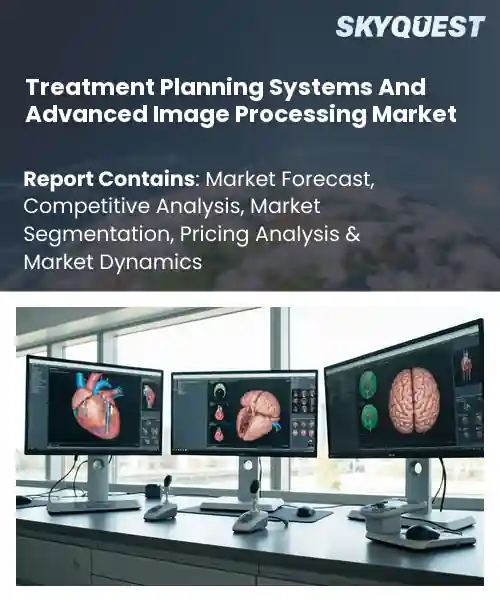
Treatment Planning Systems And Advanced Image Processing Market
Report ID: SQMIG35G2395
Report ID: SQMIG35G2395
[email protected]
USA +1 351-333-4748
Report ID:
SQMIG35G2395 |
Region:
Global |
Published Date: May, 2026
Pages:
157
|Tables:
143
|Figures:
73


Global Treatment Planning Systems And Advanced Image Processing Market size was valued at USD 1.82 Billion in 2024 and is poised to grow from USD 2.01 Billion in 2025 to USD 4.52 Billion by 2033, growing at a CAGR of 10.62% during the forecast period (2026-2033).
Global treatment planning systems and advanced image processing market includes software and calculation tools that will help accurately deliver radiotherapy, merge diagnostic images, and guide interventions. The major driver for this treatment planning systems and advanced image processing market growth is the shift to precision oncology combined with the growth in cancer rates; this causes providers to have to improve tumor targeting, while limiting damage to normal tissue. The market started with manual planning with sketches, and then moved to computer-assisted dose calculations in '80's, and 3D conformal techniques in the '90's, and now using AI accelerated adaptive platforms for CT, MRI, and PET images for real time decision making. This evolution is important because it improves the quality and efficiency of treatment. The major factor driving the growth of the market is the growing adoption of AI and cloud work streams that allow data to be turned into actionable decisions on a more reliable basis.
As Machine Learning continues to automate the segmentation process and optimise the distribution of the doses of radiation, planners are able to spend less effort on the routine portion of their work which helps facilitate adaptive radiotherapy before and after the patient has received therapy from the radiologist, thus enabling him to treat patients based on what he sees, as opposed to historical landmarks for the patient's body. This increased efficiency in the delivery of treatment results in increased capacity at hospitals and supports the trend toward remote planning services for clinics, thus creating an increased demand for cloud licensing and an integration with linear accelerators from the market. Examples of real use cases in this area include AI auto contouring for head and neck cancer, and PET based dose escalation for lung tumors, both of which produce substantial clinical benefit and demonstrable commercial upside.
How is AI Transforming the Treatment Planning Systems and Advanced Image Processing Market?
The incorporation of AI into treatment planning systems and advanced image processing is changing these two domains by automating repetitive activities and increasing image quality. These advancements include contour segmentation driven by AI, decreasing the amount of time needed to manually contour a patient; and intelligent planning generation, which increases speed of replanning for adaptive therapies. There is a strong demand from the market for AI integration into clinical workflows, to reduce variance, decrease the workload of the planner, and allow the clinician to concentrate on making more complex treatment decisions. Examples include the use of AI-empowered, cloud-based image reconstruction platforms for reduced turnaround times and online adaptive therapies, leading to a more consistent and accessible delivery of advanced therapies to a variety of patients.
Siemens Healthineers announced the CE mark for AI contouring integration with Eclipse treatment planning systems in May 2026. This showcases how AI can eliminate repetitive manual tasks and improve contouring consistency, thereby expediting treatment planning and allowing for the broader implementation of effective treatment workflows.
Market snapshot - 2026-2033
Global Market Size
USD 1.82 Billion
Largest Segment
Radiation Therapy Planning Systems
Fastest Growth
Image Processing Software
Growth Rate
10.62% CAGR
To get more insights on this market click here to Request a Free Sample Report
Global treatment planning systems and advanced image processing market is segmented by product type, technology, application, end-user, deployment and region. Based on product type, the market is segmented into Radiation Therapy Planning Systems, Surgical Planning Software and Image Processing Software. Based on technology, the market is segmented into AI-Powered, Cloud-Based and Conventional. Based on application, the market is segmented into Radiation Oncology, Neurosurgery and Orthopedic Surgery. Based on end-user, the market is segmented into Hospitals, Cancer Centers and Radiology Clinics. Based on deployment, the market is segmented into On-Premise and Cloud. Based on region, the market is segmented into North America, Europe, Asia Pacific, Latin America and Middle East & Africa.
As per global treatment planning systems and advanced image processing market analysis, the Radiation Therapy Planning Systems segment has the largest market share due to the reliance on established workflows within the field, specifically with regards to dose calculation, organ sparing, and adaptive planning capabilities that are core components of all radiation oncology practices. When combined with deep integration between the radiation therapy planning and delivery systems, validated dose calculations, and proven adherence to previous clinical use of these systems, hospitals and clinics can reduce uncertainty in cancer treatment (patient’s pathway) thus prompting them to make significant investments in these comprehensive planning platforms for coordinated planning and case review between all oncology teams and disciplines.
As per global treatment planning systems and advanced image processing market forecast, the Image Processing Software segment is emerging as the fastest growing segment as a result of advancements in automated segmentation technologies and multimodal fusion processes creating new clinical applications. Additionally, improved interoperability and modular integrations facilitate analysis across multiple platforms and clinical departments, ultimately leading to increased adoption of these platforms across numerous clinical departments and creating new service and partnership opportunities thereby extending the overall market for these systems.
As per global treatment planning systems and advanced image processing market outlook, AI-powered segment has dominant position due to machine learning and deep learning algorithms that provide predictive analytics and automation which dramatically improve consistency in contouring and optimize the delivery of radiation doses for complex cases. Continuous improvement of the underlying algorithms through clinical feedback loops reduces human variability to develop faster clinically acceptable contours and significantly decrease the time taken to prepare plans. Vendor investments in verified data and regulatory processes to obtain approval to use AI tools, build clinician's trust and encourage the integration of AI tools into existing planning processes and SOPs.
On the other hand, the emergence of cloud-based technologies are providing the fastest growth for technology solutions because of lowered barriers to deployment provided through the scalable infrastructure of cloud-based solutions, as well as the ability to leverage remote collaboration within the cloud-based architecture. Cloud-based solutions enable continuous updates of existing models and greater availability of more robust datasets for model improvement, while also providing opportunities for collaboration across multiple sites and subscription delivery, creating partnerships within an ecosystem of providers to accelerate adoption of advanced planning capabilities and increase market access to advanced planning capabilities.
To get detailed segments analysis, Request a Free Sample Report
As per global treatment planning systems and advanced image processing market regional analysis, the convergence of cutting-edge clinical infrastructure, an abundance of vendor presence, and ongoing capital infusion into oncology technologies have led to North America being the global leader in the market. The mature healthcare ecosystem provides for the rapid uptake of advanced treatment planning, image processing solutions and algorithms due to established regulatory and reimbursement pathways that enable commercialization of this new technology. Academic institutions, teaching hospitals and technology providers form collaborative networks to speed up the validation of, and enhancement of, these technologies. North America has extensive venture and corporate financing, experienced clinicians, and a focus on interoperability and data integration, and all of this work together to strengthen North America's ability to continuously innovate throughout the care continuum. Due to North America's maturity, many strategic partnerships have developed that lead to localized implementations, customised implementations of complex cancer pathways, and translational research to decrease the time from algorithm development to deployment in the clinical setting. Additionally, ongoing patient advocacy, and an ongoing demand for precision therapy will maintain a continued need to sustain funding and adoption rates.
There is a range of stakeholders involved in the Treatment Planning Systems And Advanced Image Processing Market in the US. These include academic medical centres, specialist cancer centres, technology vendors, etc. Together these groups work towards clinical validation and workflow integration. The demand from clinicians for precision radiotherapy and multimodality imaging continues to stimulate the implementation of sophisticated planning platforms. The continued presence of regulatory clarity, coupled with capital access for product enhancement, establishes an environment conducive to rapid design evolution; which is supported by established channels of commercialisation that allow institutions to utilise and incorporate the latest products into their standard clinical work-up.
Treatment Planning Systems And Advanced Image Processing Market in Canada will continue to be shaped by its publicly funded healthcare system and its provincial procurement policies. This will favour scalable, interoperable solutions over proprietary systems. As such, the academic hospitals and regional cancer centres will continue to provide venues for testing new planning tools and analytic tools. Collaborative Purchasing Consortia and Vendor relationships will continue to facilitate the deployment of these new technologies across the respective populations and continue to be a focus of clinician education and telehealth workflow design.
As per global treatment planning systems and advanced image processing market regional outlook, the expeditious expansion of Europe is largely due to the coordinated public health investment in healthcare innovation; expanding research capabilities of academics and growing interest in precision oncology, with an emphasis on advanced digitized methods of imaging for the planning of treatments. The uniformity of regulations across all countries and initiatives that foster digital health adoption will lower the barriers to entry or use across different Wise versa allowing vendor scale clinical validation efforts or commercialise across their own jurisdictions. The increased collaboration of technology providers and leading national cancer centres will help accelerate the development of bringing ‘research’ to clinical setting. The recent implementation of centralizing procurement practices in some markets will help ensure scale to deployment by allowing for broader access to sophisticated planning tools within the basic oncology model through the clinician's involvement /training in the use of those tools. The presence of start-up ecosystems throughout Europe and funding support from within Europe will help foster cross-border pilot activity and assist in the development of new vendor innovations. The level of clinician advocacy within every market place will further advance maturity of each market through evidence-based methodology.
The Treatment Planning Systems And Advanced Image Processing Market in Germany is supported by an extensive network of university hospitals, specialized cancer treatment centers, and a robust domestic medtech industry that values engineering excellence. Statutory health insurance systems, coupled with clear clinical paths, aid in supporting the uptake of advanced treatment planning solutions. Collaborative relationships between R&D organizations and industry partners speed up the clinical validation process, while established procurement channels and physician advocacy allow widespread integration across complex hospital workflows.
The United Kingdom Treatment Planning Systems And Advanced Image Processing Market drive by the National Health Service’s initiatives, innovation hubs, and a large cluster of academic oncology centers that test new treatment planning technologies. Flexible procurement mechanisms and health technology assessment frameworks help facilitate clinical trials and scaling of advanced solutions. Startup and established vendor collaboration with key clinical networks helps accelerate deployment, while emphasis on interoperability and clinician training supports integration across care delivery settings.
In France, the treatment planning system and advanced imaging market is boosted by a number of factors including the implementation of national digital health strategy, research hospitals creating an abundance of new ideas to be translated into practice, and strategic partnerships with technology start-ups. Cancer treatment centers, university/hospitals and community hospitals are typically involved in piloting advanced TPS & imaging solutions. Local language solutions, education/training for clinicians, and aligning with national health care protocol to support scale up and integration into/among public/private cancer treatment delivery paths are significant support structure for these solutions as well.
Through investing in infrastructure for imaging, expanding the number of specialty cancer centres in the region, and increasing domestic technology vendors that support existing global partnerships, Asia Pacific is gaining momentum in its role as a leader. In addition, policy initiatives that support digital health and clinical trials have improved how local markets can validate and adopt new technologies. There is an emerging trend within market dynamics of integrating artificial intelligence and automation into planning workflow processes to help meet this increase in clinical demand. In addition to facilitating the transfer of research into practice through cross-border collaboration, targeted clinician training and increased venture funding activities, research is being translated into clinical practice through numerous other efforts. In several locations, regulatory frameworks are changing to allow for clinical clearance and promote the development of innovative solutions in local markets. The creation of domestic manufacturing facilities will reduce the time and effort required to implement advanced oncology planning technologies by lowering the barriers to entry. The use of telemedicine-enabled workflows and centralised referral networks will expand access to advanced specialist planning services to underserved communities and create opportunities for the widespread adoption of advanced clinical planning and imaging technology. Innovative commercial models and locally supported commercial structures are accelerating adoption in diverse healthcare environments.
Due to Japan's established Medtech market, there is a growing connection between manufacturers of equipment & clinical sites while investments made into Imaging Infrastructure have helped also promote the development and widespread acceptance of Advanced Image Processing technologies. Since several large university hospitals serve as Centers of Excellence for validating complex planning workflows and utilizing Image Analytics; emphasis on Patient Safety & Quality along with active research related to Artificial Intelligence has established the foundation for widespread use of advanced planning solutions in all Care Environments.
As a result of South Korea's advanced healthcare infrastructure; strong support from the government for Digital Health Innovations —as well an ecosystem composed solely of start-up companies specializing in AI applications/technologies within medical technology industry; leading-edge hospitals and specialized cancer care centers have developed collaborative relationships with key industry partners to pilot & validate new planning solutions/techniques around advanced image processing technologies. An emphasis placed on conducting rapid clinical validation, achieving interoperability among various hospital/health system platforms and driving exportable innovation has spurred the development of additional new planning solutions as well facilitating regional collaboration through domestic deployment alone.
To know more about the market opportunities by region and country, click here to
Buy The Complete Report
Integration With Imaging Modalities
The use of advanced treatment planning systems that integrate CT, MRI and PET imaging allows clinicians to visualize tumor anatomy and physiology in a single workflow, thus enhancing the accuracy of delineation and dose calculation. The interoperability of these systems enables clinicians to perform manual data transfer less frequently and enhance collaboration between the multidisciplinary teams of radiation oncology and radiology by allowing both teams to evaluate treatment plans consistently and make decisions faster. The implementation of image fusion and standardization of data formats in these systems aids in promoting clinical acceptance through the improved usability of the systems and their perceived value in providing individualized, image guided treatment methods.
AI Enabled Workflow Optimization
Regulatory Approval Complexity
Regulatory requirements for software used in clinical decision-making are strict and change over time; this creates major obstacles for entering the market, as well as increasing the amount of time to make it available. It also places a large burden of validation, documentation, and continual market surveillance on developers. The need to demonstrate safety and efficacy across a range of clinical conditions increases the complexity of the development process and diverts attention from innovation to compliance activities. Small and medium-sized vendors may face an unequal burden in meeting these standards; this can reduce competition, slow product entry into the marketplace, and slow advanced planning and image processing technologies from being implemented in clinical practice.
Complex Implementation and Training
Request Free Customization of this report to help us to meet your business objectives.
Rapid technological advances related to AI have been causing consolidation within the imaging and therapy sectors. Businesses will continue looking for M&A or strategic partnership opportunities due to this competition. For example, Siemens Healthineers completed its Varian acquisition in April 2021, while Brainlab acquired a controlling interest in medPhoton in May 2022. Vendors are differentiating from their competitors with increased functionality in AI-based automated segmentation of tissue types, cloud-based treatment planning, and device-to-device interoperability, thereby maintaining their installed equipment base.
Recent Developments in the Treatment Planning Systems and Advanced Image Processing Market
SkyQuest’s ABIRAW (Advanced Business Intelligence, Research & Analysis Wing) is our Business Information Services team that Collects, Collates, Correlates, and Analyses the Data collected by means of Primary Exploratory Research backed by robust Secondary Desk research
As per SkyQuest analysis, the global treatment planning systems and advanced image processing market is propelled by AI-driven automation that accelerates segmentation and adaptive replanning as one key driver, while regulatory approval complexity is a notable restraint. The dominating region is North America and the dominating segment is Radiation Therapy Planning Systems. A second driver is growing adoption of cloud-based collaboration and integration with CT, MRI and PET that enables remote planning and scalable deployments, supporting faster innovation and broader clinical access. Vendors must balance rapid technology integration with validation, training and efforts to ensure equitable access across diverse care settings.
| Report Metric | Details |
|---|---|
| Market size value in 2024 | USD 1.82 Billion |
| Market size value in 2033 | USD 4.52 Billion |
| Growth Rate | 10.62% |
| Base year | 2024 |
| Forecast period | 2026-2033 |
| Forecast Unit (Value) | USD Billion |
| Segments covered |
|
| Regions covered | North America (US, Canada), Europe (Germany, France, United Kingdom, Italy, Spain, Rest of Europe), Asia Pacific (China, India, Japan, Rest of Asia-Pacific), Latin America (Brazil, Rest of Latin America), Middle East & Africa (South Africa, GCC Countries, Rest of MEA) |
| Companies covered |
|
| Customization scope | Free report customization with purchase. Customization includes:-
|
To get a free trial access to our platform which is a one stop solution for all your data requirements for quicker decision making. This platform allows you to compare markets, competitors who are prominent in the market, and mega trends that are influencing the dynamics in the market. Also, get access to detailed SkyQuest exclusive matrix.
Table Of Content
Executive Summary
Market overview
Parent Market Analysis
Market overview
Market size
KEY MARKET INSIGHTS
COVID IMPACT
MARKET DYNAMICS & OUTLOOK
Market Size by Region
KEY COMPANY PROFILES
Methodology
For the Treatment Planning Systems And Advanced Image Processing Market, our research methodology involved a mixture of primary and secondary data sources. Key steps involved in the research process are listed below:
1. Information Procurement: This stage involved the procurement of Market data or related information via primary and secondary sources. The various secondary sources used included various company websites, annual reports, trade databases, and paid databases such as Hoover's, Bloomberg Business, Factiva, and Avention. Our team did 45 primary interactions Globally which included several stakeholders such as manufacturers, customers, key opinion leaders, etc. Overall, information procurement was one of the most extensive stages in our research process.
2. Information Analysis: This step involved triangulation of data through bottom-up and top-down approaches to estimate and validate the total size and future estimate of the Treatment Planning Systems And Advanced Image Processing Market.
3. Report Formulation: The final step entailed the placement of data points in appropriate Market spaces in an attempt to deduce viable conclusions.
4. Validation & Publishing: Validation is the most important step in the process. Validation & re-validation via an intricately designed process helped us finalize data points to be used for final calculations. The final Market estimates and forecasts were then aligned and sent to our panel of industry experts for validation of data. Once the validation was done the report was sent to our Quality Assurance team to ensure adherence to style guides, consistency & design.
Analyst Support
Customization Options
With the given market data, our dedicated team of analysts can offer you the following customization options are available for the Treatment Planning Systems And Advanced Image Processing Market:
Product Analysis: Product matrix, which offers a detailed comparison of the product portfolio of companies.
Regional Analysis: Further analysis of the Treatment Planning Systems And Advanced Image Processing Market for additional countries.
Competitive Analysis: Detailed analysis and profiling of additional Market players & comparative analysis of competitive products.
Go to Market Strategy: Find the high-growth channels to invest your marketing efforts and increase your customer base.
Innovation Mapping: Identify racial solutions and innovation, connected to deep ecosystems of innovators, start-ups, academics, and strategic partners.
Category Intelligence: Customized intelligence that is relevant to their supply Markets will enable them to make smarter sourcing decisions and improve their category management.
Public Company Transcript Analysis: To improve the investment performance by generating new alpha and making better-informed decisions.
Social Media Listening: To analyze the conversations and trends happening not just around your brand, but around your industry as a whole, and use those insights to make better Marketing decisions.
REQUEST FOR SAMPLE
 REQUEST FREE CUSTOMIZATION
Global Treatment Planning Systems And Advanced Image Processing Market size was valued at USD 1.82 Billion in 2024 and is poised to grow from USD 2.01 Billion in 2025 to USD 4.52 Billion by 2033, growing at a CAGR of 10.62% during the forecast period (2026-2033).
Competition in treatment planning and advanced image processing is driven by consolidation and rapid AI adoption, forcing firms to pursue M&A and strategic partnerships. Examples include Siemens Healthineers completing the Varian acquisition in April 2021 and Brainlab acquiring a majority stake in medPhoton in May 2022. Vendors are differentiating via AI auto segmentation, cloud planning, and tighter device integration to protect installed bases. 'Varian Medical Systems (Siemens)', 'Elekta AB', 'RaySearch Laboratories', 'Brainlab AG', 'ViewRay Inc.', 'Accuray Inc.', 'Philips Healthcare', 'Siemens Healthineers', 'Mim Software Inc.', 'Limbus AI', 'RK Merdian (RaySearch)', 'IBA Dosimetry', 'Mirada Medical (Canon)', 'Medivision', 'Oncology Systems Ltd.'
Advanced treatment planning systems that integrate seamlessly with CT, MRI, and PET imaging enable clinicians to visualize tumor anatomy and physiology within a unified workflow, improving confidence in delineation and dose calculations. This interoperability reduces manual data transfer and streamlines multidisciplinary collaboration between radiology and radiation oncology teams, facilitating more consistent plan evaluation and faster decision making. By supporting image fusion and standardized data formats, these integrated solutions drive clinical adoption through enhanced usability and perceived value in delivering patient specific, image guided treatment approaches.
Ai Native Clinical Workflows: AI driven algorithms are increasingly embedded into treatment planning and image processing to streamline decision making, reduce variability, and enhance clinical confidence. These systems prioritize interoperability with existing imaging modalities and oncology information systems, enabling automated contouring, dose optimization suggestions, and image enhancement. Clinicians benefit from augmented workflows that surface clinically relevant options while preserving human oversight. Adoption stems from demand for consistency, faster planning cycles, and better communication across teams, positioning AI as central enabler of patient centric care.
Why does North America Dominate the Global Treatment Planning Systems And Advanced Image Processing Market? |@12


Want to customize this report? This report can be personalized according to your needs. Our analysts and industry experts will work directly with you to understand your requirements and provide you with customized data in a short amount of time. We offer $1000 worth of FREE customization at the time of purchase.
Feedback From Our Clients


 USA (+1) 351-333-4748

