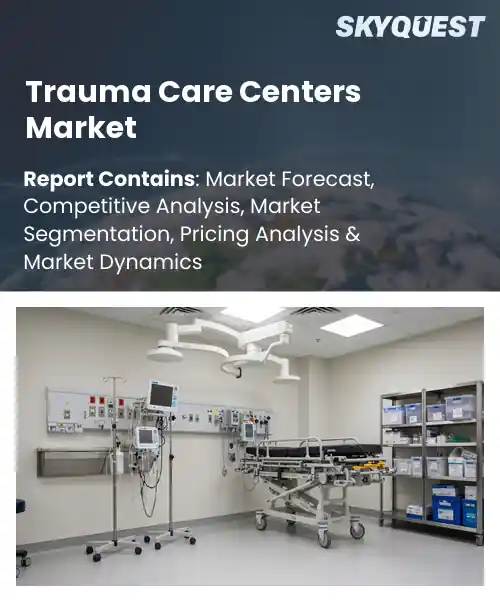
Trauma Care Centers Market
Report ID: SQMIG35E2085
Report ID: SQMIG35E2085
[email protected]
USA +1 351-333-4748
Report ID:
SQMIG35E2085 |
Region:
Global |
Published Date: June, 2026
Pages:
157
|Tables:
181
|Figures:
79


Global Trauma Care Centers Market size was valued at USD 15.4 Billion in 2024 and is poised to grow from USD 16.45 Billion in 2025 to USD 27.84 Billion by 2033, growing at a CAGR of 6.8% during the forecast period (2026-2033).
The primary driver of the global trauma care centers market is growing burden of time-sensitive injuries combined with system-level reforms that prioritize rapid, specialized treatment. Trauma care centers are organized hospital facilities with multidisciplinary teams and protocols for acute injury management, and they matter because timely intervention reduces mortality and long-term disability. Over decades the field evolved from ad hoc emergency departments to verified trauma systems, exemplified by the American College of Surgeons verification program and European trauma networks.
Technological advances such as whole-body CT and damage-control surgery became standard, while demographic shifts and urbanization continue to raise case volumes. When investments strengthen ambulance dispatch, on-scene triage and data-sharing, transfers become faster and outcomes improve, prompting payers and governments to fund additional centers. Telemedicine and registry-driven quality programs create opportunities for rural coverage and performance benchmarking; for example, the US National Trauma Data Bank enabled protocol refinements that reduced complications, while teleneurology and regional hub models in Australia and Brazil demonstrate scalable use cases that attract capital.
How is AI improving patient outcomes in trauma care centers?
In trauma centers, Artificial Intelligence (AI) enhances patient outcome through quicker diagnosis, enabling better triaging of patients, and facilitating coordination of treatments between various teams. AI plays an important role in this process through automated interpretation of imaging, prioritizing cases in real time, and providing clinical decision support. The use of clinical decision support allows physicians to concentrate on the patients that are most ill. The current application of AI in the emergency department and trauma unit provides evidence of increased use of AI for workflow and imaging as previously distinct vendor platforms begin to integrate their image analysis algorithms into radiology systems and care coordination systems.
The largest driver of demand for AI in the market comes from health systems that are trying to find tools that can eliminate delays and allow for the most efficient transfer of patients from one facility to another. Examples of AI flagging patients requiring urgent intervention due to an intracranial hemorrhage or pulmonary embolism help to eliminate diagnostic bottleneck due to time-consuming manual image analysis.
GE HealthCare in February 2026 increased collaboration with BARDA to create an AI powered point-of-care ultrasound system that aids in assessing trauma and responding to mass casualty incidents. This example of AI highlighted how the use of AI reduced operator dependency and improved diagnostic decision making in situations where physicians work under extreme pressure. The creation of this technology supports increased market growth by creating more scalable trauma imaging and creating opportunities for accelerated clinical actions across many different care delivery locations.
Market snapshot - (2026-2033)
Global Market Size
USD 15.4 Billion
Largest Segment
Level I Trauma Centers
Fastest Growth
Level III Trauma Centers
Growth Rate
6.8% CAGR
To get more insights on this market click here to Request a Free Sample Report
Global trauma care centers market is segmented by center type, ownership, service type, patient type, injury type, end user and region. Based on center type, the market is segmented into Level I Trauma Centers, Level II Trauma Centers, Level III Trauma Centers, Level IV Trauma Centers and Level V Trauma Centers. Based on ownership, the market is segmented into Public Trauma Centers, Private Trauma Centers and Non-Profit Trauma Centers. Based on service type, the market is segmented into Emergency Trauma Care, Surgical Trauma Care, Orthopedic Trauma Care, Neurotrauma Care, Rehabilitation Services, Critical Care Services and Others. Based on patient type, the market is segmented into Adult Trauma Care, Pediatric Trauma Care and Geriatric Trauma Care. Based on injury type, the market is segmented into Road Accident Injuries, Falls & Fractures, Sports Injuries, Violence & Penetrating Injuries, Burn Injuries and Others. Based on end user, the market is segmented into Hospitals, Ambulatory Surgical Centers, Specialized Trauma Centers and Rehabilitation Centers. Based on region, the market is segmented into North America, Europe, Asia Pacific, Latin America and Middle East & Africa.
Neurotrauma care segment dominates with large trauma care centers market share because it concentrates high-acuity interventions that require specialized neurosurgeons, advanced neuroimaging, and integrated critical care pathways. This concentration creates referral gravity to centers offering those capabilities, driving investments in technology and multidisciplinary teams. The need to reduce mortality and preserve neurologic function compels institutions to prioritize neurotrauma programs, which shapes clinical protocols, capital allocation, and institutional reputation, sustaining its leadership in trauma care markets.
As per trauma care centers market outlook, rehabilitation services are the fastest growing segment because emphasis on functional recovery boosts demand for post-acute programs. Investments in multidisciplinary rehab teams, outpatient and home-based models, and digital therapy tools are integrating recovery into trauma pathways, creating referral streams and revenue opportunities that extend trauma centers’ role from acute care into long-term patient restoration.
As per trauma care centers market forecast, level I trauma centers segment dominates because they provide comprehensive, multidisciplinary capabilities that handle the full spectrum of severe injuries around the clock. Their capacity for advanced surgical subspecialties, dedicated intensive care units, and integrated trauma teams concentrates referrals and institutional resources. Academic missions, research programs, and training responsibilities further reinforce clinical leadership, incentivizing continuous investment and protocol development that maintain Level I centers as the primary hubs for complex trauma management.
As per trauma care centers industry analysis, level II trauma centers are the fastest growing segment because they deliver advanced surgical and critical care without extensive academic burden. Infrastructure upgrades, telemedicine links to tertiary providers, and hospital partnerships expand their capability to treat higher-acuity cases, unlocking networked capacity growth and more efficient patient transfer and care pathways.
To get detailed segments analysis, Request a Free Sample Report
North America has well developed emergency medical systems, specialized clinical knowledge, and integrated care networks that emphasize rapid triage and complete post trauma care. The existence of a mature ecosystem of academic medical facilities, specialist trauma units and high levels of investment in medical technology permits early adoption of modern diagnostic and therapeutic methods. Collaborative structures between public agencies and private providers facilitate coordinated trauma response and ongoing professional training. Robust clinical research and outcome tracking routes allow for incremental changes to clinical practice. Reimbursement systems and health policy incentives are aligned with center of excellence models. Strong patient awareness and advocacy support demand for specialized trauma services, strengthening the regionwide leadership position.
United States trauma care centers market has a dense network of tertiary referral facilities and multidisciplinary teams focused on complex injury management. Academic institutions form the basis for innovation in procedural techniques and paths of care while integrated emergency medical services provide speedy flow of patients. Engagement with the private sector increases the capacity of public hospitals and enables investment in imaging, interventional capability and dedicated surgical programs. In line with the emphasis on outcome assessment and professional training, high standards of care and ongoing system improvement are maintained across metropolitan and regional centres.
As per trauma care centers market regional outlook, Canada features provincially coordinated systems that emphasize equitable access and interhospital transfer protocols. Centralized planning facilitates designation of specialized trauma units and supports trauma registries and quality improvement initiatives. Telemedicine and regional outreach programs address geographic disparities, enabling community hospitals to stabilize patients before transfer. Collaborative relationships between academic centers and regional providers strengthen clinical training and guideline implementation, while policy focus on system integration underpins efforts to enhance response times and post discharge rehabilitation services.
As per trauma care centers market regional forecast, policy commitments to improve emergency preparedness, increased emphasis on standardized trauma routes and spending on hospital renovation have pushed the expansion throughout Europe. Health institutions are bolstering capacity through the establishment of specialized trauma centers and promotion of cross-institutional collaboration for coordination of pre-hospital care and surgical management. Integrated care models are including advances in surgical methods, critical care and rehabilitation, and infrastructural improvements are being supported by public funding programs. Sharing best practices and clinical guidelines across borders helps to harmonize care. Emerging private sector participation and technology alliances are facilitating accelerated deployment of diagnostic and telemedicine solutions, with workforce development and focused training programs underpinning the sustained expansion across various national systems.
As per trauma care centers industry analysis, Germany highly established hospital network and culture of clinical specialization that supports high capacity trauma units benefits the market. Strong infrastructure, emphasis on guideline based care and close communication between emergency services and in hospital teams allows effective patient management. Investment in improved imaging and surgical capabilities, as well as targeted training programs, reinforce the potential to address complex injuries. Regional cooperation and systematic quality evaluation for uniform standards in urban and regional centres.
United Kingdom is undergoing rapid capacity enhancement driven by strategic policy reforms and initiatives to optimize trauma networks. Emphasis on centralized major trauma centers, streamlined transfer protocols, and enhanced prehospital coordination is shaping service delivery. Expansion is supported by focused workforce training and investments in specialist equipment and rehabilitation pathways. Integration of data driven quality improvement and national guideline implementation is accelerating system maturity and improving consistency of care across regions.
France market is evolving with focused enhancements to hospital emergency services and a growing focus on regional trauma coordination. Modernization of trauma response includes enhancing transfer networks and expanding specialist surgical and critical care capabilities. Academic hospitals partnering with regional providers foster training and the implementation of novel clinical practices. The increasing focus on rehabilitation and post-acute care pathways is boosting continuity of care and is involved in the changing function of specialist trauma centers.
Asia Pacific region is increasing its engagement with strategic investments in hospital infrastructure, acceptance of international clinical standards and expansion of pre-hospital and emergency medical services. Governments and commercial providers are collaborating to enhance trauma capabilities, deploy advanced diagnostic and interventional tools, and create specialized training programs. Cross border engagement with established centres of excellence allows for knowledge transfer and capacity enhancement. Urbanization is increasing, injury patterns are changing and so are the rapid response systems and rehabilitation services. The integration of telemedicine and digital health solutions is extending specialized help to rural places. Emphasis on research and local production of medical devices is bolstering regional self reliance and clinical innovation.
Japan is defined by technological sophistication and a strong emphasis on protocol driven emergency care. High quality imaging, minimally invasive techniques, and simulation based training support precise and efficient management of complex injuries. Integrated emergency services and coordination between tertiary hospitals and regional facilities enable timely transfers and continuity of care. Focus on clinical research and medical device innovation underpins ongoing enhancements to trauma treatment pathways and rehabilitation services.
South Korea is characterized by rapid modernization of hospital facilities and targeted investment in trauma systems. Integration of advanced diagnostics, streamlined surgical capabilities, and structured emergency response protocols enhances patient outcomes. Emphasis on training, performance measurement, and adoption of digital health tools supports efficient care coordination. Partnerships between public agencies and private hospitals facilitate capacity building and the dissemination of specialized practices across urban and regional centers.
To know more about the market opportunities by region and country, click here to
Buy The Complete Report
Rising Trauma Incidence Worldwide
Advances In Critical Care Technology
High Capital Investment Requirements
Shortage Of Trained Trauma Specialists
Request Free Customization of this report to help us to meet your business objectives.
Competitive landscape in global trauma care centers industry is driven by targeted mergers and acquisitions, hospital startup partnerships, and rapid adoption of point of care technologies; Penumbra’s acquisition of Voyage Biomedical illustrates incumbents buying specialized acute care devices. At the same time, AI triage vendors and hospital command centers are competing through integrations and pilots to shorten diagnosis to treatment times, with startups advancing CT bleed detection and command center analytics.
SkyQuest’s ABIRAW (Advanced Business Intelligence, Research & Analysis Wing) is our Business Information Services team that Collects, Collates, Correlates, and Analyses the Data collected by means of Primary Exploratory Research backed by robust Secondary Desk research.
As per SkyQuest analysis, the global trauma care centers market growth is propelled primarily by the growing burden of time-sensitive injuries that drive demand for organized, rapid multidisciplinary care, while integration of pre-hospital emergency services and trauma registries further accelerates capacity expansion and quality benchmarking. Market growth is tempered by high capital investment requirements that constrain new center development and geographic reach. North America remains the dominant region due to mature EMS, concentrated clinical expertise and strong funding, and neurotrauma care is the leading clinical segment because it concentrates high-acuity neurosurgical capabilities and referral volumes. The market outlook favors technology adoption and networked care models. The global trauma care centers market trend driven by rising injury cases, road accidents, and expanding emergency healthcare infrastructure.
| Report Metric | Details |
|---|---|
| Market size value in 2024 | USD 15.4 Billion |
| Market size value in 2033 | USD 27.84 Billion |
| Growth Rate | 6.8% |
| Base year | 2024 |
| Forecast period | (2026-2033) |
| Forecast Unit (Value) | USD Billion |
| Segments covered |
|
| Regions covered | North America (US, Canada), Europe (Germany, France, United Kingdom, Italy, Spain, Rest of Europe), Asia Pacific (China, India, Japan, Rest of Asia-Pacific), Latin America (Brazil, Rest of Latin America), Middle East & Africa (South Africa, GCC Countries, Rest of MEA) |
| Companies covered |
|
| Customization scope | Free report customization with purchase. Customization includes:-
|
To get a free trial access to our platform which is a one stop solution for all your data requirements for quicker decision making. This platform allows you to compare markets, competitors who are prominent in the market, and mega trends that are influencing the dynamics in the market. Also, get access to detailed SkyQuest exclusive matrix.
Table Of Content
Executive Summary
Market overview
Parent Market Analysis
Market overview
Market size
KEY MARKET INSIGHTS
COVID IMPACT
MARKET DYNAMICS & OUTLOOK
Market Size by Region
KEY COMPANY PROFILES
Methodology
For the Trauma Care Centers Market, our research methodology involved a mixture of primary and secondary data sources. Key steps involved in the research process are listed below:
1. Information Procurement: This stage involved the procurement of Market data or related information via primary and secondary sources. The various secondary sources used included various company websites, annual reports, trade databases, and paid databases such as Hoover's, Bloomberg Business, Factiva, and Avention. Our team did 45 primary interactions Globally which included several stakeholders such as manufacturers, customers, key opinion leaders, etc. Overall, information procurement was one of the most extensive stages in our research process.
2. Information Analysis: This step involved triangulation of data through bottom-up and top-down approaches to estimate and validate the total size and future estimate of the Trauma Care Centers Market.
3. Report Formulation: The final step entailed the placement of data points in appropriate Market spaces in an attempt to deduce viable conclusions.
4. Validation & Publishing: Validation is the most important step in the process. Validation & re-validation via an intricately designed process helped us finalize data points to be used for final calculations. The final Market estimates and forecasts were then aligned and sent to our panel of industry experts for validation of data. Once the validation was done the report was sent to our Quality Assurance team to ensure adherence to style guides, consistency & design.
Analyst Support
Customization Options
With the given market data, our dedicated team of analysts can offer you the following customization options are available for the Trauma Care Centers Market:
Product Analysis: Product matrix, which offers a detailed comparison of the product portfolio of companies.
Regional Analysis: Further analysis of the Trauma Care Centers Market for additional countries.
Competitive Analysis: Detailed analysis and profiling of additional Market players & comparative analysis of competitive products.
Go to Market Strategy: Find the high-growth channels to invest your marketing efforts and increase your customer base.
Innovation Mapping: Identify racial solutions and innovation, connected to deep ecosystems of innovators, start-ups, academics, and strategic partners.
Category Intelligence: Customized intelligence that is relevant to their supply Markets will enable them to make smarter sourcing decisions and improve their category management.
Public Company Transcript Analysis: To improve the investment performance by generating new alpha and making better-informed decisions.
Social Media Listening: To analyze the conversations and trends happening not just around your brand, but around your industry as a whole, and use those insights to make better Marketing decisions.
REQUEST FOR SAMPLE
 REQUEST FREE CUSTOMIZATION
Global Trauma Care Centers Market size was valued at USD 15.4 Billion in 2024 and is poised to grow from USD 16.45 Billion in 2025 to USD 27.84 Billion by 2033, growing at a CAGR of 6.8% during the forecast period (2026-2033).
Competitive landscape in global trauma care centers is driven by targeted mergers and acquisitions, hospital startup partnerships, and rapid adoption of point of care technologies; Penumbra’s acquisition of Voyage Biomedical illustrates incumbents buying specialized acute care devices. At the same time, AI triage vendors and hospital command centers are competing through integrations and pilots to shorten diagnosis to treatment times, with startups advancing CT bleed detection and command center analytics. 'HCA Healthcare, Inc.', 'Tenet Healthcare Corporation', 'Universal Health Services, Inc.', 'Community Health Systems, Inc.', 'Mayo Clinic', 'Cleveland Clinic', 'Banner Health', 'Kaiser Permanente', 'Ascension Health', 'University of Alabama Hospital', 'Albany Med Health System', 'University Hospital Southampton NHS Foundation Trust', 'Bellevue Hospital Center', 'St. Joseph’s Hospital and Medical Center', 'China Medical University Hospital', 'Klinikum Stuttgart', 'R Adams Cowley Shock Trauma Center', 'BG Kliniken', 'Wellstar Health System', 'Marengo Asia Hospitals'
The increasing prevalence of traumatic injuries creates a sustained need for dedicated trauma care facilities, prompting health systems to expand or upgrade centers to manage higher patient volumes and complex cases. Demand for specialized infrastructure, multidisciplinary teams, and round-the-clock services encourages investment in new centers and enhancement of existing capabilities. This pressure fosters growth by stimulating capital allocation, strategic planning, and collaboration among providers, which collectively elevate service availability and drive the establishment of trauma networks to meet evolving clinical demands.
Integration Of Teletrauma Services: Integration of teletrauma services has accelerated collaboration between acute care teams and remote specialists, enabling real-time clinical guidance, virtual triage, and enhanced prehospital coordination. Secure audiovisual links and interoperable imaging workflows support faster decision-making, continuity of care, and extended follow-up in underserved regions. Tele-education and mentorship strengthen local clinician capabilities while centralized expertise informs procedural choices. This trend fosters strategic partnerships across hospitals and emergency services, reshaping care pathways toward more resilient, distributed trauma networks that prioritize accessibility and consistency.
Why does North America Dominate the Global Trauma Care Centers Market? |@12


Want to customize this report? This report can be personalized according to your needs. Our analysts and industry experts will work directly with you to understand your requirements and provide you with customized data in a short amount of time. We offer $1000 worth of FREE customization at the time of purchase.
Feedback From Our Clients


 USA (+1) 351-333-4748

