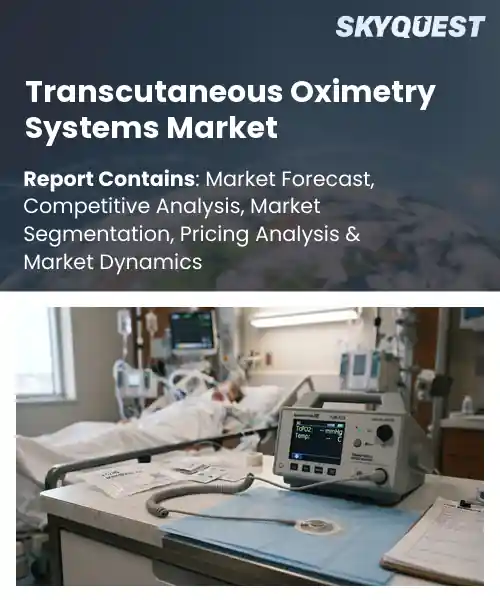
Transcutaneous Oximetry Systems Market
Report ID: SQMIG35A4403
Report ID: SQMIG35A4403
[email protected]
USA +1 351-333-4748
Report ID:
SQMIG35A4403 |
Region:
Global |
Published Date: August, 2026
Pages:
157
|Tables:
124
|Figures:
77


Global Transcutaneous Oximetry Systems Market size was valued at USD 1.42 Billion in 2024 and is poised to grow from USD 1.53 Billion in 2025 to USD 2.8 Billion by 2033, growing at a CAGR of 7.8% during the forecast period (2026-2033).
The global transcutaneous oximetry systems market comprises devices that non‑invasively measure tissue oxygen tension through the skin, providing clinicians with continuous data on peripheral perfusion. This capability matters because it enables early detection of hypoxia in neonatal intensive care, chronic wound management, and peripheral arterial disease, reducing morbidity and hospital costs. Historically, the market emerged in the 1990s when pulse‑oximetry inspired skin‑based sensors, but adoption accelerated after FDA clearance of the first commercial transcutaneous monitors in 2005. Since then, technological refinements such as heated probes and wireless telemetry have expanded clinical utility, driving steady revenue growth worldwide across multiple continents. The principal growth catalyst now lies in the rising prevalence of chronic wounds and the expanding neonatal population in emerging economies, which creates a clear demand for real‑time oxygen monitoring. As hospitals adopt value‑based care models, clinicians seek objective metrics that justify therapeutic interventions, prompting procurement of transcutaneous oximeters for bedside wound‑healing protocols and for guiding hyperbaric oxygen therapy. For example, a major US health system reported a 15 % reduction in amputation rates after integrating continuous oximetry into its diabetic foot clinic, illustrating cost‑saving potential. Consequently, manufacturers are investing in miniaturized, Bluetooth‑enabled devices, opening opportunities in home‑care and telemedicine sectors.
How is AI integration enhancing accuracy in the transcutaneous oximetry systems market?
AI algorithms are reshaping transcutaneous oximetry by refining signal‑processing pipelines and eliminating motion artifacts that once limited clinical confidence. Machine‑learning models learn the distinctive patterns of tissue oxygen diffusion, allowing devices to distinguish true physiological changes from noise in real time. This enhances the reliability of continuous readings, supports earlier detection of compromised perfusion, and reduces the need for frequent manual recalibration. Clinicians benefit from more actionable data, while hospitals see lower equipment downtime and fewer repeat measurements. The broader market is responding to these advantages with increased adoption in neonatal care, wound management and peri‑operative monitoring, positioning AI‑enabled systems as the next growth engine.Masimo June 2024 introduced an AI‑driven transcutaneous oximetry module that automatically corrects artifacts and predicts trend deviations, accelerating clinical decision‑making and reinforcing demand for smarter monitoring solutions.
Market snapshot - (2026-2033)
Global Market Size
USD 1.42 Billion
Largest Segment
Transcutaneous Oxygen Monitoring Systems
Fastest Growth
Combined Oxygen & Carbon Dioxide Monitoring Systems
Growth Rate
7.8% CAGR
To get more insights on this market click here to Request a Free Sample Report
Global transcutaneous oximetry systems market is segmented by product type, portability, application, end user and region. Based on product type, the market is segmented into Transcutaneous Oxygen Monitoring Systems, Transcutaneous Carbon Dioxide Monitoring Systems, Combined Oxygen & Carbon Dioxide Monitoring Systems and Accessories & Sensors. Based on portability, the market is segmented into Portable Systems, Handheld Systems and Stationary Systems. Based on application, the market is segmented into Neonatal Care, Respiratory Care, Vascular & Wound Care, Sleep Monitoring, Critical Care and Others. Based on end user, the market is segmented into Hospitals, Clinics, Diagnostic & Sleep Centers, Home Healthcare, Research Institutions and Others. Based on region, the market is segmented into North America, Europe, Asia Pacific, Latin America and Middle East & Africa.
Transcutaneous Oxygen Monitoring Systems segment dominates because clinicians prioritize direct, continuous measurement of tissue oxygenation to manage critical conditions. This preference stems from its proven clinical relevance in neonatal and wound care, where accurate oxygen data guides therapeutic decisions. The technology’s mature algorithms, reliable sensor performance, and integration with existing monitoring platforms reinforce its adoption, making it the core offering that underpins the market’s value proposition for healthcare providers worldwide.
However, Combined Oxygen & Carbon Dioxide Monitoring Systems are witnessing the strongest growth momentum as clinicians seek respiratory insights to streamline workflows. Sensor miniaturization and analytics enable measurement, reducing patient handling and improving data fidelity. These advances open care pathways in intensive settings, accelerating market expansion and creating opportunities for differentiated product portfolios.
Handheld Systems segment leads because point of care environments demand immediate bedside oxygen readings that fit within limited space. Their compact design allows clinicians to quickly attach sensors without disrupting workflow, enhancing patient comfort and compliance. Integration with wireless platforms and intuitive user interfaces further streamlines data capture, making handheld units the preferred choice for rapid assessment across diverse clinical settings. It is especially valued in emergency departments, outpatient clinics and home‑visiting programs plus mobile units.
Meanwhile, Portable Systems are witnessing growth momentum as providers expand monitoring for chronic wound and vascular patients. Advances in battery life and wireless data transmission enable monitoring during activities, delivering oxygen trends that inform interventions. This capability fosters adoption in programs, driving market expansion and opening revenue channels for manufacturers.
To get detailed segments analysis, Request a Free Sample Report
North America dominates due to robust healthcare infrastructure, high adoption of advanced monitoring technologies, strong reimbursement frameworks, and presence of leading manufacturers and research institutions. The market benefits from integrated care networks that prioritize patient safety and early detection of hypoxia, driving clinicians to invest in reliable transcutaneous oximetry solutions. Additionally, collaborative initiatives between academic centers and device companies accelerate product innovation and clinical validation. A supportive regulatory environment facilitates rapid product approvals, while extensive training programs ensure skilled usage across hospitals and outpatient settings. These combined factors create an ecosystem where demand remains consistently high and technological advancement is sustained.
Transcutaneous Oximetry Systems Market in United States benefits from extensive hospital networks and a culture of early adoption of cutting‑edge monitoring tools. The presence of major medical device corporations and research collaborations fuels continual product refinement. Reimbursement pathways are well defined, encouraging broad clinical integration across neonatal, surgical and critical care units. Ongoing professional education initiatives further embed the technology into routine patient management practices and quality improvement programs nationwide.
Transcutaneous Oximetry Systems Market in Canada is supported by a universal health system that emphasizes equitable access to advanced diagnostics. Strong provincial procurement frameworks streamline adoption across major medical centers, while research hubs in Toronto and Montreal drive clinical validation studies. Collaborative relationships with U.S. manufacturers enable technology transfer and localized support. Continuous clinician training and emphasis on patient safety reinforce the integration of transcutaneous oximetry into diverse therapeutic settings.
Europe experiences rapid expansion driven by coordinated healthcare policies that prioritize patient monitoring and outcome improvement. Stringent clinical guidelines encourage adoption of non‑invasive oxygen assessment in neonatal, peri‑operative and chronic wound management. Significant investment in hospital infrastructure and cross‑border research collaborations enhance technology diffusion and foster innovation. Market players benefit from harmonized regulatory pathways across the European Union, simplifying product registration. Additionally, a well‑educated clinical workforce and strong emphasis on evidence‑based practice accelerate acceptance and integration of transcutaneous oximetry devices throughout the region.
Transcutaneous Oximetry Systems Market in Germany is anchored by a dense network of tertiary care hospitals and a tradition of precision medical engineering. Leading domestic manufacturers collaborate closely with academic institutions to refine sensor technology and data analytics. Reimbursement mechanisms are aligned with value‑based care, encouraging widespread clinical adoption. National clinical guidelines endorse transcutaneous monitoring for neonatal intensive care and postoperative surveillance, reinforcing its role in standard practice. Continuous professional development programs sustain high proficiency among clinicians.
Transcutaneous Oximetry Systems Market in United Kingdom benefits from strong NHS investment in patient safety initiatives and robust clinical research funding. National health technology assessment bodies provide clear guidance that facilitates rapid incorporation of evidence‑based monitoring tools. Partnerships between universities and industry accelerate development of next‑generation devices tailored to local care pathways. Emphasis on early detection of hypoxia in neonatal and surgical settings drives demand across both primary and specialist centers. Ongoing training schemes ensure consistent competency across the workforce.
Transcutaneous Oximetry Systems Market in France is emerging as a focus of strategic healthcare modernization. Government programs promote the adoption of innovative diagnostic technologies in public hospitals and regional care networks. Collaborative clinical trials conducted by French research institutes validate the clinical benefits of transcutaneous monitoring in chronic wound and neonatal care. Reimbursement frameworks are evolving to support cost‑effective technologies, encouraging early‑stage market entry. Educational outreach by device suppliers helps familiarize clinicians with device operation and interpretation.
Asia Pacific strengthens its position through rapid modernization of healthcare facilities and growing awareness of non‑invasive monitoring benefits. Governments in key economies prioritize investment in advanced medical equipment to support expanding hospital networks and aging populations. Local manufacturers are advancing sensor miniaturization and integration with digital health platforms, fostering home‑care and remote monitoring capabilities. Collaborative research initiatives between universities and global OEMs accelerate clinical validation and foster technology transfer. Regulatory harmonization efforts across the region reduce time to market, while professional societies promote guideline adoption that elevates transcutaneous oximetry as a standard of care.
Transcutaneous Oximetry Systems Market in Japan leverages a strong tradition of precision device engineering and a healthcare system that emphasizes preventative care. Leading Japanese firms partner with international brands to incorporate advanced sensor materials and wireless data transmission. National clinical protocols endorse transcutaneous monitoring in neonatal intensive care and postoperative recovery, driving hospital uptake. Government subsidies for cutting‑edge medical technology further facilitate procurement. Continuous medical education programs ensure clinicians remain proficient in device application and data interpretation.
Transcutaneous Oximetry Systems Market in South Korea is propelled by aggressive hospital expansion and a technology‑savvy clinical environment. Domestic manufacturers focus on integrating artificial intelligence algorithms to enhance real‑time oxygen saturation analysis. Health authorities provide clear pathways for device approval, encouraging swift market entry. Collaborative projects with academic hospitals validate clinical efficacy across diverse patient populations. Emphasis on early hypoxia detection in neonatal and critical care units accelerates adoption. Regular training workshops sustain high competency among healthcare professionals.
To know more about the market opportunities by region and country, click here to
Buy The Complete Report
Advancements In Sensor Technology
Growing Emphasis on Patient Safety
High Cost Of Advanced Devices
Limited Reimbursement Frameworks
Request Free Customization of this report to help us to meet your business objectives.
The competitive landscape is shaped by rapid product innovation and strategic collaborations, with established multinationals leveraging advanced sensor technologies while nimble startups secure partnerships to expand distribution. Recent moves include a leading device maker acquiring a niche sensor firm to broaden its portfolio, and a startup forming a joint venture with a major hospital network to accelerate clinical adoption of non‑invasive monitoring solutions.
Top Player’s Company Profile
Recent Developments
SkyQuest’s ABIRAW (Advanced Business Intelligence, Research & Analysis Wing) is our Business Information Services team that Collects, Collates, Correlates, and Analyses the Data collected by means of Primary Exploratory Research backed by robust Secondary Desk research. As per SkyQuest analysis, the market is being propelled chiefly by advancements in sensor technology that boost accuracy and ease of use, while a secondary driver is the heightened focus on patient safety which pushes hospitals to adopt continuous oxygen monitoring. The dominant region remains North America, supported by strong reimbursement frameworks and a robust manufacturer base, and the Transcutaneous Oxygen Monitoring Systems segment leads in revenue because clinicians prize direct tissue‑oxygen data. However, high acquisition and maintenance costs act as a restraint, especially for smaller facilities and emerging economies, tempering the speed of broader adoption. Overall, the blend of innovative device features and safety‑driven demand suggests steady growth despite price pressures.
| Report Metric | Details |
|---|---|
| Market size value in 2024 | USD 1.42 Billion |
| Market size value in 2033 | USD 2.8 Billion |
| Growth Rate | 7.8% |
| Base year | 2024 |
| Forecast period | (2026-2033) |
| Forecast Unit (Value) | USD Billion |
| Segments covered |
|
| Regions covered | North America (US, Canada), Europe (Germany, France, United Kingdom, Italy, Spain, Rest of Europe), Asia Pacific (China, India, Japan, Rest of Asia-Pacific), Latin America (Brazil, Rest of Latin America), Middle East & Africa (South Africa, GCC Countries, Rest of MEA) |
| Companies covered |
|
| Customization scope | Free report customization with purchase. Customization includes:-
|
To get a free trial access to our platform which is a one stop solution for all your data requirements for quicker decision making. This platform allows you to compare markets, competitors who are prominent in the market, and mega trends that are influencing the dynamics in the market. Also, get access to detailed SkyQuest exclusive matrix.
Table Of Content
Executive Summary
Market overview
Parent Market Analysis
Market overview
Market size
KEY MARKET INSIGHTS
COVID IMPACT
MARKET DYNAMICS & OUTLOOK
Market Size by Region
KEY COMPANY PROFILES
Methodology
For the Transcutaneous Oximetry Systems Market, our research methodology involved a mixture of primary and secondary data sources. Key steps involved in the research process are listed below:
1. Information Procurement: This stage involved the procurement of Market data or related information via primary and secondary sources. The various secondary sources used included various company websites, annual reports, trade databases, and paid databases such as Hoover's, Bloomberg Business, Factiva, and Avention. Our team did 45 primary interactions Globally which included several stakeholders such as manufacturers, customers, key opinion leaders, etc. Overall, information procurement was one of the most extensive stages in our research process.
2. Information Analysis: This step involved triangulation of data through bottom-up and top-down approaches to estimate and validate the total size and future estimate of the Transcutaneous Oximetry Systems Market.
3. Report Formulation: The final step entailed the placement of data points in appropriate Market spaces in an attempt to deduce viable conclusions.
4. Validation & Publishing: Validation is the most important step in the process. Validation & re-validation via an intricately designed process helped us finalize data points to be used for final calculations. The final Market estimates and forecasts were then aligned and sent to our panel of industry experts for validation of data. Once the validation was done the report was sent to our Quality Assurance team to ensure adherence to style guides, consistency & design.
Analyst Support
Customization Options
With the given market data, our dedicated team of analysts can offer you the following customization options are available for the Transcutaneous Oximetry Systems Market:
Product Analysis: Product matrix, which offers a detailed comparison of the product portfolio of companies.
Regional Analysis: Further analysis of the Transcutaneous Oximetry Systems Market for additional countries.
Competitive Analysis: Detailed analysis and profiling of additional Market players & comparative analysis of competitive products.
Go to Market Strategy: Find the high-growth channels to invest your marketing efforts and increase your customer base.
Innovation Mapping: Identify racial solutions and innovation, connected to deep ecosystems of innovators, start-ups, academics, and strategic partners.
Category Intelligence: Customized intelligence that is relevant to their supply Markets will enable them to make smarter sourcing decisions and improve their category management.
Public Company Transcript Analysis: To improve the investment performance by generating new alpha and making better-informed decisions.
Social Media Listening: To analyze the conversations and trends happening not just around your brand, but around your industry as a whole, and use those insights to make better Marketing decisions.
REQUEST FOR SAMPLE
 REQUEST FREE CUSTOMIZATION


Want to customize this report? This report can be personalized according to your needs. Our analysts and industry experts will work directly with you to understand your requirements and provide you with customized data in a short amount of time. We offer $1000 worth of FREE customization at the time of purchase.
Feedback From Our Clients


 USA (+1) 351-333-4748

