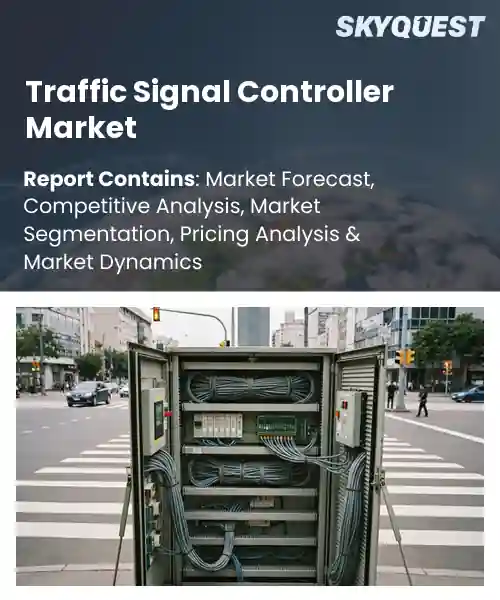
Traffic Signal Controller Market
Report ID: SQMIG45J2627
Report ID: SQMIG45J2627
[email protected]
USA +1 351-333-4748
Report ID:
SQMIG45J2627 |
Region:
Global |
Published Date: July, 2026
Pages:
157
|Tables:
117
|Figures:
77


Global Traffic Signal Controller Market size was valued at USD 1.17 Billion in 2024 and is poised to grow from USD 1.19 Billion in 2025 to USD 1.39 Billion by 2033, growing at a CAGR of 2.0% during the forecast period (2026-2033).
The global market for traffic signal controllers consists of machines used for controlling traffic flows of vehicles and pedestrians in an intersection using various sensors and communications modules. The significance of this market arises owing to increased urbanization, which results in increased congestion and increased possibilities of accidents; hence, cities start implementing control measures. The evolution of this market started in the 20th century with the development of electromechanical timers and continued with microprocessors in the 1990s to reach adaptive technologies that adjust according to the volume of traffic currently present. One example is that of Los Angeles, which installed an AI-controlled network in 2022, reducing travel times by 12 percent.
The growing need for connectivity and adaptability for traffic signal controllers is leading to the quickest market growth since cities wishing to decrease emissions have to coordinate their signals based on real-time traffic data. Being compatible with vehicle-to-infrastructure systems helps controllers to give priority to transit buses, first responders, and autonomous vehicles, making the system more safe and efficient at minimizing idle times. The growth of the 5G technology makes this process even more efficient with instant phase coordination thanks to low-latency connections. For instance, Singapore’s Smart Mobility 2030 initiative leverages 5G traffic controllers to minimize commuter time by 15 percent, serving as an example of encouraging investments in this sphere.
How is AI-driven Automation Reshaping the Traffic Signal Controller Market?
The automation process through AI is transforming the controllers of traffic signals into intelligent systems capable of learning from live traffic trends. Algorithms based on machine learning can make predictions about possible congestion and adapt the phase of time without any human help, and cloud-based systems allow for updates of firmware and centralized control. The information from the sensors and connected cars feeds streams of data that optimize adaptive algorithms, resulting in better flows and less emissions. The current market trend is oriented towards solutions that merge edge computing with predictive analysis, hence drawing attention from manufacturers who can produce AI chips for controllers.
Market snapshot - (2026-2033)
Global Market Size
USD 1.17 Billion
Largest Segment
Adaptive & AI-Based Controllers
Fastest Growth
Adaptive & AI-Based Controllers
Growth Rate
2.0% CAGR
To get more insights on this market click here to Request a Free Sample Report
Global traffic signal controller market is segmented by controller type, mobility platform, connectivity, application and region. Based on controller type, the market is segmented into Adaptive & AI-Based Controllers, Actuated Controllers, Pre-Timed Controllers and Connected / V2X-Compatible Controllers. Based on mobility platform, the market is segmented into Fixed Intersection and Mobile / Portable. Based on connectivity, the market is segmented into Wired and Wireless. Based on application, the market is segmented into Urban Traffic Management, Highway & Arterial Control, Emergency Vehicle Priority and Pedestrian Safety Systems. Based on region, the market is segmented into North America, Europe, Asia Pacific, Latin America and Middle East & Africa.
The Adaptive & AI-Based Controllers segment holds a leading position in the market as these controllers use real-time traffic data along with AI algorithms to provide dynamic traffic timing solutions that can optimize the flow. These solutions will be able to foresee congestion and adjust themselves accordingly. In addition to this, the use of such controllers leads to less delay time, improved fuel efficiency, and compatibility with smart cities projects. These controllers provide operators with scalable and predictive maintenance solutions.
On the other hand, the segment with the highest growth is the Connected / V2X-Compatible Controllers segment. This is so because the standards of communication between the vehicle and infrastructure have been established now.
The Fixed Intersection Platform Segment is dominant since it caters to most of the permanent road networks, where coordinated signaling systems are crucial for ensuring efficient traffic flow. Availability of established infrastructure provides ease of connectivity and provision of electricity, enabling sophisticated features of the controllers without being limited by temporary set-ups. Planners prefer fixed installation systems for future urban planning and thus, more investment is made on these systems which have superior control capabilities.
In contrast, the Mobile/Portable Platform Segment becomes an important growth segment in case cities use temporary traffic signaling systems during the organization of special events, road construction, or traffic management. The flexibility provided due to the absence of civil engineering work makes the system very popular.
To get detailed segments analysis, Request a Free Sample Report
Asia Pacific dominates the worldwide market for traffic signal controllers owing to a combination of state-of-the-art manufacturing, firm government resolve for improvement in urban transportation, and a proliferation of smart cities projects. An abundance of engineering expertise in the region results in constant innovation in the design of the traffic signal controllers that incorporate advancements in connection with connected vehicles. Partnership between the public and private sectors in the region ensures speedy implementation of solutions for adaptive traffic control, while low manufacturing costs result in their extensive adoption throughout young and developed cities. In addition, harmonization of standards in the region enables cross-border component supply and enhances efficiency and reliability of the systems. Manufacturers can benefit from economies of scale to keep prices low and induce municipalities to use intelligent controllers for communication of data and predictive maintenance.
Traffic Signal Controller Market in Japan features an environment where there is cooperation between manufacturers and transportation agencies, which results in a quick implementation of new functions of controllers in urbanized zones. Attention to reliability and the capability of interaction with future vehicle-to-infrastructure communication makes it possible for companies to constantly improve their hardware and software solutions. The main priorities of local standards include cybersecurity and compatibility, and this enables adaptive timing techniques to be deployed.
Market for Traffic Signal Controllers in South Korea derives from the existence of favorable government incentives for adopting intelligent transport systems in both urban and suburban settings. Some of the leading electronics companies have the capability of applying their technical knowledge in areas such as sensor technology and artificial intelligence to come up with controllers which can optimize traffic flows. Through research collaboration with institutions of higher learning, predictive analytics can be quickly developed.
There is an accelerated expansion of the traffic signal controller market in North America, with the governments focused on upgrading their outdated signal control systems to cope with the rising travel requirements and evolving traffic patterns. The high level of regulation of traffic safety and emission reduction drives adoption of adaptive controllers which can alter the timings according to real-time traffic patterns. The development of connected vehicle ecosystems generates a need for controllers capable of communicating with vehicles as well as traffic management systems. Collaboration between government organizations and industry bodies helps to fasten the process of standardizing communication protocols and thereby achieving greater levels of interoperability. Moreover, the availability of an established supply chain along with advanced semiconductors makes it possible to manufacture robust controllers with rich features.
Traffic Signal Controller Market of United States is fueled by government initiatives aimed at upgrading existing infrastructure with more intelligent systems. The focus on integration within connected vehicle initiatives and data analytics pushes vendors to include processors and communication modules within their products. Standardization organizations push for similar cybersecurity needs to ensure robust deployment. The large number of cities within the country offer ideal conditions for testing adaptive algorithms.
The Canadian Traffic Signal Controller Market focuses on sustainability and safety, as provincial governments advocate for the installation of energy-saving controllers that will enable adaptive signal control. The cooperation between municipal organizations and universities helps to incorporate real-time traffic sensing and machine-learning technology optimization, making transportation smoother on highways and even small roads within cities. Standardization of all systems guarantees their compatibility with the new connected vehicle technology, while attention to cold weather influences hardware development.
Through effective policy initiatives geared towards smart mobility and strict emission controls in member countries, Europe cements its place in the traffic signal controller industry. The development of interoperable infrastructure promotes the use of traffic controllers that can communicate in real time with the connected vehicles and the multimodal transport system. Research institutions in Germany, United Kingdom, and France are the main contributors to artificial intelligence-based optimization of traffic flow. Uniform European standards make it easier for the technology to be deployed across different borders and create healthy competition among the suppliers. Private-public partnerships speed up implementation of pilots in the city centers and prove the effectiveness of adaptive signal control.
Germany Traffic Signal Controller Market thrives on the country’s long-standing engineering background and substantial focus on the Industry 4.0 project, where signal controllers are integrated with digital twin solutions. National projects encourage installation of adaptive traffic lights through the retrofitting of old infrastructure to lower emissions and increase efficiency along the corridors. Coordination between automotive and traffic control organizations facilitates the development of V2I-compatible controllers, while certifications guarantee their reliability and cybersecurity.
The market for Traffic Signal Controllers in the UK has gained impetus from smart city initiatives that incorporate intelligent signal control into wider urban mobility strategy plans. The government’s initiatives have pushed local bodies to move from fixed controllers to adaptive ones, which adapt according to the volume of traffic and give priority to buses and bikes. Integration with connected vehicle testing programs helps to ensure that the traffic controllers can communicate with vehicle on-board units in a secure manner.
France Traffic Signal Controller Market is led by sustainable objectives that help create low emission transport corridors and incorporate renewable energy into signaling systems. Public authorities favor adaptive controllers that work in sync with tram and bus rapid transit systems in real-time, thus facilitating multimodal traffic flow. Collaboration with automakers helps design controllers that satisfy European cybersecurity requirements along with vehicle-to-infrastructure communications. Pilot projects have already shown substantial value of artificial intelligence-based signal optimization in urban historic city centers.
To know more about the market opportunities by region and country, click here to
Buy The Complete Report
Rapid Expansion of Urban Areas
The rapid growth of urban centers results in complicated traffic flows, necessitating adaptive signal controls that lead cities to install up-to-date traffic signal controls that allow real-time synchronization in order to ensure road safety and minimize traffic, thus stimulating the demand for traffic signal control systems and the corresponding software globally. The stakeholders’ desire for integration with the latest vehicular communication protocols is another reason why the market keeps growing.
Smart City Initiatives leveraging Technology
Smart city solutions that include intelligent traffic management systems with traffic signal controllers as essential nodes in data gathering and decision making that allow real-time alteration of signal phases in response to traffic, pedestrian activity, and environmental conditions have been adopted by various governments globally, which leads to better mobility and lower emissions, thus encouraging buyers to purchase advanced controllers and contributing to the expansion of the market. Compatibility with IoT platforms and cloud computing creates additional value, motivating planning departments to budget for the replacement of old infrastructure and encourage cooperation with vendors.
High Initial Investment Costs
Moreover, the high amount of upfront capital needed for installing sophisticated traffic signals, which consist of software, hardware, and installation services, often goes beyond the budgetary constraints of many cities, resulting in longer procurement processes and favoring less expensive conventional technology solutions, and hence, hampering the growth of the market. Moreover, the requirement of special training and maintenance for these sophisticated traffic signals also puts an additionalburden on the municipal budget, thus discouraging their adoption.
Regulatory Compliance Challenges
Safety standards, as well as regional rules and regulations on traffic signals, require that producers get certified, which adds time to their development and makes them more expensive, thus preventing manufacturers from quickly implementing new technologies and making it impossible for small companies to enter the market due to lack of necessary funds. Moreover, adaptation to smart-city concepts and communication systems also poses certain challenges to manufacturers, which prevents them from investing into their product and slows down their adoption by different communities.
Request Free Customization of this report to help us to meet your business objectives.
Competitive dynamics have been defined by fast AI integration and aggressive investment; whereby incumbent companies are faced with startup competitors using advanced analytics. Latest strategies in the industry include NoTraffic's Series A fundraise of $17.5 million to further enhance its AI-enabled traffic management platform and Thinking Machines Lab's $2 billion seed raise supported by NVIDIA, leading to rapid partnership agreements and embedding of AI technology in traffic signal controller devices.
Smart City Integration: Urban areas across the globe are integrating intelligent traffic signal control systems into wider smart cities frameworks through connections to live data sources like traffic cameras, transit timetables, and environmental monitors. Such integration makes possible for the optimization of traffic light signaling in accordance with congestion and pedestrian flows, as well as the movements of emergency vehicles. Urban authorities see the need to have such integrated systems in place as vital for preparing cities for the future by ensuring smooth travel and contributing to wider digital transformation goals.
AI-driven Adaptive Controls: AI algorithms are now being integrated into traffic signal controllers, where traffic signals learn from past traffic trends and adapt the phases accordingly without any need for human intervention. The advantage of this is that it optimizes intersection flow for the duration of peak times and also responds to unexpected scenarios like playing games and temporary detours due to construction. Manufacturers like the ease of operation in not having to manually calibrate their systems, but cities appreciate the added safety provided to vulnerable road users through predictive analysis.
SkyQuest’s ABIRAW (Advanced Business Intelligence, Research & Analysis Wing) is our Business Information Services team that Collects, Collates, Correlates, and Analyses the Data collected by means of Primary Exploratory Research backed by robust Secondary Desk research.
As per SkyQuest analysis, the market for global traffic signal controllers is driven mostly by the rapid growth of urban areas, resulting in difficult traffic dynamics, handled through the use of adaptive AI-based controllers; another significant factor is the growing trend towards implementing smart city initiatives on a global scale, whereby traffic signal controllers become a part of mobility systems. Asia-Pacific leads the market due to good manufacturing capabilities and aggressive funding of smart cities, which allows it to have the highest adoption rate. Adaptive & AI-based controllers have the largest share in the segment owing to their predictive abilities. Nevertheless, the high cost of implementation may pose a limitation to the market.
| Report Metric | Details |
|---|---|
| Market size value in 2024 | USD 1.17 Billion |
| Market size value in 2033 | USD 1.39 Billion |
| Growth Rate | 2.0% |
| Base year | 2024 |
| Forecast period | (2026-2033) |
| Forecast Unit (Value) | USD Billion |
| Segments covered |
|
| Regions covered | North America (US, Canada), Europe (Germany, France, United Kingdom, Italy, Spain, Rest of Europe), Asia Pacific (China, India, Japan, Rest of Asia-Pacific), Latin America (Brazil, Rest of Latin America), Middle East & Africa (South Africa, GCC Countries, Rest of MEA) |
| Companies covered |
|
| Customization scope | Free report customization with purchase. Customization includes:-
|
To get a free trial access to our platform which is a one stop solution for all your data requirements for quicker decision making. This platform allows you to compare markets, competitors who are prominent in the market, and mega trends that are influencing the dynamics in the market. Also, get access to detailed SkyQuest exclusive matrix.
Table Of Content
Executive Summary
Market overview
Parent Market Analysis
Market overview
Market size
KEY MARKET INSIGHTS
COVID IMPACT
MARKET DYNAMICS & OUTLOOK
Market Size by Region
KEY COMPANY PROFILES
Methodology
For the Traffic Signal Controller Market, our research methodology involved a mixture of primary and secondary data sources. Key steps involved in the research process are listed below:
1. Information Procurement: This stage involved the procurement of Market data or related information via primary and secondary sources. The various secondary sources used included various company websites, annual reports, trade databases, and paid databases such as Hoover's, Bloomberg Business, Factiva, and Avention. Our team did 45 primary interactions Globally which included several stakeholders such as manufacturers, customers, key opinion leaders, etc. Overall, information procurement was one of the most extensive stages in our research process.
2. Information Analysis: This step involved triangulation of data through bottom-up and top-down approaches to estimate and validate the total size and future estimate of the Traffic Signal Controller Market.
3. Report Formulation: The final step entailed the placement of data points in appropriate Market spaces in an attempt to deduce viable conclusions.
4. Validation & Publishing: Validation is the most important step in the process. Validation & re-validation via an intricately designed process helped us finalize data points to be used for final calculations. The final Market estimates and forecasts were then aligned and sent to our panel of industry experts for validation of data. Once the validation was done the report was sent to our Quality Assurance team to ensure adherence to style guides, consistency & design.
Analyst Support
Customization Options
With the given market data, our dedicated team of analysts can offer you the following customization options are available for the Traffic Signal Controller Market:
Product Analysis: Product matrix, which offers a detailed comparison of the product portfolio of companies.
Regional Analysis: Further analysis of the Traffic Signal Controller Market for additional countries.
Competitive Analysis: Detailed analysis and profiling of additional Market players & comparative analysis of competitive products.
Go to Market Strategy: Find the high-growth channels to invest your marketing efforts and increase your customer base.
Innovation Mapping: Identify racial solutions and innovation, connected to deep ecosystems of innovators, start-ups, academics, and strategic partners.
Category Intelligence: Customized intelligence that is relevant to their supply Markets will enable them to make smarter sourcing decisions and improve their category management.
Public Company Transcript Analysis: To improve the investment performance by generating new alpha and making better-informed decisions.
Social Media Listening: To analyze the conversations and trends happening not just around your brand, but around your industry as a whole, and use those insights to make better Marketing decisions.
REQUEST FOR SAMPLE
 REQUEST FREE CUSTOMIZATION
Global Traffic Signal Controller Market size was valued at USD 1.17 Billion in 2024 and is poised to grow from USD 1.19 Billion in 2025 to USD 1.39 Billion by 2033, growing at a CAGR of 2.0% during the forecast period (2026-2033).
The competitive landscape is shaped by rapid AI integration and aggressive capital deployment, with incumbents confronting agile startups that leverage advanced analytics. Recent strategic moves include NoTraffic’s $17.5 million Series A to scale its AI‑based traffic management platform and Thinking Machines Lab’s $2 billion seed round backed by NVIDIA, accelerating partnerships that embed AI into signal controller technologies. 'Siemens Mobility', 'Swarco Group (McCain)', 'Econolite', 'Cubic Corporation (Trafficware)', 'Hisense TransTech', 'Nippon Signal Co.', 'QTC (Traffic Technologies Ltd.)', 'Johnson Controls (Tyco Traffic)', 'Kyosan Electric Manufacturing', 'Nanjing Les Information Technology', 'Sumitomo Electric Industries', 'Intelight (McCain)', 'Hikvision', 'Dahua Technology', 'JARI Electronics', 'ATC Manufacturing', 'Garmin Ltd.', 'Raytheon Technologies', 'Telvent (Schneider Electric)', 'Parsons Corporation'
Rapid expansion of urban areas creates complex traffic patterns that require adaptive signal control solutions, prompting municipalities to replace legacy systems with advanced controllers capable of real‑time coordination, thereby enhancing road safety and reducing congestion, which in turn stimulates demand for modern traffic signal hardware and associated software platforms across the global market. Stakeholders also prioritize integration with emerging vehicular communication standards, fostering ecosystem development and encouraging investment in next‑generation controller technologies that support multi‑modal traffic management, further propelling market expansion.
Smart City Integration: Cities worldwide are embedding advanced traffic signal controllers within broader smart‑city platforms, linking them to real‑time data sources such as traffic cameras, public‑transport schedules, and environmental sensors. This connectivity enables dynamic signal timing that reacts to congestion patterns, pedestrian flows, and emergency vehicle routes, improving overall mobility and reducing emissions. Municipal planners view these integrated solutions as essential for future‑proofing urban infrastructure, fostering smoother travel experiences while supporting the broader digital transformation agenda and reinforcing sustainable urban growth policy goals.
Why does Asia Pacific Dominate the Global Traffic Signal Controller Market? |@12


Want to customize this report? This report can be personalized according to your needs. Our analysts and industry experts will work directly with you to understand your requirements and provide you with customized data in a short amount of time. We offer $1000 worth of FREE customization at the time of purchase.
Feedback From Our Clients


 USA (+1) 351-333-4748

