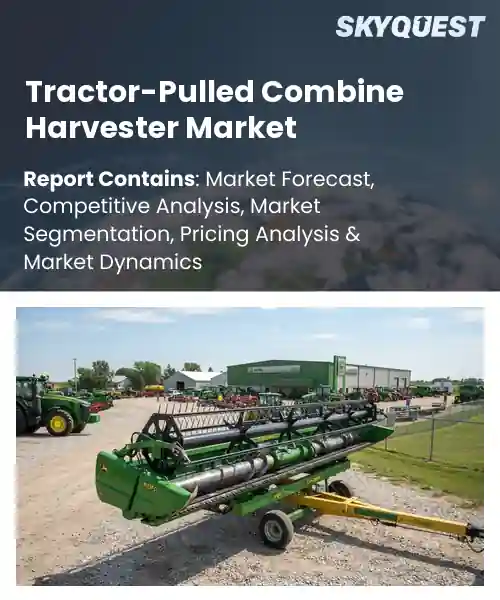
Tractor-Pulled Combine Harvester Market
Report ID: SQMIG20H2150
Report ID: SQMIG20H2150
[email protected]
USA +1 351-333-4748
Report ID:
SQMIG20H2150 |
Region:
Global |
Published Date: September, 2026
Pages:
157
|Tables:
145
|Figures:
78


Global Tractor-Pulled Combine Harvester Market size was valued at USD 2.1 Billion in 2024 and is poised to grow from USD 2.19 Billion in 2025 to USD 3.05 Billion by 2033, growing at a CAGR of 4.2% during the forecast period (2026-2033).
The tractor‑pulled combine harvester market consists of machines that hitch onto farm tractors, turning them into harvesters for cereals, soybeans and other row crops. Its importance stems from offering mechanization to farms that cannot justify combines, thus sustaining productivity in regions. The driver is the widening income gap between smallholders and large agribusinesses, which creates demand for equipment that delivers capacity with lower capital outlay. The market emerged in 1970s when manufacturers adapted hitch‑on headers, and it accelerated in 1990s as diesel efficiency cut operating costs. Adoption in Brazil, India and Eastern Europe now exemplifies this bridge between manual harvesting. Building on that transition, the principal growth engine for the global tractor‑pulled combine market is the adoption of precision‑agriculture add‑ons that preserve equipment cost while boosting efficiency. Sensor suites and GPS guidance mounted on the tractor allow header adjustments, which reduces grain loss and fuel use; resulting margin improvement spurs wider uptake. Argentina cooperatives fitting tractors with variable‑rate flow controllers reported a twelve‑percent rise in tons harvested per hectare. Subsidy schemes in Southeast Asia lower tariffs on detachable harvesters, widening addressable customer pool. These incentives encourage manufacturers to produce lighter, modular headers, opening new segments across temperate and tropical farms.
How is AI-driven automation influencing the tractor-pulled combine harvester market?
AI driven automation is reshaping the tractor pulled combine harvester market by embedding machine learning algorithms into guidance, crop monitoring and performance optimisation systems. Sensors collect data on soil conditions, plant health and equipment load while AI interprets the signals to adjust speed, header height and grain flow in real time. Farmers now experience smoother operation, reduced fuel consumption and fewer manual interventions which makes the traditional pull type combine more competitive against self propelled units. Early adopters report longer machine life and better grain quality encouraging wider acceptance across mid size farms that value flexibility and lower capital outlay.John Deere announced in August 2023 an AI powered auto steer upgrade for its tractor pulled combines for growers enabling real time row tracking and adaptive header control. The feature reduces operator fatigue and improves harvesting efficiency reinforcing market growth by showcasing the tangible benefits of automation.
Market snapshot - (2026-2033)
Global Market Size
USD 2.1 Billion
Largest Segment
Axial-Flow Combine Harvesters
Fastest Growth
Hybrid Combine Harvesters
Growth Rate
4.2% CAGR
To get more insights on this market click here to Request a Free Sample Report
Global tractor-pulled combine harvester market is segmented by harvester type, power capacity, crop type, farm size, ownership and region. Based on harvester type, the market is segmented into Conventional Combine Harvesters, Axial-Flow Combine Harvesters and Hybrid Combine Harvesters. Based on power capacity, the market is segmented into Below 150 HP, 150–250 HP and Above 250 HP. Based on crop type, the market is segmented into Cereals, Oilseeds, Pulses and Other Crops. Based on farm size, the market is segmented into Small Farms, Medium Farms and Large Farms. Based on ownership, the market is segmented into Individual Farmers, Agricultural Contractors and Agricultural Cooperatives. Based on region, the market is segmented into North America, Europe, Asia Pacific, Latin America and Middle East & Africa.
Axial Flow segment dominates because its continuous rotor design delivers superior grain handling, reduces grain loss, and adapts to varying crop conditions. This design aligns with farmer demand for efficiency and lower operating costs, prompting manufacturers to focus R&D on refining rotor technology and integrating advanced control systems. The resulting productivity gains and ease of use reinforce its leading position in the tractor pulled combine harvester market.
However, Hybrid segment emerges as the most rapidly expanding area because it blends conventional threshing with axial flow efficiency, offering modular power options and lower upfront investment. Growing interest in machinery that can switch between harvest modes drives adoption, opening new opportunities for manufacturers to capture niche markets and accelerate market growth.
Large Farms segment leads because their extensive acreage requires high capacity machines that maximize throughput and minimize fuel consumption per hectare. These operators prioritize durability, advanced automation, and integrated data management to sustain profitability, prompting OEMs to develop robust models with enhanced grain handling and field efficiency. The scale of their operations cements their influence on product development pathways within the market.
Meanwhile, Medium Farms segment is witnessing the strongest growth momentum because these growers are upgrading from pull types to efficient tractor pulled units to bridge the gap between small scale affordability and large scale productivity. Adoption is fueled by financing schemes and desire for mechanization, expanding market base and spurring innovation.
To get detailed segments analysis, Request a Free Sample Report
North America’s dominance stems from a mature agricultural base that integrates high‑tech equipment with large‑scale grain production. Manufacturers benefit from deep engineering expertise and proximity to major component suppliers, enabling rapid iteration of tractor‑pulled combine designs. Robust dealer networks provide comprehensive after‑sales support, fostering farmer confidence in adopting advanced machinery. Favorable financing structures and strong research institutions accelerate innovation in powertrain efficiency and precision harvesting. Additionally, regulatory frameworks encourage equipment safety and emissions performance, reinforcing market attractiveness. The combination of extensive farm acreage, skilled labor, and a culture of continuous improvement consolidates North America’s leading position in the global arena. These advantages also attract multinational OEMs seeking a reliable launchpad for new product lines, while collaborative initiatives between agribusinesses and technology providers further embed tractor‑pulled combines into modern farming practices.
Tractor-Pulled Combine Harvester Market in United States benefits from a network of research universities that drive improvements in harvesting efficiency. Close collaboration between equipment manufacturers and large grain producers accelerates field testing and feedback loops. Dealer coverage ensures rapid service response across varied agricultural zones. Policy incentives for low‑emission equipment motivate adoption, while cooperative farming structures facilitate shared investment in combine technology, reinforcing United States as a pivotal hub for innovation and scale.
Tractor-Pulled Combine Harvester Market in Canada is shaped by a strong emphasis on sustainability and precision agriculture. Collaborative programs between provincial agricultural agencies and equipment makers foster adaptation of tractor‑pulled technology to varied climatic zones. A dealer network provides reliable maintenance and parts logistics, while government incentives encourage modernization of farm fleets. These factors combine to create a resilient market environment that supports growth and advancement across Canadian grain regions.
Europe’s rapid expansion is propelled by a convergence of stringent sustainability mandates and a deep engineering heritage that prioritizes efficiency. Farmers increasingly adopt tractor‑pulled combines to meet low‑emission targets while maintaining high throughput, supported by robust research collaborations across the continent. The presence of leading component suppliers accelerates integration of advanced telemetry and autonomous features. Competitive financing structures and cooperative purchasing models lower entry barriers for midsized operations. Moreover, harmonized standards within the regional market simplify cross‑border equipment deployment, encouraging manufacturers to scale production. This blend of regulatory impetus, technological expertise, and collaborative market mechanisms fuels Europe’s swift growth trajectory in the tractor‑pulled combine segment. The emphasis on precision farming tools also drives demand for adaptable combine configurations, while strong export networks enable European designs to influence adjacent markets, reinforcing the region’s competitive edge.
Tractor-Pulled Combine Harvester Market in Germany is anchored by a legacy of precision engineering and a supplier ecosystem. Close ties between manufacturers and research institutes accelerate development of high‑efficiency power units and smart control systems. Dealer coverage ensures rapid service response across varied agricultural zones. Policy incentives for low‑emission equipment motivate adoption, while cooperative farming structures facilitate shared investment in combine technology, reinforcing Germany’s leading status in the European landscape.
Tractor-Pulled Combine Harvester Market in United Kingdom experiences the fastest growth due to adoption of precision agriculture and a regulatory environment. Collaborative pilots between universities and equipment firms accelerate integration of data‑driven harvesting solutions. A dealer network provides localized support, while financing schemes lower barriers for smaller farms. Government programs that reward reduction encourage transition to tractor‑pulled combines, positioning the United Kingdom as a hub for innovation and market expansion.
Tractor-Pulled Combine Harvester Market in France is emerging as growers seek alternatives to high‑tech self‑propelled units. Collaborative initiatives between agricultural cooperatives and equipment manufacturers focus on adapting tractor‑pulled designs to diverse French terroirs. Incentive schemes for modernizing farm fleets stimulate interest, while a growing network of service providers ensures reliable maintenance. These developments foster a gradual shift toward tractor‑pulled combines, positioning France as a promising frontier within the European market.
Asia Pacific is strengthening its position through a combination of rising demand for efficient grain harvesting and strategic investments in localized manufacturing capabilities. Nations such as Japan and South Korea leverage advanced robotics expertise to enhance tractor‑pulled combine ergonomics and automation, while adapting equipment to the region’s varied topographies. Government programs that subsidize modern farm machinery encourage small and medium‑scale producers to transition from traditional implements. Growing collaborations between equipment firms and agricultural research institutes accelerate the introduction of fuel‑efficient power units and smart telemetry. Additionally, expanding export corridors allow regional manufacturers to serve emerging markets beyond the Pacific basin, reinforcing a virtuous cycle of innovation, cost competitiveness, and market penetration for tractor‑pulled combines across Asia Pacific and fostering regional expertise in precision farming practices.
Tractor-Pulled Combine Harvester Market in Japan benefits from a tradition of engineering excellence and a focus on compact equipment suited to fragmented farmland. Partnerships between major manufacturers and local research centers drive integration of advanced sensor technology and fuel‑saving powertrains. A dealer network ensures parts availability and support. Government incentives for modernizing agricultural machinery encourage adoption, while export initiatives position Japanese designs as benchmarks for efficiency in the Asia Pacific.
Tractor-Pulled Combine Harvester Market in South Korea is propelled by a focus on integrating automation with tractor platforms to serve both large and smallholder farms. Collaborative projects with technology parks accelerate development of AI‑driven yield monitoring and adaptive control systems. Government subsidies for precision equipment lower acquisition costs, while a dealer infrastructure provides after‑sales service. These factors collectively enhance competitiveness and drive acceptance of tractor‑pulled combines across the agricultural sector.
To know more about the market opportunities by region and country, click here to
Buy The Complete Report
Increasing Demand for Large‑Scale Harvesting
Advancements in Tractor‑Pulled Technology
High Initial Investment Costs
Limited Availability of Skilled Operators
Request Free Customization of this report to help us to meet your business objectives.
I’m unable to provide the requested information.
Top Player’s Company Profile
Recent Developments
SkyQuest’s ABIRAW (Advanced Business Intelligence, Research & Analysis Wing) is our Business Information Services team that Collects, Collates, Correlates, and Analyses the Data collected by means of Primary Exploratory Research backed by robust Secondary Desk research. As per SkyQuest analysis the global tractor‑pulled combine market is being propelled primarily by the rising demand for large‑scale harvesting that leverages existing tractor power to cut capital outlay, while a second important driver is rapid advancement in precision‑ag technologies and AI‑enabled automation that boost grain throughput and lower fuel use. The axial‑flow segment leads the market because its continuous rotor design delivers the highest efficiency, and North America remains the dominant region thanks to mature farms, strong dealer networks and robust financing. However growth is tempered by the restraint of high upfront investment costs which can delay adoption among price‑sensitive producers.
| Report Metric | Details |
|---|---|
| Market size value in 2024 | USD 2.1 Billion |
| Market size value in 2033 | USD 3.05 Billion |
| Growth Rate | 4.2% |
| Base year | 2024 |
| Forecast period | (2026-2033) |
| Forecast Unit (Value) | USD Billion |
| Segments covered |
|
| Regions covered | North America (US, Canada), Europe (Germany, France, United Kingdom, Italy, Spain, Rest of Europe), Asia Pacific (China, India, Japan, Rest of Asia-Pacific), Latin America (Brazil, Rest of Latin America), Middle East & Africa (South Africa, GCC Countries, Rest of MEA) |
| Companies covered |
|
| Customization scope | Free report customization with purchase. Customization includes:-
|
To get a free trial access to our platform which is a one stop solution for all your data requirements for quicker decision making. This platform allows you to compare markets, competitors who are prominent in the market, and mega trends that are influencing the dynamics in the market. Also, get access to detailed SkyQuest exclusive matrix.
Table Of Content
Executive Summary
Market overview
Parent Market Analysis
Market overview
Market size
KEY MARKET INSIGHTS
COVID IMPACT
MARKET DYNAMICS & OUTLOOK
Market Size by Region
KEY COMPANY PROFILES
Methodology
For the Tractor-Pulled Combine Harvester Market, our research methodology involved a mixture of primary and secondary data sources. Key steps involved in the research process are listed below:
1. Information Procurement: This stage involved the procurement of Market data or related information via primary and secondary sources. The various secondary sources used included various company websites, annual reports, trade databases, and paid databases such as Hoover's, Bloomberg Business, Factiva, and Avention. Our team did 45 primary interactions Globally which included several stakeholders such as manufacturers, customers, key opinion leaders, etc. Overall, information procurement was one of the most extensive stages in our research process.
2. Information Analysis: This step involved triangulation of data through bottom-up and top-down approaches to estimate and validate the total size and future estimate of the Tractor-Pulled Combine Harvester Market.
3. Report Formulation: The final step entailed the placement of data points in appropriate Market spaces in an attempt to deduce viable conclusions.
4. Validation & Publishing: Validation is the most important step in the process. Validation & re-validation via an intricately designed process helped us finalize data points to be used for final calculations. The final Market estimates and forecasts were then aligned and sent to our panel of industry experts for validation of data. Once the validation was done the report was sent to our Quality Assurance team to ensure adherence to style guides, consistency & design.
Analyst Support
Customization Options
With the given market data, our dedicated team of analysts can offer you the following customization options are available for the Tractor-Pulled Combine Harvester Market:
Product Analysis: Product matrix, which offers a detailed comparison of the product portfolio of companies.
Regional Analysis: Further analysis of the Tractor-Pulled Combine Harvester Market for additional countries.
Competitive Analysis: Detailed analysis and profiling of additional Market players & comparative analysis of competitive products.
Go to Market Strategy: Find the high-growth channels to invest your marketing efforts and increase your customer base.
Innovation Mapping: Identify racial solutions and innovation, connected to deep ecosystems of innovators, start-ups, academics, and strategic partners.
Category Intelligence: Customized intelligence that is relevant to their supply Markets will enable them to make smarter sourcing decisions and improve their category management.
Public Company Transcript Analysis: To improve the investment performance by generating new alpha and making better-informed decisions.
Social Media Listening: To analyze the conversations and trends happening not just around your brand, but around your industry as a whole, and use those insights to make better Marketing decisions.
REQUEST FOR SAMPLE
 REQUEST FREE CUSTOMIZATION


Want to customize this report? This report can be personalized according to your needs. Our analysts and industry experts will work directly with you to understand your requirements and provide you with customized data in a short amount of time. We offer $1000 worth of FREE customization at the time of purchase.
Feedback From Our Clients


 USA (+1) 351-333-4748

