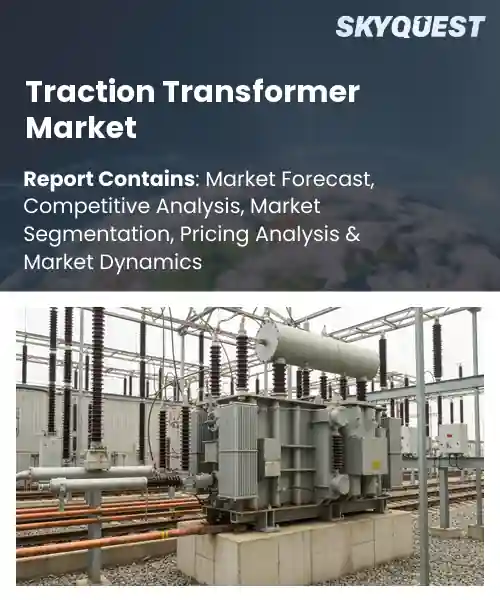
Traction Transformer Market
Report ID: SQMIG20D2681
Report ID: SQMIG20D2681
[email protected]
USA +1 351-333-4748
Report ID:
SQMIG20D2681 |
Region:
Global |
Published Date: June, 2026
Pages:
157
|Tables:
147
|Figures:
78


Global Traction Transformer Market size was valued at USD 2.12 Billion in 2024 and is poised to grow from USD 2.27 Billion in 2025 to USD 3.9 Billion by 2033, growing at a CAGR of 7.0% during the forecast period (2026-2033).
Traction transformers are a key component of electrified rail systems that change high voltage to useable traction voltage, and condition power for traction converters, consequently, they have a direct bearing on the reliability and energy efficiency of rail fleets. There is demand for on-board as well as substation transformers for use in locomotives, electric multiple units (EMUs), metro systems, and tram systems. Electrification of rail helps reduce carbon emissions and operating costs whilst allowing for the running of trains at higher speeds and greater weight capacities. Demand for traction transformers has increased over the past several decades, as cities have become more urbanized after WWII, and China and Europe have invested in high-speed rail lines and metro systems leading to innovation from oil-immersed traction transformer designs to more compact and dry designs with power electronics integrated.
The surge in infrastructure investment and greater decarbonization targets is providing a strong driver for traction transformer demand, as government funding and private-sector partnerships are creating new electrified rail corridors that necessitate resilient and low-loss traction transformers engineered for high-power applications. For instance, India's railway electrification initiatives require off-the-shelf modular transformer designs for various voltage levels, while countries in Europe have focused on retrofitting their existing rail fleets with more compact oil-free traction transformers to meet the rules for traction transformer safety. Technological advances such as silicon carbide devices and digital condition monitoring lower lifecycle costs, therefore manufacturers can offer value-added retrofit services and predictive maintenance platforms, opening lucrative aftermarkets and localization opportunities in emerging regions.
How is AI Improving Efficiency In The Traction Transformer Market?
The traction transformer industry is increasingly utilizing AI to improve efficiency through smart asset management and streamlined engineering. Continuous condition monitoring driven by sensor data, machine learning driven predictive maintenance, the use of digital twin simulations that accurately represent real-world aging and AI-assisted design to reduce losses and simplify manufacturing are just a few of the ways AI is revolutionizing the traction transformer market. The industry's move from calendar-based servicing to condition-based interventions improves uptime and prolongs the life of equipment.
For example, some vendors provide platforms to combine telemetry from many sources, facilitating early detection of anomalies, and manufacturers are using analytics to reduce the time required for testing and commissioning. In June of 2026, Hitachi Energy announced that they would be significantly increasing production through digitalization and analytics (improving traction transformer capabilities and modernizations), thus bolstering the traction transformer industry's overall adoption of AI-supported digital twins and predictive maintenance across their production and fleet operations; ultimately leading to faster, more reliable service through continuous condition-based optimization.
Market snapshot - (2026-2033)
Global Market Size
USD 2.12 Billion
Largest Segment
Underframe
Fastest Growth
Roof
Growth Rate
7.0% CAGR
To get more insights on this market click here to Request a Free Sample Report
Global traction transformer market is segmented by mounting position, voltage network, rolling stock, technology, sales channel and region. Based on mounting position, the market is segmented into Underframe, Machine Room, Roof and Others. Based on voltage network, the market is segmented into Alternating Current Systems, Direct Current Systems and Others. Based on rolling stock, the market is segmented into High-Speed Trains, Electric Locomotives, Metros, Tram-Trains and Others. Based on technology, the market is segmented into Tap Changer Transformers, Electronic Traction Transformers and Others. Based on sales channel, the market is segmented into Direct OEM Sales, Government Railway Tenders and Others. Based on region, the market is segmented into North America, Europe, Asia Pacific, Latin America and Middle East & Africa.
Due to its positioning beneath the car body, optimaling how the weight is spread throughout the vehicle, providing direct mehanical connection, and simplifying the interfacing with existing bogie and traction systems result in less engineering complexity and reduced life cycle maintenance needs. The closeness of the traction motors to the cooling pathways provides improved thermal management and greater reliability; whereas, because of standardised mounting interfaces, OEMs and operators tend toward underframe designs due to proven operational strength and the economics of deploying fleets with lower capital costs.
As per traction transformer market analysis, there is currently more momentum around Roof, as Operators are seeking rooftop installations to capitalise on previously unused space in the roof of the vehicle and to simplify the retrofit of the new systems to the car body. Improvements in compact insulation and modular mounting systems reduce installation time and downtime resulting in faster upgrades to existing fleet items. This will also create refurbish and capability enhancement opportunities that were previously limited to rolling stock of many different types.
Mechanical tap changers are leading dominant in the market because of legacy design reliability for regulating traction loads, coupled with a proven history for resiliency built around ease of in-vehicle maintainability as part of fleet maintenance practices over the life of the fleet. This compatibility with legacy traction controls along with predictability for fault and overload conditions relative to tap changers is reducing the risk of integrating into OEM and operator fleets and as a result, OEMs and operators are motivated to favour tap changer solutions for fleets focused on reliability and reducing lifecycle costs.
As per traction transformer market forecast, Electronic traction transformers are experiencing explosive growth resulting from advancements in power electronics, smaller sizes and the integration of digital controls, which enhance efficiency and increase the number of voltages that can be used together. These advances reduce both weight and space required for installation, simplify the interfacing of electric grids for the recovery of regenerative electricity, and accelerate the modernization of rolling stock and traction systems.
To get detailed segments analysis, Request a Free Sample Report
The global traction transformer market is led by the Asia Pacific region because of rail electrification initiative, urbanisation and the well-developed manufacturing base of electrical equipment. Asia Pacific has numerous engineering hubs, which provide an infrastructure for ongoing research and development of compact, efficient traction transformers; this enables manufacturers to rapidly prototype and produce traction transformers. Original equipment manufacturers (OEMs) work very closely with their suppliers, and maintenance providers, allowing manufacturers to provide comprehensive aftermarket support and services over the life cycle of the transformers. Policies that advocate for sustainable urban mobility and significant funding of high-speed rail and commuter rail systems create a high level of competition in the marketplace. The cross-border trading environment, and export orientation, further enhance capacity utilisation, equipment distribution, and technology dissemination, to create a strong marketplace for sustaining mutual growth between manufacturers and end-users. A highly skilled workforce, combined with ongoing research partnerships between academia and industry, results in accelerated refinement of products, and adaptation to meet changing requirements on the networks.
The Traction Transformer market in Japan is supported by the local culture's strong heritage of precision engineering, collaborations between railway operators and manufacturers of equipment, and a preference for reliable, compact designs in the context of high-speed and urban rail. Japanese manufacturers focus heavily on providing safe and high-quality products. They do this by utilizing state-of-the-art testing capabilities for all types of traction transformers and working closely with research institutions to develop new products and technologies. They also put a lot of emphasis on lifecycle services and exporting specialized units, creating an advanced technical market that is focused on providing efficiency and interoperability.
The South Korean Traction Transformer market has an advantage due to its high-density electronic and material supply chain, which encourages the development of compact, highly-efficient units that are well-suited for urban and high-speed rail applications. There is a high level of collaboration between technology companies and transport operators in order to expedite the adoption of modular designs and predictive maintenance solutions. Furthermore, strong manufacturing capabilities allow for the upgrading of the domestic fleet and also for exporting products to foreign markets. Additionally, policy frameworks and technical institutes support ongoing product refinement and improvements in the operating performance of traction transformers.
Rapid expansion of the traction transformer market in Europe is driven by a cohesive emphasis on rail modernization, decarbonization objectives, and interoperable cross border transport strategies. Investment priorities center on upgrading legacy networks, integrating advanced traction components, and improving energy efficiency across commuter and freight corridors. Regulatory frameworks and standardization efforts encourage adoption of proven designs while stimulating competitive local manufacturing and specialized engineering services. Retrofit programs create steady demand for compact, backward compatible units, and a mature service ecosystem supports maintenance, testing, and lifecycle optimization. Innovation hubs in technical centers foster collaboration among equipment suppliers, system integrators, and research institutions, accelerating deployment of modular solutions tailored to diverse national network characteristics and operational profiles. Access to specialized financing mechanisms and collaborative procurement models helps align investment cycles, while a strong aftermarket and export orientation enable manufacturers to scale and adapt products for varied service conditions.
Traction Transformer Market in Germany is characterized by a robust industrial base and deep engineering expertise that support manufacturing and system integration. Domestic suppliers work closely with rail operators and original equipment manufacturers to deliver high reliability units tailored for heavy freight and dense commuter networks. Emphasis on stringent technical standards, modular designs, and maintenance services reinforces leadership in domestic deployment and export markets, underpinned by strong technical talent pool.
Traction Transformer Market in United Kingdom is marked by accelerating modernization across urban and intercity networks and a growing focus on energy efficiency and digital diagnostics. A dynamic procurement landscape and active engagement from system integrators, technology startups, and innovation hubs encourage adoption of modular and retrofit solutions. Emphasis on fleet reliability and lifecycle cost reduction supports expanded maintenance services, while international partnerships help scale domestic deployment and export opportunities.
Traction Transformer Market in France is emerging through upgrades to regional rail systems and a growing focus on energy efficient traction components. Domestic engineering firms and specialized manufacturers are developing compact, adaptable units suited for retrofit and new builds, supported by research centers. Procurement trends favor standardized, interoperable solutions that simplify integration across networks, while maintenance service providers and export minded suppliers work to scale production and further refine offerings.
North America is strengthening its position in the traction transformer market through a combination of network modernization efforts, growing emphasis on freight electrification, and enhanced collaboration between manufacturers and rail operators. Regional suppliers are investing in flexible manufacturing approaches and modular product architectures to meet diverse service environments from dense urban transit to long haul freight corridors. Increasingly sophisticated maintenance providers and testing facilities support lifecycle performance and reduce operational disruption. Strategic partnerships with technology firms accelerate adoption of advanced materials and digital monitoring capabilities. Policy initiatives and targeted procurement models encourage localization of supply chains, while export opportunities and cross border projects promote scale and technology transfer across the continent. Skilled engineers and research collaborations support product development for demanding operating conditions, while retrofit demand and niche suppliers drive differentiation on reliability and service.
Traction Transformer Market in United States is shaped by rail infrastructure renewal and investment in commuter and freight electrification. Domestic manufacturers and system integrators emphasize scalable, modular designs with strong testing and certification processes. Collaboration with technology firms advances digital monitoring and predictive maintenance capabilities. A growing aftermarket and specialized service network supports fleet reliability, while procurement strategies and partnerships encourage localization of supply chains and further enhanced production capacity.
Traction Transformer Market in Canada emphasizes reliability and ruggedization to meet diverse climatic and regional service conditions across commuter and remote lines. Manufacturers and system integrators focus on cold climate performance, ease of maintenance, and compatibility with cross border equipment standards. Collaboration with North American suppliers assists scaling manufacturing and aftermarket services. Public procurement preferences and regional retrofit programs encourage tailored solutions that prioritize durability, serviceability, and operational resilience.
To know more about the market opportunities by region and country, click here to
Buy The Complete Report
Rising Demand For Electric Vehicles
Infrastructure Modernization And Upgrades
High Capital Investment Requirements
Complex Regulatory And Standards Landscape
Request Free Customization of this report to help us to meet your business objectives.
The competitive landscape for traction transformers now combines legacy OEM consolidation with deep tech startup disruption. Recent strategic activity includes the acquisition of ABB Power Grids by Hitachi. Corporate investors are backing solid state transformer startups and companies such as Amperesand and Heron Power are advancing medium voltage solid state transformer platforms for critical infrastructure deployments.
SkyQuest’s ABIRAW (Advanced Business Intelligence, Research & Analysis Wing) is our Business Information Services team that Collects, Collates, Correlates, and Analyses the Data collected by means of Primary Exploratory Research backed by robust Secondary Desk research.
As per SkyQuest analysis, the global traction transformer market is poised for steady growth driven primarily by accelerated infrastructure investment and stringent decarbonization targets that expand electrified rail corridors. The key driver is government funding and network upgrades, while a second driver is rising demand for electrified transportation including electric trains and broader EV trends. A notable restraint is high capital investment and long lead times that can delay modernization and deter smaller operators. Asia Pacific remains the dominating region due to large-scale rail programs and manufacturing strength, and the underframe mounting segment continues to dominate thanks to proven integration, thermal advantages and lifecycle efficiency favored by OEMs.
| Report Metric | Details |
|---|---|
| Market size value in 2024 | USD 2.12 Billion |
| Market size value in 2033 | USD 3.9 Billion |
| Growth Rate | 7.0% |
| Base year | 2024 |
| Forecast period | (2026-2033) |
| Forecast Unit (Value) | USD Billion |
| Segments covered |
|
| Regions covered | North America (US, Canada), Europe (Germany, France, United Kingdom, Italy, Spain, Rest of Europe), Asia Pacific (China, India, Japan, Rest of Asia-Pacific), Latin America (Brazil, Rest of Latin America), Middle East & Africa (South Africa, GCC Countries, Rest of MEA) |
| Companies covered |
|
| Customization scope | Free report customization with purchase. Customization includes:-
|
To get a free trial access to our platform which is a one stop solution for all your data requirements for quicker decision making. This platform allows you to compare markets, competitors who are prominent in the market, and mega trends that are influencing the dynamics in the market. Also, get access to detailed SkyQuest exclusive matrix.
Table Of Content
Executive Summary
Market overview
Parent Market Analysis
Market overview
Market size
KEY MARKET INSIGHTS
COVID IMPACT
MARKET DYNAMICS & OUTLOOK
Market Size by Region
KEY COMPANY PROFILES
Methodology
For the Traction Transformer Market, our research methodology involved a mixture of primary and secondary data sources. Key steps involved in the research process are listed below:
1. Information Procurement: This stage involved the procurement of Market data or related information via primary and secondary sources. The various secondary sources used included various company websites, annual reports, trade databases, and paid databases such as Hoover's, Bloomberg Business, Factiva, and Avention. Our team did 45 primary interactions Globally which included several stakeholders such as manufacturers, customers, key opinion leaders, etc. Overall, information procurement was one of the most extensive stages in our research process.
2. Information Analysis: This step involved triangulation of data through bottom-up and top-down approaches to estimate and validate the total size and future estimate of the Traction Transformer Market.
3. Report Formulation: The final step entailed the placement of data points in appropriate Market spaces in an attempt to deduce viable conclusions.
4. Validation & Publishing: Validation is the most important step in the process. Validation & re-validation via an intricately designed process helped us finalize data points to be used for final calculations. The final Market estimates and forecasts were then aligned and sent to our panel of industry experts for validation of data. Once the validation was done the report was sent to our Quality Assurance team to ensure adherence to style guides, consistency & design.
Analyst Support
Customization Options
With the given market data, our dedicated team of analysts can offer you the following customization options are available for the Traction Transformer Market:
Product Analysis: Product matrix, which offers a detailed comparison of the product portfolio of companies.
Regional Analysis: Further analysis of the Traction Transformer Market for additional countries.
Competitive Analysis: Detailed analysis and profiling of additional Market players & comparative analysis of competitive products.
Go to Market Strategy: Find the high-growth channels to invest your marketing efforts and increase your customer base.
Innovation Mapping: Identify racial solutions and innovation, connected to deep ecosystems of innovators, start-ups, academics, and strategic partners.
Category Intelligence: Customized intelligence that is relevant to their supply Markets will enable them to make smarter sourcing decisions and improve their category management.
Public Company Transcript Analysis: To improve the investment performance by generating new alpha and making better-informed decisions.
Social Media Listening: To analyze the conversations and trends happening not just around your brand, but around your industry as a whole, and use those insights to make better Marketing decisions.
REQUEST FOR SAMPLE
 REQUEST FREE CUSTOMIZATION
Global Traction Transformer Market size was valued at USD 2.12 Billion in 2024 and is poised to grow from USD 2.27 Billion in 2025 to USD 3.9 Billion by 2033, growing at a CAGR of 7.0% during the forecast period (2026-2033).
The competitive landscape for traction transformers now combines legacy OEM consolidation with deep tech startup disruption. Recent strategic activity includes the acquisition of ABB Power Grids by Hitachi. Corporate investors are backing solid state transformer startups and companies such as Amperesand and Heron Power are advancing medium voltage solid state transformer platforms for critical infrastructure deployments. 'ABB', 'Siemens', 'Alstom', 'Mitsubishi Electric', 'Schneider Electric', 'Bombardier', 'CG Power and Industrial Solutions', 'Hind Rectifiers', 'JST Transformateurs', 'Setrans Holding', 'Brush Traction', 'SPX Transformer', 'EMCO', 'Daiichi Electric', 'CSR (CRRC)', 'Hitachi', 'Toshiba', 'WEG', 'Wilson Transformer', 'Bharat Heavy Electricals (BHEL)'
Traction transformers play a central role in electrified transportation by converting grid power to the voltages and waveforms required by traction motors and onboard systems, so growing adoption of electric vehicles and expanded electrified rail networks directly elevates equipment demand. As operators and manufacturers seek reliable, efficient power conversion and improved energy management, procurement of robust traction transformers becomes a priority. This drives manufacturer investment in capacity and innovation, fosters supplier partnerships, and expands aftermarket and servicing opportunities, collectively supporting sustained market expansion and technology deployment.
Battery Integration Synergy: Manufacturers are optimizing traction transformer designs to align with evolving battery architectures and vehicle power electronics, enabling tighter packaging, reduced mass, and improved energy transfer efficiency. Closer collaboration between transformer developers and battery system integrators accelerates modular platforms and supports validation cycles. Emphasis on compatible electrical interfaces, thermal coupling strategies, and lifecycle alignment fosters performance consistency across vehicle variants. This trend stimulates co-development agreements, creates differentiation through system-level optimization, and influences procurement strategies toward integrated component solutions in mobility ecosystems.
Why does Asia Pacific Dominate the Global Traction Transformer Market? |@12


Want to customize this report? This report can be personalized according to your needs. Our analysts and industry experts will work directly with you to understand your requirements and provide you with customized data in a short amount of time. We offer $1000 worth of FREE customization at the time of purchase.
Feedback From Our Clients


 USA (+1) 351-333-4748

