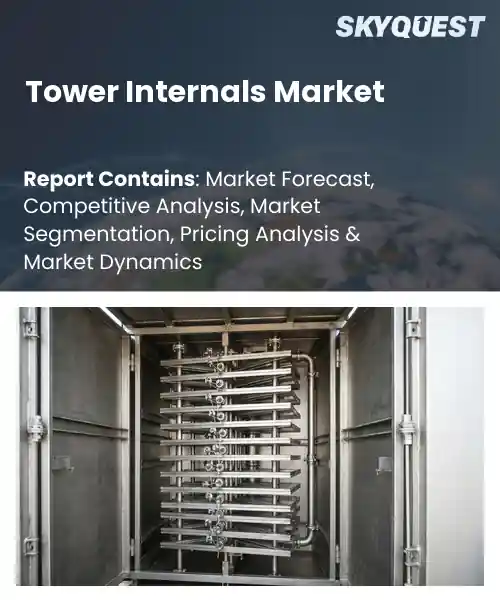
Tower Internals Market
Report ID: SQMIG20I3088
Report ID: SQMIG20I3088
[email protected]
USA +1 351-333-4748
Report ID:
SQMIG20I3088 |
Region:
Global |
Published Date: June, 2026
Pages:
157
|Tables:
139
|Figures:
78


Global Tower Internals Market size was valued at USD 3.4 Billion in 2024 and is poised to grow from USD 3.66 Billion in 2025 to USD 6.62 Billion by 2033, growing at a CAGR of 7.69% during the forecast period (2026-2033).
The primary driver of the tower internals market is accelerating mobile data demand and successive network upgrades toward 5G. Tower internals cover radio units, remote radio heads, feeder and coaxial cabling, fiber backhaul, power distribution, battery backups and mounting hardware that sit on towers to deliver coverage and reliability. This market matters because those components affect capacity, latency and energy consumption, shaping consumer experience, enterprise connectivity and public-safety communications. Over time the sector shifted from simple passive feeders in 2G and 3G to integrated radio and fiber architectures in 4G, then intensified with urban densification and extensive 5G rollouts worldwide.A pivotal factor fueling growth in the tower internals market is network densification and fiberization driven by 5G requirements. As operators deploy higher-frequency spectrum and massive MIMO, cause: antennas and remote radio units multiply on towers, effect: demand grows for advanced mountings, higher-capacity feeders and fiber backhaul to preserve signal integrity. Consequently suppliers expand modular, weatherproof enclosures and low-loss cable solutions, enabling faster field upgrades. This creates opportunities in retrofit contracts, edge compute hosting and hybrid power systems since increased active equipment raises energy needs; real-world cases include urban small-cell clusters and carrier-led tower modernization programs that monetize infrastructure sharing.
How is IoT enhancing operational efficiency in the tower internals market?
Internet of Things is improving operational efficiency in the tower internals market by bringing continuous sensing, condition monitoring and data driven control to distillation and absorption columns. Key aspects include real time measurement of temperature, pressure and liquid distribution, edge analytics and digital twins that convert sensor streams into actionable maintenance and process adjustments. The current state sees growing adoption of sensor arrays and integrated analytics as operators move from calendar based turnarounds to condition based interventions. In practice this means earlier detection of fouling and maldistribution, targeted internals retrofits and smoother revamps that preserve separation performance and reduce disruption.Emerson April 2026, the company deployed Aspen Hybrid Models with Aramco to optimize refinery planning and operations, illustrating how IoT fed models and analytics can improve column performance, enable predictive maintenance and guide internals upgrades to raise throughput while reducing unplanned downtime.
Market snapshot - (2026-2033)
Global Market Size
USD 3.4 Billion
Largest Segment
Structural Supports
Fastest Growth
Cooling Systems
Growth Rate
7.69% CAGR
To get more insights on this market click here to Request a Free Sample Report
Global tower internals market is segmented by tower components, measurement equipment, control systems, power supply, safety systems and region. Based on tower components, the market is segmented into Cooling Systems and Structural Supports. Based on measurement equipment, the market is segmented into Pressure Sensors and Temperature Sensors. Based on control systems, the market is segmented into Automation Controls and Monitoring Systems. Based on power supply, the market is segmented into Backup Power Systems and Distribution Boards. Based on safety systems, the market is segmented into Fire Suppression Systems and Emergency Response Gear. Based on region, the market is segmented into North America, Europe, Asia Pacific, Latin America and Middle East & Africa.
Pressure Sensors segment dominates because robust pressure monitoring underpins operational stability within tower internals, enabling early detection of flow anomalies and structural load changes that would otherwise compromise uptime. Their integration into control loops and compatibility with varied process media drive their centrality; reliable sensing reduces maintenance cycles, informs predictive maintenance strategies, and creates a dependable foundation for upstream optimization across tower systems in the Tower Internals Market.
However, Temperature Sensors are the most rapidly expanding measurement area, propelled by adoption of precise thermal profiling, tighter process tolerances, and sensor miniaturization enabling denser instrumentation. Their wider deployment improves model accuracy and energy optimization, catalyzing demand for integrated monitoring solutions and new instrumentation services within the Tower Internals Market.
Fire Suppression Systems segment stands out because comprehensive fire protection is fundamental to safeguarding sensitive tower internals, preventing catastrophic loss and minimizing downtime caused by thermal events. Their integration with detection, suppression agents, and structural access strategies drives investment; reliable suppression architectures reduce insurance exposure, preserve critical equipment, and support safe maintenance regimes, making them a focal procurement priority across the Tower Internals Market.
However, Emergency Response Gear is emerging as the most rapidly expanding safety area, driven by stricter safety mandates, greater emphasis on worker protection, and demand for portable interoperable kits suited to tower internals. Improved training and modular equipment offerings accelerate aftermarket services and create recurring opportunity across the Tower Internals Market.
To get detailed segments analysis, Request a Free Sample Report
Asia Pacific dominates the global tower internals market due to a convergence of industrial depth, concentrated petrochemical and refining capacity, and strong process engineering capabilities across key economies. Widespread investment in complex separation units, coupled with active retrofit and maintenance cycles, sustains demand for specialized internals. Regional manufacturers and engineering firms have developed tailored designs that address high throughput and corrosive feedstock challenges, enhancing adoption. Dense supplier networks and proximity to large end users shorten supply chains and reduce lead times. Regulatory focus on efficiency and emissions, along with ongoing capacity optimization initiatives, encourages adoption of advanced internals. Collaborative research between industry and technical institutes accelerates innovation, while competitive production costs support both domestic deployment and export activity, reinforcing regional leadership in tower internals.
Tower Internals Market in Japan benefits from advanced manufacturing precision, strong materials engineering, and close integration with major petrochemical clusters. Domestic firms emphasize high reliability and customization for tight process tolerances, supporting retrofits and new builds. Collaboration between industrial manufacturers and research institutions yields incremental design improvements that address corrosion resistance and flow distribution. Robust aftermarket services and quality assurance standards enhance confidence among operators seeking performance and reduced downtime.
Tower Internals Market in South Korea is driven by strong integration with petrochemical complexes and a focus on high performance process equipment. Local engineering capabilities emphasize modularization and rapid deployment, meeting operator needs for efficient turnarounds. Manufacturers prioritize advanced alloys and precision fabrication to withstand demanding feedstocks and temperature profiles. Close collaboration between EPC contractors and end users supports tailored internals solutions while a competitive supplier landscape promotes product refinement.
Rapid expansion of the tower internals market in North America is driven by a combination of modernization initiatives within refining and petrochemical sectors, a strong aftermarket culture, and robust engineering and fabrication capabilities. Operators pursue upgrades for improved process efficiency, energy optimization, and extend asset life, generating demand for retrofit internals and advanced packing solutions. A mature service ecosystem of independent suppliers and specialized contractors enables swift project execution and maintenance turnarounds. Emphasis on operational reliability and stringent quality standards elevates demand for high performance internals. Integration of digital monitoring and diagnostic practices informs tailored internals selection and predictive maintenance, while collaborative partnerships between equipment makers and operators accelerate adoption of innovative materials and proprietary designs that reduce pressure drop and improve mass transfer performance, reinforcing competitive advantages for regional suppliers.
Tower Internals Market in United States is characterized by a large base of complex refineries and plants that prioritize upgrades and efficiency. A dense network of specialized fabricators and engineering firms enables tailored solutions for high throughput and aggressive service conditions. Operators demand robust internals that deliver predictable performance under varied feedstocks. Strong aftermarket services and facilities support deployment and quality assurance, while collaborative vendor relationships drive innovation and optimization.
Tower Internals Market in Canada is shaped by retrofit activity and plant projects serving domestic markets. Local fabricators provide customized internals suited to heavy and variable feedstocks, with focus on corrosion resistance and maintenance access. Operators prefer modular designs that simplify installation during turnarounds. A service oriented supply chain and collaboration between engineering consultancies and operators support practical adaptations and steady adoption of improved internals across refining and chemical processing.
Europe is strengthening its position in the tower internals market through strategic emphasis on high efficiency designs, advanced materials, and stringent quality frameworks that align with operator priorities. Investment in research and collaborative programs between manufacturers and universities drives development of novel packing geometries and corrosion resistant solutions tailored to diverse feedstocks. Retrofit programs in mature facilities create steady demand for engineered internals coupled with comprehensive support services. Strong manufacturing capabilities across specialized suppliers, combined with a focus on lifecycle cost reduction and sustainability, enhance competitiveness. Close coordination among EPC firms, asset owners, and testing laboratories fosters rigorous qualification processes, while adoption of digital design tools and advanced simulation enables precise performance prediction and accelerates qualification, reducing implementation risk for operators.
Tower Internals Market in Germany draws on advanced engineering and precision fabricators serving chemical and refining industries. Manufacturers focus on high integrity designs and material innovations to meet aggressive service conditions and mass transfer demands. Operators rely on qualification protocols and maintenance packages to reduce downtime. Close collaboration between technology providers and end users enables tailored solutions, while emphasis on sustainability and efficiency informs internals selection and asset lifecycle planning.
Tower Internals Market in United Kingdom benefits from strong engineering consultancies and a focus on modular, high efficiency internals for refining and chemical operations. Suppliers emphasize proven designs and rigorous quality assurance to meet demanding process specifications. The aftermarket includes service providers offering installation, inspection, and performance tuning. Close ties between universities and industry encourage material innovation, while regulatory focus on operational integrity supports steady adoption of advanced internals solutions.
Tower Internals Market in France reflects retrofit activity in refineries and targeted demand from chemical sectors. French manufacturers supply bespoke packing and internals that emphasize process flexibility and material compatibility for varied feedstocks. Operators prefer internals that deliver stable separation performance and ease of maintenance. Engineering consultancies and testing facilities provide qualification and adaptation to local specifications. Collaboration between industry clusters and research centers supports practical innovation and performance improvements.
To know more about the market opportunities by region and country, click here to
Buy The Complete Report
Network Infrastructure Expansion
Rising Demand For High-Capacity Backhaul
High Installation And Maintenance Costs
Fragmented Supply Chain Complexity
Request Free Customization of this report to help us to meet your business objectives.
Do you mean tower internals for chemical process columns such as structured packing and trays, or telecom tower internals such as power, shelter and site equipment?
Top Player’s Company Profile
Recent Developments
SkyQuest’s ABIRAW (Advanced Business Intelligence, Research & Analysis Wing) is our Business Information Services team that Collects, Collates, Correlates, and Analyses the Data collected by means of Primary Exploratory Research backed by robust Secondary Desk research. As per SkyQuest analysis, the global tower internals market is driven primarily by network densification and 5G rollouts that increase equipment density and demand for advanced internals, and a second strong driver is rising demand for high-capacity backhaul to support data-intensive services. Growth is anchored by Asia Pacific, where heavy industrial activity, retrofit cycles and local manufacturing shorten lead times and boost adoption. Pressure sensors represent the dominating segment due to their role in ensuring operational stability and enabling predictive maintenance. A significant restraint remains high installation and maintenance costs, which can delay upgrades and lengthen procurement cycles despite clear long-term performance and efficiency benefits.
| Report Metric | Details |
|---|---|
| Market size value in 2024 | USD 3.4 Billion |
| Market size value in 2033 | USD 6.62 Billion |
| Growth Rate | 7.69% |
| Base year | 2024 |
| Forecast period | (2026-2033) |
| Forecast Unit (Value) | USD Billion |
| Segments covered |
|
| Regions covered | North America (US, Canada), Europe (Germany, France, United Kingdom, Italy, Spain, Rest of Europe), Asia Pacific (China, India, Japan, Rest of Asia-Pacific), Latin America (Brazil, Rest of Latin America), Middle East & Africa (South Africa, GCC Countries, Rest of MEA) |
| Companies covered |
|
| Customization scope | Free report customization with purchase. Customization includes:-
|
To get a free trial access to our platform which is a one stop solution for all your data requirements for quicker decision making. This platform allows you to compare markets, competitors who are prominent in the market, and mega trends that are influencing the dynamics in the market. Also, get access to detailed SkyQuest exclusive matrix.
Table Of Content
Executive Summary
Market overview
Parent Market Analysis
Market overview
Market size
KEY MARKET INSIGHTS
COVID IMPACT
MARKET DYNAMICS & OUTLOOK
Market Size by Region
KEY COMPANY PROFILES
Methodology
For the Tower Internals Market, our research methodology involved a mixture of primary and secondary data sources. Key steps involved in the research process are listed below:
1. Information Procurement: This stage involved the procurement of Market data or related information via primary and secondary sources. The various secondary sources used included various company websites, annual reports, trade databases, and paid databases such as Hoover's, Bloomberg Business, Factiva, and Avention. Our team did 45 primary interactions Globally which included several stakeholders such as manufacturers, customers, key opinion leaders, etc. Overall, information procurement was one of the most extensive stages in our research process.
2. Information Analysis: This step involved triangulation of data through bottom-up and top-down approaches to estimate and validate the total size and future estimate of the Tower Internals Market.
3. Report Formulation: The final step entailed the placement of data points in appropriate Market spaces in an attempt to deduce viable conclusions.
4. Validation & Publishing: Validation is the most important step in the process. Validation & re-validation via an intricately designed process helped us finalize data points to be used for final calculations. The final Market estimates and forecasts were then aligned and sent to our panel of industry experts for validation of data. Once the validation was done the report was sent to our Quality Assurance team to ensure adherence to style guides, consistency & design.
Analyst Support
Customization Options
With the given market data, our dedicated team of analysts can offer you the following customization options are available for the Tower Internals Market:
Product Analysis: Product matrix, which offers a detailed comparison of the product portfolio of companies.
Regional Analysis: Further analysis of the Tower Internals Market for additional countries.
Competitive Analysis: Detailed analysis and profiling of additional Market players & comparative analysis of competitive products.
Go to Market Strategy: Find the high-growth channels to invest your marketing efforts and increase your customer base.
Innovation Mapping: Identify racial solutions and innovation, connected to deep ecosystems of innovators, start-ups, academics, and strategic partners.
Category Intelligence: Customized intelligence that is relevant to their supply Markets will enable them to make smarter sourcing decisions and improve their category management.
Public Company Transcript Analysis: To improve the investment performance by generating new alpha and making better-informed decisions.
Social Media Listening: To analyze the conversations and trends happening not just around your brand, but around your industry as a whole, and use those insights to make better Marketing decisions.
REQUEST FOR SAMPLE
 REQUEST FREE CUSTOMIZATION


Want to customize this report? This report can be personalized according to your needs. Our analysts and industry experts will work directly with you to understand your requirements and provide you with customized data in a short amount of time. We offer $1000 worth of FREE customization at the time of purchase.
Feedback From Our Clients


 USA (+1) 351-333-4748

