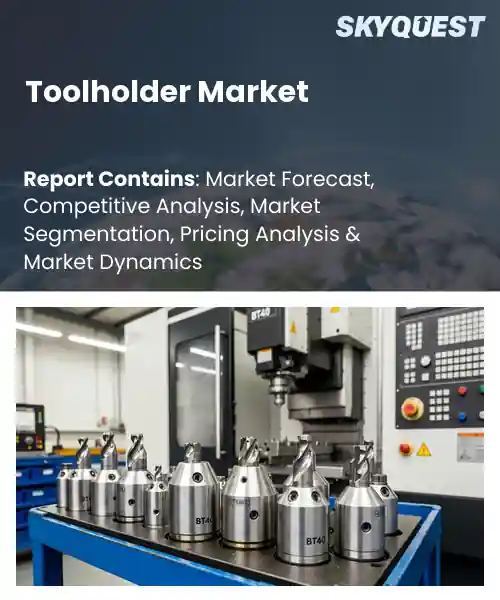
Toolholder Market
Report ID: SQMIG20I2892
Report ID: SQMIG20I2892
[email protected]
USA +1 351-333-4748
Report ID:
SQMIG20I2892 |
Region:
Global |
Published Date: April, 2026
Pages:
157
|Tables:
89
|Figures:
76


Global Toolholder Market size was valued at USD 3.42 Billion in 2024 and is poised to grow from USD 3.6 Billion in 2025 to USD 3.4 Billion by 2033, growing at a CAGR of 5.4% during the forecast period (2026-2033).
Rapid adoption of CNC machining and demand for precision are the primary drivers of the toolholder market, because manufacturers require consistent clamping, repeatability to reduce scrap and cycle times. Toolholder market comprises components that secure cutting tools to spindles, and it matters for productivity and product quality across industries such as automotive and aerospace where tolerances are tight. Historically the market evolved from simple fixed collets to modular systems with balance optimization and coatings, enabling higher spindle speeds and longer tool life. For example, aerospace suppliers replaced legacy holders with balanced designs with coolant delivery to meet surface finish requirements.Building on that evolution, the primary growth engine is automation combined with a shift toward high speed unattended manufacturing, and this drives demand for toolholders offering balance, thermal stability and quick change capability to maximize uptime. As producers increase spindle speeds and run multiple shifts, toolholders with through coolant delivery or embedded sensors enable predictive maintenance and cut unexpected downtime, a pattern seen in automotive lines where quick change chucks reduce setup time significantly. As a result suppliers prioritize modular platforms and aftermarket services, creating opportunities in sensor retrofits, regional manufacturing and tailored supply solutions for critical production sites today.
How is AI improving predictive maintenance in the toolholder market?
AI is improving predictive maintenance in the toolholder market by turning raw sensor streams into actionable condition insight. Key aspects include vibration and torque sensing on driven holders, edge analytics that flag anomalies quickly, and machine learning models that learn wear signatures from cutting data. Today suppliers integrate digital tool libraries and cloud analytics so shops can schedule maintenance based on condition instead of reaction. This shift reduces unexpected downtime and stabilizes process quality while letting application engineers refine parameters from aggregated field data. Practical instances include driven tool monitoring and AI enabled toolpath optimization with tooling companies partnering with software specialists.Sandvik Coromant March 2026, demonstrated integrated tooling data and digital continuity at TechDays which helps convert toolholder sensor signals into predictive signals and supports more efficient maintenance planning and higher shop floor utilization.
Market snapshot - (2026-2033)
Global Market Size
USD 3.42 Billion
Largest Segment
Lucerne Hay & Bales
Fastest Growth
Lucerne Pellets & Cubes
Growth Rate
5.4% CAGR
To get more insights on this market click here to Request a Free Sample Report
Global toolholder market is segmented by product type, application vertical, nature and region. Based on product type, the market is segmented into Lucerne Hay & Bales, Lucerne Pellets & Cubes and Lucerne Meal/Powder. Based on application vertical, the market is segmented into Dairy Cow Nutrition (Primary Segment), Equine/Horse Feed and Others (Poultry & Small Ruminants). Based on nature, the market is segmented into Conventional Lucerne and Organic/Certified Lucerne. Based on region, the market is segmented into North America, Europe, Asia Pacific, Latin America and Middle East & Africa.
Lucerne Pellets & Cubes segment dominates because its production requires high-precision, high-rigidity toolholders for milling, pelletizing dies, and frequent die changes, which drives demand for durable, modular toolholding solutions. Consistent geometry and continuous throughput create pressure for standardized interfaces and long tool life, prompting suppliers to prioritize robust clamping, wear-resistant coatings, and maintenance-friendly designs tailored to pellet and cube manufacturing environments.
However, Lucerne Hay & Bales is emerging as the fastest-growing area as increasing mechanization and automation in baling and handling requires versatile, heavy duty toolholders for cutting, tedding and baler drives. Demand for robust quick-change systems and adaptable clamping for irregular bulky feedstock accelerates new toolholder design adoption.
Dairy Cow Nutrition segment leads because large-scale dairy feed operations require continuous, high-throughput processing where toolholders must deliver exceptional repeatability, rigidity, and hygienic service life. The need for consistent particle size, contaminant control, and quick maintenance cycles drives OEMs and end users to favor robust, easily serviceable toolholding systems, prompting suppliers to optimize clamping accuracy, corrosion resistance, standardized interfaces, and lifecycle cost efficiency.
However, Equine/Horse Feed is the fastest-growing area as demand for precision-formulated, high-quality feeds drives small-batch production and specialized processing lines that require adaptable, high-precision toolholders. Innovations in quick-change micro tooling, contamination control features, and tailored clamping solutions support product differentiation and open aftermarket opportunities, accelerating toolholder R&D and specialized product portfolios.
To get detailed segments analysis, Request a Free Sample Report
Asia Pacific leads the toolholder market due to a convergence of manufacturing scale, advanced machining ecosystems, and strong supply chain integration across key industrial hubs. Deep specialization in automotive, electronics, and precision engineering drives sustained demand for high-performance toolholding solutions. Local manufacturers combine rapid product development with close collaboration with end users, enabling iterative improvements that suit regional production practices. Investment in automation and a dense network of tooling suppliers support efficient aftermarket services and tooling lifecycle management. Regional standards and close proximity to component producers reduce lead times and foster cost efficiencies, while a skilled technical workforce and localized engineering capabilities promote adoption of innovative clamping systems and modular toolholder designs. Policy frameworks encouraging industrial modernization and collaborations with tooling research centers further strengthen regional leadership, creating a resilient ecosystem that attracts global tooling investment.
Toolholder Market in Japan is characterized by precision engineering expertise, close alignment between tool manufacturers and OEMs, and a culture of continuous improvement that emphasizes tolerances and process stability. Manufacturers prioritize high-accuracy clamping systems compatible with advanced machining centers. Collaboration between research institutions and industry accelerates materials and design innovation, while established aftermarket networks ensure reliability and swift maintenance support. This environment promotes uptake of premium, application-specific toolholder solutions widely.
Toolholder Market in South Korea focuses on high-speed production, integration with automated machining lines, and rapid adaptation of new clamping technologies. Strong ties between heavy machinery builders and tooling suppliers enable custom configurations for automotive and electronics manufacturing. Emphasis on vertical integration and process optimization results in standardized toolholder platforms suited for high throughput. Local service ecosystems provide responsive maintenance and retrofit capabilities, supporting consistent performance within demanding production environments.
Expansion in Europe is driven by a combination of industrial modernization, strategic investments in advanced machining capabilities, and collaborative networks linking manufacturers, tooling specialists, and research centers. Adoption of high-precision manufacturing practices across automotive, aerospace, and industrial equipment sectors elevates demand for versatile and high-performance toolholders. Regional emphasis on machining accuracy, interoperability standards, and aftermarket serviceability encourages suppliers to develop modular and digitally enabled solutions. Policy support for manufacturing competitiveness and initiatives promoting closer ties between OEMs and suppliers accelerate technology transfer. Further, a diverse supplier base and strong engineering talent enable tailored solutions for niche segments, while longstanding export orientation keeps Europe influential in setting performance benchmarks for toolholding technologies. Increasing collaboration with metrology and automation providers, and focus on sustainability in machining practices, further stimulate demand for durable, serviceable toolholder systems adapted to evolving production models.
Toolholder Market in Germany is driven by heavy industrial demand, machine tool manufacturers, and strict engineering standards that emphasize precision and durability. Supplier networks deliver integrated toolholding solutions tailored to demanding production lines in automotive and industrial machinery sectors. Close collaboration between OEMs and tooling specialists results in specification-rich products, while aftermarket services ensure calibration and maintenance. The environment supports development of high-capability, standardized toolholder platforms preferred by manufacturers.
Toolholder Market in United Kingdom reflects strong adoption of flexible manufacturing, machining integration, and collaboration between industrial clusters and technology providers. Focus on small-batch customization and agile production increases demand for modular quick-change toolholder systems. Partnerships between tooling firms and automation specialists support deployment of condition-monitoring features and digital interfaces. A dynamic supplier base and services sector enable customization, training, and responsive aftermarket support that helps manufacturers modernize machining operations.
Toolholder Market in France reflects emerging demand from aerospace, precision engineering, and luxury goods sectors that require specialized tooling solutions. Focus on high-quality finishes and tight tolerances drives interest in bespoke toolholder designs and advanced clamping technologies. Collaboration between engineering centers and tooling manufacturers fosters material and design innovation, while regional clusters support early adoption and aftermarket services, helping to build local capability for complex machining tasks and commercial applications.
North America is strengthening its position through a focus on modernization of machining practices, strategic collaboration between OEMs and tooling specialists, and expanding service ecosystems that prioritize reliability and uptime. Investment in digital manufacturing, condition monitoring, and integration of toolholders with machine controls enhances process transparency and reduces operational friction. Tooling suppliers intensify R&D efforts to deliver robust, adaptable clamping solutions suited to diversified manufacturing needs. Regional emphasis on aftermarket support, training, and rapid technical response builds confidence among manufacturers seeking to optimize tool life and process stability. Cross-border supplier partnerships and closer ties with academic research centers further accelerate technology adoption, enabling North America to play a more influential role in defining performance and service expectations for global toolholder solutions.
Toolholder Market in United States is shaped by a broad manufacturing base, focus on R&D, and adoption of digital tooling solutions that integrate with machine controls. Demand from aerospace and advanced machinery sectors drives development of high-reliability clamping systems and condition-monitoring features. Suppliers emphasize service networks, retrofit options, and application engineering to meet diverse production needs. Collaboration with research institutions and automation firms accelerates innovation and supports tailored toolholder platforms.
Toolholder Market in Canada benefits from clusters focused on precision manufacturing, energy sector tooling needs, and an active supplier community that supports machining demands. Emphasis on durable, serviceable toolholder designs suits maintenance-oriented operations and retrofit projects. Close industrial collaboration and strong aftermarket capabilities enable rapid technical support and customization. Partnerships with equipment OEMs and research groups drive improvements and support adoption of modular, efficient toolholding solutions suited to production environments.
To know more about the market opportunities by region and country, click here to
Buy The Complete Report
Rising Adoption Of CNC Technology
Demand For Lightweight Composite Holders
Compatibility Challenges With Legacy Machines
High Cost Of Precision Toolholders
Request Free Customization of this report to help us to meet your business objectives.
Competition in the global toolholder market is driven by a race to own sensorized and digitally integrated holders, with incumbents using acquisitions and targeted partnerships to secure data and automation capabilities. Examples include SCHUNK’s collaboration with startup TOOL IT on the iTENDO smart hydraulic holder and Sandvik’s acquisition of pro-micron to add sensorised tooling and software to its portfolio.
Top Player’s Company Profile
Recent Developments
SkyQuest’s ABIRAW (Advanced Business Intelligence, Research & Analysis Wing) is our Business Information Services team that Collects, Collates, Correlates, and Analyses the Data collected by means of Primary Exploratory Research backed by robust Secondary Desk research. As per SkyQuest analysis, the global toolholder market is being driven primarily by rapid adoption of CNC machining and rising demand for precision, and growth is further supported by automation and a shift toward high speed unattended manufacturing that increases demand for balanced, quick change holders. A key restraint remains compatibility challenges with legacy machines which slows adoption of modern holders. Asia Pacific dominates the market thanks to deep manufacturing ecosystems and supply chain integration, while the Lucerne Pellets & Cubes segment is the leading application area due to its need for high precision and durable, modular toolholding solutions. Suppliers focusing on modularity, sensorization and aftermarket services will capture growth.
| Report Metric | Details |
|---|---|
| Market size value in 2024 | USD 3.42 Billion |
| Market size value in 2033 | USD 3.4 Billion |
| Growth Rate | 5.4% |
| Base year | 2024 |
| Forecast period | (2026-2033) |
| Forecast Unit (Value) | USD Billion |
| Segments covered |
|
| Regions covered | North America (US, Canada), Europe (Germany, France, United Kingdom, Italy, Spain, Rest of Europe), Asia Pacific (China, India, Japan, Rest of Asia-Pacific), Latin America (Brazil, Rest of Latin America), Middle East & Africa (South Africa, GCC Countries, Rest of MEA) |
| Companies covered |
|
| Customization scope | Free report customization with purchase. Customization includes:-
|
To get a free trial access to our platform which is a one stop solution for all your data requirements for quicker decision making. This platform allows you to compare markets, competitors who are prominent in the market, and mega trends that are influencing the dynamics in the market. Also, get access to detailed SkyQuest exclusive matrix.
Table Of Content
Executive Summary
Market overview
Parent Market Analysis
Market overview
Market size
KEY MARKET INSIGHTS
COVID IMPACT
MARKET DYNAMICS & OUTLOOK
Market Size by Region
KEY COMPANY PROFILES
Methodology
For the Toolholder Market, our research methodology involved a mixture of primary and secondary data sources. Key steps involved in the research process are listed below:
1. Information Procurement: This stage involved the procurement of Market data or related information via primary and secondary sources. The various secondary sources used included various company websites, annual reports, trade databases, and paid databases such as Hoover's, Bloomberg Business, Factiva, and Avention. Our team did 45 primary interactions Globally which included several stakeholders such as manufacturers, customers, key opinion leaders, etc. Overall, information procurement was one of the most extensive stages in our research process.
2. Information Analysis: This step involved triangulation of data through bottom-up and top-down approaches to estimate and validate the total size and future estimate of the Toolholder Market.
3. Report Formulation: The final step entailed the placement of data points in appropriate Market spaces in an attempt to deduce viable conclusions.
4. Validation & Publishing: Validation is the most important step in the process. Validation & re-validation via an intricately designed process helped us finalize data points to be used for final calculations. The final Market estimates and forecasts were then aligned and sent to our panel of industry experts for validation of data. Once the validation was done the report was sent to our Quality Assurance team to ensure adherence to style guides, consistency & design.
Analyst Support
Customization Options
With the given market data, our dedicated team of analysts can offer you the following customization options are available for the Toolholder Market:
Product Analysis: Product matrix, which offers a detailed comparison of the product portfolio of companies.
Regional Analysis: Further analysis of the Toolholder Market for additional countries.
Competitive Analysis: Detailed analysis and profiling of additional Market players & comparative analysis of competitive products.
Go to Market Strategy: Find the high-growth channels to invest your marketing efforts and increase your customer base.
Innovation Mapping: Identify racial solutions and innovation, connected to deep ecosystems of innovators, start-ups, academics, and strategic partners.
Category Intelligence: Customized intelligence that is relevant to their supply Markets will enable them to make smarter sourcing decisions and improve their category management.
Public Company Transcript Analysis: To improve the investment performance by generating new alpha and making better-informed decisions.
Social Media Listening: To analyze the conversations and trends happening not just around your brand, but around your industry as a whole, and use those insights to make better Marketing decisions.
REQUEST FOR SAMPLE
 REQUEST FREE CUSTOMIZATION


Want to customize this report? This report can be personalized according to your needs. Our analysts and industry experts will work directly with you to understand your requirements and provide you with customized data in a short amount of time. We offer $1000 worth of FREE customization at the time of purchase.
Feedback From Our Clients


 USA (+1) 351-333-4748

