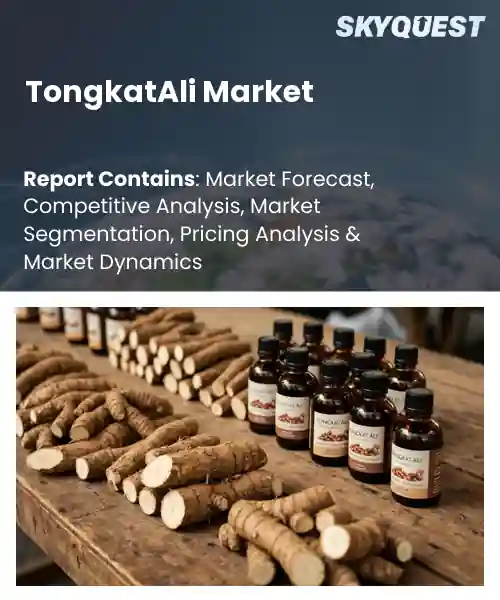
TongkatAli Market
Report ID: SQMIG35I2568
Report ID: SQMIG35I2568
[email protected]
USA +1 351-333-4748
Report ID:
SQMIG35I2568 |
Region:
Global |
Published Date: March, 2026
Pages:
157
|Tables:
118
|Figures:
77


Global Tongkat Ali Market size was valued at USD 96.0 Million in 2024 and is poised to grow from USD 102.62 Million in 2025 to USD 175.01 Million by 2033, growing at a CAGR of 6.9% during the forecast period (2026-2033).
Increased global use of herbal products, caused by increased demand and clinical studies, stimulated the export of tropical plant-based supplements from Southeast Asia, especially from Malaysia and Indonesia. This was accomplished through the establishment of Tongkat Ali as a "normal" herbal medicine for vitality and male reproductive health by utilizing traditional ethnobotanical knowledge and developing standardized extraction methods over the last several decades.
The extensive establishment of ecommerce websites and trade agreements increased the number of distribution channels and increased interest in the Tongkat Ali from end-users due to increased access to objective clinical research on the health benefits of Tongkat Ali. Suppliers also adjusted their production capacity to meet this increased market demand and market demand by developing additional channels to source their raw materials, which has had a substantial impact on growing market sustainable practices. The establishment of quality control measures and scientific validation of Tongkat Ali are keys to creating consumer trust in this growing segment of the market, which will allow continued growth of Tongkat Ali through innovation and increased investment. Controlled clinical trials and chemotype assessments demonstrating the safety and efficacy of Tongkat Ali are providing manufacturers with incentives to invest in standardized extraction methodologies for Tongkat Ali, thereby providing consistency and allowing for certification from regulatory agencies.
This will enable the Tongkat Ali to enter traditional distribution channels such as sports nutrition companies, men's health clinics and fortified beverage companies that only purchase quality-certified products. Improving supply chain reliability and developing sustainable production methods for Tongkat Ali are critical to reducing the chances of adulteration and establishing pricing stability in the market, thereby creating investment opportunities for export-oriented growers and producers of Tongkat Ali.
How is AI Driving Product Development and Consumer Targeting in the Tongkat Ali Market?
Using AI technologies (machine learning and AI-predictive analytics) to alter the way that brands create and position new products, particularly in the Tongkat Ali supply chain, is becoming common practice. For example, companies use machine learning algorithms to identify bioavailability issues or how to modify existing formulas to improve customer satisfaction. Brands also use these same technologies to better segment consumers and create and deliver targeted messages to those consumers based on their lifestyles. An example of the impact of AI on the Tongkat Ali market is Evoke. By increasing the number of products they create, conducting more thorough testing, changing the way they market to consumers, and having an accurate picture of what consumers want from their product, Evoke has been able to launch their newest product line, which includes Tongkat Ali, at an accelerated pace and with less variability.
Additionally, Evoke created a series of AI-driven pilot products that utilize the AI-algorithm-based simulation capabilities to create more efficient consumer experience, generate greater buying frequency, and build greater levels of trust with their customers. The combination of all of these factors will ultimately result in more accessible and wider availability of Tongkat Ali, and the consumer experience will be better than it has ever been.
Market snapshot - (2026-2033)
Global Market Size
USD 96.0 Million
Largest Segment
Capsules
Fastest Growth
Capsules
Growth Rate
6.9% CAGR
To get more insights on this market click here to Request a Free Sample Report
Global Tongkat Ali market is segmented into product type, application, end user, distribution channel and region. Based on product type, the market is segmented into raw extract, capsules, powdered form and others. Based on application, the market is segmented into dietary supplements, athletic performance and others. Based on end user, the market is segmented into health enthusiasts, athletes, general population and others. Based on distribution channel, the market is segmented into online and offline. Based on region, the market is segmented into North America, Europe, Asia Pacific, Latin America and Middle East & Africa.
Capsules have been the leading segment due to the fact that the convenience and accuracy of the dosages involved in purchased products fit into the way in which the manufacturers configures and markets their respective Tongkat Ali products. Capsules allow for consistency in dosing and shelf life, thereby simplifying both compliance with regulations and retail listing. The manufacturers prefer to encapsulate their products as a way of having consistency in the potency of their products for branding purposes. As a result there is a greater acceptance of these products by the average supplement buyer, which promotes repeat purchases through clear labelling and consistent user experience.
As per Tongkat Ali market analysis, raw extract is becoming the fastest growing segment of Tongkat Ali products. The drive for products to have fewer processing and be able to show where they came from has increased the demand for producers to create concentrated, traceable raw extracts that appeal more to the practitioner as well as specialty formulators. Thus, increasing the producer's ability to position themselves as a premium producer of Tongkat Ali products and gain B2B business by collaborating with producers of Quality Tongkat Ali products. This global Tongkat Ali market trend has increased the opportunity for innovative high potency formulations and has provided producers with additional opportunities to create custom product lines and gain endorsement from professional consumers of the products.
As per Tongkat Ali market outlook, the online segment is growing rapidly due to increased accessibility and efficiency of e-commerce as an access point for the large variety of tongue-katali products sold. With consumers increasingly relying on research-oriented purchases and subscription-based purchasing habits, many have transitioned their shopping habits from physical stores to online. The use of digital channels allows brands to showcase not only their sourcing and production capabilities but also provide education and information regarding their products. Small barriers to entry for trying new products, and rapid feedback-based product refinements, it is through online channels that brands will be able to grow their Tongkat Ali market share significantly.
As per Tongkat Ali market forecast, the offline segment is also continuing to grow significantly as retailers and practitioners begin to carry tongue-katali products in their naturally curated product lines and use sampling and in-store demonstrations to help build trust with consumers. Retailers and practitioners are providing access to tongue-katali through their store shelves to facilitate private-label agreements as well providing the opportunity for consumers to refer to practitioners for their purchase. The growth of this offline segment of the tongue-katali market supports the overall growth of the greater market through expanding access to the product and building the trust of local consumers' support networks.
To get detailed segments analysis, Request a Free Sample Report
The Asia Pacific region dominates the market due to strong cultural connections, an established sourcing base to the regions where plants are grown and developed, and mature nutraceutical ecosystems that have long appreciated the therapeutic benefits of plant-based traditional herbal remedies. The major benefits for manufacturers in the region include complete integrated supply chains, specific extraction and formulation processes, and supportive regulatory environments that recognize botanical products as acceptable.
Japan's Tongkat Ali market is characterized by a high level of consumer interest and demand for evidence based natural performance and health products. Companies in Japan are emphasizing improved formulation, extensive safety testing and thorough labelling to meet consumer expectations as well as the requirements of regulatory and retail channels. There are many retail channels for product distribution, including specialty retailers, drug stores and well established e-commerce, where premium positioned brands have proven very appealing to health-conscious consumers.
The Tongkat Ali market in South Korea is growing rapidly and is being driven largely due to the popularity of functional ingredients, in addition to a strong Korean culture of beauty and wellness; therefore, the focus on performance and vitality is a key component of product development. Companies are increasingly utilizing advanced extraction techniques, clinical messaging and multi-ingredient formulations targeted towards active lifestyles. Distribution includes a wide range of retail avenues from online retailers through health and drug stores, all of which utilize strong marketing efforts including engaging influencers.
The increase in consumer demand for natural options for men's health, physical performance, and overall vitality combined with the growing acceptance of botanical supplements by mainstream consumers has been a major contributor to the growth of the North American market for these products. The increasing availability of all-natural performance and wellness supplements in retail stores and online has greatly expanded access to this growing category of products. Retailers of natural supplements include specialty nutrition retailers, health care providers, pharmacies, and many different types of electronic retailing sites, all of which help to facilitate the discovery and purchase of these products. Manufacturers continue to promote their use of standardization, third-party testing, and transparent sourcing to meet the expectations of both consumers and regulatory agencies who are increasingly informed about supplements.
Broad consumer acceptance of natural performance and wellness supplements, along with a high level of sophistication among U.S. consumers, has created a sizeable market for Tongkat Ali (EA) products. The U.S. market for Tongkat Ali supplements is served through a well-established retail and e-commerce infrastructure, with manufacturers focusing on providing scientific evidence for the efficacy of their products and standardized extracts, as well as open and transparent sourcing. Manufacturers and retailers use digital marketing strategies to reach both the active and middle-aged segments of consumers.
The Tongkat Ali market in Canada is characterized by a cautious but receptive consumer base that seeks out quality assurance and products with real health claims. Manufacturers and distributors adhere to strict industry and regulatory standards, conduct rigorous testing, and emphasize ethical sourcing, thereby helping to establish consumer confidence. The retail landscape for Tongkat Ali includes health food stores, pharmacies, and various online shopping platforms, providing multiple options for the health-conscious shopper who is searching for a natural way to enhance performance.
The role of the European Union (EU) in the global herbal and dietary supplement market continues to advance due to the convergence of regulatory clarity, requirements for products to meet safety standards, and increasing consumer demand for evidence-based botanical supplements. Key businesses in this market are working to invest in standardized product extracts, develop traceable supply chains, and obtain certifications to meet the expectations of regional quality standards for smoother market access as well as to build retailer confidence in their products. Additionally, both cross-border distribution networks and specialty supplement retailers support the availability of products within a variety of market segments.
The Germany Tongkat Ali market includes emphasis on scientific validation, high quality and safety standards, and accurate product descriptions to appeal to educated consumers. Brands selling Tongkat Ali use standardized product extracts, perform extensive product testing, and meet stringent retail criteria to build credibility. Distribution channels for Tongkat Ali products consist of pharmacies, specialty retailers/health food stores, and online platforms that place a high value on evidence-based marketing. Establishing relationships with healthcare providers and providing clear communication regarding the benefits and uses of Tongkat Ali increases consumer awareness and acceptance of Tongkat Ali products.
In the UK, the Tongkat Ali market is characterized by informed customers and an evolving retail landscape featuring health food shops, pharmacies and e-commerce platforms. Regulatory adherence via third party testing/supply chain transparency & taking consumer satisfaction seriously is the top priority for everyone in this industry looking to create trust with their customer bases. Tailored products geared towards the active male demographic resonate strongly, as do the marketing efforts employed by experts in the wellness/fitness sectors (e.g., medical practitioners, health coaches) to give buyers insight into how these products can improve their physical performance and overall well-being. Additionally, there is a growing emphasis placed by consumers on sustainability and clearly labelled products to achieve premium category positioning and long-term loyalty from their customer bases.
In France, the Tongkat Ali market operates under strict regulatory oversight and under a consumer base that has very different views towards using botanical supplements than their UK counterparts. Companies who wish to play in this market will be required to show proof of safety, traceability and product compliance with labelling regulations if they want retailers and/or practitioners to stock their brands. Distribution channels that service this market include specialty retailers, pharmacies and internet-based businesses with strong quality conscious customers. Using messaging that builds consumer confidence through scientific research, ethical sourcing and transparent manufacturing will mitigate any concerns from consumers who are adopting more natural means to achieve vitality and performance.
To know more about the market opportunities by region and country, click here to
Buy The Complete Report
Rising Demand Among Wellness Consumers
As interest in natural and botanical medicine grows, so does the interest of consumers in Tongkat Ali to use it as a natural alternative to synthetics for increased energy and overall wellness. This shift in consumer preference has increased the number of manufacturers who will now offer dietary supplements, functional foods and personal care products using Tongkat Ali root extracts as part of their product line, as well as increased their presence in the market. The current focus on a total mind-body connection in terms of health and longevity has driven companies to continue developing their formulation of uniform strength, standardized extracts for Tongkat Ali, thus allowing for a more consistent acceptance within the market, while also providing manufacturers with a foundation to support their marketing efforts that discuss the historical use of the product relative to current production standards and increased levels of quality assurance.
Expansion of Nutraceutical Applications
Continued innovation in development of new products and the expansion of current products into the nutraceutical category has helped to enhance the commercial value of Tongkat Ali, with formulators investigating a wide variety of delivery methods including but not limited to; capsules, powders and beverage blends. The integration of different sports nutrition and functional beverage categories has created new distribution opportunities for the suppliers and provided opportunities for collaborative partnerships between ingredient suppliers and manufacturers of consumer products. The emphasis placed on clean labels and ingredient verification has created a differentiation for brands that invest in scalable extraction methods and stability formulations that maintain activitithic properties. Therefore, increasing the supplier's confidence while encouraging a broader and greater quantity of both retail and online distribution assortments.
Regulatory Uncertainty In Key Markets
The inability of manufacturers and distributors to consistently comply with regulatory frameworks across jurisdictions ultimately limits market expansion due primarily to increased compliance complexity, which leads to manufacturers and distributors taking a cautious approach in developing products and delaying the launch of product lines. Manufacturers must assess botanical ingredient approval processes for use in product formulations based upon differing requirements for botanical ingredient approval throughout different jurisdictions, permissible product claims, and documentation requirements for product quality. As a result, firms consolidate operation of resources for developing products with faster commercialization timelines into the legal assessment of compliance requirements rather than commercialization.
Supply Chain and Quality Variability
The supply chain and quality variability associated with raw materials and the fragmentation of the supply chain limits overall market confidence due to the differences that exist in sourcing procedure, extraction procedure and the raw materials' underlying botanical source. The result is that manufacturers and retailers who sell both retail and wholesale products will create an environment of increased procurement complexity and associated operational costs when the manufacturers and retailers continue to impose stricter sourcing requirements as compared with acceptable business practices due to concerns related to product adulteration; thus consistent supply of raw materials for large-volume production will not be readily available, which will limit both the rate at which mainstream consumers will adopt products and the willingness of firms to invest in product lines that depend upon consistent performance of raw materials.
Request Free Customization of this report to help us to meet your business objectives.
Ingredient owners, extract specialists, and fast-moving supplement innovators make up the competitive landscape of the global Tongkat Ali industry. The competition among these players is driven by two factors buyers demand validated, patented extracts; brand owners use acquisitions, distribution agreements, supplier partnerships around proprietary extracts, and data-driven product formulations to differentiate themselves from other companies.
SkyQuest’s ABIRAW (Advanced Business Intelligence, Research & Analysis Wing) is our Business Information Services team that Collects, Collates, Correlates, and Analyses the Data collected by means of Primary Exploratory Research backed by robust Secondary Desk research.
As per SkyQuest analysis, the global Tongkat Ali industry is being propelled primarily by growing consumer demand for natural health and performance supplements, while a second important driver is increasing scientific validation and standardization of extracts that enable broader institutional adoption. However, regulatory uncertainty in key markets remains a major restraint, complicating cross-border launches and labeling. Asia Pacific retains dominance due to cultural familiarity, established supply chains and specialized extraction capabilities, and capsules lead product formats because of convenience, precise dosing and retail friendliness. Overall the market balances strong consumer interest and improving quality assurance against regulatory complexity that will shape global Tongkat Ali market growth trajectories.
| Report Metric | Details |
|---|---|
| Market size value in 2024 | USD 96.0 Million |
| Market size value in 2033 | USD 175.01 Million |
| Growth Rate | 6.9% |
| Base year | 2024 |
| Forecast period | (2026-2033) |
| Forecast Unit (Value) | USD Million |
| Segments covered |
|
| Regions covered | North America (US, Canada), Europe (Germany, France, United Kingdom, Italy, Spain, Rest of Europe), Asia Pacific (China, India, Japan, Rest of Asia-Pacific), Latin America (Brazil, Rest of Latin America), Middle East & Africa (South Africa, GCC Countries, Rest of MEA) |
| Companies covered |
|
| Customization scope | Free report customization with purchase. Customization includes:-
|
To get a free trial access to our platform which is a one stop solution for all your data requirements for quicker decision making. This platform allows you to compare markets, competitors who are prominent in the market, and mega trends that are influencing the dynamics in the market. Also, get access to detailed SkyQuest exclusive matrix.
Table Of Content
Executive Summary
Market overview
Parent Market Analysis
Market overview
Market size
KEY MARKET INSIGHTS
COVID IMPACT
MARKET DYNAMICS & OUTLOOK
Market Size by Region
KEY COMPANY PROFILES
Methodology
For the TongkatAli Market, our research methodology involved a mixture of primary and secondary data sources. Key steps involved in the research process are listed below:
1. Information Procurement: This stage involved the procurement of Market data or related information via primary and secondary sources. The various secondary sources used included various company websites, annual reports, trade databases, and paid databases such as Hoover's, Bloomberg Business, Factiva, and Avention. Our team did 45 primary interactions Globally which included several stakeholders such as manufacturers, customers, key opinion leaders, etc. Overall, information procurement was one of the most extensive stages in our research process.
2. Information Analysis: This step involved triangulation of data through bottom-up and top-down approaches to estimate and validate the total size and future estimate of the TongkatAli Market.
3. Report Formulation: The final step entailed the placement of data points in appropriate Market spaces in an attempt to deduce viable conclusions.
4. Validation & Publishing: Validation is the most important step in the process. Validation & re-validation via an intricately designed process helped us finalize data points to be used for final calculations. The final Market estimates and forecasts were then aligned and sent to our panel of industry experts for validation of data. Once the validation was done the report was sent to our Quality Assurance team to ensure adherence to style guides, consistency & design.
Analyst Support
Customization Options
With the given market data, our dedicated team of analysts can offer you the following customization options are available for the TongkatAli Market:
Product Analysis: Product matrix, which offers a detailed comparison of the product portfolio of companies.
Regional Analysis: Further analysis of the TongkatAli Market for additional countries.
Competitive Analysis: Detailed analysis and profiling of additional Market players & comparative analysis of competitive products.
Go to Market Strategy: Find the high-growth channels to invest your marketing efforts and increase your customer base.
Innovation Mapping: Identify racial solutions and innovation, connected to deep ecosystems of innovators, start-ups, academics, and strategic partners.
Category Intelligence: Customized intelligence that is relevant to their supply Markets will enable them to make smarter sourcing decisions and improve their category management.
Public Company Transcript Analysis: To improve the investment performance by generating new alpha and making better-informed decisions.
Social Media Listening: To analyze the conversations and trends happening not just around your brand, but around your industry as a whole, and use those insights to make better Marketing decisions.
REQUEST FOR SAMPLE
 REQUEST FREE CUSTOMIZATION
Global Tongkatali Market size was valued at USD 96.0 Million in 2024 and is poised to grow from USD 102.62 Million in 2025 to USD 175.01 Million by 2033, growing at a CAGR of 6.9% during the forecast period (2026-2033).
Competitive landscape in the global Tongkat Ali market is defined by ingredient owners, extract specialists, and nimble supplement startups vying on extract standardization, traceable sourcing, and branded supply agreements. Competition is driven by buyers demanding validated, patented extracts and by brands using acquisitions, distribution deals, supplier collaborations around proprietary extracts, and data driven formulation to differentiate products. 'Herbalife Nutrition Ltd.', 'Nature's Way Products, LLC', 'GNC Holdings, Inc.', 'NOW Foods', 'Solaray', 'Nutricost', 'Zen Nutrients', 'Source Naturals', 'BulkSupplements.com', 'Lost Empire Herbs', 'Momentous', 'Highlander Botanicals', 'Pure Synergy', 'Herbal Secrets', 'Tonik Health', 'Starwest Botanicals', 'Natural Factors', 'Energy & Endurance LLC', 'Swanson Health Products', 'Herb Pharm'
Consumer preference for natural and plant-based remedies has elevated demand for Tongkat Ali, as consumers seek alternatives to synthetic compounds for vitality and general well-being. This preference drives manufacturers to incorporate root extracts into dietary supplements, functional foods, and personal care products, expanding product portfolios and retail presence. Emphasis on holistic health and longevity encourages ongoing development of standardized extract formulations, which supports broader market acceptance and stimulates marketing efforts that highlight traditional use alongside modern production standards and enhanced quality assurance.
Premiumization Driving Product Positioning: Premiumization is prompting suppliers and brands to reposition extracts as high-value functional ingredients tailored for discerning consumers seeking efficacy, traceability, and sustainable sourcing. This trend encourages development of certified, branded formulas with enhanced marketing narratives focused on provenance and clinical-grade quality, enabling higher margins. Retailers and online platforms are allocating premium shelf space and storytelling resources, while manufacturers invest in differentiated processing and certification to justify price premiums and foster brand loyalty among health-conscious, affluent buyer segments globally and regionally.
The Asia Pacific region dominates the market due to strong cultural connections, an established sourcing base to the regions where plants are grown and developed, and mature nutraceutical ecosystems that have long appreciated the therapeutic benefits of plant-based traditional herbal remedies.


Want to customize this report? This report can be personalized according to your needs. Our analysts and industry experts will work directly with you to understand your requirements and provide you with customized data in a short amount of time. We offer $1000 worth of FREE customization at the time of purchase.
Feedback From Our Clients


 USA (+1) 351-333-4748

