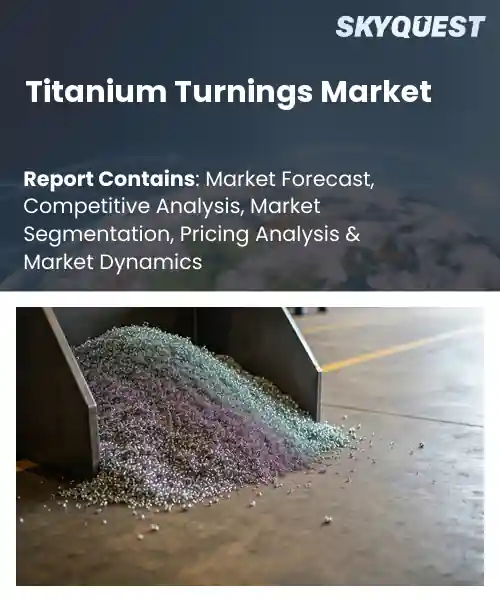
Titanium Turnings Market
Report ID: SQMIG15J2158
Report ID: SQMIG15J2158
[email protected]
USA +1 351-333-4748
Report ID:
SQMIG15J2158 |
Region:
Global |
Published Date: February, 2026
Pages:
157
|Tables:
155
|Figures:
78


Global Titanium Turnings Market size was valued at USD 1.40 Billion in 2024 and is poised to grow from USD 1.5 Billion in 2025 to USD 2.8 Billion by 2033, growing at a CAGR of 7.5% during the forecast period (2026-2033).
The global titanium turnings market growth is driven because industries demand more titanium turning recovery from high-value applications which include aerospace and additive manufacturing. The material titanium turnings consist of swarf and chips which emerge from the machining process of components. This material holds significance because its recovery process helps companies achieve cost savings through reduced raw material expenses, and companies handle their environmental responsibilities through responsible material management. The reclamation rates have improved during the past twenty years because of better processing technologies and company recycling programs and stronger supply chain controls. Aerospace OEMs gather swarf for remelting purposes while powder makers use recycled feed to create titanium powder which they use in 3D printing applications.
Moreover, the global titanium turnings market penetration depends on processing advancements and contamination control progress because oil and ferrous contaminants and mixed alloys make materials difficult to recycle and reduce alloy performance. The industry is investing in sorting and cleaning and remelting facilities because oil and ferrous contaminants and mixed alloys in materials reduce their recycling potential and the performance of alloys. Processors use automated separation together with chemical cleaning and vacuum melting methods to create certified reclaimed ingots. This process decreases their need for virgin ore while helping manufacturers save money. Aerospace suppliers use remelted ingots to produce fasteners which create closed-loop supply chains for additive manufacturers who transform cleaned turnings into profitable powder products.
The global titanium turning market outlook changes due to the use of AI technology to automate its quality control processes while recycling operations become more efficient through its advanced feedstock classification capabilities. The system operates on three main components which include machine learning-based visual and spectral analysis, real-time sorting with contamination identification capabilities and process control that sends operational data back to the melting processes. The industry now recognizes recycled turnings as essential circular feedstock which requires both purity and traceability to maintaintheir value for aerospace and industrial alloy production. The AI optical sorters together with the inline analyzers create a system which identifies contaminants before the melting process starts to decrease manual work and material wastage while enhancing recycled titanium production efficiency and product consistency.
Market snapshot - (2026-2033)
Global Market Size
USD 0.64 Million
Largest Segment
Grade 5 (Ti-6Al-4V)
Fastest Growth
Grade 5 (Ti-6Al-4V)
Growth Rate
6.4% CAGR
To get more insights on this market click here to Request a Free Sample Report
The global titanium turnings market is segmented by grade type, processing type, product form, application, end-user industry, and region. Based on grade type, the market is categorized into Grade 1, Grade 2, Grade 3, Grade 4, Grade 5 (Ti-6Al-4V), Grade 7, Grade 12, and others. By processing type, the market is segmented into machining turnings, grinding turnings, milling turnings, and lathing turnings. In terms of product form, the market includes chips, shavings, and scraps. Based on application, the market is divided into aerospace, automotive, medical, chemical processing, marine, power generation, sports equipment, and others. By the end-user industry, the market is segmented into manufacturing units, recycling units, and metal fabrication. Regionally, the market is categorized into North America, Europe, Asia Pacific, Latin America, and the Middle East & Africa.
As per the global titanium turnings market analysis, the Grade 5 (Ti-6Al-4V) segment leads the market because its alloy features distribute essential material properties which all critical applications require, thus industrial operations demand high-quality turnings without interruption. The material delivers superior strength to weight ratio, which establishes standard machining requirements; thus, manufacturers create specialized supply networks that drive up product costs. The system maintains reliable operation which increases processing throughput while financial backing for tooling development and inspection systems and supply chain relationships grows because of its essential market position.
Whereas the Grade 2 segment shows the strongest market growth because manufacturers need to balance machinability with cost efficiency for their industrial production needs. The cutting characteristics demonstrate easier operation which reduces cycle times while extending tool lifespan, thus secondary applications and recycling streams now use this material. The practical appeal together with the growing number of applications drives demand for processed turnings while establishing new opportunities for suppliers to enter the market.
According to the global titanium turnings market forecast, the machining turnings segment leads the market because it provides critical titanium applications with necessary precision and surface integrity, which enables businesses to meet their strict dimensional and surface finish requirements. The market achieves high CNC machining adoption through advanced tooling equipment, which provides controlled cutting parameters, thus helping businesses reduce material waste while achieving consistent production results that build customer trust. The market drives businesses to invest in machining capacity and process improvements because they need parts which meet narrow tolerance limits, thus maintaining machining turnings as their primary supply method.
Whereas the grinding turnings category is anticipated to have the highest titanium turnings market share because customers need better surface finishes, and buyers demand thin section components which require minimal post processing work. The new abrasive technologies together with updated dressing technologies now make it possible to reach higher production levels for difficult titanium alloys, which in turn creates new business opportunities within high precision medical and aerospace component manufacturing. The process of refining materials now expands with value capture, which leads to more investments in dedicated grinding facilities.
To get detailed segments analysis, Request a Free Sample Report
As per the titanium turnings market regional forecast, the manufacturing ecosystems inside Asia Pacific create advanced processing systems which enable production between integrated manufacturing systems and their nearby main users. The established industrial clusters in this area support direct cooperation between raw material suppliers and precision turning specialists who work to deliver high-quality products for aerospace and medical industries and advanced industrial manufacturing. The skilled machining workforce together with specialized machine tool suppliers provides resources which enable manufacturers to create customized titanium parts with high-quality standards. The system of localized supply chains together with logistics networks enables companies to achieve faster delivery times while they can adapt their operations to meet new requirements. The cooperation between component manufacturers and system integrators establishes a strong process that leads to new product development which attracts customers who want to create both standard production runs and advanced titanium turning technologies.
The titanium turnings sector in Japan combines two precision engineering clusters which need specialized machine tool producers to fulfill their requirements. Aerospace component manufacturers and research centers work together to improve turning techniques which handle difficult titanium alloys. High-value production depends on traceability together with repeatable processes which need process improvement to increase production value. Japan supply chain systems rely on deep technical training which works with tight supplier networks to deliver advanced mobility and defense components.
South Korea combines agile manufacturing practices with strong electronics and shipbuilding sectors for its Titanium Turnings Market. The business model focuses on fast prototype creation, which allows production of customized titanium parts that meet specific requirements. The relationship between fabricators and integrators supports an ongoing process of design improvement and quality evaluation. Investing skilled operators and localized material sourcing improves the speed of production processes while the company achieves reliable performance. The market offers dynamic turning solutions which match local industrial requirements while supporting export activities to different regions.
European markets are expanding at a fast rate because advanced manufacturing experts work together with precision sector customers who need supply chain resilience protection. European manufacturers establish production partnerships with research institutes which speed up their adoption of advanced turning methods which scientists use to validate their titanium alloy systems. The supply chain mechanisms which govern the product delivery process will require suppliers to enhance product quality while developing more effective methods to track their items. The production of complex aerospace medical and high-performance automotive components requires deep engineering expertise which manufacturers achieve by investing in both automation and high-precision machine tools. The European market functions as a hub for titanium turning solutions because geographic clusters and cross-border supplier networks allow customers to obtain customized products which develop their essential business needs.
Germany bases its Titanium Turnings Market on three main factors which include precision engineering hubs and aerospace and automotive supply chain connections and its developed machine tool system. The production of intricate titanium components requires strict quality standards and certification programs which guarantee product reliability. The engineering process between manufacturers and system integrators leads to improvements in manufacturing operations. German advanced machining capabilities provide European and worldwide markets with premium titanium turnings which meet their exacting requirements.
The United Kingdom industry of titanium turnings is advancing to faster development because of dedicated funding for three fields which include advanced manufacturing and lightweight mobility and specialized supplier businesses. The business model focuses on fast prototype creation, which allows production of customized titanium parts that meet specific requirements. United Kingdom has developed into a major exporter for precision titanium turnings because its companies now concentrate on high-value niche components which build their supply chain resilience capabilities.
France establishes its Titanium Turnings Market through specialized machining clusters which deliver services to medical device producers and energy companies and aerospace manufacturers. Research partnerships together with SME innovation work to create production processes which use new turning techniques from development laboratories. The production of highly complex titanium products needs material science expertise together with artisanal precision skills. France has become a regional destination which offers both specialized titanium turning services and innovative solutions.
North America strengthens its position through dedicated investment in advanced fabrication technologies and strategic supplier development and better alignment with essential end markets. The continuous need for qualified titanium turnings exists because aerospace and medical and defense manufacturers maintain a strong presence which leads suppliers to establish strict qualification and traceability procedures. The combination of automation and hybrid machining methods with digital quality controls results in higher throughput and consistent performance for intricate parts. Supplier ecosystems develop new capabilities to deliver immediate aftermarket assistance together with specialized finishing solutions. The North American titanium turning industry becomes more resilient through combination of research institutions and industry partners and end users who help accelerate process validation and skills training initiatives.
The Titanium Turnings Market in the United States demonstrates both its advanced fabrication capacity and high demand from the aerospace and medical sectors and its current investments in automation and hybrid machining technology. Qualification standards and supplier accreditation together with end-user collaboration increase mission-critical titanium component production. Providers who operate integrated supply chains deliver both immediate aftermarket service and custom finishing solutions. The ecosystem develops strong technical skills which help multiple industries improve their titanium turning processes for various industrial uses and different levels of operational capacity.
The Titanium Turnings Market of Canada expands through development of specific capacities which include precision machining and material sourcing and subcontracting work for the aerospace and energy sectors. The business sector requires skilled workers who can directly communicate with clients while working together with research institutions to improve titanium alloy turning techniques. The growing number of specialized service providers combined with improved quality management systems enables organizations to produce intricate small-scale components. Canada offers adaptable customer-oriented titanium turning services which support both domestic production and international shipping requirements.
To know more about the market opportunities by region and country, click here to
Buy The Complete Report
Rising Demand from Aerospace Industry
Manufacturers in the aerospace sector need lightweight materials which possess high strength and titanium turnings to serve as a reliable recycling source which manufacturers can utilize for their recycling and remanufacturing processes. The ability to use turnings as raw materials helps manufacturers reduce their need for raw titanium ore while achieving circular manufacturing practices which support industry goals of weight reduction and fuel efficiency. Aerospace suppliers currently focus on sustainable material sourcing and supply chain efficiency, which allows them to use titanium turnings as a way tolower machining costs while creating additional possibilities to market reclaimed titanium to make components and repair processes.
Growth in Medical Device Manufacturing
Medical device manufacturers utilize biocompatible materials which exhibit exact metallurgical specifications, while titanium turnings serve as a secondary material solution which can be transformed into implantable components and surgical instruments after passing strict quality checks. The market for reclaimed material streams exists because titanium maintains its role as the preferred material for prosthetics and implants which directly sustains demand for recycled titanium resources. Manufacturers can establish closed-loop sourcing systems through accessible titanium turnings which improve resource efficiency across medical supply chains while enabling them to control material availability through recycling and reuse strategies.
Contamination and Quality Concerns
Titanium turnings which have become scrap status show different levels of contamination through the presence of coolants and oils and alloying elements, which makes reprocessing difficult and limits their use in high-specification applications. The need to clean materials thoroughly and sort them while conducting testing procedures creates extended processing times which lead to reduced quantities of turnings that can be used in critical component manufacturing. Users of products require assurance that they will function as expected which makes reclaimed turnings less valuable because of contamination risks thus increasing the need for virgin material when quality assurance and regulatory compliance become critical.
Limited Recycling Infrastructure Availability
The current titanium turning reuse system for different areas requires both collection systems and segregation methods and industrial-scale reprocessing capabilities which prevents manufacturers from obtaining processed materials. The establishment of reliable secondary markets faces challenges due to limited specialized facilities and the presence of fragmented scrap streams and difficulties with logistics. The recycling networks must become standardized and available to everyone because their absence makes it hard to create traceable systems and certification processes which preventmanufacturers from using reclaimed feedstock for sensitive applications. The current situation prevents material recovery initiatives from expanding their operations while it obstructs market development.
Request Free Customization of this report to help us to meet your business objectives.
The global titanium turning market faces competitors who aim to obtain scrap feedstock which they will transform into low carbon powders used for aerospace and additive manufacturing applications. Companies use M and A activities together with supplying partnerships and processing technology advancements to secure feedstock resources while increasing their profit margins. The IperionX and Aperam recycling partnership Kymera’s acquisition of AmeriTi and Sortera and Sun Metalon’s latest AI sorting plus low energy heating investments represent three current market developments.
Recent Developments in the Titanium Turnings Market
Aerospace Lightweighting Adoption: Demand for lightweight high-performance airframes create a market need for titanium turnings because they serve as valuable feedstock in reclaimed material manufacturing. Original equipment manufacturers and tier suppliers are collaborating with scrap processors to obtain certified materials which fulfill their rigorous metallurgical and traceability standards. The trend promotes closed loop procurement while enabling manufacturers to obtain titanium chemistry for their secondary production processes. Supply chain partners are working together to develop industrywide specifications while establishing quality control methods and design techniques that allow for reclaimed titanium material use across all markets.
Digital Traceability Integration: Titanium turnings market participants are allocating funds to develop digital traceability systems which will authenticate alloy composition and tracing history of titanium turnings from their source. The combination of sensor tracking and secure ledgers with supplier systems creates a method to authenticate material origins which regulated user's trust. Enhanced traceability enables efficient supply chain matching with quality reconciliation and contract obligations to be resolved through direct matching of materials. Digital systems which enable procurement transparency to become a priority will enhance coordination between machining operations and recycling processors and manufacturers, which allows for the wider distribution of recycled titanium inputs across various markets.
SkyQuest’s ABIRAW (Advanced Business Intelligence, Research & Analysis Wing) is our Business Information Services team that Collects, Collates, Correlates, and Analyses the Data collected by means ofPrimary Exploratory Research backed by robust Secondary Desk research.
As per SkyQuest analysis, as the automotive and aerospace and medical sectors increase their demand for titanium turnings, experts project that the global titanium turnings market will see steady growth. Grade 5 (Ti-6Al-4V) is used in engine and structural components which leads to higher aircraft manufacturing requirements. The market is expanding because consumers are showing greater interest in sustainable manufacturing methods which include metal recycling. The remelting processes of titanium turnings enable them to be reused after their initial application. Supply dynamics in the Asia Pacific sector are strengthened by improved machining technology and increased industrial production. The market will continue to expand because strong end-user demand and recycling efforts and technological advances are creating a persistent demand for recycling.
| Report Metric | Details |
|---|---|
| Market size value in 2024 | USD 0.64 Million |
| Market size value in 2033 | USD 1.12 Million |
| Growth Rate | 6.4% |
| Base year | 2024 |
| Forecast period | (2026-2033) |
| Forecast Unit (Value) | USD Million |
| Segments covered |
|
| Regions covered | North America (US, Canada), Europe (Germany, France, United Kingdom, Italy, Spain, Rest of Europe), Asia Pacific (China, India, Japan, Rest of Asia-Pacific), Latin America (Brazil, Rest of Latin America), Middle East & Africa (South Africa, GCC Countries, Rest of MEA) |
| Companies covered |
|
| Customization scope | Free report customization with purchase. Customization includes:-
|
To get a free trial access to our platform which is a one stop solution for all your data requirements for quicker decision making. This platform allows you to compare markets, competitors who are prominent in the market, and mega trends that are influencing the dynamics in the market. Also, get access to detailed SkyQuest exclusive matrix.
Table Of Content
Executive Summary
Market overview
Parent Market Analysis
Market overview
Market size
KEY MARKET INSIGHTS
COVID IMPACT
MARKET DYNAMICS & OUTLOOK
Market Size by Region
KEY COMPANY PROFILES
Methodology
For the Titanium Turnings Market, our research methodology involved a mixture of primary and secondary data sources. Key steps involved in the research process are listed below:
1. Information Procurement: This stage involved the procurement of Market data or related information via primary and secondary sources. The various secondary sources used included various company websites, annual reports, trade databases, and paid databases such as Hoover's, Bloomberg Business, Factiva, and Avention. Our team did 45 primary interactions Globally which included several stakeholders such as manufacturers, customers, key opinion leaders, etc. Overall, information procurement was one of the most extensive stages in our research process.
2. Information Analysis: This step involved triangulation of data through bottom-up and top-down approaches to estimate and validate the total size and future estimate of the Titanium Turnings Market.
3. Report Formulation: The final step entailed the placement of data points in appropriate Market spaces in an attempt to deduce viable conclusions.
4. Validation & Publishing: Validation is the most important step in the process. Validation & re-validation via an intricately designed process helped us finalize data points to be used for final calculations. The final Market estimates and forecasts were then aligned and sent to our panel of industry experts for validation of data. Once the validation was done the report was sent to our Quality Assurance team to ensure adherence to style guides, consistency & design.
Analyst Support
Customization Options
With the given market data, our dedicated team of analysts can offer you the following customization options are available for the Titanium Turnings Market:
Product Analysis: Product matrix, which offers a detailed comparison of the product portfolio of companies.
Regional Analysis: Further analysis of the Titanium Turnings Market for additional countries.
Competitive Analysis: Detailed analysis and profiling of additional Market players & comparative analysis of competitive products.
Go to Market Strategy: Find the high-growth channels to invest your marketing efforts and increase your customer base.
Innovation Mapping: Identify racial solutions and innovation, connected to deep ecosystems of innovators, start-ups, academics, and strategic partners.
Category Intelligence: Customized intelligence that is relevant to their supply Markets will enable them to make smarter sourcing decisions and improve their category management.
Public Company Transcript Analysis: To improve the investment performance by generating new alpha and making better-informed decisions.
Social Media Listening: To analyze the conversations and trends happening not just around your brand, but around your industry as a whole, and use those insights to make better Marketing decisions.
REQUEST FOR SAMPLE
 REQUEST FREE CUSTOMIZATION
Global Titanium Turnings Market size was valued at USD 0.64 Million in 2024 and is poised to grow from USD 0.68 Million in 2025 to USD 1.12 Million by 2033, growing at a CAGR of 6.4% during the forecast period (2026-2033).
Competitive dynamics in the global titanium turnings market center on securing scrap feedstock and converting it into low carbon powders for aerospace and additive manufacturing. Companies pursue M and A, supply partnerships and processing innovation to win feedstock and margin. Examples include the IperionX and Aperam recycling partnership, Kymera’s acquisition of AmeriTi, and recent investments in AI sorting and low energy heating by Sortera and Sun Metalon. 'Titanium Industries, Inc.', 'VSMPO-AVISMA Corporation', 'RTI International Metals', 'Timet', 'Titanium Metal Supply', 'Carpenter Technology Corporation', 'Allegheny Technologies Incorporated', 'Phoenix Specialty Manufacturing', 'Ultimet Materials', 'Titanium Fabrication Technologies', 'Dynamic Materials Corporation', 'American Elements', 'Ametek Specialty Metal Products', 'Titanium Processing Center', 'Seco Warwick Corporation', 'Houghton International, Inc.', 'Advanced Metallurgical Group N.V.', 'Allvac', 'AMETEK in titanium', 'Haynes International, Inc.'
Consumers in aerospace require lightweight, high-strength materials, and titanium turnings benefit manufacturers by providing a reliable feedstock for recycling and remanufacturing processes. The availability of usable turnings reduces raw titanium ore reliance and supports circular manufacturing practices that align with industry priorities for weight reduction and fuel efficiency. As aerospace suppliers prioritize sustainable material sourcing and streamlined supply chains, titanium turnings facilitate cost containment in machining operations and broaden secondary market opportunities, thereby encouraging greater adoption of reclaimed titanium in component production and repair workflows.
Aerospace Lightweighting Adoption: Growing demand for lighter, high performance airframes is driving interest in titanium turnings as a feedstock for reclaimed material streams. OEMs and tier suppliers are engaging with scrap processors to secure certifiable supplies that meet stringent metallurgical and traceability requirements. This trend supports closed loop procurement and enables effective access to titanium chemistry for secondary manufacturing. Increased collaboration across the value chain is fostering specification harmonization, quality assurance protocols, and design approaches that accommodate reclaimed titanium inputs industrywide across markets.
Asia Pacific Dominates the Global Titanium Turnings Market


Want to customize this report? This report can be personalized according to your needs. Our analysts and industry experts will work directly with you to understand your requirements and provide you with customized data in a short amount of time. We offer $1000 worth of FREE customization at the time of purchase.
Feedback From Our Clients


 USA (+1) 351-333-4748

