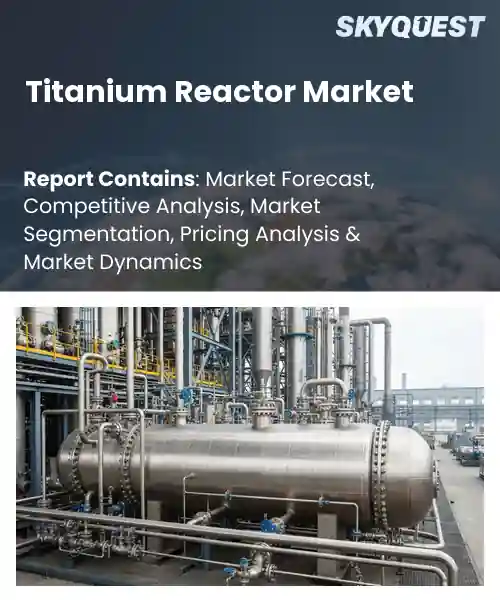
Titanium Reactor Market
Report ID: SQMIG20I2758
Report ID: SQMIG20I2758
[email protected]
USA +1 351-333-4748
Report ID:
SQMIG20I2758 |
Region:
Global |
Published Date: March, 2026
Pages:
157
|Tables:
114
|Figures:
77


Global Titanium Reactor Market size was valued at USD 970.0 Million in 2024 and is poised to grow from USD 1040.0 Million in 2025 to USD 1840.0 Million by 2033, growing at a CAGR of 7.4% during the forecast period (2026-2033).
Titanium reactors are pressure vessels and mixing systems selected where acids, chlorides or seawater degrade common alloys, this drives market demand by reducing downtime, contamination risk and total lifecycle costs for chemical, pharmaceutical and desalination operations. Historically adoption started with chlor‑alkali electrolysis and titanium heat exchangers and then broadened as fabrication, welding and coating methods improved and economies of scale lowered premiums, with examples including offshore platforms and high‑purity pharmaceutical synthesis globally.
Building on corrosion resistance, the key trend driving the global titanium reactor sector demand is the accelerating need for reliable equipment in desalination, hydrogen electrolysis, and high-purity chemical synthesis. As coastal utilities and petrochemical refineries increase throughput to meet population and energy transitions, operators choose titanium to prevent failure and lower maintenance, which in turn stimulates orders for larger, custom reactors. Examples include titanic-lined vessels within gulf desalination projects to accommodate chlorination of seawater, while developing green hydrogen facilities use titanium electrolytic parts to manage alkaline and/or seawater as feedstocks. This provides an opportunity to expand manufacturing capabilities and offer aftermarket services and enhanced supplier networks for those who provide such systems.
How is AI Enhancing Performance and Reliability in the Titanium Reactor Market?
AI is improving performance and reliability in the titanium reactor market by combining sensors, machine learning and digital twin methods to catch early signs of corrosion, predict electrode wear, and optimize operating conditions. Operators now deploy online sensor arrays and AI models to detect anomalies and schedule intervention before failures, which cuts unplanned downtime and lengthens component life. AI also tunes process set points to improve current distribution and reduce fouling. These advances help projects scale more predictably and make titanium solutions more attractive to industrial buyers.
Market snapshot - 2026-2033
Global Market Size
USD 0.97 Billion
Largest Segment
Continuous Reactors
Fastest Growth
Continuous Reactors
Growth Rate
7.4% CAGR
To get more insights on this market click here to Request a Free Sample Report
The titanium reactor market is segmented by type of reactor, design complexity, material composition, end-use industry and region. Based on type of reactor, the market is segmented into batch reactors and continuous reactors. Based on design complexity, the market is segmented into standard designs and customized designs. Based on material composition, the market is segmented into titanium alloys and pure titanium. Based on end-use industry, the market is segmented into chemical industry, pharmaceutical industry and energy sector. Based on region, the market is segmented into North America, Europe, Asia Pacific, Latin America and Middle East & Africa.
Based on the global titanium reactor market growth, batch reactors segment dominates because it delivers operational flexibility and meticulous control over reaction parameters, which is vital for titanium reactor applications involving corrosive or sensitive chemistries. The stop / start capabilities allow for thorough cleaning and the ability to passivate between runs, thus minimizing the risk of contamination and accommodating variable formulations. The flexibility is of great interest to customers whose focus is on the purity of product and reliability of processing, thus furthering their preference for batch configurations for niche chemical and pharmaceutical-related applications.
However, continuous reactors segment is witnessing the strongest growth momentum as industry interest shifts toward continuous processing in titanium systems. Innovations in flow design and corrosion-resistant fabrication enable steady, automated operation. This rising adoption drives investment in continuous titanium reactor technologies and creates pathways for scalable, efficient production and long-term operational savings.
Titanium alloys segment dominates because alloying strategies enable tuning of mechanical and corrosion-resistant properties that meet demanding reactor conditions, extending component life in aggressive chemistries. Using alloy variants increases the ability to weld materials together, gives ability to withstand fatigue, allows for much more complex designs where the pressure rating is higher in nature, and reduces the amount of maintenance. The end user is generally choosing the alloys for their predictable performance and to use those alloys more widely across chemical, pharmaceutical and energy applications where a durable and low risk solution is required.
Conversely, pure titanium segment is emerging as the key high-growth area due to strict purity demands in pharmaceutical and specialty chemical reactors. Its minimal alloying reduces contamination risk and simplifies regulatory compliance for ultra-clean processes. Improved supplier capability in producing high-purity titanium fuels adoption and expands opportunities for pure titanium reactors.
To get detailed segments analysis, Request a Free Sample Report
As per the global titanium reactor market share, Asia Pacific dominance in the titanium reactor market is rooted in a deep industrial ecosystem that couples advanced materials expertise with large scale process manufacturing. Working through collaborative networks formed between manufacturers and research institutions, new corrosion-resistant coating processes and welding techniques have resulted in time-critical advancements in developing titanium products. Supportive industrial policies and supplier networks that have developed in this region have enabled manufacturers to respond more quickly to demand through faster lead-times for the production of their products, which makes it possible for manufacturers to develop prototypes rapidly.
The specialized workforce composed of engineering professionals (known as engineering degree holders) and aftermarket service providers helps to support the region’s continued leadership in this market by providing customers with highly reliable equipment that provides long life cycles when installed as part of complex reactor systems.
Titanium reactor market in Japan is characterized by high precision engineering and a focus on premium quality for demanding applications. Manufacturers that have been around for a long time collaborate with research entities to further enhance their manufacturing and joining processes to improve the corrosion resistance and durability of titanium-based products. Users in the specialty chemicals and high-tech electronics industries appreciate consistency of performance and stringent quality control. Service systems focus on predictive maintenance, specialized modifications, and export-oriented manufacturing to continue to position Japan as a provider of high-tech titanium reactor solutions.
Titanium reactor market in South Korea is driven by strong ties to heavy industry, petrochemical processing, and high tech manufacturing clusters. Reactor procurement is integrated with downstream process engineering at large industrial companies to maximize efficient production flow. Rapid iteration and dynamic adaptation of reactor design to changing chemistries of process. Strategic collaborations between manufacturers and end users promote cost efficient implementation while maintaining stringent performance standards for corrosion and pressure containment.
Based on global titanium reactor regional forecast, rapid expansion in North America reflects a convergence of advanced process development, emphasis on cleaner technologies, and active industrial investment in corrosion resistant infrastructure. Demand from specialty chemical synthesis, high purity manufacturing, and energy transition projects requires durable contamination-free reactor environments, driving the market. An extensive innovation ecosystem of universities, national laboratories, and engineering companies accelerates the development and commercialization of novel reactor designs and surface treatments.
Supply chain diversification and creating fabrication capacity in the United States decrease reliance on foreign suppliers, allowing for faster project completion times. Modular solutions provided by service providers and lifecycle support reduce operational risks associated with the adoption of modular solutions and provide reliable custom installations for complex chemical and materials processing applications.
Titanium reactor market in United States benefits from a robust innovation landscape and plentiful engineering expertise focused on high performance reactor systems. Demand from specialty chemicals, semiconductor fabrication, and defense related applications drives development of bespoke designs and advanced surface engineering. The contract manufacturing and research organization industries work together to verify new material technologies and joining processes. The importance placed on certification, safety and lifecycle support provides asset owners with confidence when considering the use of durable, low-contaminating reactor systems, thus creating strong aftermarket service and retrofit opportunities.
Titanium reactor market in Canada is shaped by resource oriented industries and a growing focus on cleaner processing technologies. Specialists and integrators that fabricate equipment and reactors with corrosion resistance support the construction of reactors for the refining and chemical industries. Provincial industrial programs and collaborative engineering networks are designed to facilitate the transfer of technology from researchers to commercial use. Each step of the manufacturing process will focus on reducing capital intensity while providing operational reliability in remote and distributed installations (modular deployment and serviceability). Close partnerships between suppliers and end users foster practical, cost conscious solutions.
As per the global titanium reactor regional outlook, Europe is strengthening its position through a combination of engineering excellence, regulatory coherence, and strategic focus on sustainable process technologies. Utilizing high-quality titanium reactor solutions that are made using strong historical ties within the area (precision manufacturing and chemical processing), the area produces reactor solutions that satisfy the highest standards in both environmental and safety requirements. There is also significant collaboration across borders among fabricators who specialize in being suppliers to Industry consortia and academia.
Knowledge sharing and standardization of best practices for corrosion control/welding is promoted via this cross border activity. Emphasis on circular economy principles and tighter emissions requirements stimulates demand for long lasting, low maintenance reactors. These strengths position Europe to capture niche high value opportunities and to provide technically sophisticated alternatives in the global market.
Titanium reactor market in Germany reflects a blend of precision engineering and industrial process know how that suits demanding chemical and pharmaceuticals applications. The design of reactors by local manufacturers successfully integrates into automated control systems and quality management systems. This is made possible through strong relationships between engineering companies and end users, which lead to the ability of the engineering company to provide custom-made solutions for all types of processes and support the efficient commissioning of these custom-made solutions.
Titanium reactor market in United Kingdom is supported by a vibrant research community and a service oriented supply base that specializes in pilot scale and custom reactor solutions. The capabilities of consultancy and testing are strong enough to verify the technology and help increase production volumes. There is a strong focus on modular systems to allow for fast delivery to specialty chemical and fine chemical manufacturers; flexible manufacturing allows for faster delivery as well. With extensive experience in both project management and compliance, we can help companies navigate their regulatory environment, as well as reliably integrate their technology into existing processes.
Titanium reactor market in France benefits from a long standing chemical industry and integrated industrial clusters that streamline adoption of corrosion resistant reactor technologies. The best way to create optimized reactors for complex chemistries with strict quality specifications is through collaboration between manufacturers and the engineers who design the processes. State-sponsored programs and industrial partnerships help to foster creativity in the area of materials and surface treatments resulting in the marketplace being comprised of tailored solutions, an abundant supply of post-sale repairs, and adherence to both national and local sustainability goals as defined by the industrial strategy being used in each country.
To know more about the market opportunities by region and country, click here to
Buy The Complete Report
Increasing Demand From Aerospace
Supportive Regulatory And Environmental Policies
High Material And Fabrication Costs
Limited Domestic Manufacturing Capacity
Request Free Customization of this report to help us to meet your business objectives.
Competitive landscape in the global titanium reactor market outlook is marked by consolidation, strategic partnerships and technology led differentiation. Incumbents and newcomers use acquisitions and IP purchases such as Newcleo acquiring Hydromine and IperionX acquiring Blacksand to secure proprietary processes; alliances with national laboratories and corporate partners like Helion’s collaboration with Microsoft accelerate validation and deployment of reactor designs.
Vertical Integration And Supply Resilience
Advanced Surface Engineering Demand
SkyQuest’s ABIRAW (Advanced Business Intelligence, Research & Analysis Wing) is our Business Information Services team that Collects, Collates, Correlates, and Analyses the Data collected by means of Primary Exploratory Research backed by robust Secondary Desk research.
As per SkyQuest analysis, the global titanium reactor industry is propelled by corrosion resistance that prolongs service life in aggressive chemical environments, identified as a key driver, while a second driver is growing demand from desalination, hydrogen electrolysis and high‑purity chemical synthesis. A restraint is the high material and specialized fabrication costs that raise capital barriers. The Asia Pacific region has the largest share of the market, while Batch reactors hold the largest share of the market segments due to the region's manufacturing ecosystem and need for flexible processing with contamination sensitivity. Suppliers that focus on investing in surface engineering, vertical integration and AI-enabled predictive maintenance will benefit from the overall market growth due to improvements in reliability and reduced life cycle costs.
| Report Metric | Details |
|---|---|
| Market size value in 2024 | USD 970.0 Million |
| Market size value in 2033 | USD 1840.0 Million |
| Growth Rate | 7.4% |
| Base year | 2024 |
| Forecast period | 2026-2033 |
| Forecast Unit (Value) | USD Million |
| Segments covered |
|
| Regions covered | North America (US, Canada), Europe (Germany, France, United Kingdom, Italy, Spain, Rest of Europe), Asia Pacific (China, India, Japan, Rest of Asia-Pacific), Latin America (Brazil, Rest of Latin America), Middle East & Africa (South Africa, GCC Countries, Rest of MEA) |
| Companies covered |
|
| Customization scope | Free report customization with purchase. Customization includes:-
|
To get a free trial access to our platform which is a one stop solution for all your data requirements for quicker decision making. This platform allows you to compare markets, competitors who are prominent in the market, and mega trends that are influencing the dynamics in the market. Also, get access to detailed SkyQuest exclusive matrix.
Table Of Content
Executive Summary
Market overview
Parent Market Analysis
Market overview
Market size
KEY MARKET INSIGHTS
COVID IMPACT
MARKET DYNAMICS & OUTLOOK
Market Size by Region
KEY COMPANY PROFILES
Methodology
For the Titanium Reactor Market, our research methodology involved a mixture of primary and secondary data sources. Key steps involved in the research process are listed below:
1. Information Procurement: This stage involved the procurement of Market data or related information via primary and secondary sources. The various secondary sources used included various company websites, annual reports, trade databases, and paid databases such as Hoover's, Bloomberg Business, Factiva, and Avention. Our team did 45 primary interactions Globally which included several stakeholders such as manufacturers, customers, key opinion leaders, etc. Overall, information procurement was one of the most extensive stages in our research process.
2. Information Analysis: This step involved triangulation of data through bottom-up and top-down approaches to estimate and validate the total size and future estimate of the Titanium Reactor Market.
3. Report Formulation: The final step entailed the placement of data points in appropriate Market spaces in an attempt to deduce viable conclusions.
4. Validation & Publishing: Validation is the most important step in the process. Validation & re-validation via an intricately designed process helped us finalize data points to be used for final calculations. The final Market estimates and forecasts were then aligned and sent to our panel of industry experts for validation of data. Once the validation was done the report was sent to our Quality Assurance team to ensure adherence to style guides, consistency & design.
Analyst Support
Customization Options
With the given market data, our dedicated team of analysts can offer you the following customization options are available for the Titanium Reactor Market:
Product Analysis: Product matrix, which offers a detailed comparison of the product portfolio of companies.
Regional Analysis: Further analysis of the Titanium Reactor Market for additional countries.
Competitive Analysis: Detailed analysis and profiling of additional Market players & comparative analysis of competitive products.
Go to Market Strategy: Find the high-growth channels to invest your marketing efforts and increase your customer base.
Innovation Mapping: Identify racial solutions and innovation, connected to deep ecosystems of innovators, start-ups, academics, and strategic partners.
Category Intelligence: Customized intelligence that is relevant to their supply Markets will enable them to make smarter sourcing decisions and improve their category management.
Public Company Transcript Analysis: To improve the investment performance by generating new alpha and making better-informed decisions.
Social Media Listening: To analyze the conversations and trends happening not just around your brand, but around your industry as a whole, and use those insights to make better Marketing decisions.
REQUEST FOR SAMPLE
 REQUEST FREE CUSTOMIZATION
Global Titanium Reactor Market size was valued at USD 0.97 Billion in 2024 and is poised to grow from USD 1.04 Billion in 2025 to USD 1.84 Billion by 2033, growing at a CAGR of 7.4% during the forecast period (2026-2033).
Key vendors in the titanium reactor market include global leaders like Titanium Fabrication Corp (TiFab), Bachiller, and TAN Metal Fabricators. Other influential manufacturers are ATI Inc., Kobe Steel, Zhejiang Weihai, Nuvotec Titanium, and Suzhou Xinxing, specializing in corrosion-resistant vessels for chemical and pharmaceutical industries.
The key driver is the surging demand for exceptional corrosion resistance in the chemical and pharmaceutical industries. Titanium's ability to withstand aggressive substances ensures longer equipment life, while its high strength-to-weight ratio and biocompatibility satisfy stringent safety and purity regulations globally.
The key market trend in the Titanium Reactor Market is the increasing adoption of advanced and efficient reactor designs, including modular, compact, and titanium-lined systems, along with integration of automation and smart monitoring technologies to enhance process efficiency, durability, and sustainability.
Asia-Pacific accounted for the largest share in the Titanium Reactor Market, driven by rapid growth in the chemical and petrochemical industries, strong industrial expansion, and increasing demand for corrosion-resistant processing equipment in countries like China and India.


Want to customize this report? This report can be personalized according to your needs. Our analysts and industry experts will work directly with you to understand your requirements and provide you with customized data in a short amount of time. We offer $1000 worth of FREE customization at the time of purchase.
Feedback From Our Clients


 USA (+1) 351-333-4748

