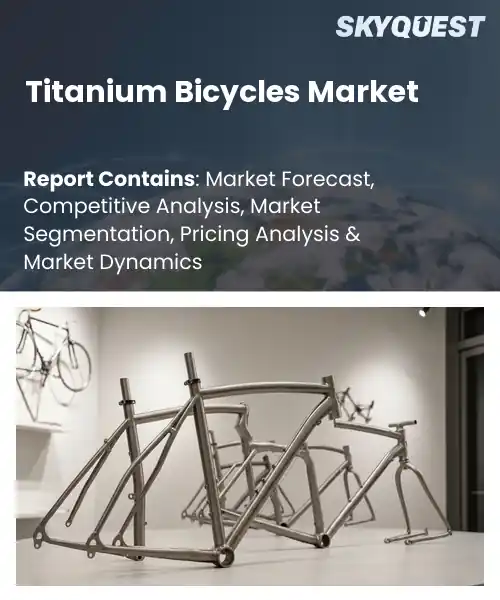
Titanium Bicycles Market
Report ID: SQMIG25J2161
Report ID: SQMIG25J2161
[email protected]
USA +1 351-333-4748
Report ID:
SQMIG25J2161 |
Region:
Global |
Published Date: February, 2026
Pages:
157
|Tables:
147
|Figures:
78


Global Titanium Bicycles Market size was valued at USD 1.12 Billion in 2024 and is poised to grow from USD 5.86 Billion in 2025 to USD 6.41 Billion by 2033, growing at a CAGR of 5.8% during the forecast period (2026-2033).
The demand for bikes made of lightweight, durable titanium has driven the titanium bike industry for years as discerning consumers and producers want quality and performance over time. The market for titanium bikes consists of many types of products which can include road, gravel, mountain, and custom-built bikes. Using titanium offers significant advantages over other materials due to its corrosion resistance, fatigue life, and excellent strength to weight ratio, which enables manufacturers to charge a premium for their products. Having a resale of good value, requiring lower maintenance costs during your lifetime and having a use in both pro teams and riders makes the titanium market a very attractive one for boutique builders and established brands.
The main factors affecting the global growth of the titanium bicycle industry are the cost of raw materials and labor to produce titanium bicycles and the availability of production capacity to produce them. When the cost of alloy goes up manufacturers will either lower their profit margins or increase their price and thus result in less demand from price-sensitive customers.
How is IoT Enhancing Performance Monitoring in the Titanium Bicycle Market?
Using IoT to measure the performance of titanium bicycles provides enhanced performance measurement by fusing embedded sensors, telematics and cloud analytics to capture rider effort frame strain and ride dynamics in real-time. Important components of this type of development include strain sensing for early identification of metal fatigue, inertial sensing for evaluating stability and performing vibration analysis, and power telemetry for evaluating pedaling efficiency. Currently, titanium builders and companies producing premium components are incorporating lightweight sensors & processing to help maintain a minimal frame weight while providing actionable information about a bicycle’s features. In a market focused on longevity and custom craftsmanship, these tools enable builders to fine-tune geometry, predict maintenance, and provide riders with better feedback regarding performance and comfort.
Market snapshot - (2026-2033)
Global Market Size
USD 0.56 Billion
Largest Segment
Road Bikes
Fastest Growth
Mountain Bikes
Growth Rate
5.5% CAGR
To get more insights on this market click here to Request a Free Sample Report
Global titanium bicycles market is segmented into product type, price range, application, distribution channel, end-user and region. Based on product type, the market is segmented into road bikes, mountain bikes, hybrid bikes, touring bikes and others. Based on price range, the market is segmented into economical, mid-range and premium. Based on application, the market is segmented into professional sports, recreational activities and commuting. Based on distribution channel, the market is segmented into online retail, specialty bicycle stores and others. based on end-user, the market is segmented into men, women and kids. Based on region, the market is segmented into North America, Europe, Asia Pacific, Latin America and Middle East & Africa.
As per titanium bicycles market outlook, the road bikes segment dominates the market, as the unique combination of titanium's high strength-to-weight ratio and high fatigue resistance is ideally suited to the requirements of road cycling for frames that are lightweight yet durable. Titanium is a material that premium road cyclists and custom frame builders value because of its ability to last a long time and provide an extremely refined ride. As a result, manufacturers are focusing on developing engineering, tubing shaping, and performance-oriented finishes to make their products as good as possible. With this narrow focus and excellent brand positioning, and a dedicated supply chain, manufacturers have been able to maintain their position of leadership in this market. As per the titanium bicycles market forecast, mountain bikes represent the fastest growing segment of the titanium bicycle market. Off-road cyclists are looking for frames that are extremely durable, resistant to corrosion, and are lightweight. There have been many advances in titanium suspension designs, allowance for custom geometries for bikepacking and enduro, and an increase in demand for long-life adventure bikes, creating new product development and interest from retailers.
As per titanium bicycles market analysis, specialty bicycle stores segment leads because these retail outlets offer expert product knowledge, custom fitting services, and hands-on test ride opportunities that are critical for selling premium titanium bicycles to discerning buyers. By working closely with frame builders on custom orders, having an established history of servicing bicycles after purchases, and having the ability to demonstrate quality ride characteristics, specialty bicycle stores encourage customers to trust them enough to consider buying a high-cost titanium bicycle, prompting manufacturers to use them as a channel for new limited edition and customized products.
Online retail is emerging as the most rapidly expanding area in the titanium bicycles market as direct-to-consumer models, configurators, and virtual fitting tools to reduce purchase friction and broaden access to niche titanium offerings. Lower distribution costs and social media marketing of titanium bicycle products offered by manufacturers online are creating new distribution channels and allowing small batch/one-off manufacturers to quickly distribute their products via these channels.
To get detailed segments analysis, Request a Free Sample Report
As per titanium bicycles market outlook, the basis of Europe’s total dominance in the industry can be traced back to a combination of several factors such as an abundance of advanced engineering traditions, a developed premium cycling culture and density of specialist manufacturers and independent frame builders. The demand for high-quality, durable bicycles is already strong among urban and recreation-oriented consumers, which have spurred the continued investment by the industry in titanium fabrication/finishing processes. Established after-market service/support distributors as well as a consumer base that appreciates both the craftsmanship and innovation of materials make it easier for manufacturers to position titanium as a premium product.
Germany titanium bicycles industry exemplifies precision engineering and a commitment to high-quality technical craftsmanship. The numerous independent craftsmen and manufacturers, many of whom enjoy long-standing ties to the field of industrial metallurgy, deliver tightly controlled welding techniques and frame designs targeted to customers who demand the highest levels of ride quality, strong frame durability, and overall performance.
UK titanium bicycles market thrives because of the custom-building culture and rich cycling history, as well as an appreciation of bespoke workmanship. Small manufacturer artisans and independent frame builders design and build scene and a deep-rooted cycling heritage that values bespoke craftsmanship. Retailing businesses selling premium bicycles and/or bicycles designed to be used for adventure cycling promote purchasing titanium bicycles as a safe long-term investment for long-distance riding.
France titanium bicycles market shows a strong culture of cycling and is highly regarded for its heritage workmanship. Manufacturers and boutique customer frame builders have utilized France’s long history of competitors and recreational cyclists to create value for customers seeking performance and comfort in their bicycle frame material selection. The diverse geography throughout the country results in a wide range of cyclists who are interested in titanium bicycle solutions; therefore, frame designs that meet all endurance and sport requirements are in demand throughout the entire country. There are many established events and local cycling clubs that serve to keep both titanium as well as premium materials top-of-mind with consumers and independent retailers.
As per titanium bicycles industry analysis, the growth of high-quality, long-lasting bicycles that are light in weight is what is driving the rapid expansion of North America market; as a result of the increased interest in premium materials and a desire to ride longer distances, North Americans are looking for premium materials that provide maximum performance, durability, and long-term value. Many consumers are specifically looking for titanium to meet their needs, whether they are riding endurance, gravel, or mixed-terrain bicycles; as such, the majority of the manufacturers are boutique manufacturers or custom frame builders, and there are also an increasing number of direct-to-consumer brands that provide innovative products and accelerated market penetration.
There is a strong culture of bespoke bicycle manufacturing in the United States, and consumers in the US have a strong preference for high performance and durability when selecting their bicycles. Many custom frame builders and niche bicycle manufacturers provide custom geometry, and most independent bicycle manufacturers have focused on providing durable frames that can withstand long-distance and mixed-surface riding.
Canada titanium bicycle market is characterized by a preference for reliable and durable bicycle frames that perform well in a variety of weather and terrain conditions. Specialty retailers and boutique fabricators consider the ability to resist corrosion and provide a comfortable riding experience to be the most important attributes for long-distance cycling and all-season cycling. In Canada, the prominence of the outdoor lifestyle and the popularity of adventure cycling have created an increasing demand for lightweight bicycles made from materials that provide maximum durability and strength.
As per titanium bicycles market forecast, the Asia Pacific region is improving its market due to its expertise in advanced materials, precision manufacturing ability, and rising consumer interest in upscale bicycles. The investment in metallurgy research and high-precision fabrication has led to the creation of high-quality titanium parts and complete bicycles. As cities continue to grow rapidly and there are more recreational cycling communities emerging in targeted areas, the need for specialty bicycles has increased. While local bicycle manufacturers and engineering firms collaborate with international designers to enhance their products, they are working hard to meet the demands of their customers.
Titanium bicycle manufacturing in Japan has developed from the Japanese tradition of producing quality goods through quality workmanship, using quality materials. Japanese bicycle manufacturers use precision solutions and high-quality control policies when creating their bicycle frames to provide consumers with the "elite," or "high-end," bicycle "ride-feel," durability and ultimately rider satisfaction. Japan's craftsmanship is emulated by small independent wood- and metal-working shops and/or special boutiques that support enthusiasts.
Titanium bicycle manufacturing in South Korea benefits from technological advances in manufacturing along with an increasing interest by consumers for premium bicycles. The engineering expertise of the South Korean manufacturers' metalworking and finishing processes produces bicycle frames that have strong, clean welds and consistent tolerances. The growing number of up-and-coming boutique manufacturers emphasize contemporary style and performance factors to appeal to urban and adventure cyclists.
To know more about the market opportunities by region and country, click here to
Buy The Complete Report
Rising Demand for Lightweight Materials
The increasing demand for lighter, stronger, and corrosion resistant bikes has led many bike manufacturers to use titanium as a frame material. As a result of this trend, titanium is gaining popularity among both cyclists and manufacturers based on its exceptional strength to weight ratio, corrosion resistance, and long lifespan. This material's properties allow bike manufacturers and retailers to differentiate their products from competitors and command higher prices. In addition, titanium's positive attributes will attract cyclists who desire a quality product that will last. Overall, the demand for titanium bikes will continue to increase as brands focus on developing and promoting their titanium bicycles.
Premium Brand Positioning and Image
Titanium bicycles are manufactured and sold as premium products with a reputation for quality, uniqueness, and superior performance. As a result, manufacturers and retailers can sell their titanium bikes for a premium price and market them to consumers who desire premium products. Also, through carefully cultivated customer loyalty to these brands, their customers develop loyalty to these brands and make repeat purchases. In addition, the growth of prestige associated with titanium frames encourages retail distribution of titanium bicycles through specialty retailers and custom bike builders, which increases the visibility of titanium bicycles in the market.
High Production and Material Costs
Titanium underframes are expensive to manufacture because of both an expensive base metal and its unique production method. Thus, most titanium bicycles are sold to customers at a price significantly higher than similarly priced alternatives made from aluminum or steel. Because of this pricing model, a large portion of the market cannot afford to purchase a titanium bicycle, as consumers are likely to consider price the most important factor when they are making purchasing decisions and will likely choose to purchase a lower-cost aluminum or steel bicycle. Higher production costs also increase the barriers to entry for new manufacturers and limit long-established manufacturers in terms of how flexible they are in pricing their products. Therefore, the titanium bicycles market penetration is restricted to a small percentage of the bicycle market-population, the small percentage of manufacturer-provided service options, and ultimately reduce the growth in the overall market for titanium bicycles.
Limited Repair and Maintenance Network
There are complications in the ability of owners of titanium frame bicycles to easily and/or regularly maintain their bicycles due to a lack of available technicians skilled in titanium welding and/or repair, a lack of service facilities/buildings equipped with the tools needed to assist with titanium frame repairs and a lack of established repair service networks. Therefore, when the owner of a titanium frame bicycle requires maintenance or repair to their bicycle, they are likely to experience longer repair/completion times and elevated repair costs. Consequently, titanium bicycle owners will view their titanium bicycle as having a much lower product-convenience and the total cost-of-ownership for their titanium bicycle as significantly higher than a bicycle made of an alternative material.
Request Free Customization of this report to help us to meet your business objectives.
The competitive situation of the global titanium bicycle industry is based on how products or supplies differ from other products or supplies. A lot of businesses are trying to obtain companies that do artisanal manufacturing, aerospace, and working with materials by forming partnerships or making acquisitions to establish aerospace or titanium alloy expertise by making them use 3D printing processes to reduce time from design/development. Some examples of this activity include Velocita acquiring Van Nicholas and looking for material partners with NASA, as well as producing boutique 3D printed titanium bicycles.
Lightweight Performance Advantage: The increased demand for titanium bikes has been fueled by their unique characteristics and the exceptional ride quality they provide. Consequently, manufacturers and builders have focused on their products’ ability to provide endurance, comfort and long-term reliability, which ultimately translate into opportunities to differentiate themselves from their competition through custom builds, collaborative production runs, and lifestyle positioning, thus attracting affluent riders looking for uniqueness. Retailers /brands are responding with customized marketing and post-sale communications focused on craftsmanship/value, further increasing titanium’s status as a signature material for performance-oriented cycling and brand cache.
Sustainability and Brand Differentiation: Manufacturers/brands are using titanium’s durability/recyclability to create sustainability stories to attract environmentally mindedconsumers and build customer loyalty, ultimately enhancing overall brand positioning. This titanium bicycles market trend also encourages manufacturers/brands to pursue circular strategies such as service programs, refinishing, and selective sourcing partnerships that emphasize ethical practices. By effectively communicating the capacity to repair and the utility of their products over multiple decades, businesses justify higher price points while being in alignment with their consumers’ lifestyle values, creating a foundation on which supply-chain collaborators can create collective, positive stories about each company to enhance trust between their brands and customers, strengthening the relationship and customer loyalty.
SkyQuest’s ABIRAW (Advanced Business Intelligence, Research & Analysis Wing) is our Business Information Services team that Collects, Collates, Correlates, and Analyses the Data collected by means of Primary Exploratory Research backed by robust Secondary Desk research.
As per SkyQuest analysis, the demand for bicycles made from lightweight and durable materials, such as titanium, has created a large market for the titanium bicycle. However, one of the biggest obstacles to these bicycles achieving mass acceptance is the high cost of producing them and metal itself. Europe continues to dominate this market due to its significant cycling culture, numerous specialty manufacturer locations and road bikes segments of the market being driven by performance and fatigue resistance characteristics of titanium. Additionally, premium brands tend to be priced higher than their competitors, which assists in creating brand loyalty and allows both new boutique manufacturers and established companies to gain niche titanium bicycle market growth.
| Report Metric | Details |
|---|---|
| Market size value in 2024 | USD 0.56 Billion |
| Market size value in 2033 | USD 0.91 Billion |
| Growth Rate | 5.5% |
| Base year | 2024 |
| Forecast period | (2026-2033) |
| Forecast Unit (Value) | USD Billion |
| Segments covered |
|
| Regions covered | North America (US, Canada), Europe (Germany, France, United Kingdom, Italy, Spain, Rest of Europe), Asia Pacific (China, India, Japan, Rest of Asia-Pacific), Latin America (Brazil, Rest of Latin America), Middle East & Africa (South Africa, GCC Countries, Rest of MEA) |
| Companies covered |
|
| Customization scope | Free report customization with purchase. Customization includes:-
|
To get a free trial access to our platform which is a one stop solution for all your data requirements for quicker decision making. This platform allows you to compare markets, competitors who are prominent in the market, and mega trends that are influencing the dynamics in the market. Also, get access to detailed SkyQuest exclusive matrix.
Table Of Content
Executive Summary
Market overview
Parent Market Analysis
Market overview
Market size
KEY MARKET INSIGHTS
COVID IMPACT
MARKET DYNAMICS & OUTLOOK
Market Size by Region
KEY COMPANY PROFILES
Methodology
For the Titanium Bicycles Market, our research methodology involved a mixture of primary and secondary data sources. Key steps involved in the research process are listed below:
1. Information Procurement: This stage involved the procurement of Market data or related information via primary and secondary sources. The various secondary sources used included various company websites, annual reports, trade databases, and paid databases such as Hoover's, Bloomberg Business, Factiva, and Avention. Our team did 45 primary interactions Globally which included several stakeholders such as manufacturers, customers, key opinion leaders, etc. Overall, information procurement was one of the most extensive stages in our research process.
2. Information Analysis: This step involved triangulation of data through bottom-up and top-down approaches to estimate and validate the total size and future estimate of the Titanium Bicycles Market.
3. Report Formulation: The final step entailed the placement of data points in appropriate Market spaces in an attempt to deduce viable conclusions.
4. Validation & Publishing: Validation is the most important step in the process. Validation & re-validation via an intricately designed process helped us finalize data points to be used for final calculations. The final Market estimates and forecasts were then aligned and sent to our panel of industry experts for validation of data. Once the validation was done the report was sent to our Quality Assurance team to ensure adherence to style guides, consistency & design.
Analyst Support
Customization Options
With the given market data, our dedicated team of analysts can offer you the following customization options are available for the Titanium Bicycles Market:
Product Analysis: Product matrix, which offers a detailed comparison of the product portfolio of companies.
Regional Analysis: Further analysis of the Titanium Bicycles Market for additional countries.
Competitive Analysis: Detailed analysis and profiling of additional Market players & comparative analysis of competitive products.
Go to Market Strategy: Find the high-growth channels to invest your marketing efforts and increase your customer base.
Innovation Mapping: Identify racial solutions and innovation, connected to deep ecosystems of innovators, start-ups, academics, and strategic partners.
Category Intelligence: Customized intelligence that is relevant to their supply Markets will enable them to make smarter sourcing decisions and improve their category management.
Public Company Transcript Analysis: To improve the investment performance by generating new alpha and making better-informed decisions.
Social Media Listening: To analyze the conversations and trends happening not just around your brand, but around your industry as a whole, and use those insights to make better Marketing decisions.
REQUEST FOR SAMPLE
 REQUEST FREE CUSTOMIZATION
Global Titanium Bicycles Market size was valued at USD 0.56 Billion in 2024 and is poised to grow from USD 0.59 Billion in 2025 to USD 0.91 Billion by 2033, growing at a CAGR of 5.5% during the forecast period (2026-2033).
Competitive landscape in the global titanium bicycles market is driven by product and supply differentiation, with firms pursuing targeted acquisitions to secure artisanal manufacturing, aerospace and materials partnerships for titanium alloy knowhow, and additive manufacturing collaborations to shorten development cycles; recent illustrative moves include Velo-ce acquiring Van Nicholas, NASA-linked material partnerships and boutique 3D printed titanium bike launches. 'Lynskey Performance', 'Moots Cycles', 'Seven Cycles', 'Ritte Cycles', 'T-Lab Bikes', 'Firefly Bicycles', 'Ellis Cycles', 'Serotta Bicycles', 'No. 22 Bicycle Co.', 'Litespeed', 'TiCycle', 'Burficti Bicycles', 'Enigma Bikes', 'Sage Titanium', 'Van Nicholas', 'Argonaut Cycles', 'Trek Bicycle', 'Baum Cycles', 'Mosaic Cycles', 'Curve Cycling'
The increasing preference among cyclists for lightweight, durable frames encourages manufacturers to choose titanium because it offers an exceptional strength-to-weight profile, corrosion resistance, and long service life. This material advantage supports product differentiation, enables premium positioning, and attracts enthusiasts seeking performance and longevity. As a result, brands intensify development and marketing of titanium models, expanding availability and consumer awareness. The broadening model range and perceived value reinforce purchase intent, helping to sustain steady market expansion and supplier investment in titanium bicycle offerings.
Lightweight Performance Advantage: Demand for titanium bicycles is increasingly driven by its superior strength to weight characteristics and the premium ride experience it enables, prompting manufacturers and builders to highlight endurance, comfort, and long term reliability. This trend supports bespoke frame offerings, series collaborations, and lifestyle positioning that attract affluent enthusiasts seeking distinctiveness. Retailers and brands are responding with tailored marketing and aftersales narratives emphasizing craftsmanship and value, further elevating titanium as a signature material for performance oriented cycling segments and brand cachet
As per titanium bicycles market outlook, the basis of Europe’s total dominance in the industry can be traced back to a combination of several factors such as an abundance of advanced engineering traditions, a developed premium cycling culture and density of specialist manufacturers and independent frame builders.


Want to customize this report? This report can be personalized according to your needs. Our analysts and industry experts will work directly with you to understand your requirements and provide you with customized data in a short amount of time. We offer $1000 worth of FREE customization at the time of purchase.
Feedback From Our Clients


 USA (+1) 351-333-4748

