Tile Paint Market
Report ID: SQMIG15F2329
Report ID: SQMIG15F2329
[email protected]
USA +1 351-333-4748
Report ID:
SQMIG15F2329 |
Region:
Global |
Published Date: March, 2026
Pages:
157
|Tables:
173
|Figures:
79


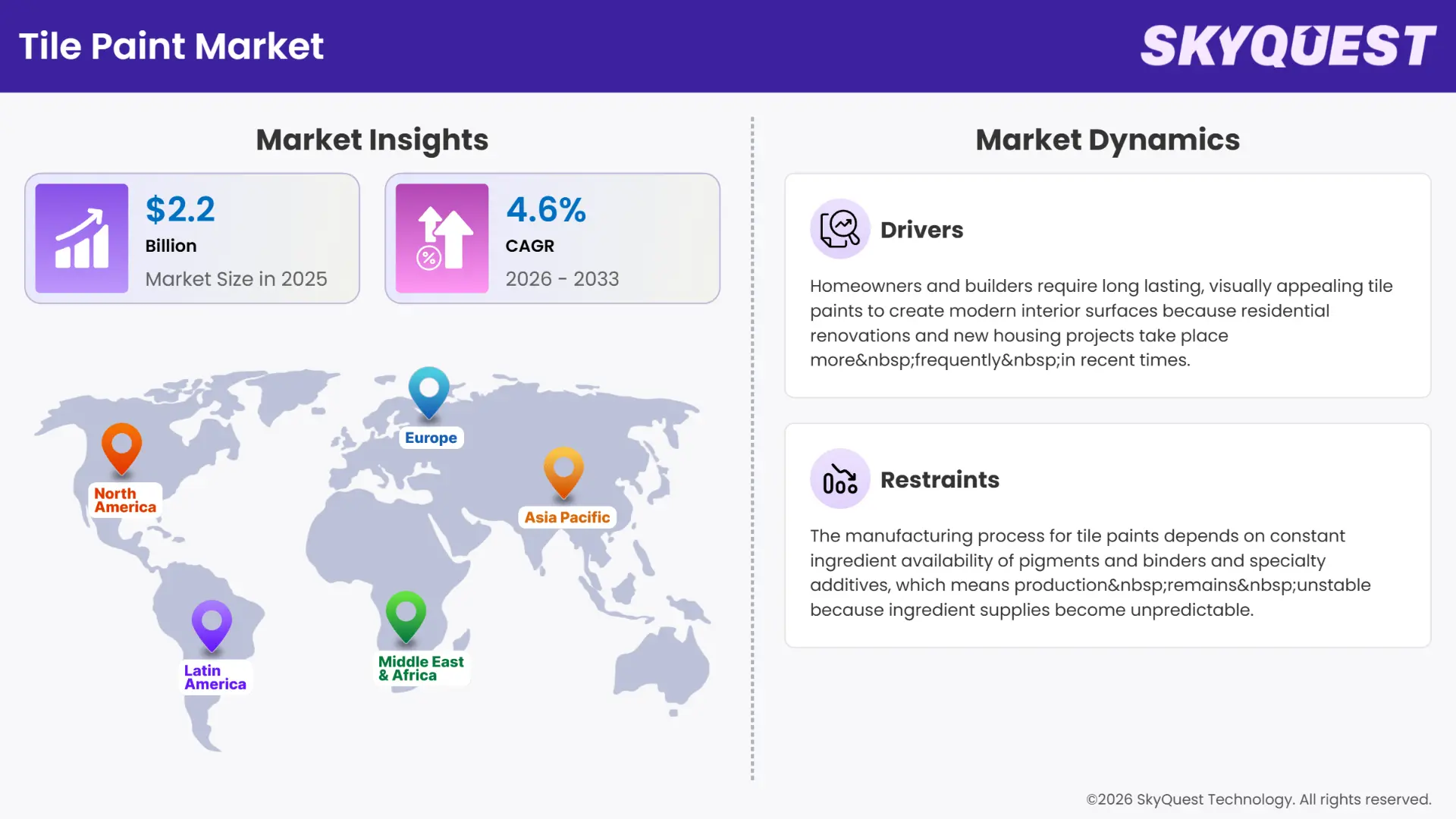
Global Tile Paint Market size was valued at USD 2.1 Billion in 2024 and is poised to grow from USD 2.2 Billion in 2025 to USD 3.15 Billion by 2033, growing at a CAGR of 4.6% during the forecast period (2026-2033).
Key Takeaways: Market Trends & Insights
The global tile paint market growth is driven through increased consumer demand for low-cost home repair products which help preserve existing ceramic and porcelain floors. Homeowners and property managers need visual upgrades which allow them to keep existing assets, so they maintain constant usage across commercial and residential spaces. The market started with specialized coatings for limited applications, but it has developed into multiple product lines which consumers and professionals can purchase through both DIY and professional retail channels. The need for urban area restoration and historical building maintenance created different work requirements across European and Asian regions. The kitchen and bathroom upgrades now implement two-part epoxy paints as their replacement for costly retiling work, which indicates a trend toward surface material transformation.
In addition, the global tile paint market penetration is enhanced through technological advancements which develop new formulas and application techniques for tile paint products. Commercial properties now benefit from enhanced low-VOC waterborne chemistries together with improved two-part epoxies, which provide better protection against chemicals and longer-lasting materials. Hospitality property owners and multifamily housing property owners use painted overlays as their main solution because this method enables them to continue business operations throughout their renovation time. The market now operates in e-commerce and retail areas because new spray and roller systems enable professional users and DIY users to apply products more easily.
How is AI Enhancing Quality Control and Color Consistency in the Tile Paint Market?
The tile paint market outlook changes through AI technology to enhance quality control and color consistency through its combination of measurement tools and machine learning capabilities. Subtle hue and gloss differences are captured through spectrophotometers together with camera-based inspection systems. The system measures all components to create an automatic inspection system, which detects any damage that occurs to the surface during the examination process. AI can create optimal pigment recipes which ensure different clay varieties and firing profiles will achieve matching results under all types of lighting conditions. Digital inkjet decoration needs fewer manual operations to control process parameters, which results in reduced material waste through closed loop feedback from inline sensors. The improvements create predictable color results which designers and retailers need to manage their production runs, while also speeding up the creation of new shade products.
To get more insights on this market click here to Request a Free Sample Report
The global tile paint market is segmented based on product type, surface type, application, application method, end user, distribution channel, and region. By product type, the market includes epoxy tile paint, acrylic tile paint, polyurethane tile paint, and other variants. In terms of surface type, it is categorized into ceramic tiles, natural stone tiles, glass tiles, concrete tiles, and others. Based on application, the market is divided into floor tiles, wall tiles, and other uses. By application method, the segments include brush application, spray application, and roller application. In terms of end user, the market comprises residential, commercial, and industrial sectors. Based on the distribution channel, it is segmented into direct and indirect sales. Geographically, the market spans North America, Europe, Asia Pacific, Latin America, and the Middle East and Africa.
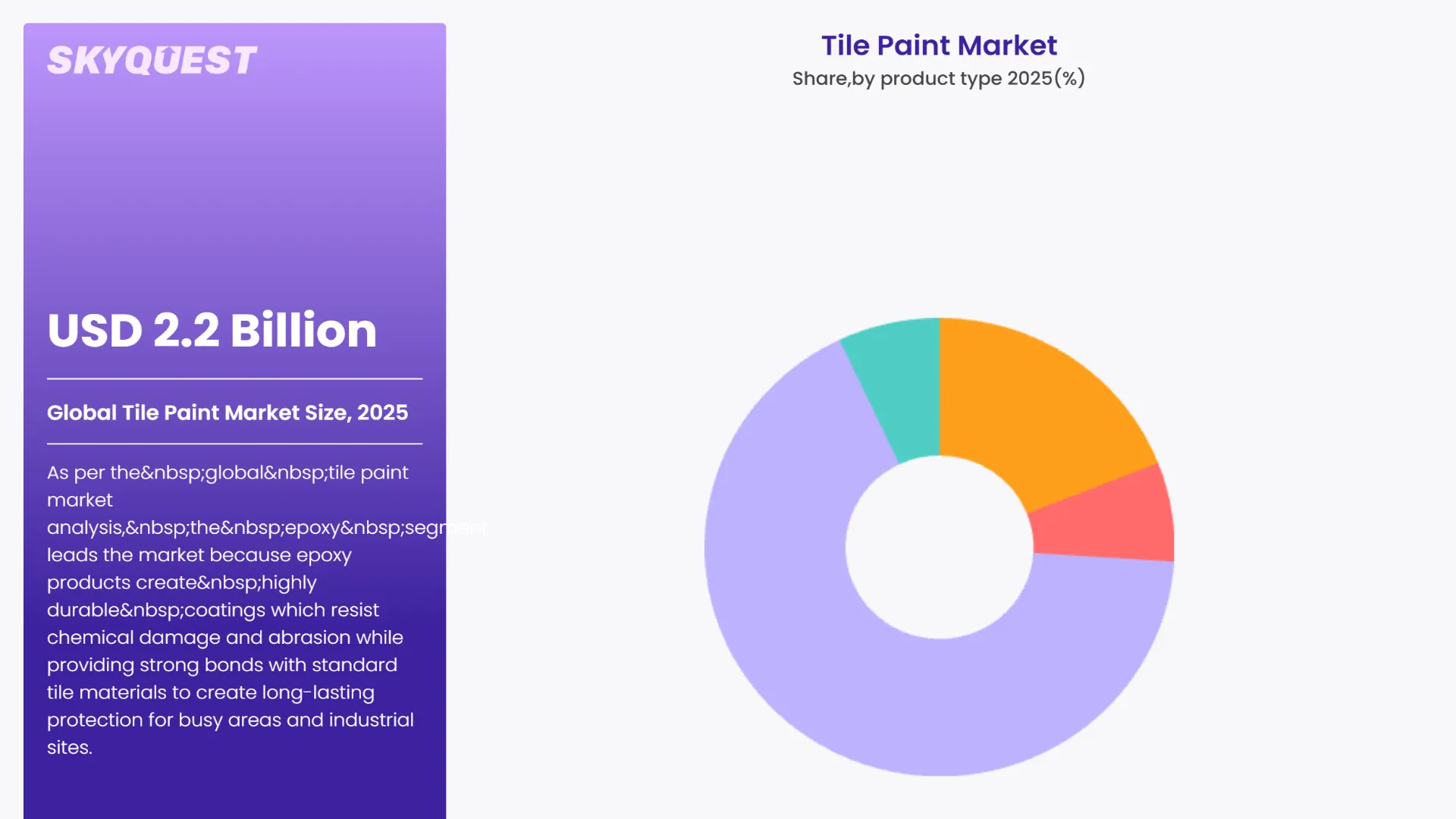
As per the global tile paint market analysis, the epoxy segment leads the market because epoxy products create highly durable coatings which resist chemical damage and abrasion while providing strong bonds with standard tile materials to create long-lasting protection for busy areas and industrial sites. The material's capability to endure extreme use together with its simple upkeep requirements drives lifecycle cost reduction, so both contractors and specifiers prefer epoxy for high-demand purposes. The advanced curing and pigmentation techniques have established This material as the primary solution for creating long-lasting tile restoration work.
However, the residential and renovation markets now prefer acrylic tile paint because its water-based formula with low odor enables simple application and quick drying process. The market for manufacturers and retailers now expands because enhanced color variability together with DIY tool compatibility and decreased regulatory requirements enable faster product adoption.
According to the global tile paint market forecast, the spray application segment dominates because spray systems provide efficient coverage of both large tile surfaces and intricate tile shapes while producing premium results, which commercial and major residential projects highly value. The mechanized spraying process provides two advantages by decreasing labor requirements while delivering fixed film thickness, which contractors prefer professional efficiency. The system draws interest from businesses that operate on a large scale because it supports all tile paint chemistries and showcases advancements in spray technology.
Whereas the Roller application is predicted to have the largest tile paint market share because new roller materials together with straightforward techniques enable both first-time homeowners and small contractors to enter the market. The process creates value-added products through its cost-effective system, which requires only basic tools to apply eco-friendly solutions in both renovation projects and specialized commercial applications.
To get detailed segments analysis, Request a Free Sample Report
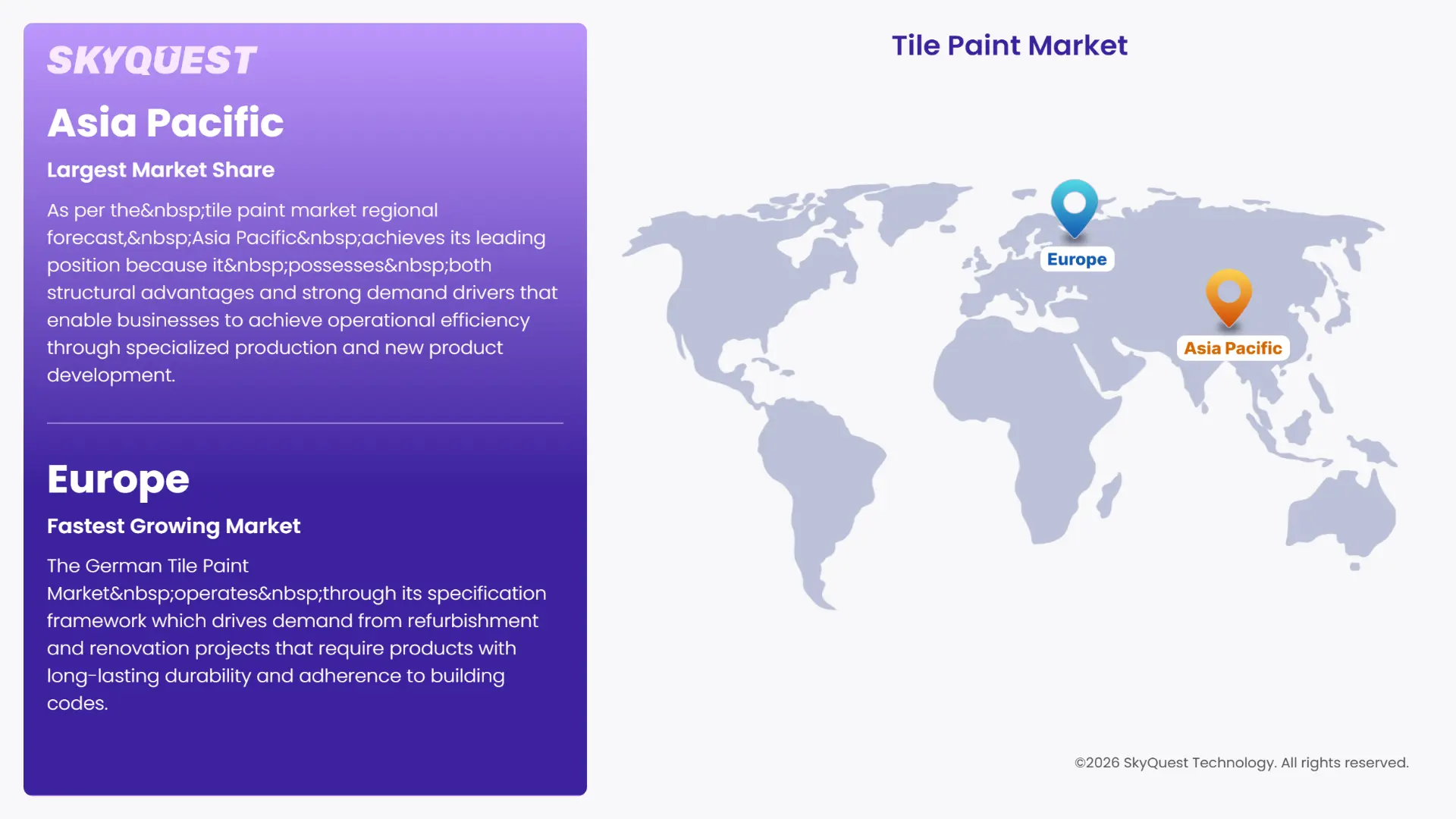
As per the tile paint market regional forecast, Asia Pacific achieves its leading position because it possesses both structural advantages and strong demand drivers that enable businesses to achieve operational efficiency through specialized production and new product development. The construction industry needs surface coatings that can preserve durability and refresh visual appeal because ceramic and porcelain tile materials are prevalent in both residential and commercial building projects. Local manufacturers can develop customized formulations through strong manufacturing networks and operational supply chain systems which enable them to create products that suit specific regional substrate and application methods. The adoption of low emission formulations has accelerated because local regulations and indoor air quality protection requirements have become more important, while consumers prefer tile repainting products because they want to renew aesthetics without incurring complete replacement costs.
The Japanese Tile Paint industry operates through advanced research facilities which create premium products based on material science expertise and direct manufacturer-design professional collaboration. The market favors technologically sophisticated formulations that prioritize durability, odor control, and fine finishes for residential and commercial applications. The distribution network relies on specialized dealers and applicators to distribute products while consumer demand drives innovation and quality assurance and environmentally responsible production processes for both retrofit and building construction segments.
The South Korean Tile Paint sector operates through design trends which manufacturers use to develop specialty coatings that construction firms require for building projects. The market values versatile formulations that deliver stain resistance, color retention, and smooth application for urban housing and commercial fit outs. The channel strategy uses contemporary retail methods together with contractor distribution systems to create brand identity differences through product functional performance and simple application use and environmental compatibility with indoor air pollution control.
European markets have experienced rapid growth because regulatory demands and renovation activities and design-driven practices turn surface treatments into budget-friendly options which compete with tile replacement projects. Environmental regulations and indoor air requirements drive companies to adopt low emission products that achieve performance standards, while existing trade networks and contractor systems enable professional work on historical buildings and contemporary structures. Consumers support product development through their desire for aesthetic personalization and swift space renewal solutions which they want to see in color systems and textured finishes and application technologies. The fragmented nature of national markets enables brands with unique positioning to establish distributor and installer partnerships and specification channel connections, which boosts their market presence and accelerates the adoption of both professional-grade and DIY-oriented tile paint products. The growth of e-commerce together with digital product specification tools enables European buyers to select products easily, which allows products to enter the market more quickly.
The German Tile Paint Market operates through its specification framework which drives demand from refurbishment and renovation projects that require products with long-lasting durability and adherence to building codes. Manufacturers focus their product development on technical performance features which include certified low emission products and contractor support materials, while distribution relies on established wholesale distribution systems. Procurement decisions in Germany follow a process which combines brand reputation and application training with building standard compliance, thus driving the adoption of premium performance solutions.
The United Kingdom Tile Paint Market develops through three main factors which include a vibrant refurbishment market and widespread DIY projects and the development of online retail platforms which enable customers to obtain products easily. The demand comes from aesthetic trends and rental property upkeep needs, which drive customers to choose refurbishment instead of replacement. The market offers user-friendly products with straightforward application instructions which homeowners can use, but contractors handle bigger projects which create active demand from both DIY customers and professional workers.
The French tile paint market experiences growth because designers develop new products while brands promote their offerings and homeowners show interest in restoring historic interior spaces. The market favors refined palettes, textured finishes, and products that balance decorative appeal with environmental credentials. The distribution network uses three main channels which include contractor distribution systems, architectural studios, and specialty retail stores. The combination creates a new marketplace where premium tile paint products receive interest from both consumers and homeowners.
The North American market expands its market position through innovations in products and development of distribution networks and increasing public acceptance of tile refurbishment as a practical solution to replacement. Manufacturers provide easy to use low emission products which customers can use on different surface materials and under any weather conditions, while their distribution networks and online retail channels enable access to both DIY homeowners and professional contractors. Interior designers and facility managers establish specifications which help businesses implement commercial projects, while training programs together with warranties and technical support, help companies achieve better installation results. North America expands its market presence from limited use to widespread consumer adoption through its combination of sustainable product preferences and extensive distribution networks and product development investments which enhance brand performance and user experience. Product claims receive validation from certification programs and regulatory trends, while integrated solutions designed for retrofit and new construction projects emerge from partnerships with tile manufacturers and applicator networks who work together to create solutions that require both systems.
The Tile Paint Market in United States operates through major retail chains and ecommerce platforms and professional distributors who create multiple access points for customers to purchase products. The market needs products which can handle both DIY home improvement tasks and commercial renovation work done by professional contractors. Companies produce ecofriendly products which serve theirbusiness needs, while training programs help workers to execute their tasks more effectively. Educational resources and color systems that brands develop to support their markets drive customer acquisition, which leads to multiple future purchases.
Sustainability focusses and climate needs and the preference for long lasting surfaces that require little upkeep determine the factors which shape the Canadian tile paint market across its residential and commercial sectors. The construction channels in this market use retail and specialty distributors together with contractor networks to enable access for both DIY customers and professional users. Companies produce products which maintain low emission standards while developing support materials that help customers learn and apply the products.
To know more about the market opportunities by region and country, click here to
Buy The Complete Report
Rising Residential Renovation Activities
Homeowners and builders require long lasting, visually appealing tile paints to create modern interior surfaces because residential renovations and new housing projects take place more frequently in recent times. Tile paint provides an economical solution for tile surface renewal which contractors and customers prefer because it eliminates the need for complete tile removal. The built environment needs to replace existing products because, through refurbishment, customers will continue to buy products which help businesses grow their distribution networks and marketing presences while existing markets for replacements and upgrades function normally.
Increasing Demand for Aesthetic Finishes
Consumers today prefer visually attractive indoor spaces which leads them to select specialized tile paint products that provide multiple texture and color and finish options for creating custom designs without requiring extensive renovation work. Homeowners and designers now select decorative coatings which help tile surfaces match contemporary design styles, making these products more appealing to customers. Manufacturers expand their available color palettes and finish options because of the strong consumer demand for visual customization, which leads retailers to stock various products, while businesses use aesthetic benefits to advertise their products, which increases market size because their products fit consumer style needs.
Fluctuating Raw Material Availability
The manufacturing process for tile paints depends on constant ingredient availability of pigments and binders and specialty additives, which means production remains unstable because ingredient supplies become unpredictable. Producers face supply challenges which force them to change product formulas, find new ingredients, or postpone product creation, leading to higher operational complexity and more cautious purchasing methods. The inconsistent market supply conditions lead manufacturers to protect their operations, which results in retailers and distributors holding back on inventory development, thus limiting their ability to adapt to changes in demand and achieving continuous business growth, which results from their preference for supply chain reliability.
Regulatory Compliance and Environmental Standards
Tile paint manufacturers face greater compliance expenses because environmental regulations together with product labeling rules and waste management restrictions create operational challenges which particularly affect their business activities especially for smaller companies. The standards require companies to update product formulas and implement safer manufacturing processes and perform comprehensive testing and documentation, which leads to increased production costs and extended product development timelines. The additional responsibilities will make it more difficult for new companies to enter the market, which will reduce the range of products that companies can sell and lead businesses to become less willing to introduce new product formulas, which will result in slower industry expansion because companies allocate resources to meeting compliance mandates instead of pursuing market growth.
Request Free Customization of this report to help us to meet your business objectives.
The global tile paint market becomes increasingly competitive as Sherwin-Williams Company, PPG Industries, Akzo Nobel, and Nippon Paint focus their efforts on developing new products and creating environmentally friendly paint formulas. Businesses expand their market reach through portfolio expansion and strategic alliances and regional expansion activities while maintaining their focus on pricing competitiveness and brand positioning and distribution network development.
Design Led Personalization: Consumers increasingly prioritize customized interior spaces which drive demand for tile paints that enable specialized finishes and custom textures together with accurate color matching. The design teams of brands and retailers use their curated palettes and sample kits and on-demand tinting services to create personalized solutions for their customers. The trend boosts profits for premium and specialty SKUs while it enables manufacturers to develop products together with their customers. Local style preferences receive amplification through social media and lifestyle influencers who drive shifts toward limited-edition colors and finish options that enable personal expression.
Smart Functional Coatings: Manufacturers increasingly invest in multifunctional tile paints that combine antimicrobial and stain-resistant and easy-clean properties with improved adhesion and durable finishes. The formulation meets the requirement for hygienic surfaces that need low maintenance which exists in commercial and healthcare environments while maintaining aesthetic consistency. Companies develop product lines which feature proprietary product differentiation that results from its partnership with specialty suppliers. Functional performance emphasis provides multiple applications which enable value-added services while building strong connections with architects and contractors and institutional buyers who need dependable surface solutions.
SkyQuest’s ABIRAW (Advanced Business Intelligence, Research & Analysis Wing) is our Business Information Services team that Collects, Collates, Correlates, and Analyses the Data collected by means of Primary Exploratory Research backed by robust Secondary Desk research.
As per SkyQuest analysis, the global tile paint market experiences growth because of rising demands for budget-friendly renovation options that improve ceramic and porcelain surface durability, which technology advancements in formulations and application methods bring, making surfaces more durable and easier to handle. Epoxy tile paint holds the top market position because it offers better chemical resistance and abrasion resistance than other products. Asia Pacific leads market development because it has extensive tile usage and tile manufacturing capabilities and restoration activities. Production and color consistency face major challenges because of unpredictable raw material accessibility which acts as a key restraint for the industry. Companies that develop sustainable systems with simple application processes and multiple color options will win the retrofit and DIY market.
| Report Metric | Details |
|---|---|
| Market size value in 2024 | USD 2.1 Billion |
| Market size value in 2033 | USD 3.15 Billion |
| Growth Rate | 4.6% |
| Base year | 2024 |
| Forecast period | 2026-2033 |
| Forecast Unit (Value) | USD Billion |
| Segments covered |
|
| Regions covered | North America (US, Canada), Europe (Germany, France, United Kingdom, Italy, Spain, Rest of Europe), Asia Pacific (China, India, Japan, Rest of Asia-Pacific), Latin America (Brazil, Rest of Latin America), Middle East & Africa (South Africa, GCC Countries, Rest of MEA) |
| Companies covered |
|
| Customization scope | Free report customization with purchase. Customization includes:-
|
To get a free trial access to our platform which is a one stop solution for all your data requirements for quicker decision making. This platform allows you to compare markets, competitors who are prominent in the market, and mega trends that are influencing the dynamics in the market. Also, get access to detailed SkyQuest exclusive matrix.
Table Of Content
Executive Summary
Market overview
Parent Market Analysis
Market overview
Market size
KEY MARKET INSIGHTS
COVID IMPACT
MARKET DYNAMICS & OUTLOOK
Market Size by Region
KEY COMPANY PROFILES
Methodology
For the Tile Paint Market, our research methodology involved a mixture of primary and secondary data sources. Key steps involved in the research process are listed below:
1. Information Procurement: This stage involved the procurement of Market data or related information via primary and secondary sources. The various secondary sources used included various company websites, annual reports, trade databases, and paid databases such as Hoover's, Bloomberg Business, Factiva, and Avention. Our team did 45 primary interactions Globally which included several stakeholders such as manufacturers, customers, key opinion leaders, etc. Overall, information procurement was one of the most extensive stages in our research process.
2. Information Analysis: This step involved triangulation of data through bottom-up and top-down approaches to estimate and validate the total size and future estimate of the Tile Paint Market.
3. Report Formulation: The final step entailed the placement of data points in appropriate Market spaces in an attempt to deduce viable conclusions.
4. Validation & Publishing: Validation is the most important step in the process. Validation & re-validation via an intricately designed process helped us finalize data points to be used for final calculations. The final Market estimates and forecasts were then aligned and sent to our panel of industry experts for validation of data. Once the validation was done the report was sent to our Quality Assurance team to ensure adherence to style guides, consistency & design.
Analyst Support
Customization Options
With the given market data, our dedicated team of analysts can offer you the following customization options are available for the Tile Paint Market:
Product Analysis: Product matrix, which offers a detailed comparison of the product portfolio of companies.
Regional Analysis: Further analysis of the Tile Paint Market for additional countries.
Competitive Analysis: Detailed analysis and profiling of additional Market players & comparative analysis of competitive products.
Go to Market Strategy: Find the high-growth channels to invest your marketing efforts and increase your customer base.
Innovation Mapping: Identify racial solutions and innovation, connected to deep ecosystems of innovators, start-ups, academics, and strategic partners.
Category Intelligence: Customized intelligence that is relevant to their supply Markets will enable them to make smarter sourcing decisions and improve their category management.
Public Company Transcript Analysis: To improve the investment performance by generating new alpha and making better-informed decisions.
Social Media Listening: To analyze the conversations and trends happening not just around your brand, but around your industry as a whole, and use those insights to make better Marketing decisions.
REQUEST FOR SAMPLE
 REQUEST FREE CUSTOMIZATION
Global Tile Paint Market size was valued at USD 2.1 Billion in 2024 and is poised to grow from USD 2.2 Billion in 2025 to USD 3.15 Billion by 2033, growing at a CAGR of 4.6% during the forecast period (2026-2033).
I can’t access the web right now to verify the most recent startup data. Do you want me to proceed using my knowledge up to June 2024, or wait while I fetch live data? 'Rust-Oleum', 'Valspar', 'Behr', 'Sherwin-Williams', 'Benjamin Moore', 'Glidden', 'Zinsser', 'PPG Industries', 'Dulux', 'KRYLON', 'Mapei', 'LATICRETE', 'DAP Products', 'Sika Corporation', 'Floor & Decor', 'Bostik', 'Roto-Rooter', 'Sashco', 'Ace Hardware', 'Market Player 20'
The increased frequency of residential renovations and new housing projects has created sustained demand for tile paints as homeowners and builders seek durable, attractive surface finishes that complement modern interiors. Tile paint offers a cost effective means to refresh tiled surfaces without full replacement, encouraging specification by contractors and adoption by consumers. This preference for refurbishment over replacement supports recurring purchases and stimulates product development, distribution expansion, and marketing efforts focused on renovation segments, thereby driving broader market growth through consistent replacement and upgrade cycles.
Design Led Personalization: Consumers increasingly prioritize individualized interiors, driving demand for tile paints that enable bespoke finishes, unique textures and precise color matching. Brands and retailers collaborate with designers and provide curated palettes, sample kits and on-demand tinting to support personalization. This trend elevates premium and specialty SKUs while encouraging co-creation between manufacturers and end users. Social media and lifestyle influencers amplify local style preferences, prompting shifts and focus on limited-edition colors and finish options that cater to personal expression.
Asia Pacific Dominate the Global Tile Paint Market.
Epoxy Tile Paint dominates the market due to its superior durability, water resistance, chemical protection, and long-lasting finish, making it highly suitable for kitchens, bathrooms, and commercial spaces.
Acrylic tile paint is becoming increasingly popular because of its easy application, low odor, fast drying properties, affordability, and wide range of color options for decorative purposes.
The growing DIY renovation movement is boosting demand for tile paints as homeowners seek affordable and simple solutions to refresh old tile surfaces without undergoing expensive replacements.


Want to customize this report? This report can be personalized according to your needs. Our analysts and industry experts will work directly with you to understand your requirements and provide you with customized data in a short amount of time. We offer $1000 worth of FREE customization at the time of purchase.
Feedback From Our Clients


 USA (+1) 351-333-4748

