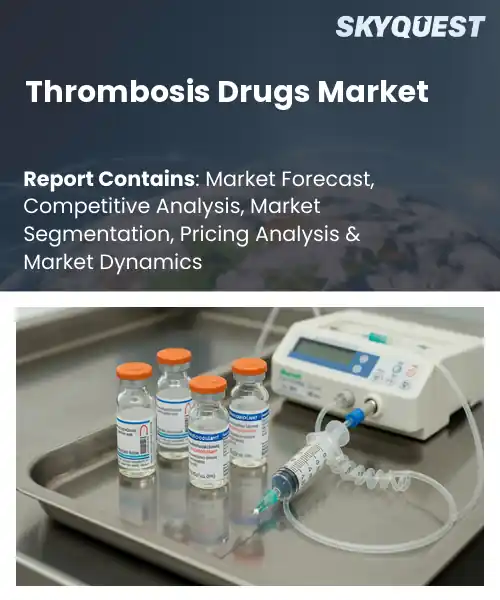
Thrombosis Drugs Market
Report ID: SQMIG35I2782
Report ID: SQMIG35I2782
[email protected]
USA +1 351-333-4748
Report ID:
SQMIG35I2782 |
Region:
Global |
Published Date: June, 2026
Pages:
157
|Tables:
91
|Figures:
76


Global Thrombosis Drugs Market size was valued at USD 26.11 Billion in 2024 and is poised to grow from USD 28.21 Billion in 2025 to USD 52.32 Billion by 2033, growing at a CAGR of 8.0% during the forecast period (2026-2033).
Increasing prevalence of cardiovascular and oncological conditions, along with an aging global population are the main drivers of the thrombosis drugs market trends. The risk of clotting is higher in older adults and patients with cancer, necessitating long term anticoagulation. Market includes anticoagulants, antiplatelet agents, thrombolytics and diagnostics for prevention and treatment of venous and arterial thromboembolism. This market is important because of high morbidity, mortality and health care costs associated with preventable clots. Over the past two decades, the market has shifted from predominantly warfarin-based therapy to direct oral anticoagulants such as dabigatran and rivaroxaban, which improve adherence and reduce the monitoring burdens of care.
A key driver is regulatory approval of broader indications, given the therapeutic shift towards direct oral anticoagulants, which translates trial evidence into practice and increases the number of eligible patients. When guidelines recommend DOACs for atrial fibrillation stroke prevention clinicians prescribe DOACs instead of warfarin which increases sales as seen with rivaroxaban uptake in hospital stroke programs. Also approval for cancer associated thrombosis and perioperative prophylaxis leads to real world use cases in oncology and orthopedics that increase demand. These effects afford manufacturers opportunities to extend patient support, develop fixed dose formulations and also enter underserved geographies internationally.
How is AI Improving Patient Stratification in the Thrombosis Drugs Market?
In the thrombosis drugs market growth, AI enhances patient stratification by combining clinical records imaging and molecular markers to build predictive models that determine patients most likely to respond to specific anticoagulant regimens. Including EHR data imaging characteristics and laboratory trends to construct richer patient phenotypes and interpretable models for clinicians to act on are important elements. Today, these tools are assisting trial teams and providers in refining inclusion criteria, enhancing cohort homogeneity, and supporting more confident therapy selection. In market terms this shortens development timelines increases uptake of targeted therapies and helps payers focus resources on patients with the clearest expected benefit.
Bristol Myers Squibb May 2026 announced a strategic agreement to deploy Anthropic Claude Enterprise across research and commercial operations which brings advanced AI reasoning to clinical and molecular datasets. This capability aids in refining anticoagulant patient selection enhancing trial efficiency and enabling more targeted prescribing to fuel market growth and operational efficiency.
Market snapshot - (2026-2033)
Global Market Size
USD 26.11 Billion
Largest Segment
Anticoagulants
Fastest Growth
Anticoagulants
Growth Rate
8.03% CAGR
To get more insights on this market click here to Request a Free Sample Report
Global thrombosis drugs market is segmented by drug class mechanism, application clinical indication, distribution channel and region. Based on drug class mechanism, the market is segmented into anticoagulants, antiplatelet agents and thrombolytic drugs. Based on application clinical indication, the market is segmented into deep vein thrombosis, pulmonary embolism, atrial fibrillation management and acute coronary syndrome. Based on distribution channel, the market is segmented into hospital pharmacies, retail pharmacies and online pharmacies. Based on region, the market is segmented into North America, Europe, Asia Pacific, Latin America and Middle East & Africa.
Anticoagulants are the leading segment in the thrombosis drugs market share, due to their central role in long-term prevention and management of thrombosis in various indications and their clinical preference due to proven efficacy and availability in various oral and parenteral formulations. The wide therapeutic applicability of these drugs supports prescriber reliance, allowing payers to prioritize formulary placement and manufacturers to invest in lifecycle innovations. This leads to persistent prescribing patterns and strong endorsement of clinical guidelines that solidifies market leadership and continued product development.
But antiplatelet agents are emerging as the fastest growing sector with Increasing dual pathway therapy adoption and device related thrombotic prevention needs. Continued innovation on drug formulations and combination regimens and updates to guidelines that favor tailored antiplatelet strategies are driving uptake, while new opportunities for product differentiation and market entrants are emerging.
The hospital pharmacies segment leads driven by its control of inpatient supply chains and central role in administering acute care thrombosis therapies, including parenteral anticoagulants and thrombolytics. Their integration with clinical teams provides stewardship, protocol driven use and efficient procurement which impacts on prescribing patterns and supplier relationships. Preference for hospital channel distribution is driven by strong hospital purchasing and therapeutic monitoring capabilities, affecting product adoption and incentivizing manufacturers to customize packaging, dosing forms and support services.
However, online pharmacies are the fastest growing distribution channel driven by patient preference for home delivery, streamlined refill services and integration with telehealth platforms. Enhanced cold chain and specialty logistics with digital patient support and subscription models are expanding access to oral thrombosis therapies and creating new patient acquisition channels to drive manufacturer investment and tailored commercial strategies.
To get detailed segments analysis, Request a Free Sample Report
North America is the leading region in the global thrombosis drugs market forecast owing to the existence of a strong healthcare infrastructure, a concentration of innovative pharmaceutical companies, and a regulatory landscape conducive to rapid access to novel treatments. Strong research ecosystems and high levels of clinical trial activity facilitate the rapid translation of science into commercial products. Payer frameworks and established reimbursement pathways support the uptake of high-value anticoagulants and anticoagulation management tools. Physicians are highly aware and diagnostics are widely available so detection and treatment can start early. Integrated care delivery models, industry-academic partnerships and mature distribution networks enable efficient market penetration. Further growth in digital health tools and anticoagulation clinic networks, along with substantial private and public investment in innovative modalities, further increases market depth and patient access.
Thrombosis drugs market outlook in United States is characterized by a dense ecosystem of research institutions and large pharmaceutical companies that drive drug discovery and commercialization. Strong clinical trial infrastructure and proactive regulatory engagement enable the introduction of advanced anticoagulant therapies. The uptake by clinicians is aided by strong specialist networks, integrated care pathways and anticoagulation clinics. Strong patient support programs and collaborations between industry, academia and payers are instrumental in sustaining product uptake and ongoing innovation in therapeutic strategies.
Thrombosis drugs market regional outlook in Canada is supported by a publicly funded healthcare system that promotes access to anticoagulant therapies and coordinated chronic disease management. Clinical programme participation and technology transfer are underpinned by strong links with international research networks. Diagnosis and long term management are facilitated by provincial specialist centres and community care pathways. The collaboration between academic institutions, local biopharma companies and healthcare providers supports the local adaptation of global treatment advances to local needs and local innovation.
European thrombosis drugs market regional forecast is experiencing rapid growth due to aligned healthcare priorities, robust pharmaceutical and biotech capabilities, and progressive regulatory frameworks that enable cross-border clinical development and uptake. Robust hospital systems and well-established specialist networks mean that pathways for diagnosis and management are timely, and health technology assessment processes help to reconcile clinical value with reimbursement decisions. Investment in translational research and partnerships between industry and academic centers accelerate the availability of novel anticoagulant options. There is increasing attention on integrated care, outpatient anticoagulation services and digital patient management tools to improve therapy adherence and monitoring. Furthermore, joint procurement and market access strategies across countries, and growing awareness among clinicians, contribute to a faster adoption of advanced treatment regimens and a competitive environment for therapeutic innovation.
Thrombosis drugs market analysis in Germany has a deep industrial base in pharmaceuticals and medical technology which can support the development and manufacturing of anticoagulant agents. Integrated hospital networks and specialist cardiovascular centres enable strong clinical uptake and real world evidence generation. Strong collaboration between industry, universities and research institutes accelerates translation of scientific advances. Predictable market access through established reimbursement mechanisms and structured health technology assessment. Supply resilience through domestic production capabilities.
Thrombosis drugs industry in United Kingdom has a vibrant life sciences ecosystem which supports the clinical translation and commercialization of novel anticoagulant therapies. Strong clinical trial infrastructure and supportive regulatory engagement allow efficient pathway navigation. Early adoption of advanced treatment options is fostered by collaboration among biotech innovators, academic centers, and healthcare providers. Digital health, integrated care models and community anticoagulation services are working to enhance monitoring and adherence, creating a positive environment for market growth.
Thrombosis drugs market penetration in France is emerging with an improved clinical research capacity and growing involvement of biotech firms and developers. Structured hospital systems and specialist cardiology centres underpin clinical adoption and long term management pathways. National pricing and reimbursement mechanisms are aligning more closely with clinical value and this is facilitating the market entry of new anticoagulant therapies. Academia-industry partnerships accelerate the evidence generation process and promote wider access to innovative treatment strategies.
Asia Pacific is fortifying its stake in the thrombosis drugs market through regulatory modernization, upgraded clinical research infrastructure, and increased involvement of both local and global pharmaceutical firms. Market players are investing in local development programs, setting up regional manufacturing hubs and working with global developers to speed up product availability. Health systems are increasingly implementing standardized clinical pathways and digital monitoring tools to support outpatient anticoagulation management. Regulatory agencies are improving the review process and encouraging alignment to international standards allowing easier access to the market. Furthermore, rising clinician awareness, improved diagnostic capabilities and targeted patient education efforts are all helping to drive earlier diagnosis and wider adoption of therapies. Targeted investments in clinician training, local guideline development and participation in cross-border clinical trials further enhance the region’s ability to adopt innovative therapies and maximize patient outcomes.
Thrombosis drugs market analysis in Japan is well-positioned due to its mature pharmaceutical research ecosystem and established clinical networks, which enable rapid assessment and uptake of advanced anticoagulant therapies. High standards of manufacturing and quality control allow for domestic production. Regulatory pathways are increasingly harmonised with international review practices, allowing for efficient access to innovative products. Robust hospital systems, diagnostic capacities, and targeted clinician education programs are the foundation for effective management and adoption of new treatment modalities.
Thrombosis drugs industry trends in South Korea is progressing with a robust biopharmaceutical industry and progressive regulatory policies that facilitate clinical development and market entry. Strong local manufacturing capacity and quality standards allow for reliable supply to local markets. Participation in clinical trials and collaborations with global developers speeds the availability of novel anticoagulant therapies. Digital health and clinician training programs enhance the tracking and integration of new treatment approaches into routine care.
To know more about the market opportunities by region and country, click here to
Buy The Complete Report
Increasing Prevalence Of Thrombotic Disorders
Advances In Oral Anticoagulants
High Cost Of Novel Therapies
Safety Concerns And Bleeding Risk
Request Free Customization of this report to help us to meet your business objectives.
The competitive landscape in the global thrombosis drugs market is shifting as incumbent pharmaceutical groups defend share through licensing, co development and strategic out licensing of late stage assets, while biotech entrants pursue novel mechanisms and reversal technologies. Examples include the Anthos spin out backed by Blackstone and Novartis for abelacimab, CSL's collaboration with VarmX, and Alveron's recent financing and first in human progress.
Top Player’s Company Profile
Recent Developments
SkyQuest’s ABIRAW (Advanced Business Intelligence, Research & Analysis Wing) is our Business Information Services team that Collects, Collates, Correlates, and Analyses the Data collected by means of Primary Exploratory Research backed by robust Secondary Desk research. As per SkyQuest analysis, the global thrombosis drugs market is propelled primarily by an aging population and rising prevalence of cardiovascular and oncological conditions, while high costs of novel therapies limit access and slow adoption. North America remains the dominant region and anticoagulants lead as the largest segment, driven by a multi-decade shift from warfarin to direct oral anticoagulants and expanding guideline endorsements. A second important driver is advances in oral anticoagulant pharmacology that improve adherence and enable outpatient management, creating opportunities for broader use, fixed-dose formulations and digital adherence solutions. Manufacturers and health systems must balance innovation with affordability and safety to sustain long-term growth.
| Report Metric | Details |
|---|---|
| Market size value in 2024 | USD 26.11 Billion |
| Market size value in 2033 | USD 52.32 Billion |
| Growth Rate | 8.03% |
| Base year | 2024 |
| Forecast period | (2026-2033) |
| Forecast Unit (Value) | USD Billion |
| Segments covered |
|
| Regions covered | North America (US, Canada), Europe (Germany, France, United Kingdom, Italy, Spain, Rest of Europe), Asia Pacific (China, India, Japan, Rest of Asia-Pacific), Latin America (Brazil, Rest of Latin America), Middle East & Africa (South Africa, GCC Countries, Rest of MEA) |
| Companies covered |
|
| Customization scope | Free report customization with purchase. Customization includes:-
|
To get a free trial access to our platform which is a one stop solution for all your data requirements for quicker decision making. This platform allows you to compare markets, competitors who are prominent in the market, and mega trends that are influencing the dynamics in the market. Also, get access to detailed SkyQuest exclusive matrix.
Table Of Content
Executive Summary
Market overview
Parent Market Analysis
Market overview
Market size
KEY MARKET INSIGHTS
COVID IMPACT
MARKET DYNAMICS & OUTLOOK
Market Size by Region
KEY COMPANY PROFILES
Methodology
For the Thrombosis Drugs Market, our research methodology involved a mixture of primary and secondary data sources. Key steps involved in the research process are listed below:
1. Information Procurement: This stage involved the procurement of Market data or related information via primary and secondary sources. The various secondary sources used included various company websites, annual reports, trade databases, and paid databases such as Hoover's, Bloomberg Business, Factiva, and Avention. Our team did 45 primary interactions Globally which included several stakeholders such as manufacturers, customers, key opinion leaders, etc. Overall, information procurement was one of the most extensive stages in our research process.
2. Information Analysis: This step involved triangulation of data through bottom-up and top-down approaches to estimate and validate the total size and future estimate of the Thrombosis Drugs Market.
3. Report Formulation: The final step entailed the placement of data points in appropriate Market spaces in an attempt to deduce viable conclusions.
4. Validation & Publishing: Validation is the most important step in the process. Validation & re-validation via an intricately designed process helped us finalize data points to be used for final calculations. The final Market estimates and forecasts were then aligned and sent to our panel of industry experts for validation of data. Once the validation was done the report was sent to our Quality Assurance team to ensure adherence to style guides, consistency & design.
Analyst Support
Customization Options
With the given market data, our dedicated team of analysts can offer you the following customization options are available for the Thrombosis Drugs Market:
Product Analysis: Product matrix, which offers a detailed comparison of the product portfolio of companies.
Regional Analysis: Further analysis of the Thrombosis Drugs Market for additional countries.
Competitive Analysis: Detailed analysis and profiling of additional Market players & comparative analysis of competitive products.
Go to Market Strategy: Find the high-growth channels to invest your marketing efforts and increase your customer base.
Innovation Mapping: Identify racial solutions and innovation, connected to deep ecosystems of innovators, start-ups, academics, and strategic partners.
Category Intelligence: Customized intelligence that is relevant to their supply Markets will enable them to make smarter sourcing decisions and improve their category management.
Public Company Transcript Analysis: To improve the investment performance by generating new alpha and making better-informed decisions.
Social Media Listening: To analyze the conversations and trends happening not just around your brand, but around your industry as a whole, and use those insights to make better Marketing decisions.
REQUEST FOR SAMPLE
 REQUEST FREE CUSTOMIZATION
Global Thrombosis Drugs Market size was valued at USD 26.11 Billion in 2024 and is poised to grow from USD 28.21 Billion in 2025 to USD 52.32 Billion by 2033, growing at a CAGR of 8.03% during the forecast period (2026-2033).
The competitive landscape in the global thrombosis drugs market is shifting as incumbent pharmaceutical groups defend share through licensing, co development and strategic out licensing of late stage assets, while biotech entrants pursue novel mechanisms and reversal technologies. Examples include the Anthos spin out backed by Blackstone and Novartis for abelacimab, CSL's collaboration with VarmX, and Alveron's recent financing and first in human progress. 'Sanofi', 'Bayer AG', 'Bristol-Myers Squibb', 'Pfizer', 'Johnson & Johnson', 'Boehringer Ingelheim', 'Daiichi Sankyo', 'AstraZeneca', 'GlaxoSmithKline', 'Merck & Co', 'Eli Lilly and Company', 'Takeda Pharmaceutical', 'Novartis', 'AbbVie', 'Roche Holding', 'Teva Pharmaceutical Industries', 'Viatris', 'Sun Pharmaceutical Industries', 'Cipla', 'Dr. Reddy's Laboratories'
Rising incidence of thrombotic disorders has expanded the addressable patient population, prompting greater demand for effective antithrombotic therapies and sustained development efforts. Clinicians prioritize initiation of treatment and long-term management to reduce morbidity, which encourages adoption of established and novel agents. Industry participants respond by focusing on product availability, educational initiatives, and tailored formulations to meet diverse clinical needs, thereby reinforcing market uptake. This sustained clinical need stimulates research investment and commercialization activities that collectively drive market growth and treatment penetration.
Precision Medicine Integration: Adoption of precision medicine is reshaping thrombosis care by enabling individualized anticoagulant selection, dosing and therapy duration based on genetic profiling, biomarkers and patient comorbidities. Tailored approaches support improved safety and efficacy perceptions, foster clinician confidence, and encourage guideline updates that recognize stratified treatment pathways. This trend stimulates partnerships between diagnostics and pharmaceutical companies, drives demand for companion assays, and prompts payers to consider value based coverage that rewards demonstrated patient centered outcomes and long term benefits.
Why does North America Dominate the Global Thrombosis Drugs Market? |@12


Want to customize this report? This report can be personalized according to your needs. Our analysts and industry experts will work directly with you to understand your requirements and provide you with customized data in a short amount of time. We offer $1000 worth of FREE customization at the time of purchase.
Feedback From Our Clients


 USA (+1) 351-333-4748

