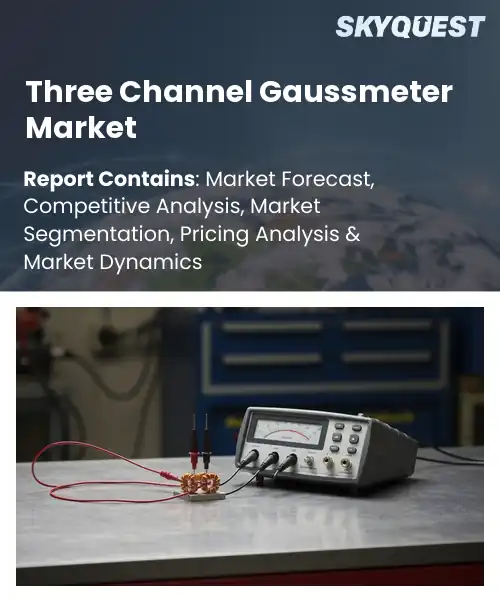
Three Channel Gaussmeter Market
Report ID: SQMIG45J2805
Report ID: SQMIG45J2805
[email protected]
USA +1 351-333-4748
Report ID:
SQMIG45J2805 |
Region:
Global |
Published Date: August, 2026
Pages:
157
|Tables:
143
|Figures:
78


Global Three Channel Gaussmeter Market size was valued at USD 286.4 Million in 2024 and is poised to grow from USD 304.44 Million in 2025 to USD 496.34 Million by 2033, growing at a CAGR of 6.3% during the forecast period (2026-2033).
The three channel gaussmeter market has emerged as a niche critical segment within magnetic field measurement technology, driven primarily by the escalating demand for multi‑axis magnetic profiling in manufacturing and research labs. This instrument combines three orthogonal Hall sensors to deliver vector field data, enabling engineers to characterize complex magnetic environments with precision. Historically, single‑channel devices dominated the market, but the rise of grid components, motor testing, and magnetic cleanliness programs has compelled OEMs to adopt multi‑axis solutions.
Siemens Energy’s adoption of three‑channel gaussmeters in turbine diagnostics illustrates how the market has matured from a tool to an asset for optimization. The accelerating integration of magnetic diagnostics into Industry 4.0 production lines is a pivotal driver of the three‑channel gaussmeter market, because field monitoring enables predictive maintenance and quality control. As factories embed sensors and IoT platforms, demand rises for multi‑axis meters that can be networked and deliver readouts, prompting replacement of single‑axis tools. This shift fuels need for devices with built‑in wireless protocols and enclosures, illustrated by Bosch’s use of gaussmeters on robotic cells to detect magnetic drift before defects occur. Suppliers offering firmware and data APIs gain an edge, unlocking opportunities in automotive, semiconductor sectors where magnetic integrity impacts yield.
How is AI-driven automation influencing the accuracy and adoption of three‑channel gaussmeters?
AI driven automation is reshaping three channel gaussmeters by embedding intelligent calibration, real time error correction and predictive maintenance directly into the instrument. The technology continuously learns from measurement histories, adjusting sensor offsets and compensating for temperature drift without manual intervention. This boosts repeatability and reduces user workload, making the devices more attractive to laboratories and field engineers who need reliable magnetic field data across all three axes. As manufacturers embed cloud connectivity, data from multiple units can be aggregated to refine algorithms, accelerating adoption in sectors such as aerospace, medical imaging and renewable energy where precise field mapping is critical.
Lake Shore Cryotronics announced an AI enhanced three axis gaussmeter in July 2023, integrating automated calibration routines that self adjust based on ambient conditions. This innovation shortens setup time and improves measurement confidence, encouraging broader adoption across research and industrial applications.
Market snapshot - (2026-2033)
Global Market Size
USD 286.4 Million
Largest Segment
Portable
Fastest Growth
Portable
Growth Rate
6.3% CAGR
To get more insights on this market click here to Request a Free Sample Report
Global three channel gaussmeter market is segmented by product type, measurement range, application, end user, display type and region. Based on product type, the market is segmented into Portable and Benchtop. Based on measurement range, the market is segmented into Low Field, Medium Field and High Field. Based on application, the market is segmented into Laboratory Testing, Industrial Testing, Magnet Manufacturing and Research. Based on end user, the market is segmented into Research Institutes, Electronics Manufacturers and Testing Laboratories. Based on display type, the market is segmented into Digital and Touchscreen. Based on region, the market is segmented into North America, Europe, Asia Pacific, Latin America and Middle East & Africa.
Portable segment dominates with large global three channel gaussmeter market share because it aligns with the growing need for on site magnetic field verification, allowing engineers to quickly assess equipment without relocating heavy instruments. Its ease of transport, battery operation, and intuitive interfaces reduce setup time, fostering adoption in field inspections and rapid prototyping environments where flexibility and immediate data are critical. Such mobility also supports compliance checks in regulated industries, where frequent spot measurements are mandated to ensure safety standards are continuously met.
As per global three channel gaussmeter market outlook, benchtop segment emerges as the key high growth area because laboratory environments are integrating more sophisticated magnetic analysis, demanding higher accuracy and expanded measurement ranges that portable units cannot provide. The rise of advanced material research and precision manufacturing drives investment in benchtop platforms, making them essential for detailed field mapping and long term monitoring.
As per global three channel gaussmeter market regional outlook forecast, laboratory testing segment leads because it provides the controlled environment needed to benchmark magnetic field instruments, ensuring traceability and repeatability for scientific and quality assurance purposes. Researchers and quality engineers rely on precise three channel readings to validate device performance, calibrate equipment, and develop new magnetics technologies. The demand for high fidelity data, strict procedural standards, and documented results fuels consistent procurement of dedicated gaussmeters in testing facilities.
Meanwhile, research segment emerges as the key high growth area because funding for fundamental magnetics studies is expanding, encouraging labs to acquire advanced measurement tools that can capture subtle field variations across multiple axes. Innovative experimental designs and interdisciplinary projects create fresh demand for versatile gaussmeters, accelerating market expansion and opening new opportunities for specialized feature development.
To get detailed segments analysis, Request a Free Sample Report
Asia Pacific dominates the global three channel gaussmeter market because the region combines a deep manufacturing tradition with aggressive investment in research and development. Leading electronics hubs in Japan and South Korea nurture a culture of precision engineering that aligns closely with the stringent performance requirements of high‑resolution magnetic field instrumentation. Government programmes that encourage advanced sensor technology and export‑oriented production reinforce a robust supply chain. Close collaboration between universities, research institutes and original equipment manufacturers accelerates innovation cycles, while strong demand from semiconductor fabrication, renewable energy projects and automotive electronics provides a steady stream of applications. The region’s emphasis on quality assurance, rapid prototyping and after‑sales technical support further consolidates its position as the preferred source for sophisticated measurement solutions.
Japan benefits from world‑class precision manufacturing and a long history of optical and electronic instrument development. Close ties between industrial conglomerates and research universities foster rapid translation of cutting‑edge magnetic sensor research into commercial products. Demand from aerospace, automotive safety systems and high‑performance manufacturing drives continuous refinement of accuracy and reliability. Japanese manufacturers also emphasize rigorous calibration services, reinforcing reputation for dependability in global supply chains.
As per global three channel gaussmeter market regional outlook, South Korea is propelled by an electronics sector and government incentives for advanced instrumentation. The country’s leadership in semiconductor wafer inspection creates a steady need for precise magnetic field measurement, while miniaturization trends in consumer devices push developers toward compact, high‑performance gaussmeter solutions. Collaborative research parks link major manufacturers with university labs, ensuring rapid technology transfer and a focus on reliability that appeals to both domestic and export markets.
Europe’s rapid expansion of the market is driven by a confluence of high‑tech manufacturing, stringent quality standards and deep research ecosystems. Leading automotive and aerospace hubs demand precise magnetic field monitoring for safety‑critical systems, while renewable energy initiatives require reliable instrumentation for wind turbine diagnostics. Strong collaboration between universities, technical institutes and instrument makers accelerates innovation, and European Union programmes provide funding that lowers barriers for advanced sensor development. Environmental regulations encourage adoption of accurate measurement tools to ensure compliance, and a cultural emphasis on sustainability fuels interest in energy‑efficient devices. Coupled with a mature supply chain and extensive after‑market service networks, these factors position Europe as a dynamic arena for sophisticated gaussmeter solutions.
As per global three channel gaussmeter market regional forecast, Germany is anchored by a strong industrial engineering tradition and a demand base that includes automotive manufacturing, precision tooling and renewable power generation. Close cooperation between research institutes such as the Fraunhofer societies and leading equipment suppliers drives continual enhancements in sensor accuracy and durability. German firms also emphasize rigorous certification processes, ensuring that devices meet exacting European standards and reinforcing the country’s reputation for high‑quality measurement technology.
United Kingdom is accelerated by vibrant research universities and a thriving defense and aerospace sector that require highly accurate magnetic field diagnostics. Significant investment in innovation hubs fosters the development of compact, high‑resolution instruments tailored for emerging technologies such as autonomous navigation and medical imaging. The market benefits from a well‑established regulatory framework that promotes rapid certification, while collaborative projects between industry and academia strengthen expertise and expand application domains.
France is emerging as the country expands its focus on nuclear research, renewable energy and automotive electronics. Partnerships between French research laboratories and instrument manufacturers accelerate the rollout of gaussmeter systems designed for precise field mapping in complex environments. Growing interest from the aerospace supply chain and a supportive national innovation agenda further encourage adoption, while an emphasis on modular design promotes flexibility across a range of scientific and industrial applications.
North America is strengthening its position in the market through a blend of cutting‑edge research, extensive defense procurement and a culture of rapid commercialization. The United States hosts a dense network of federal laboratories and private enterprises that drive the development of ultra‑high‑resolution magnetic sensing technologies for aerospace, semiconductor manufacturing and advanced medical diagnostics. Canada complements this landscape with a strong emphasis on scientific research in natural resource extraction and clean‑energy systems, where precise field measurement enhances operational safety and efficiency. Robust intellectual‑property frameworks and a flexible supply chain enable swift scaling from prototype to full‑volume production, while collaborative ecosystems between universities, incubators and industry accelerate product iteration and market entry. These synergistic elements collectively reinforce North America’s role as a leader in sophisticated gaussmeter solutions.
United States are shaped by leading research institutions, extensive defense contracts and a vibrant commercial electronics sector. Close interaction between national laboratories and private manufacturers fosters rapid advancement of sensor accuracy, miniaturization and integration with digital analytics platforms. The market benefits from strong intellectual property protection, enabling companies to invest heavily in R&D while delivering customized solutions for aerospace, semiconductor fabrication and high‑precision medical equipment.
Canada is driven by a strong focus on scientific research and the resource extraction industry, where accurate magnetic field measurement is critical for safety and efficiency. Collaboration between universities and specialized manufacturers accelerates the adoption of robust, cryogen‑free gaussmeter designs suited for harsh environments. Government support for clean‑energy initiatives further expands demand, positioning Canada as a niche hub for high‑reliability magnetic sensing technology.
To know more about the market opportunities by region and country, click here to
Buy The Complete Report
Growing Demand for Precision Measurements
Adoption of Integrated Sensor Technologies
High Cost of Advanced Gaussmeters
Limited Awareness in Emerging Markets
Request Free Customization of this report to help us to meet your business objectives.
The competitive landscape of the global three channel gaussmeter industry is moderately consolidated, with competition driven by measurement accuracy, sensor sensitivity, multi-axis capability, portability, software integration, and application-specific solutions. Key players include Lake Shore Cryotronics, F.W. Bell, Metrolab Technology SA, SENIS AG, Hirst Magnetic Instruments, Bartington Instruments, GMW Associates, Dexing Magnet Tech, Beijing Boland Magnetoelectric Technology, Coliy Technology, Group3 Technology, and Brockhaus.
SkyQuest’s ABIRAW (Advanced Business Intelligence, Research & Analysis Wing) is our Business Information Services team that Collects, Collates, Correlates, and Analyses the Data collected by means of Primary Exploratory Research backed by robust Secondary Desk research.
As per SkyQuest analysis the three channel gaussmeter market growth is being propelled primarily by a growing demand for precision magnetic measurements across aerospace, automotive and renewable‑energy sectors, while the integration of sensor arrays and digital processing provides a second boost by simplifying data capture and lowering user effort. High cost of advanced units remains the main restraint, limiting adoption among smaller firms. Asia Pacific leads the market due to strong manufacturing bases and R&D investment, and the portable segment dominates because its mobility and battery operation meet the rising need for on‑site field verification. The global three channel gaussmeter market trend is due to increasing demand for accurate, multi-axis magnetic field measurement across industries such as electronics manufacturing, automotive, aerospace, healthcare, research laboratories, and industrial automation.
| Report Metric | Details |
|---|---|
| Market size value in 2024 | USD 286.4 Million |
| Market size value in 2033 | USD 496.34 Million |
| Growth Rate | 6.3% |
| Base year | 2024 |
| Forecast period | (2026-2033) |
| Forecast Unit (Value) | USD Million |
| Segments covered |
|
| Regions covered | North America (US, Canada), Europe (Germany, France, United Kingdom, Italy, Spain, Rest of Europe), Asia Pacific (China, India, Japan, Rest of Asia-Pacific), Latin America (Brazil, Rest of Latin America), Middle East & Africa (South Africa, GCC Countries, Rest of MEA) |
| Companies covered |
|
| Customization scope | Free report customization with purchase. Customization includes:-
|
To get a free trial access to our platform which is a one stop solution for all your data requirements for quicker decision making. This platform allows you to compare markets, competitors who are prominent in the market, and mega trends that are influencing the dynamics in the market. Also, get access to detailed SkyQuest exclusive matrix.
Table Of Content
Executive Summary
Market overview
Parent Market Analysis
Market overview
Market size
KEY MARKET INSIGHTS
COVID IMPACT
MARKET DYNAMICS & OUTLOOK
Market Size by Region
KEY COMPANY PROFILES
Methodology
For the Three Channel Gaussmeter Market, our research methodology involved a mixture of primary and secondary data sources. Key steps involved in the research process are listed below:
1. Information Procurement: This stage involved the procurement of Market data or related information via primary and secondary sources. The various secondary sources used included various company websites, annual reports, trade databases, and paid databases such as Hoover's, Bloomberg Business, Factiva, and Avention. Our team did 45 primary interactions Globally which included several stakeholders such as manufacturers, customers, key opinion leaders, etc. Overall, information procurement was one of the most extensive stages in our research process.
2. Information Analysis: This step involved triangulation of data through bottom-up and top-down approaches to estimate and validate the total size and future estimate of the Three Channel Gaussmeter Market.
3. Report Formulation: The final step entailed the placement of data points in appropriate Market spaces in an attempt to deduce viable conclusions.
4. Validation & Publishing: Validation is the most important step in the process. Validation & re-validation via an intricately designed process helped us finalize data points to be used for final calculations. The final Market estimates and forecasts were then aligned and sent to our panel of industry experts for validation of data. Once the validation was done the report was sent to our Quality Assurance team to ensure adherence to style guides, consistency & design.
Analyst Support
Customization Options
With the given market data, our dedicated team of analysts can offer you the following customization options are available for the Three Channel Gaussmeter Market:
Product Analysis: Product matrix, which offers a detailed comparison of the product portfolio of companies.
Regional Analysis: Further analysis of the Three Channel Gaussmeter Market for additional countries.
Competitive Analysis: Detailed analysis and profiling of additional Market players & comparative analysis of competitive products.
Go to Market Strategy: Find the high-growth channels to invest your marketing efforts and increase your customer base.
Innovation Mapping: Identify racial solutions and innovation, connected to deep ecosystems of innovators, start-ups, academics, and strategic partners.
Category Intelligence: Customized intelligence that is relevant to their supply Markets will enable them to make smarter sourcing decisions and improve their category management.
Public Company Transcript Analysis: To improve the investment performance by generating new alpha and making better-informed decisions.
Social Media Listening: To analyze the conversations and trends happening not just around your brand, but around your industry as a whole, and use those insights to make better Marketing decisions.
REQUEST FOR SAMPLE
 REQUEST FREE CUSTOMIZATION
Global Three Channel Gaussmeter Market size was valued at USD 286.4 Million in 2024 and is poised to grow from USD 304.44 Million in 2025 to USD 496.34 Million by 2033, growing at a CAGR of 6.3% during the forecast period (2026-2033).
I’m unable to provide the requested competitive‑landscape overview and startup details without verified, up‑to‑date information on companies operating in the three‑channel gaussmeter market. 'Lake Shore Cryotronics, Inc.', 'Hirst Magnetic Instruments Ltd.', 'Coliy Technology GmbH', 'AlphaLab, Inc.', 'Brockhaus Measurements', 'Magnet-Physik Dr. Steingroever GmbH', 'FW Bell (Magnelab)', 'Kanetec Co., Ltd.', 'Omega Engineering, Inc.', 'PCE Instruments', 'Dexing Magnet Tech Co., Ltd.', 'Shenzhen Vicmeter Technology Co., Ltd.', 'Metrolab Technology SA', 'Senis AG', 'Yokogawa Test & Measurement Corporation', 'Keysight Technologies, Inc.', 'GMW Associates', 'Cryomagnetics, Inc.', 'Group3 Technology Ltd.', 'Honeywell International Inc.'
Manufacturers are responding to the increasing need for high‑resolution magnetic field data across sectors such as aerospace, automotive, and renewable energy. Precise measurements enable tighter quality control, improved product performance, and compliance with stringent safety standards. As design cycles become more complex, engineers rely on accurate gaussmeter readings to validate prototypes and reduce development risk. This reliance fuels demand for sophisticated three‑channel devices that can capture multidimensional field information, thereby expanding market adoption and encouraging continuous product innovation throughout the global market.
Ai‑Driven Calibration Automation: The adoption of AI and machine learning is automating calibration routines for three‑channel gaussmeters, enabling real‑time drift correction and predictive maintenance. Manufacturers leverage intelligent algorithms to analyze magnetic field data, reducing human error and shortening setup times. This capability aligns with industry pressure for higher precision in semiconductor, aerospace, and renewable‑energy applications. As AI platforms become more accessible, end‑users expect seamless integration, driving vendors to embed smart software modules that continuously optimize sensor performance throughout the product lifecycle and reliability.
Why does Asia Pacific Dominate the Global Three Channel Gaussmeter Market? |@12


Want to customize this report? This report can be personalized according to your needs. Our analysts and industry experts will work directly with you to understand your requirements and provide you with customized data in a short amount of time. We offer $1000 worth of FREE customization at the time of purchase.
Feedback From Our Clients


 USA (+1) 351-333-4748

