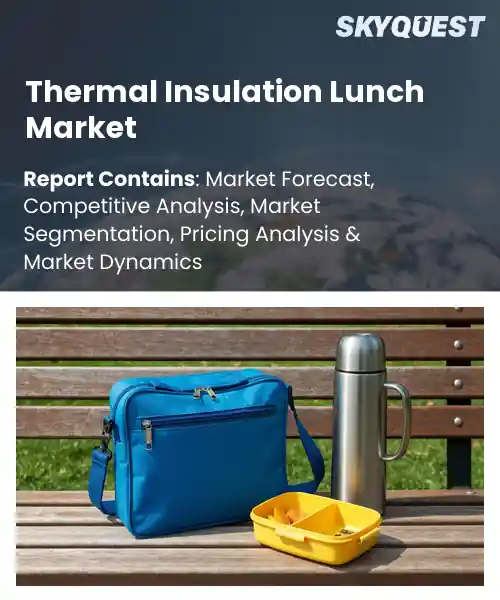
Thermal Insulation Lunch Market
Report ID: SQMIG20I2951
Report ID: SQMIG20I2951
[email protected]
USA +1 351-333-4748
Report ID:
SQMIG20I2951 |
Region:
Global |
Published Date: April, 2026
Pages:
157
|Tables:
89
|Figures:
76


Global Thermal Insulation Lunch Market size was valued at USD 942.5 Million in 2024 and is poised to grow from USD 991.51 Million in 2025 to USD 946.9 Million by 2033, growing at a CAGR of 5.2% during the forecast period (2026-2033).
The primary driver of the thermal insulated lunch market is rising consumer demand for food temperature control, driven by changing work patterns and greater awareness of food safety. The market covers insulated lunch boxes, bags and containers using foam, vacuum panels or phase change materials to keep meals safe, and it matters because it reduces spoilage, supports midday nutrition, and aligns with sustainability when reusable options displace single use packaging. Over time the sector moved from basic insulated fabrics to advanced lightweight materials, exemplified by companies offering vacuum insulated stainless steel bottles and compact bento systems in global urban markets.Building on those developments, a key factor driving global expansion is urbanization coupled with rising dual income households, which increases demand for convenient, temperature stable meals and pushes employers and retailers to offer corporate gifting and private label insulated solutions. As consumers choose home prepared lunches over quick service food, manufacturers respond by adding compartments, reliable seals and designs that work with reheating methods, which causes broader distribution through e commerce platforms and subscription meal services. For example, office catering programs that deploy insulated carriers reduce waste and extend freshness, creating procurement demand for durable and easy to clean products.
How is IoT enhancing quality control in the thermal insulation lunch market?
IoT is improving quality control in the thermal insulation lunch market by embedding sensors into insulated containers to monitor temperature, humidity and seal integrity throughout storage and transit. Manufacturers use this data for product validation, design improvement and compliance with food safety standards while retailers track performance in the field. Connected diagnostics enable predictive maintenance of heating elements and alerts that reduce spoilage and returns. Feedback loops from usage data guide materials choices and sealing methods so products better preserve temperature and freshness. Examples include app based temperature monitoring, multi compartment boxes with zone control and cloud analytics that enable supply chain traceability.Zojirushi March 2024, the company introduced a high end IoT enabled lunch box with remote temperature monitoring which strengthens quality control by enabling continuous temperature logs and remote diagnostics and supports market efficiency through faster fault detection and improved consumer trust.
Market snapshot - (2026-2033)
Global Market Size
USD 942.5 Million
Largest Segment
Airports & International Transit Hubs (Major Revenue)
Fastest Growth
Malls & Retail Shopping Centers
Growth Rate
5.2% CAGR
To get more insights on this market click here to Request a Free Sample Report
Global thermal insulation lunch market is segmented by deployment location, functional capability, end-user vertical and region. Based on deployment location, the market is segmented into Airports & International Transit Hubs (Major Revenue), Malls & Retail Shopping Centers and Telecommunication Stores (Self-service). Based on functional capability, the market is segmented into Dispensing Only Kiosks and Multi-functional (Registration, KYC & Payment). Based on end-user vertical, the market is segmented into Telecom Service Providers (MNOs/MVNOs) and Tourism & Hospitality Services. Based on region, the market is segmented into North America, Europe, Asia Pacific, Latin America and Middle East & Africa.
Airports & International Transit Hubs segment dominates because they concentrate high traveler throughput and long dwell times that create persistent demand for temperature-controlled grab-and-go meals, making large-scale installations commercially viable. Operators favor proven, robust thermal insulation lunch systems in these locations due to predictable demand patterns, strong concession partnerships, premium pricing opportunities, and operational efficiencies that simplify replenishment and maintenance across multiple touchpoints.
However, Malls & Retail Shopping Centers are the most rapidly expanding area as evolving food halls and extended hours boost demand for convenient insulated lunch options. Mall operators favor modular kiosk rollouts and promotional tie-ins, which widen distribution, enable frequent consumer interactions, and create scalable revenue opportunities for thermal insulation lunch offerings.
Dispensing Only Kiosks segment dominates because operators prioritize simplicity and reliability for core thermal insulation lunch distribution, reducing technical complexity and maintenance burden compared with integrated platforms. Buyers and service providers opt for hardened dispensing units that ensure consistent temperature control and fast throughput, enabling rapid rollouts across diverse venues; this focus on proven functionality lowers barriers to adoption and supports steady revenue generation from routine replenishment and logistics models.
Meanwhile, Multi-functional (Registration, KYC & Payment) is the fastest growing option as providers pursue data capture, seamless payment, and loyalty features that enable premium services. Integration with backend systems and identity workflows fuels pilots and commercial rollouts, broadening use cases and creating new monetization pathways for thermal insulation lunch offerings.
To get detailed segments analysis, Request a Free Sample Report
Asia Pacific dominance in the Thermal Insulation Lunch Market reflects a convergence of structural advantages and strategic initiatives. A deep manufacturing ecosystem supports material development and cost effective production, while rapid urbanization and infrastructure expansion sustain demand across multiple sectors. Regional policy emphasis on energy efficiency encourages adoption of advanced insulation technologies and stimulates retrofit activity. Proximity to major supply chains and ports enables efficient distribution and export orientation. Strong research and development capacity in advanced materials, combined with close collaboration between industry and academic institutions, accelerates product innovation. Market fragmentation allows agile local players to tailor solutions for diverse climatic and application needs, and competitive labor and input costs reinforce the region as a cost and capability leader. Consolidation among key manufacturers and growing investment in specialized insulation formats for electronics and industrial applications further solidify regional leadership and market depth.
Thermal Insulation Lunch Market Japan emphasizes advanced materials research and precision manufacturing to deliver high performance and compact solutions. Urban density and demanding electronics industries drive preference for specialized insulation formats. Collaboration between manufacturers and research institutes fosters innovative formulations and rigorous quality assurance. Established logistics networks and reputation for reliability enable domestic producers to meet stringent application requirements while focusing on product longevity and integration into energy efficient buildings.
Thermal Insulation Lunch Market South Korea leverages strong fabrication capabilities and export oriented base that require high performance insulation. Heavy industry and advanced electronics demand tailored thermal solutions emphasizing reliability under intensive operating conditions. Tight collaboration between component makers and system integrators accelerates specialty material commercialization. Agile suppliers and focused research activity foster adoption of formats and ensure products meet stringent durability and integration standards across industrial and construction applications.
Expansion in North America stems from a combination of building renovation momentum, evolving energy efficiency expectations, and a mature distribution and contracting ecosystem that enables rapid product uptake. Stakeholder emphasis on reducing operational energy use and meeting green building benchmarks encourages adoption of advanced insulation types across residential, commercial, and industrial segments. Robust networks of distributors and installers shorten time to market for innovative materials while manufacturers invest in product differentiation to address regional performance needs. Demand diversity, from high specification industrial applications to targeted retrofit solutions, supports a dynamic market where quality, compliance and installer proficiency are key competitively differentiating factors. Policy signals and incentive programs aimed at lowering energy use and lifecycle cost considerations prompt building owners to prioritize insulation investments, while rising interest in circular materials drives innovation in recycled and bio based insulation solutions.
Thermal Insulation Lunch Market United States shows broad demand across residential, commercial and industrial segments driven by renovation activity and construction. A mature distribution network and experienced installer base enable rapid deployment of new materials. Emphasis on building codes and third party certification raises product specification and measured performance. Manufacturers focus on material innovation, sustainability claims and lifecycle cost advantages to meet buyer expectations and address varied regional climate applications.
Thermal Insulation Lunch Market Canada is shaped by cold climate performance requirements and a focus on thermal efficiency across residential and commercial buildings. Remote construction projects increase demand for durable, moisture resistant insulation solutions that perform in harsh conditions. Regional suppliers support specification tailoring and logistics for dispersed markets. Emphasis on energy efficient retrofits and proven systems encourages uptake that balances installation practicality and long term performance and durability standards.
Europe is strengthening its position in the Thermal Insulation Lunch Market through a coordinated focus on energy efficient renovation, sustainability and product standardization. Policy frameworks and procurement priorities favor materials with clear environmental credentials and recyclability, encouraging manufacturers to adopt circular approaches and low impact formulations. Cross border collaboration among industry organizations, research centers and certification bodies accelerates harmonized performance benchmarks. Investment in retrofit programs for aging building stock, combined with strong technical expertise among installers and producers, advances adoption of sophisticated insulation systems that meet rigorous quality and environmental expectations across diverse European markets. Regional innovation hubs in Germany, United Kingdom and France contribute specialized research and pilot programs that translate into commercially viable insulation formats. Public private partnerships and targeted training initiatives strengthen installer competence while emphasizing lifecycle performance and whole building integration, reinforcing market confidence in advanced insulation solutions.
Thermal Insulation Lunch Market Germany combines engineering rigor and industrial scale production to supply high specification insulation for construction and process industries. A concentration of specialized manufacturers and institutions promotes translation of advanced materials into reliable products. Market emphasis on certification, lifecycle performance and integration with heating systems supports sophisticated solutions for retrofit and new build projects. Close cooperation between suppliers and specifiers ensures products meet functional and environmental expectations.
Thermal Insulation Lunch Market United Kingdom is driven by efforts to upgrade aging housing and improve thermal performance in constrained buildings. Demand favors adaptable insulation systems that integrate into tight cavities and complex wall assemblies with minimal disruption. Policy incentives and evolving standards encourage specification of verified products, while a skilled installer network and focused training improve onsite execution and long term performance widely across domestic and commercial refurbishment projects.
Thermal Insulation Lunch Market France prioritizes thermal comfort and building performance across residential and public sectors. Renovation initiatives and public procurement emphasize solutions that combine energy efficiency with comfort and acoustic benefits. Manufacturers and installers collaborate to tailor products for masonry and mixed construction types. Growing interest in lower carbon and recyclable materials steers product development, while regional supply chains and technical expertise support dependable delivery and long term durability.
To know more about the market opportunities by region and country, click here to
Buy The Complete Report
Stricter Energy Efficiency Regulations
Urbanization and Construction Growth
Raw Material Price Volatility
Shortage Of Trained Installers
Request Free Customization of this report to help us to meet your business objectives.
Competition in the Global Thermal Insulation Lunch Market centers on strategic partnerships, targeted acquisitions of specialty material makers, and rapid technology commercialization to capture specification driven projects. Incumbents pursue supplier consolidation while challengers secure public grants and pilot lines to validate novel aerogels and vacuum insulations. For example AeroShield expanded pilot manufacturing and won ARPA-E support and Thermalytica advanced TIISA aerogel commercialization
Top Player’s Company Profile
Recent Developments
SkyQuest’s ABIRAW (Advanced Business Intelligence, Research & Analysis Wing) is our Business Information Services team that Collects, Collates, Correlates, and Analyses the Data collected by means of Primary Exploratory Research backed by robust Secondary Desk research. As per SkyQuest analysis, the global thermal insulation lunch market is driven by rising consumer demand for food temperature control as changing work patterns and greater awareness of food safety prompt adoption of reusable insulated lunchware. Urbanization and growing dual income households act as a second driver by increasing demand for convenient, temperature stable meals and corporate and retail offerings. A key restraint is raw material price volatility which can squeeze margins and slow product development. Asia Pacific dominates the market due to manufacturing scale and rapid urban growth, while Airports and International Transit Hubs are the dominating deployment segment because high traveler throughput creates steady demand for robust temperature controlled grab and go solutions.
| Report Metric | Details |
|---|---|
| Market size value in 2024 | USD 942.5 Million |
| Market size value in 2033 | USD 946.9 Million |
| Growth Rate | 5.2% |
| Base year | 2024 |
| Forecast period | (2026-2033) |
| Forecast Unit (Value) | USD Million |
| Segments covered |
|
| Regions covered | North America (US, Canada), Europe (Germany, France, United Kingdom, Italy, Spain, Rest of Europe), Asia Pacific (China, India, Japan, Rest of Asia-Pacific), Latin America (Brazil, Rest of Latin America), Middle East & Africa (South Africa, GCC Countries, Rest of MEA) |
| Companies covered |
|
| Customization scope | Free report customization with purchase. Customization includes:-
|
To get a free trial access to our platform which is a one stop solution for all your data requirements for quicker decision making. This platform allows you to compare markets, competitors who are prominent in the market, and mega trends that are influencing the dynamics in the market. Also, get access to detailed SkyQuest exclusive matrix.
Table Of Content
Executive Summary
Market overview
Parent Market Analysis
Market overview
Market size
KEY MARKET INSIGHTS
COVID IMPACT
MARKET DYNAMICS & OUTLOOK
Market Size by Region
KEY COMPANY PROFILES
Methodology
For the Thermal Insulation Lunch Market, our research methodology involved a mixture of primary and secondary data sources. Key steps involved in the research process are listed below:
1. Information Procurement: This stage involved the procurement of Market data or related information via primary and secondary sources. The various secondary sources used included various company websites, annual reports, trade databases, and paid databases such as Hoover's, Bloomberg Business, Factiva, and Avention. Our team did 45 primary interactions Globally which included several stakeholders such as manufacturers, customers, key opinion leaders, etc. Overall, information procurement was one of the most extensive stages in our research process.
2. Information Analysis: This step involved triangulation of data through bottom-up and top-down approaches to estimate and validate the total size and future estimate of the Thermal Insulation Lunch Market.
3. Report Formulation: The final step entailed the placement of data points in appropriate Market spaces in an attempt to deduce viable conclusions.
4. Validation & Publishing: Validation is the most important step in the process. Validation & re-validation via an intricately designed process helped us finalize data points to be used for final calculations. The final Market estimates and forecasts were then aligned and sent to our panel of industry experts for validation of data. Once the validation was done the report was sent to our Quality Assurance team to ensure adherence to style guides, consistency & design.
Analyst Support
Customization Options
With the given market data, our dedicated team of analysts can offer you the following customization options are available for the Thermal Insulation Lunch Market:
Product Analysis: Product matrix, which offers a detailed comparison of the product portfolio of companies.
Regional Analysis: Further analysis of the Thermal Insulation Lunch Market for additional countries.
Competitive Analysis: Detailed analysis and profiling of additional Market players & comparative analysis of competitive products.
Go to Market Strategy: Find the high-growth channels to invest your marketing efforts and increase your customer base.
Innovation Mapping: Identify racial solutions and innovation, connected to deep ecosystems of innovators, start-ups, academics, and strategic partners.
Category Intelligence: Customized intelligence that is relevant to their supply Markets will enable them to make smarter sourcing decisions and improve their category management.
Public Company Transcript Analysis: To improve the investment performance by generating new alpha and making better-informed decisions.
Social Media Listening: To analyze the conversations and trends happening not just around your brand, but around your industry as a whole, and use those insights to make better Marketing decisions.
REQUEST FOR SAMPLE
 REQUEST FREE CUSTOMIZATION


Want to customize this report? This report can be personalized according to your needs. Our analysts and industry experts will work directly with you to understand your requirements and provide you with customized data in a short amount of time. We offer $1000 worth of FREE customization at the time of purchase.
Feedback From Our Clients


 USA (+1) 351-333-4748

