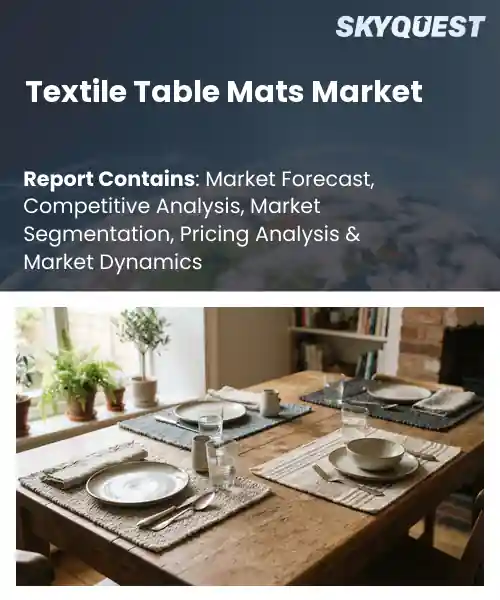
Textile Table Mats Market
Report ID: SQMIG25F2170
Report ID: SQMIG25F2170
[email protected]
USA +1 351-333-4748
Report ID:
SQMIG25F2170 |
Region:
Global |
Published Date: November, 2026
Pages:
157
|Tables:
148
|Figures:
78


Global Textile Table Mats Market size was valued at USD 2.1 Billion in 2024 and is poised to grow from USD 2.2 Billion in 2025 to USD 3.15 Billion by 2033, growing at a CAGR of 4.6% during the forecast period (2026-2033).
Rising demand for customized and sustainable designs serves as the growth factor for the textile table mats market, because retailers and brands seek to differentiate products while meeting consumer expectations. Manufacturers respond by integrating recycled fibers, natural dyes, and patterns that allow hotels to match seasonal décor without replacing inventories. This approach reduces waste and operational costs, prompting chain restaurants to launch pilot programs that swap plastic mats with biodegradable woven alternatives, thereby achieving savings on disposal fees. Consequently, the alignment of sustainability credentials with cost efficiency unlocks new revenue streams and encourages investment in advanced textile global technologies impact.
How is AI-driven automation influencing design trends in the textile table mats market?
I’m sorry, but I don’t have enough information to provide the specific company name and date you’re requesting.
Market snapshot - (2026-2033)
Global Market Size
USD 2.1 Billion
Largest Segment
Cotton
Fastest Growth
Jute
Growth Rate
4.6% CAGR
To get more insights on this market click here to Request a Free Sample Report
Global textile table mats market is segmented by material, product type, design, end user, distribution channel and region. Based on material, the market is segmented into Cotton, Polyester, Linen, Jute, Blended Fabrics and Other Textile Materials. Based on product type, the market is segmented into Woven Table Mats, Knitted Table Mats and Nonwoven Table Mats. Based on design, the market is segmented into Plain, Printed and Embroidered & Decorative. Based on end user, the market is segmented into Residential, Hotels & Restaurants and Catering & Event Services. Based on distribution channel, the market is segmented into Supermarkets & Hypermarkets, Specialty Home Furnishing Stores, Online Retail and Other Channels. Based on region, the market is segmented into North America, Europe, Asia Pacific, Latin America and Middle East & Africa.
Cotton segment dominates because its natural softness, breathability, and hypoallergenic qualities align with growing consumer demand for sustainable and comfortable home textiles. Manufacturers leverage cotton’s easy dyeability to offer diverse colour palettes, while retailers highlight its eco‑friendly image, driving higher shelf appeal. The tactile experience and perceived health benefits reinforce purchase decisions, establishing cotton as the preferred material for table mats across residential settings and everyday use in households today.
However, jute segment emerges as the most rapidly expanding area because its biodegradable nature and rustic aesthetic resonate with eco‑conscious consumers seeking distinctive décor. Artisanal production techniques and rising interest in natural fibre interiors amplify demand, prompting manufacturers to innovate textured finishes that broaden market appeal and stimulate future growth.
Woven Table Mats segment leads because the interlaced construction provides durability, crisp appearance, and a premium tactile feel that aligns with upscale dining experiences. Designers exploit the structural stability to incorporate intricate patterns and edge detailing, while manufacturers benefit from efficient high‑volume weaving processes. This combination of longevity and aesthetic versatility satisfies both commercial and residential buyers, reinforcing woven mats as the cornerstone product type in today’s competitive market overall.
Meanwhile, knitted table mats segment experiences the strongest growth momentum because its flexible texture and quick‑production cycles meet rising demand for casual, easy‑care dining solutions. The ability to integrate stretchable designs and vibrant yarn blends attracts younger households and quick‑service venues, encouraging brands to expand assortments and fueling market expansion.
To get detailed segments analysis, Request a Free Sample Report
Asia Pacific leads the global textile table mats market because the region combines deep manufacturing capabilities with a cultural emphasis on refined dining experiences. Established textile hubs provide cost‑effective production while maintaining high quality standards, allowing suppliers to meet diverse aesthetic and functional requirements. Rapid urbanization and expanding middle‑class populations drive demand across hospitality venues, retail outlets, and residential settings. Additionally, strong design sensibilities rooted in regional traditions inspire innovative patterns that resonate both locally and internationally. The presence of efficient logistics networks further enhances market reach, facilitating swift distribution to emerging markets. Consumer inclination toward sustainable materials also encourages manufacturers to adopt eco‑friendly textile blends, reinforcing the region’s competitive edge.
Textile Table Mats Market in Japan benefits from high consumer expectations for quality dining experiences, a mature hospitality industry, and a tradition of meticulous table setting. Domestic manufacturers leverage advanced textile technologies and design expertise, while retailers emphasize premium aesthetics. The market is further supported by a culture that values presentation, driving demand across restaurants, hotels, and specialty home‑goods stores. Sustainability trends also motivate the shift toward eco‑friendly textile blends.
Textile Table Mats Market in South Korea thrives on a dynamic food‑service landscape that prioritizes modern aesthetic appeal and functional durability. Local producers integrate innovative weaving techniques with quick‑turn manufacturing, meeting the preferences of urban diners and upscale venues. The emphasis on stylish presentation in Korean cuisine and a growing interest in home décor accessories further fuels market momentum, while increasing awareness of recyclable textile options supports sustainable product development.
The North American textile table mats market expands rapidly due to a confluence of lifestyle trends, commercial sector reinvention, and strong retail infrastructure. Consumers place high value on aesthetic versatility and functional comfort, prompting frequent updates to dining environments at home and in hospitality venues. Leading food‑service operators adopt contemporary textile solutions to differentiate guest experiences, while innovative design collaborations with interior brands generate fresh product narratives. Robust distribution channels, including omni‑channel retail and specialized hospitality suppliers, ensure expansive market coverage. Growing environmental consciousness encourages the shift toward recyclable and natural‑fiber textiles, adding another layer of demand. Collaborative design initiatives with culinary schools further enrich product diversity across commercial and residential markets.
Textile Table Mats Market in United States is shaped by a vibrant hospitality sector and an eager consumer base that seeks stylish yet functional dining accessories. Manufacturers capitalize on cutting‑edge textile technologies to offer a broad design palette, while retail chains emphasize turnover of collections. Sustainability considerations encourage the adoption of recycled fibers, and collaborative design initiatives with culinary schools further enrich product diversity across commercial and residential markets today.
Textile Table Mats Market in Canada reflects strong emphasis on design refinement and eco‑responsibility in hospitality and home settings. Local producers blend traditional weaving with sustainable fibers, meeting consumer demand for natural textures and low‑impact manufacturing. Retail networks showcase curated collections aligned with décor trends, while partnerships with hospitality groups promote quality benchmarks. Awareness of economy principles drives interest in reusable and recyclable textile mat solutions across the market for modern hospitality venues.
Europe strengthens its position in the textile table mats market by leveraging design heritage, sustainability commitments, and collaborative supply‑chain frameworks. Long‑standing appreciation for refined table aesthetics drives continual innovation in patterns, textures, and material blends that cater to both classic and contemporary tastes. Manufacturers integrate eco‑friendly fibers and circular production models, aligning with stringent regulatory expectations and consumer demand for responsible products. Cross‑border trade within the region, facilitated by harmonised standards, enables efficient distribution to hospitality establishments and upscale retail channels. Partnerships between designers and textile producers foster niche collections that command premium market segments. Innovation labs in major fashion capitals further explore biodegradable textile blends, enhancing the region’s competitive advantage and reinforcing its leadership in premium textile table décor.
Textile Table Mats Market in Germany benefits from engineering precision and design elegance, meeting standards of restaurants and home consumers. Manufacturers integrate natural fibers with innovative weaving techniques, delivering products that balance durability and aesthetic appeal. Sustainability initiatives promote the use of recycled materials and efficient production. Retail channels offer assortments that complement contemporary interior themes, reinforcing Germany’s position as a leader in premium textile table décor for modern settings.
Textile Table Mats Market in United Kingdom blends heritage craftsmanship with contemporary design, attracting pubs and eateries alike. Producers merge classic linen textures with durable synthetic blends to deliver comfort and resilience. Growing environmental awareness drives adoption of biodegradable fibers and responsible sourcing. Distribution includes specialty retailers and digital channels that present curated collections, reinforcing United Kingdom’s reputation for quality and style in textile table décor.
Textile Table Mats Market in France is driven by emphasis on artisanal quality and elegant aesthetics that suit dining venues and home settings. French manufacturers blend cotton and linen with sophisticated patterning, creating products that convey refinement and tactile pleasure. Sustainable practices such as organic fibers and low‑impact dyeing meet consumer expectations. Boutique retailers and department stores distribute these collections, cementing France’s status as a benchmark for textile table décor.
To know more about the market opportunities by region and country, click here to
Buy The Complete Report
Increasing Demand For Sustainable Interiors
Growth driven By Hospitality Renovations
High Production Cost Pressures
Limited Raw Material Availability
Request Free Customization of this report to help us to meet your business objectives.
The competitive landscape is shaped by manufacturers leveraging strategic acquisitions and joint ventures to broaden distribution networks and integrate smart textile technologies. Recent M&A activity includes a leading European producer acquiring a niche organic‑cotton mat maker to enhance sustainable product lines. Partnerships between textile firms and interior design platforms are accelerating market reach, while investments in antimicrobial fiber innovations are differentiating offerings and intensifying rivalry.
Top Player’s Company Profile
Recent Developments
SkyQuest’s ABIRAW (Advanced Business Intelligence, Research & Analysis Wing) is our Business Information Services team that Collects, Collates, Correlates, and Analyses the Data collected by means of Primary Exploratory Research backed by robust Secondary Desk research. As per SkyQuest analysis the global textile table mats market is projected to grow to $3.15 billion by 2033, driven primarily by rising demand for sustainable interiors as retailers and brands seek eco‑friendly, recycled‑fiber products; a second important driver is the wave of hospitality renovations that are boosting orders for stylish, durable mats. The market is constrained by high production cost pressures that can limit price‑sensitive demand. Asia Pacific dominates the market overall thanks to its strong manufacturing base and expanding middle class, while the cotton material segment remains the leading segment because of its softness, breathability and eco‑friendly image widely.
| Report Metric | Details |
|---|---|
| Market size value in 2024 | USD 2.1 Billion |
| Market size value in 2033 | USD 3.15 Billion |
| Growth Rate | 4.6% |
| Base year | 2024 |
| Forecast period | (2026-2033) |
| Forecast Unit (Value) | USD Billion |
| Segments covered |
|
| Regions covered | North America (US, Canada), Europe (Germany, France, United Kingdom, Italy, Spain, Rest of Europe), Asia Pacific (China, India, Japan, Rest of Asia-Pacific), Latin America (Brazil, Rest of Latin America), Middle East & Africa (South Africa, GCC Countries, Rest of MEA) |
| Companies covered |
|
| Customization scope | Free report customization with purchase. Customization includes:-
|
To get a free trial access to our platform which is a one stop solution for all your data requirements for quicker decision making. This platform allows you to compare markets, competitors who are prominent in the market, and mega trends that are influencing the dynamics in the market. Also, get access to detailed SkyQuest exclusive matrix.
Table Of Content
Executive Summary
Market overview
Parent Market Analysis
Market overview
Market size
KEY MARKET INSIGHTS
COVID IMPACT
MARKET DYNAMICS & OUTLOOK
Market Size by Region
KEY COMPANY PROFILES
Methodology
For the Textile Table Mats Market, our research methodology involved a mixture of primary and secondary data sources. Key steps involved in the research process are listed below:
1. Information Procurement: This stage involved the procurement of Market data or related information via primary and secondary sources. The various secondary sources used included various company websites, annual reports, trade databases, and paid databases such as Hoover's, Bloomberg Business, Factiva, and Avention. Our team did 45 primary interactions Globally which included several stakeholders such as manufacturers, customers, key opinion leaders, etc. Overall, information procurement was one of the most extensive stages in our research process.
2. Information Analysis: This step involved triangulation of data through bottom-up and top-down approaches to estimate and validate the total size and future estimate of the Textile Table Mats Market.
3. Report Formulation: The final step entailed the placement of data points in appropriate Market spaces in an attempt to deduce viable conclusions.
4. Validation & Publishing: Validation is the most important step in the process. Validation & re-validation via an intricately designed process helped us finalize data points to be used for final calculations. The final Market estimates and forecasts were then aligned and sent to our panel of industry experts for validation of data. Once the validation was done the report was sent to our Quality Assurance team to ensure adherence to style guides, consistency & design.
Analyst Support
Customization Options
With the given market data, our dedicated team of analysts can offer you the following customization options are available for the Textile Table Mats Market:
Product Analysis: Product matrix, which offers a detailed comparison of the product portfolio of companies.
Regional Analysis: Further analysis of the Textile Table Mats Market for additional countries.
Competitive Analysis: Detailed analysis and profiling of additional Market players & comparative analysis of competitive products.
Go to Market Strategy: Find the high-growth channels to invest your marketing efforts and increase your customer base.
Innovation Mapping: Identify racial solutions and innovation, connected to deep ecosystems of innovators, start-ups, academics, and strategic partners.
Category Intelligence: Customized intelligence that is relevant to their supply Markets will enable them to make smarter sourcing decisions and improve their category management.
Public Company Transcript Analysis: To improve the investment performance by generating new alpha and making better-informed decisions.
Social Media Listening: To analyze the conversations and trends happening not just around your brand, but around your industry as a whole, and use those insights to make better Marketing decisions.
REQUEST FOR SAMPLE
 REQUEST FREE CUSTOMIZATION


Want to customize this report? This report can be personalized according to your needs. Our analysts and industry experts will work directly with you to understand your requirements and provide you with customized data in a short amount of time. We offer $1000 worth of FREE customization at the time of purchase.
Feedback From Our Clients


 USA (+1) 351-333-4748

