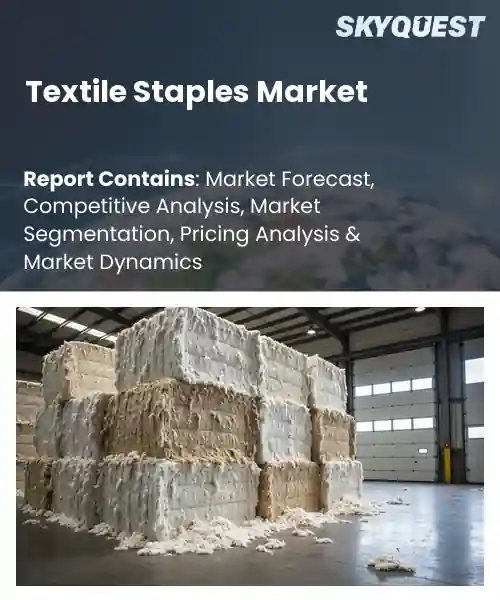
Textile Staples Market
Report ID: SQMIG15E3858
Report ID: SQMIG15E3858
[email protected]
USA +1 351-333-4748
Report ID:
SQMIG15E3858 |
Region:
Global |
Published Date: July, 2026
Pages:
157
|Tables:
116
|Figures:
77


Global Textile Staples Market size was valued at USD 22.52 Billion in 2024 and is poised to grow from USD 23.72 Billion in 2025 to USD 35.85 Billion by 2033, growing at a CAGR of 5.32% during the forecast period (2026-2033).
The textile staples market revolves around standardized natural and synthetic fibers, usually sold in bulk, for yarn spinning and nonwoven production, and the main push here is global demand for cheaper but durable apparel plus industrial textiles. This stuff matters because staples sit upstream as the feedstock , and that decides cost, quality, and even sustainability profiles through the whole textile value chain.
Since supply patterns and innovation set the baseline, the leading factor for the textile staples market growth is more like technological and regulatory pressure, pushing sustainable fibers, and that makes manufacturers ramp recycled and bio-based staple output. When brands commit to circularity, demand for mechanically and chemically recycled polyester goes up, so investment follows in sorting and depolymerization facilities, which reduces feedstock swings and opens new profit channels. In the real world, mills using recycled staples can feed fibers into performance apparel and automotive interiors, which speeds adoption and helps justify more capacity. So, these dynamics create openings for niche fiber producers, advanced recycling players, and even reshoring.
Automation is changing the textile staples market outlook by using robotics plus automated spinning and bale handling, sensor-driven process control, and digital workflows to push fiber toward yarn and fabric with fewer manual steps. A key part is consistent quality, along with continuous monitoring and tighter integrated operations that cut rework and reduce material waste. Right now, there is wider use in spinning mills, and also in on-demand print facilities, because firms deal with labor limits and cost pressure. Practically, automation can include automated transport, smart quality sensors, and connected production lines, so throughput becomes steadier, and scaling up feels less chaotic, making plants more predictable and more responsive to customer needs.
Market snapshot - (2026-2033)
Global Market Size
USD 22.52 Billion
Largest Segment
Polyester Staple Fiber (PSF)
Fastest Growth
Viscose/Rayon Staple Fiber
Growth Rate
5.32% CAGR
To get more insights on this market click here to Request a Free Sample Report
The global textile staples market is segmented by fiber type, application, end-use, distribution and region. Based on fiber type, the market is segmented into Polyester Staple Fiber (PSF), Viscose/Rayon Staple Fiber, Cotton Staple Fiber and Acrylic Staple Fiber. Based on application, the market is segmented into Apparel, Home Textiles and Nonwovens. Based on end-use, the market is segmented into Spinning (Yarn) and Nonwoven Fabrics. Based on distribution, the market is segmented into Direct to Spinners and Textile Distributors. Based on region, the market is segmented into North America, Europe, Asia Pacific, Latin America and Middle East & Africa.
As per the textile staples market analysis, polyester staple fiber dominates because polyester fibers have this blend of cost-effectiveness, flexible use, and easy handling that fits big-scale textile manufacturing like it’s ready for production lines. Their pleasant mechanical behavior and the fact they match well with continuous spinning plus blending make a lot of manufacturers lean toward polyester for core yarns. Ongoing factory spending on polyester-compatible machines, and the steady supply of raw materials also keep the momentum going. So, it stucks in a good way, entrenched buying habits and supply chains that keep polyester in the lead across textile staple fibers.
However, Viscose/Rayon staple fiber is showing up as the fastest-moving segment, mainly because people want biodegradable options and a softer hand feel for fashion and home use. New ideas around closed-loop production and brands paying more attention to cellulosic alternatives speed up adoption, which then widens product catalogs and opens fresh sourcing chances for spinners and the manufacturers downstream.
According to the textile staples market forecast, nonwovens stand out because it offers process nimbleness and a faster path from staple fibers into fabrics. That cuts steps, and it makes scaling more cost-effective for hygiene, filtration, and technical uses. Plus, manufacturers can draw from a broad menu of staple fibers, from synthetic to cellulosic, so they can tune performance traits. This pushes investments into web formation and bonding methods, and those upgrades boost throughput, while also making nonwovens feel like a main application route in the textile staples market.
On the other hand, apparel is the quickest-growing application area, since brands are hunting for lighter-weight, performance-driven, and more sustainable yarns for newer garments. Growing consumer interest in comfort and practical finishes pushes spinners into unusual staple fiber blends and specialized processing, which widens technical reach and opens up higher value product categories, which in turn supports textile staples market growth.
To get detailed segments analysis, Request a Free Sample Report
As per the textile staples market regional forecast, Asia Pacific dominates the market due to manufacturing depth, value chain integration, and a sustained innovation mindset across the region. Big established industrial clusters help stuff move faster from raw materials into those finished yarns and staples, while solid supplier webs for textile machinery and all the needed inputs lower the waiting times a lot, and make output feel more dependable. There’s also continuous spending in material science and process tech, which pushes functional and sustainable staples forward so they can follow brand needs as they evolve. On top of that, policy support plus trade-friendly infrastructure keeps export competitiveness moving, and close collaboration between producers, fabric makers, and global brands helps new staples land quicker in the market. All of this, capacity to cover broad mass demand and also the more specialized technical segments, keeps leadership steady, and it’s attractive for both upstream and downstream investors, even when things get a bit complicated.
Japan Textile Staples Market
The Textile Staples sector in Japan is mostly known for specialization in high-quality, high-performance fibers, powered by advanced material science and very precise manufacturing. Producers tend to put energy into invention of functional and sustainable staples, the kind that have to clear strict quality hurdles for technical and niche clothing use. There’s a strong rhythm with domestic machinery producers, plus trusted links to research institutions, so new staple categories can be iterated quickly, almost like feedback loops that don’t slow down much. Another theme is value-added products and teamwork with international brand developers, which helps keep demand strong for premium staples through both domestic routes and export channels.
South Korea Textile Staples Market
In South Korea, the textile staples industry leans hard into innovation for synthetic and composite staples, and it benefits from the region’s integrated chemical and textile industries. This ecosystem helps produce advanced filament and staple offerings. Material developers and downstream fabricators coordinate closely, which makes adoption faster for functional characteristics like durability and specialty finishes. Strong export focus matters too, because partnerships tied to electronics and automotive sectors create more non-apparel use cases. At the same time, investments into sustainable processing, and recycling pathways, make regional staples more appealing to buyers who are increasingly environmentally aware.
The European rapid textile staples market penetration comes from multiple pressures, like a steady appetite for sustainable, high-quality fibers, deep know-how in apparel and technical textiles, and regulatory rules that basically reward circularity. European producers often rely on specialized clusters and advanced manufacturing capabilities, so they can deliver premium staples that fit fashion houses, industrial buyers, and technical applications with less friction. Designers, material innovators, and academic centers collaborate to speed up commercialization of bio-based and recycled staples, which is a big deal. Strategic funding for production modernization and cross-border supply chain partnerships also boosts competitiveness, while the overall reputation for provenance and quality makes it easier to hold a higher value position in global markets.
Germany Textile Staples Market
The Germany’s textile staples market is strongly shaped by industrial and technical fiber production, with precision manufacturing at the core and meaningful chemical engineering strength behind it. Producers channel effort into high-performance and specialty staples for industrial, automotive, and protective textile applications. Integration with machinery providers and engineering companies supports process innovation, and there’s a continued emphasis on sustainability and efficiency that supports competitiveness over the long haul. Overall, the Germany market strength stays tied to reliability, advanced processing techniques, and deep relationships with industrial end users.
United Kingdom Textile Staples Market
The Textile Staples Market share in the UK is increasing through a mix of design-led innovation and technical textile development, helped by research institutions and parts of the creative industries. Producers, plus start-ups, collaborate with fashion labels and industrial partners to build premium staples that are functionally more differentiated. The market leans into niche segments, prototyping capabilities, and applied research, which helps them serve both specialized apparel needs and performance textile requirements. Also, interest is growing around circular business models and material traceability, and that makes UK-produced staples feel more attractive to more buyer types.
France Textile Staples Market
The French textile staples industry is seeing quicker growth as it builds strong connections to luxury fashion, along with a clear focus on sustainable and high-quality fibers. The momentum is pushed by collaboration between designers, material innovators, and manufacturing platforms that prioritize provenance and circularity. Investments in bio-based and recycled staple development are feeding the premium apparel segment, and also attracting conscious consumers. In France, market energy is boosted further by branding synergies that raise the perceived value of domestically developed staples, not just within Europe but across global buyers too.
North America looks like it is tightening its grip, not just by talking about it but by zeroing in on advanced material innovation, supply chain resilience and, strategic reshoring of production capacity. The industry folks keep underlining development of technical staples for industrial, medical and performance apparel markets, with more investment going into recycling technologies plus more sustainable feedstocks, because environmental expectations keep climbing. There are also these connected ecosystems, where manufacturers, research institutions, and end users work together, which helps novel staple ideas scale up faster. On top of that policy attention to domestic supply chains makes companies more willing to invest. In general the focus on quality, customization, and quicker time to market helps North American suppliers snag higher value segments and get a bigger seat in global staple supply networks.
United States Textile Staples Market
The Textile Staples Market in the United States is driven by a strong ability to produce advanced, performance-oriented staples, backed by deep R&D and active industry collaboration. Producers are leaning into functional fibers for medical, protective, and industrial uses, plus they are also trying to scale recycled and bio-based staples alongside that. By integrating with downstream manufacturers and pushing rapid prototyping, they stay more responsive when market conditions shift. Strategic investments and partnerships are intended to boost domestic supply resilience and to cover both domestic needs and export opportunities, using differentiated staple offerings.
Canada Textile Staples Market
The Textile Staples Market in Canada leans into niche, sustainable staple production, while also benefiting from strengths in natural resource-based fibers and circular processing innovation. Collaboration shows up between forestry-linked material developers and textile manufacturers, which supports these unique fiber pathways. There is a clear thread of environmental stewardship and traceability, and that resonates with buyers who are paying attention. Canadian producers aim for specialized applications and export channels that value provenance, and that basically rewards a sustainable supply chain story, positioning the market as a provider of differentiated staple solutions.
To know more about the market opportunities by region and country, click here to
Buy The Complete Report
Rising Demand From Apparel Manufacturers
Adoption Of Technical Textile Applications
Volatile Raw Material Availability
Stringent Environmental Compliance Requirements
Request Free Customization of this report to help us to meet your business objectives.
Competitive dynamics in the global textile staples market are nudged by consolidation, especially for recycling capacity, plus supplier-brand collaborations that lock in sustainable feedstocks, and then, faster product innovation cycles that move faster than people think. This can be seen in Indorama Ventures integrating recyclers, to secure feedstock flows more or less, Lenzing scaling REFIBRA partnerships with brands for recycled lyocell, and Hyosung’s big bio-BDO investment intended to commercialize bio-based elastane, which is supposed to help the whole chain.
Top Player’s Company Profile
Recent Developments in the Textile Staples Market
SkyQuest’s ABIRAW (Advanced Business Intelligence, Research & Analysis Wing) is our Business Information Services team that Collects, Collates, Correlates, and Analyses the Data collected by means of Primary Exploratory Research backed by robust Secondary Desk research.
As per SkyQuest analysis, the global textile staples market is being pushed forward mainly by rising demand from apparel manufacturers, which keeps basic fibers moving and supports scale-up in spinning, plus nonwoven production. A second push is the shift toward recycled and bio-based fibers, since brands are chasing circularity. Still, the market is largely led by Polyester Staple Fiber and the Asia Pacific region, mostly because supply chains are integrated, and manufacturing depth is strong. But there are constraints too; volatile raw material availability can slow expansion by raising procurement risk and inventory costs. The opportunities are basically about funding recycling, process automation, and specialized fibers, so the sector can meet both sustainability goals and technical textile requirements.
| Report Metric | Details |
|---|---|
| Market size value in 2024 | USD 22.52 Billion |
| Market size value in 2033 | USD 35.85 Billion |
| Growth Rate | 5.32% |
| Base year | 2024 |
| Forecast period | (2026-2033) |
| Forecast Unit (Value) | USD Billion |
| Segments covered |
|
| Regions covered | North America (US, Canada), Europe (Germany, France, United Kingdom, Italy, Spain, Rest of Europe), Asia Pacific (China, India, Japan, Rest of Asia-Pacific), Latin America (Brazil, Rest of Latin America), Middle East & Africa (South Africa, GCC Countries, Rest of MEA) |
| Companies covered |
|
| Customization scope | Free report customization with purchase. Customization includes:-
|
To get a free trial access to our platform which is a one stop solution for all your data requirements for quicker decision making. This platform allows you to compare markets, competitors who are prominent in the market, and mega trends that are influencing the dynamics in the market. Also, get access to detailed SkyQuest exclusive matrix.
Table Of Content
Executive Summary
Market overview
Parent Market Analysis
Market overview
Market size
KEY MARKET INSIGHTS
COVID IMPACT
MARKET DYNAMICS & OUTLOOK
Market Size by Region
KEY COMPANY PROFILES
Methodology
For the Textile Staples Market, our research methodology involved a mixture of primary and secondary data sources. Key steps involved in the research process are listed below:
1. Information Procurement: This stage involved the procurement of Market data or related information via primary and secondary sources. The various secondary sources used included various company websites, annual reports, trade databases, and paid databases such as Hoover's, Bloomberg Business, Factiva, and Avention. Our team did 45 primary interactions Globally which included several stakeholders such as manufacturers, customers, key opinion leaders, etc. Overall, information procurement was one of the most extensive stages in our research process.
2. Information Analysis: This step involved triangulation of data through bottom-up and top-down approaches to estimate and validate the total size and future estimate of the Textile Staples Market.
3. Report Formulation: The final step entailed the placement of data points in appropriate Market spaces in an attempt to deduce viable conclusions.
4. Validation & Publishing: Validation is the most important step in the process. Validation & re-validation via an intricately designed process helped us finalize data points to be used for final calculations. The final Market estimates and forecasts were then aligned and sent to our panel of industry experts for validation of data. Once the validation was done the report was sent to our Quality Assurance team to ensure adherence to style guides, consistency & design.
Analyst Support
Customization Options
With the given market data, our dedicated team of analysts can offer you the following customization options are available for the Textile Staples Market:
Product Analysis: Product matrix, which offers a detailed comparison of the product portfolio of companies.
Regional Analysis: Further analysis of the Textile Staples Market for additional countries.
Competitive Analysis: Detailed analysis and profiling of additional Market players & comparative analysis of competitive products.
Go to Market Strategy: Find the high-growth channels to invest your marketing efforts and increase your customer base.
Innovation Mapping: Identify racial solutions and innovation, connected to deep ecosystems of innovators, start-ups, academics, and strategic partners.
Category Intelligence: Customized intelligence that is relevant to their supply Markets will enable them to make smarter sourcing decisions and improve their category management.
Public Company Transcript Analysis: To improve the investment performance by generating new alpha and making better-informed decisions.
Social Media Listening: To analyze the conversations and trends happening not just around your brand, but around your industry as a whole, and use those insights to make better Marketing decisions.
REQUEST FOR SAMPLE
 REQUEST FREE CUSTOMIZATION
Global Textile Staples Market size was valued at USD 22.52 Billion in 2024 and is poised to grow from USD 23.72 Billion in 2025 to USD 35.85 Billion by 2033, growing at a CAGR of 5.32% during the forecast period (2026-2033).
Competitive dynamics in the global textile staples market are driven by consolidation for recycling capacity, supplier-brand partnerships to secure sustainable feedstocks, and rapid product innovation. Examples include Indorama Ventures integrating recyclers to lock feedstock, Lenzing scaling REFIBRA partnerships with brands on recycled lyocell, and Hyosung’s major bio-BDO investment to commercialize bio-based elastane. 'Indorama Ventures', 'Reliance Industries (Recron)', 'Tongkun Group', 'Hengli Petrochemical', 'Xinfengming Group', 'Far Eastern New Century', 'Aditya Birla Group (Birla Cellulose)', 'Lenzing AG', 'Sateri Holdings', 'Asia Pacific Rayon (RGE)', 'Toray Industries', 'Teijin Limited', 'Huvis Corporation', 'Trevira GmbH (Indorama)', 'DAK Americas (Indorama)', 'Silon (Czech)', 'Dupont de Nemours', 'Wellman International', 'Unifi Inc.', 'Fortress Investment Group (DAK)'
Rising demand from apparel manufacturers stimulates the textile staples market by increasing steady consumption of basic fibers and yarns needed for mass production. Buyers seek reliable supplies to meet fashion cycles and seasonal collections, encouraging suppliers to scale production, secure raw material sources, and invest in efficient logistics. This sustained procurement behavior strengthens supplier revenue visibility and supports capacity expansion, fostering supply chain commitments and collaborative planning that further enable market growth through predictable demand patterns and enhanced investment in staple textile production capabilities.
Sustainable Circular Material Shift: Industry stakeholders are accelerating adoption of recycled fibers and regenerative feedstocks to reduce waste and extend product lifecycles. Brands and manufacturers are collaborating across supply chains to implement takeback programs, design for disassembly, and certified traceability systems. This shift fosters premium positioning, mitigates resource dependency, and opens new revenue models based on reuse and refurbishment. Consumer preference for ethically sourced textiles and corporate sustainability commitments reinforce long-term investment in circular processing infrastructure and innovation in low-impact fiber technologies and scalability.
Why does Asia Pacific Dominate the Global Textile Staples Market? |@12


Want to customize this report? This report can be personalized according to your needs. Our analysts and industry experts will work directly with you to understand your requirements and provide you with customized data in a short amount of time. We offer $1000 worth of FREE customization at the time of purchase.
Feedback From Our Clients


 USA (+1) 351-333-4748

