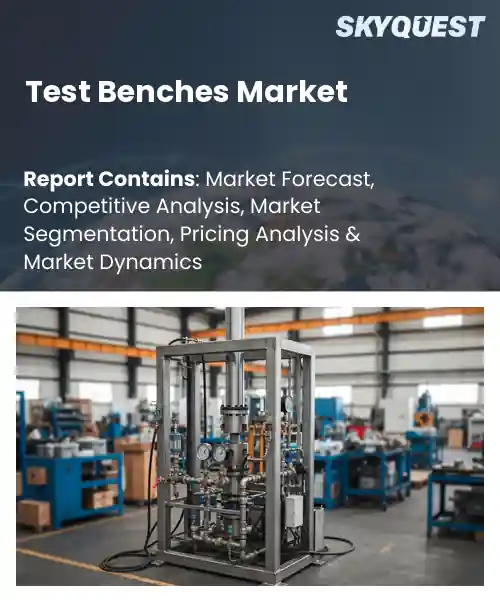
Test Benches Market
Report ID: SQMIG20F2063
Report ID: SQMIG20F2063
[email protected]
USA +1 351-333-4748
Report ID:
SQMIG20F2063 |
Region:
Global |
Published Date: May, 2026
Pages:
157
|Tables:
184
|Figures:
79


Global Test Benches Market size was valued at USD 1.80 Billion in 2024 and is poised to grow from USD 1.90 Billion in 2025 to USD 2.96 Billion by 2033, growing at a CAGR of 5.7% during the forecast period (2026-2033).
The primary factor driving the test benches market growth is increasing complexity and integration of electronic systems which will lead manufacturers to establish a complete verification infrastructure. Test benches refer to both software and hardware environments that allow for the simulation and monitoring of how a component behaves throughout development and manufacturing; defective parts can cause both safety issues and expensive product recalls or regulatory fines. Testing has changed over time; in the past, testing involved manual setups or instruments to measure performance, but testing has now transitioned to automated programmable rigs and arrayed FPGA-based emulation devices. Historically, products such as cars that contain advanced driver assistance systems [ADAS] have required extensive testing with hardware in the loop (HIL) systems (hardware) before they can be validated and made available to consumers, while semiconductor probes (testing devices) are moving toward using virtualized testbeds as a result of reduced product life cycles.
As previously mentioned, the rise in system complexity and alternate test methods, including virtualization and automation, have forced companies to look for faster validation solutions. Virtual testbeds, cloud-based testing services, and artificial intelligence-enhanced test optimization are decreasing product design timeframes while at the same time increasing defect escape rates, lowering warranty costs and improving profit margins. Examples of how companies are utilizing virtual testbeds are validated by hardware in the loop (HIL) ADAS testing done for obtaining firmware updates, semiconductor fabrication facilities utilizing automated wafer sort benches in order to increase the throughput of products and bars of countries such as telecommunications vendors using cloud testing suites for 5G certification.
How is AI Enhancing Efficiency and Accuracy in the Test Benches Market?
Automating mundane tasks and increasing precision in measurements through AI (Artificial Intelligence), test benches are experiencing major changes. Furthermore, artificial intelligence is rapidly changing how test vendors and instrument manufacturers implement their products, including the introduction of intelligent data aggregation; use of machine learning to detect anomalies in data; automated generation of test cases to reduce manual scripting; etc. As development of devices continues to become more complex and traditional testing methods will have difficulty keeping up, software vendors are using artificial intelligence as an integral part of their test/warning systems to speed up development cycles and increase throughput. AI is also providing improved techniques for modeling of devices for characterization purposes, as well as closed loop optimizations of test parameters to reduce the number of retests, leading to greater efficiency and accuracy in laboratory and manufacturing testing.
Test vendors, such as Emerson in May 2026, expanded their use of NI's (National Instruments) Nigel AI throughout the entire physical test environments, thereby enabling prompt code generation based on context-aware guidance; thus providing an example of how AI is providing significant benefits to the testing community by reducing debugging and retest cycles in real world applications, resulting in reduced validation times and improved through put in manufacturing testing.
Market snapshot - (2026-2033)
Global Market Size
USD 1.8 Billion
Largest Segment
Engine Test Benches
Fastest Growth
Motor Test Benches
Growth Rate
5.7% CAGR
To get more insights on this market click here to Request a Free Sample Report
Global test benches market is segmented by type, component, mobility, operation, application, end-use industry and region. Based on type, the market is segmented into engine test benches, motor test benches, transmission test benches, brake test benches, suspension & steering test benches, hydraulic & pneumatic test benches, electrical & electronic test benches, material testing benches and others. Based on component, the market is segmented into hardware and software. Based on mobility, the market is segmented into fixed test benches and portable/mobile test benches. Based on operation, the market is segmented into manual test benches, semi-automatic test benches and fully automatic test benches. Based on application, the market is segmented into research & development, quality control & inspection, performance testing, durability & endurance testing, production testing and calibration & validation. Based on end-use industry, the market is segmented into automotive, aerospace & defense, industrial manufacturing, energy & power, electronics & semiconductors, railways, marine, educational & research institutes and others. Based on region, the market is segmented into North America, Europe, Asia Pacific, Latin America and Middle East & Africa.
The segment that dominates the market of engine test benches has a major role as they represent the foundation for powertrain engineering by replicating the actual operating conditions and the associated combustion behaviors of an engine (under real-world operation) to validate design improvements and certify designs. The inherent technical depth of engine test benches combined with their ability to blend seamlessly with OEM calibration cycles and to have been established as part of an established tooling ecosystem decreases the risk associated with product development and quickly assists in accelerating the product development process through iterations. Once more, strong aftermarket service support and specialized service networks contribute to the purchasing preference towards and long-term commitment to the investment in the physical test infrastructure.
However, electrical & electronic test benches are the fastest-growing area, propelled by vehicle electrification and complex electronic control testing that require precise simulation and high-fidelity measurement. Innovation in power electronics and battery management testing, together with closer integration with software tools, is boosting adoption and creating new validation, calibration, and service opportunities for suppliers supporting electrified platforms.
Many factors including the availability of solid, tangible objects, such as actuators, fixtures, sensors and data acquisition systems to provide the deterministic interfaces necessary to capture actual physical and environmental behaviour during testing, hardware continues to dominate. The ability of hardware to support production environments, work with legacy systems and have suppliers that can calibrate and service hardware resides on-site reduce downtime (by providing the user with reliable, repeatable measurements), which all make hardware the product that most manufacturers looking to invest in verifiable and auditable reliability assurance will default on buying.
Meanwhile, software is the most rapidly expanding area, driven by greater reliance on simulation, digital twins, automation, and data analytics to streamline testing workflows. Software platforms enable virtual validation, remote monitoring, and model-based testing, unlocking scalable repeatability and new commercial services while meeting growing integration demands from modern electronic test setups.
To get detailed segments analysis, Request a Free Sample Report
Asia Pacific is the leading region for the sophisticated validation of test benches market trends due to a dense concentration of electronics, automotive, and semiconductor manufacturing, which drive continual demand for validated test benches for these types of manufacturers. Rapid iterations of test bench solutions are possible given the size and number of local supply chains and proximity to large producers of test bench components. Additionally, the presence of highly skilled engineering professionals and collaborative partnerships between the testing and manufacturing industries and research institutions enable the continued development and innovation of customized testing solutions in the areas of automation, diagnostics, fixture design and integration. Equipment manufacturers and local systems integrators are focused on creating interoperability between software solutions to meet the requirements for validated testing of high-volume, high-reliability applications. Government initiatives in support of advanced industrial modernization policy and a competitive manufacturing environment will also continues to stimulate the adoption of advanced testing technologies. Collectively, these factors provide an optimal environment for the development, customization, and large-scale deployment of validated test benches for multiple industrial segments.
Test benches market share in Japan benefits from a mature precision manufacturing base and advanced semiconductor and automotive sectors that demand rigorous validation. Close collaboration between equipment makers and OEMs yields highly customized testing platforms. Emphasis on reliability and miniaturization drives innovation in fixture design and automation. Strong engineering talent and integrated supply chains support rapid prototyping and continuous improvement, positioning Japan as a leader in complex, high-reliability test bench solutions globally.
Test benches market outlook in South Korea benefits from an established electronics manufacturing cluster, as well as sophisticated memory and display sectors that demand both precision testing and high-volume production. There are many local system integrators that can provide large automated test benches that are designed to be compatible with the methods of the original equipment manufacturers (OEMs). A strong focus on innovation, system architecture, and working together has allowed for the quick implementation of these automated test benches. The emphasis on quality assurance and global competitiveness by both the government and corporate entities is driving the continual improvement of test methodologies, as well as the addition of digital diagnostics to the design of these test benches.
North America is experiencing rapid expansion driven by a combination of advanced industry needs, innovation capacity, and strong service ecosystems. Diverse end markets such as aerospace, defense, automotive electrification, and semiconductor manufacturing demand highly reliable, software-driven validation platforms. A network of specialized OEMs, system integrators, and aftermarket providers accelerates development of modular, automated test benches with enhanced diagnostics and remote monitoring capabilities. Close collaboration between research institutions and industry supports commercialization of new validation approaches and interoperability of test protocols. Emphasis on lifecycle services, customization, and integration of data analytics into testing workflows enables faster iteration and higher throughput. These strengths position the region to adopt and scale complex test bench solutions for demanding applications.
Test benches market forecast in United States has a varied support base of industrial sectors including aerospace, defense, automotive, and semiconductors where there is a need for rigorous validation. The presence of innovative test equipment manufacturers and flexible system integrators encourages the creation of modular software-centric platforms. Remote diagnostics, data analytics, and lifecycle support combined with ongoing technical support has created an increase in the demand for a wide array of comprehensive testing services. Working together, research institutions partner with industries to help to commercialize and validate new test methods and procedures in accordance with both regulatory and customer needs.
Test benches market regional outlook in Canada reflects a growing focus on clean technology, communications, and precision manufacturing that demand adaptable testing platforms. Strong emphasis on collaboration between technology firms and academic centers fosters innovation in modular and energy-efficient bench designs. Local integrators provide tailored solutions that address unique environmental and regulatory needs. Support services for maintenance and calibration are well established, enabling longer equipment lifecycles and refinement of testing protocols across sectors.
Combining deep engineering capabilities with extensive cross-border collaboration and a strong emphasis on standards, sustainability, and energy efficiency, Europe continues to enhance its competitive advantage. Leading manufacturers in the automotive, aerospace, and industrial equipment sectors are underscoring the need for advanced testing capabilities and interoperability, while dense network of suppliers have developed modular platforms that can be used across multiple industries; thus, enabling the growth of an increasingly interconnected world. In addition to meeting regulatory requirements through efficient design and risk analysis methodologies, government policies also promote the development of environmentally-friendly design and support the creation of viable bench test capabilities that are compliant with European Commission directives and ISO certifications. Investments in digitalization will help improve testing efficiencies and support the use of data-driven validation systems and procedures.
Test benches market regional forecast in Germany benefits from a robust engineering sector and leading automotive clusters that require precision testing. Strong mechanical and systems integration expertise supports development of modular bench architectures tailored to factory environments. Close collaboration between OEMs, equipment manufacturers, and research institutes accelerates innovation in automation and diagnostics. Focus on reliability and industrial standards positions Germany as a source of high test bench solutions for demanding complex production settings.
Test benches market penetration in United Kingdom has a strong base of test bench suppliers from its aerospace and defense industries, which rely heavily on providing validated products through test benches. Suppliers provide system engineering and software testing expertise to deliver flexible and modular test benches needed to meet requirements of complex products during verification. There is also an established network of support services that provide calibration, maintenance, and lifecycle support which adds to the performance of test benches. Collaboration between test bench suppliers, certifying agencies, and research facilities will facilitate the implementation of interoperable testing protocols and will enable diagnostic and remote testing development.
Test benches market analysis in France emphasizes innovation in automotive, aerospace, and renewable energy applications that demand versatile testing solutions. Strong network of SMEs and technology centers enables development of compact, energy-efficient bench designs and advanced measurement techniques. Collaboration with certification agencies supports compliance-focused development, while system integrators offer tailored automation and diagnostic packages. Emphasis on sustainability and productivity encourages lifecycle service models and integration of data analytics into validation workflows locally.
To know more about the market opportunities by region and country, click here to
Buy The Complete Report
Rising Demand For Automotive Electronic Testing
Growth In Renewable Energy Testing Needs
High Initial Capital Expenditure
Fragmented Industry Standards and Protocols
Request Free Customization of this report to help us to meet your business objectives.
The competition in the global test benches market is moving away from low-price solutions, and instead towards the pursuit of software and systems integration. The need for battery validation for electric vehicles, e-axle testing, and to increase the throughput capability of semiconductors is shifting buyer specifications. There are several examples of how vendors are pursuing targeted mergers and acquisitions to give their organizations measurement and data analytics capabilities, as well as establishing engineering partnerships in order to provide HIL (hardware-in-the-loop) and cloud connected solutions (e.g. Vector's acquisition of CSM or collaborations such as MdynamiX with Applied Intuition), while continuing to work with AI-enabled inspection vendors who offer expanded hardware and analytics solutions.
Top Player’s Company Profile
Recent Developments in the Test Benches Market
SkyQuest’s ABIRAW (Advanced Business Intelligence, Research & Analysis Wing) is our Business Information Services team that Collects, Collates, Correlates, and Analyses the Data collected by means of Primary Exploratory Research backed by robust Secondary Desk research. As per SkyQuest analysis, rising complexity and integration of electronic systems is a key driver pushing manufacturers to adopt comprehensive verification infrastructures, and the growing adoption of virtualization and automation acts as a second driver enabling faster validation and reduced defect escape rates. A major restraint remains the high initial capital expenditure required for advanced benches and integration, which can deter smaller organisations. Asia Pacific dominates the market due to dense electronics, automotive and semiconductor manufacturing clusters and supportive ecosystems. Engine test benches are the leading segment because they reproduce real powertrain conditions, support OEM calibration cycles and lower development risk, sustaining demand for physical test infrastructure.
| Report Metric | Details |
|---|---|
| Market size value in 2024 | USD 1.8 Billion |
| Market size value in 2033 | USD 2.96 Billion |
| Growth Rate | 5.7% |
| Base year | 2024 |
| Forecast period | (2026-2033) |
| Forecast Unit (Value) | USD Billion |
| Segments covered |
|
| Regions covered | North America (US, Canada), Europe (Germany, France, United Kingdom, Italy, Spain, Rest of Europe), Asia Pacific (China, India, Japan, Rest of Asia-Pacific), Latin America (Brazil, Rest of Latin America), Middle East & Africa (South Africa, GCC Countries, Rest of MEA) |
| Companies covered |
|
| Customization scope | Free report customization with purchase. Customization includes:-
|
To get a free trial access to our platform which is a one stop solution for all your data requirements for quicker decision making. This platform allows you to compare markets, competitors who are prominent in the market, and mega trends that are influencing the dynamics in the market. Also, get access to detailed SkyQuest exclusive matrix.
Table Of Content
Executive Summary
Market overview
Parent Market Analysis
Market overview
Market size
KEY MARKET INSIGHTS
COVID IMPACT
MARKET DYNAMICS & OUTLOOK
Market Size by Region
KEY COMPANY PROFILES
Methodology
For the Test Benches Market, our research methodology involved a mixture of primary and secondary data sources. Key steps involved in the research process are listed below:
1. Information Procurement: This stage involved the procurement of Market data or related information via primary and secondary sources. The various secondary sources used included various company websites, annual reports, trade databases, and paid databases such as Hoover's, Bloomberg Business, Factiva, and Avention. Our team did 45 primary interactions Globally which included several stakeholders such as manufacturers, customers, key opinion leaders, etc. Overall, information procurement was one of the most extensive stages in our research process.
2. Information Analysis: This step involved triangulation of data through bottom-up and top-down approaches to estimate and validate the total size and future estimate of the Test Benches Market.
3. Report Formulation: The final step entailed the placement of data points in appropriate Market spaces in an attempt to deduce viable conclusions.
4. Validation & Publishing: Validation is the most important step in the process. Validation & re-validation via an intricately designed process helped us finalize data points to be used for final calculations. The final Market estimates and forecasts were then aligned and sent to our panel of industry experts for validation of data. Once the validation was done the report was sent to our Quality Assurance team to ensure adherence to style guides, consistency & design.
Analyst Support
Customization Options
With the given market data, our dedicated team of analysts can offer you the following customization options are available for the Test Benches Market:
Product Analysis: Product matrix, which offers a detailed comparison of the product portfolio of companies.
Regional Analysis: Further analysis of the Test Benches Market for additional countries.
Competitive Analysis: Detailed analysis and profiling of additional Market players & comparative analysis of competitive products.
Go to Market Strategy: Find the high-growth channels to invest your marketing efforts and increase your customer base.
Innovation Mapping: Identify racial solutions and innovation, connected to deep ecosystems of innovators, start-ups, academics, and strategic partners.
Category Intelligence: Customized intelligence that is relevant to their supply Markets will enable them to make smarter sourcing decisions and improve their category management.
Public Company Transcript Analysis: To improve the investment performance by generating new alpha and making better-informed decisions.
Social Media Listening: To analyze the conversations and trends happening not just around your brand, but around your industry as a whole, and use those insights to make better Marketing decisions.
REQUEST FOR SAMPLE
 REQUEST FREE CUSTOMIZATION
Global Test Benches Market size was valued at USD 1.8 Billion in 2024 and is poised to grow from USD 1.9 Billion in 2025 to USD 2.96 Billion by 2033, growing at a CAGR of 5.7% during the forecast period (2026-2033).
Competition in the global test benches market is shifting from price to software and systems integration as EV battery validation, e axle testing and higher semiconductor throughput drive buyer specifications. Vendors are pursuing targeted M&A to add measurement and data analytics capabilities and forming engineering partnerships to deliver HIL and cloud linked solutions, for example Vector’s acquisition of CSM and collaborations such as MdynamiX with Applied Intuition, while AI enabled inspection vendors expand hardware and analytics offerings. 'Keysight Technologies, Inc.', 'National Instruments Corporation', 'Rohde & Schwarz GmbH & Co. KG', 'Teradyne, Inc.', 'Chroma ATE Inc.', 'Averna Technologies Inc.', 'MTS Systems Corporation', 'Bosch Rexroth AG', 'Siemens AG', 'dSPACE GmbH', 'AB Dynamics plc', 'Ametek, Inc.', 'Marvin Test Solutions, Inc.', 'ATEQ Corp.', 'Konrad GmbH', 'Maccor, Inc.', 'Vector Informatik GmbH', 'Dewesoft d.o.o.', 'ViTrox Corporation Berhad', 'Team Corporation'
The proliferation of complex electronic systems in vehicles has increased the need for reliable test benches that can validate sensors, powertrains, and communication modules across development stages. Automotive manufacturers and suppliers prioritize test solutions that ensure functional safety, interoperability, and performance, prompting procurement of advanced benches and customization services. This demand stimulates vendors to expand offerings, integrate modular architectures, and collaborate with tier-one partners, thereby creating a sustained market expansion driven by requirements for repeatable validation environments and accelerated time-to-market for new vehicle electronics.
Digital Test Automation Expansion: Adoption of digital automation platforms is accelerating as manufacturers seek faster, repeatable validation cycles and reduced manual intervention. Integrated software toolchains and model-based testing enable remote orchestration, virtual prototyping, and continuous verification across product lifecycles. This trend fosters higher throughput, improved traceability, and easier scalability of test bench deployments while encouraging partnerships between equipment vendors and systems integrators. Emphasis on modular, software-defined architectures allows rapid adaptation to new test scenarios and time to market for complex electromechanical and electronic systems.
Why does Asia Pacific Dominate the Global Test Benches Market? |@12


Want to customize this report? This report can be personalized according to your needs. Our analysts and industry experts will work directly with you to understand your requirements and provide you with customized data in a short amount of time. We offer $1000 worth of FREE customization at the time of purchase.
Feedback From Our Clients


 USA (+1) 351-333-4748

