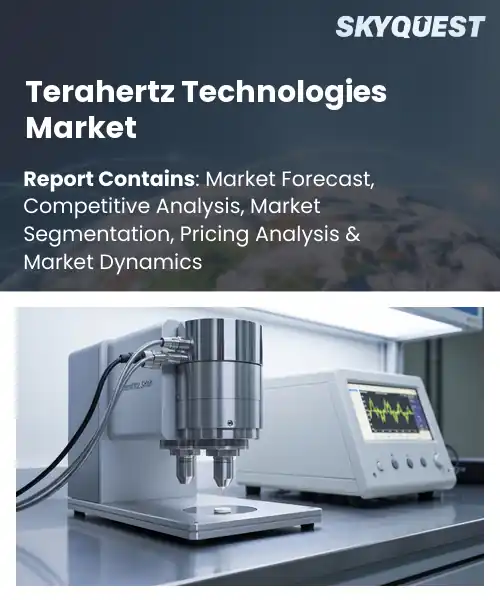
Terahertz Technologies Market
Report ID: SQMIG45I2369
Report ID: SQMIG45I2369
[email protected]
USA +1 351-333-4748
Report ID:
SQMIG45I2369 |
Region:
Global |
Published Date: May, 2026
Pages:
157
|Tables:
189
|Figures:
79


Global Terahertz Technologies Market size was valued at USD 1.4 Billion in 2024 and is poised to grow from USD 1.58 Billion in 2025 to USD 4.27 Billion by 2033, growing at a CAGR of 13.2% during the forecast period (2026-2033).
The primary driver of the terahertz technologies market is the maturation of source and detector technologies that have shifted terahertz from laboratory curiosity to instruments. This market comprises hardware, software and services that generate, detect and process electromagnetic waves between microwave and infrared bands, and it matters because terahertz waves enable non‑ionizing, high-resolution spectroscopy, imaging and short‑range high-bandwidth communications for industries ranging from security to semiconductor inspection. Over the past decade improvements in quantum cascade lasers, Schottky diodes and photoconductive antennas have reduced cost and increased reliability, allowing pilot deployments in airport screening, pharmaceutical quality control and wafer fault isolation.
A pivotal factor driving global market expansion is demand for ultra‑high capacity wireless links and specialized sensing that creates commercial incentives for semiconductor firms to invest in terahertz platforms. As telecom consortia define terahertz bands for 6G trials and regulators consider licensing frameworks, vendors gain certainty to fund chip fabs and testbeds, lowering component costs and accelerating system integration. The effect appears in deployments where operators trial terahertz backhaul for dense urban hotspots, manufacturers deploy terahertz spectroscopy to detect counterfeit drugs and automotive suppliers prototype short‑range radar for gesture recognition, generating revenue and iterative innovation across multiple industrial settings worldwide.
How is AI Accelerating Commercialization of the Terahertz Technologies Market?
Terahertz technologies combine sensing imaging and high frequency communications. AI accelerates commercialization by improving system design signal processing and interpretation of complex terahertz spectra. In the current state researchers and vendors are moving prototypes into pilot deployments across security scanning semiconductor inspection and research networks. AI enables smarter beam steering noise reduction and automated anomaly detection which lowers testing time and operator skill requirements. It also powers digital twin models and cloud analytics that speed validation and standardization. These capabilities make terahertz systems more reliable and easier to integrate into operational workflows attracting customers and partners.
RaySecur March 2026, the company launched an AI based terahertz threat detection platform that applies machine learning to terahertz video and sensor data to automate detection and fleet management enabling quicker deployments and a scalable service model that helps operators monetize systems and maintain performance remotely.
Market snapshot - (2026-2033)
Global Market Size
USD 1.4 Billion
Largest Segment
Terahertz Systems
Fastest Growth
Terahertz Sources
Growth Rate
13.2% CAGR
To get more insights on this market click here to Request a Free Sample Report
Global terahertz technologies market is segmented by component, technology type, frequency range, application, end-use industry, deployment type and region. Based on component, the market is segmented into terahertz sources, terahertz detectors, terahertz systems and supporting components. Based on technology type, the market is segmented into terahertz imaging, terahertz spectroscopy, terahertz communication and terahertz radar & sensing. Based on frequency range, the market is segmented into low frequency terahertz, mid frequency terahertz and high frequency terahertz. Based on application, the market is segmented into Non-Destructive Testing (NDT), security screening & surveillance, semiconductor inspection, wireless communication, medical imaging & diagnostics, pharmaceutical inspection & quality control, material characterization, spectral analysis & research, food & agricultural inspection, aerospace & defense sensing, environmental monitoring and others. Based on end-use industry, the market is segmented into healthcare & life sciences, aerospace & defense, semiconductor & electronics, telecommunications, industrial manufacturing, pharmaceutical industry, food & agriculture, research institutes & academia, government & homeland security, automotive and others. Based on deployment type, the market is segmented into Fixed Systems and Portable/Handheld Systems. Based on region, the market is segmented into North America, Europe, Asia Pacific, Latin America and Middle East & Africa.
Terahertz sources segment dominates because advances in compact, tunable generation techniques have made reliable, application ready sources the foundation of system development. Consistent power output and spectral flexibility reduce integration complexity for system designers, enabling broader adoption across inspection, research, and communications applications. Investment made on source performance leads to parallel enhancements in detector and system performance creating a virtuous cycle towards market expansion and technology maturation.
Terahertz detectors are rapidly evolving due to advancements in materials science, sensitivity, and miniaturization coupled with the increasing demand for fast, real time, high volume manufacturing and security detection, innovation and alternatives in cooling technologies and increasing usage of terahertz enabled solutions.
The terahertz imaging segment continues to dominate the market due to its ability to provide non-ionizing visual representation of materials and objects beneath their surface helping eliminate the limits of traditional inspection or screening methods. Terahertz Imaging makes it easier for operators to interpret what they see and aids them in recognizing and fully automating any defect they find, thus increasing throughput and decreasing false positive results within a quality control or security type environment. Advances in resolution capabilities, increased scanning speed capabilities, and greater system integration capabilities continue to make imaging the entry point of choice for many end users, resulting in many companies committing to build turnkey imaging systems.
Terahertz communications are experiencing significant growth as advancements in ultra-high bandwidth, low-latency connectivity are driving greater opportunities in data-intensive networking. The development of new devices, combined with emerging standards, will result in pilot deployments for high-capacity backhaul environments and specialized wireless systems. These advancements are also driving demand for supporting devices and accelerating the commercialization of terahertz-based connectivity.
To get detailed segments analysis, Request a Free Sample Report
A combination of advanced research infrastructure with a well-established semiconductor and photonics manufacturing industry, as well as the high demand for defense and aerospace, has contributed to North America's dominance. Additionally, close collaboration among universities, national labs, and private companies facilitates development in both technology and infrastructure, allowing for faster commercialization of products. The presence of leading manufacturers of equipment and systems integrated within most industries provides all parts of the supply chain necessary for the successful development of new technologies. Supportive procurement policies, standards development for communication and security, and a diverse customer base spanning from medical imaging to industrial inspection to Wireless applications, and a vibrant security screening to deliver reliable performance-driving forces, while supporting ongoing demand. Through strong intellectual property-related activities and a robust network of strategic partnerships, we are creating an environment that will continue to drive this regional leadership.
Terahertz technologies market growth in United States benefits from concentrated research institutions, defense and commercial interest, and strong device and system development. Collaboration between academic groups and industry accelerates prototype to deployment pathways. Advanced applications in imaging, sensing, and communications have developed into an extensive ecosystem of suppliers and integrators. There are numerous policy and procurement incentives in place to facilitate initial testing of these solutions; therefore, private-sector funding and partnerships are helping to spur invention and commercialisation of an array of end-user sectors and adoption rates.
The Terahertz technology market in Canada will be supported through collaborative research networks, government research facilities, and niche industries that are focusing on applications concerning sensing and imaging. Being located physically close to larger regional supply chains, along with establishing partnership opportunities with academic centres, will help facilitate technology maturation. Industry consortia will promote field demonstrations along with pathways to commercially sell products through targeted procurement activities. Emphasis on healthcare diagnostics, environmental monitoring, and security screening creates diverse use case development and cross sector collaboration that strengthens.
Asia Pacific expansion is driven by intense focus on advanced materials, electronics manufacturing, and telecommunications upgrades that create demand for terahertz enabled components and systems. Companies in a region, along with various research institutions, are working to develop small-scale sources and detectors to create specialized imaging, spectroscopic or wireless test solutions. Government innovation programs and industry efforts are supporting demonstration projects and creating cross-border partnerships to enhance avenues for commercializing the new solutions. Because of large electronics supply chains and contract manufacturers, significant production and integration capabilities have been established; (i.e., scalable production). The region is becoming a large and expanding marketplace for commercializing such solutions. In addition to this growth, many ecosystem participants are taking part in partnerships with local and global vendors and also have an increased demand for solutions in healthcare diagnostics, industrial inspection, and increased capacity communication technologies. In addition, investments continue to be made in skill development and creating prototype validation facilities which should lead to the shortening of the time to market and create additional demand for adoption by industry whether it be through domestic or export channels.
The terahertz technologies market regional forecast in Japan is helped by the country's great skills in precision manufacturing, photonics research, and systems integration capabilities. There is an ongoing collaboration between many of Japan's leading research institutions and industry to commercialize these lab-based innovations as reliable modules ready for use in a variety of industries. With strong supply chain resiliency and an emphasis on quality, terahertz technologies have many potential applications including semiconductor inspection, material analysis, and non-invasive imaging techniques. Strategic partnerships between technology vendors and end-users encourage pilot deployments to continue refining prototype technologies toward eventual fieldable systems.
The terahertz technology market trends in South Korea has been influenced by the vast production abilities of electronics manufacturers, extensive research being conducted on test methods for semiconductors, and collaborative efforts between businesses and universities. National technology initiatives as well as R&D investments made by companies are targeted at implementing terahertz sensing into inspection processes and communication systems. There are a number of local foundries and system integration companies who are facilitating quick iterations of prototypes and seamless integration into their supply chain. A strong emphasis on commercial readiness is fostering accelerated use of these technologies in both industrial and healthcare settings.
Europe has become more competitive through joint research initiatives, industrial partnerships, and improving standardization and interoperability to allow for cross border support of implementation. High quality academic institutions partner up with specialized manufacturers and SMEs in photonics to produce application specific products for use in security screening, nondestructive testing, and biomedical imaging applications. Public/private partnerships and regional consortiums encourage new pilot programs, shared facilities, and access to prototype validation. Agency alignment on regulations and approval processes reduces impediments to adoption of technology within conservative end user markets. Finally, through partnerships with global technology suppliers and investments in skills transfer, an environment is created where innovative terahertz devices and systems can be developed and introduced to multiple vertical markets in the region. The growing market demand for sustainable manufacturing and modular design and will continue to improve competitiveness by aligning technology development with overall business goals and procurement criteria.
Germany's terahertz technology market benefits greatly from its rich engineering history, a high level of accuracy in the production of goods and processes and an extensive industry validation process. The joint work between research organizations and automotive, aerospace and manufacturing companies has led to advances in the fields of nondestructive testing; material characterization; and industrial inspection applications. There is also a high concentration of equipment vendors and system integrators that provide support for prototype development and scalable production. There is a focus on standards and certification as well as integration/automation of industrial systems that promote the adoption and supply chain integration for major manufacturing sectors.
Terahertz technologies market regional outlook in United Kingdom draws on strong photonics research, university spinouts, and specialized instrument makers. Collaborative innovation hubs enable translation of spectroscopy and imaging research into compact systems for healthcare diagnostics, security screening, and materials analysis. Industry partnerships and trials through public procurement provide the validated evidence in the field needed for refining through user feedback. An emphasis placed on both interoperability and systems integration will therefore facilitate the uptake of new technologies and link laboratory developments with pathways to commercialise across different market segments.
In the Terahertz technologies industry in France, there are many trends because there are many academic researchers in photonic sciences and many national laboratories that are focused on spectroscopic and imaging techniques. Technology developers are cooperatively partnering with end-users including those in health-care, security, or other industries to perform effective demonstrations and validation. There is also a diverse range of specialised-SMEs that provide support for prototype development and systems integration. Collaborations through consortiums and infrastructure enable timely transfer of innovation into usable instruments and encourage alignment with regulatory requirements so that they can be easily adopted by the end-users.
To know more about the market opportunities by region and country, click here to
Buy The Complete Report
Increasing Demand for High Speed Imaging
Expansion Of Wireless Communication Research
High Cost of Component Fabrication
Regulatory and Standardization Challenges
Request Free Customization of this report to help us to meet your business objectives.
Competition in the global terahertz technologies market is driven by consolidation, strategic venture partnerships, and rapid product innovation that directly affect competitive positioning. Recent M&A and IP acquisitions in measurement and sensing broaden incumbents’ portfolios, while VC and corporate fund investments accelerate scale. Examples include industry acquisitions of terahertz measurement assets and Amazon’s Industrial Innovation Fund backing of a chip based 3D imaging startup alongside aggressive sensor development by new entrants.
SkyQuest’s ABIRAW (Advanced Business Intelligence, Research & Analysis Wing) is our Business Information Services team that Collects, Collates, Correlates, and Analyses the Data collected by means of Primary Exploratory Research backed by robust Secondary Desk research.
As per SkyQuest analysis, the global terahertz technologies market is being driven by maturation of compact, reliable terahertz sources and detectors that have moved the field from laboratory curiosity into application-ready instruments. A key restraint remains the high cost of component fabrication which limits wider deployment and slows supplier scale-up. North America is the dominant region supported by strong research infrastructure, defense and semiconductor demand. The Terahertz Sources segment leads market activity as improvements in generation performance lower integration barriers. A second driver is growing demand for ultra-high capacity wireless links and specialized sensing that incentivize chip and system investment and commercial pilots.
| Report Metric | Details |
|---|---|
| Market size value in 2024 | USD 1.4 Billion |
| Market size value in 2033 | USD 4.27 Billion |
| Growth Rate | 13.2% |
| Base year | 2024 |
| Forecast period | (2026-2033) |
| Forecast Unit (Value) | USD Billion |
| Segments covered |
|
| Regions covered | North America (US, Canada), Europe (Germany, France, United Kingdom, Italy, Spain, Rest of Europe), Asia Pacific (China, India, Japan, Rest of Asia-Pacific), Latin America (Brazil, Rest of Latin America), Middle East & Africa (South Africa, GCC Countries, Rest of MEA) |
| Companies covered |
|
| Customization scope | Free report customization with purchase. Customization includes:-
|
To get a free trial access to our platform which is a one stop solution for all your data requirements for quicker decision making. This platform allows you to compare markets, competitors who are prominent in the market, and mega trends that are influencing the dynamics in the market. Also, get access to detailed SkyQuest exclusive matrix.
Table Of Content
Executive Summary
Market overview
Parent Market Analysis
Market overview
Market size
KEY MARKET INSIGHTS
COVID IMPACT
MARKET DYNAMICS & OUTLOOK
Market Size by Region
KEY COMPANY PROFILES
Methodology
For the Terahertz Technologies Market, our research methodology involved a mixture of primary and secondary data sources. Key steps involved in the research process are listed below:
1. Information Procurement: This stage involved the procurement of Market data or related information via primary and secondary sources. The various secondary sources used included various company websites, annual reports, trade databases, and paid databases such as Hoover's, Bloomberg Business, Factiva, and Avention. Our team did 45 primary interactions Globally which included several stakeholders such as manufacturers, customers, key opinion leaders, etc. Overall, information procurement was one of the most extensive stages in our research process.
2. Information Analysis: This step involved triangulation of data through bottom-up and top-down approaches to estimate and validate the total size and future estimate of the Terahertz Technologies Market.
3. Report Formulation: The final step entailed the placement of data points in appropriate Market spaces in an attempt to deduce viable conclusions.
4. Validation & Publishing: Validation is the most important step in the process. Validation & re-validation via an intricately designed process helped us finalize data points to be used for final calculations. The final Market estimates and forecasts were then aligned and sent to our panel of industry experts for validation of data. Once the validation was done the report was sent to our Quality Assurance team to ensure adherence to style guides, consistency & design.
Analyst Support
Customization Options
With the given market data, our dedicated team of analysts can offer you the following customization options are available for the Terahertz Technologies Market:
Product Analysis: Product matrix, which offers a detailed comparison of the product portfolio of companies.
Regional Analysis: Further analysis of the Terahertz Technologies Market for additional countries.
Competitive Analysis: Detailed analysis and profiling of additional Market players & comparative analysis of competitive products.
Go to Market Strategy: Find the high-growth channels to invest your marketing efforts and increase your customer base.
Innovation Mapping: Identify racial solutions and innovation, connected to deep ecosystems of innovators, start-ups, academics, and strategic partners.
Category Intelligence: Customized intelligence that is relevant to their supply Markets will enable them to make smarter sourcing decisions and improve their category management.
Public Company Transcript Analysis: To improve the investment performance by generating new alpha and making better-informed decisions.
Social Media Listening: To analyze the conversations and trends happening not just around your brand, but around your industry as a whole, and use those insights to make better Marketing decisions.
REQUEST FOR SAMPLE
 REQUEST FREE CUSTOMIZATION
Global Terahertz Technologies Market size was valued at USD 1.4 Billion in 2024 and is poised to grow from USD 1.58 Billion in 2025 to USD 4.27 Billion by 2033, growing at a CAGR of 13.2% during the forecast period (2026-2033).
Competition in the global terahertz technologies market is driven by consolidation, strategic venture partnerships, and rapid product innovation that directly affect competitive positioning. Recent M&A and IP acquisitions in measurement and sensing broaden incumbents’ portfolios, while VC and corporate fund investments accelerate scale. Examples include industry acquisitions of terahertz measurement assets and Amazon’s Industrial Innovation Fund backing of a chip based 3D imaging startup alongside aggressive sensor development by new entrants. 'ADVANTEST Corporation', 'TOPTICA Photonics AG', 'HÜBNER GmbH & Co. KG', 'Thorlabs, Inc.', 'Luna Innovations Incorporated', 'TeraView Limited', 'Menlo Systems GmbH', 'TeraSense Group Inc.', 'Gentec Electro-Optics Inc.', 'QMC Instruments Ltd.', 'Virginia Diodes, Inc.', 'SWISSto12 SA', 'Del Mar Photonics, Inc.', 'Microtech Instruments, Inc.', 'Batop GmbH', 'TeTechS Inc.', 'Advanced Photonix, Inc.', 'Photon etc.', 'Bridge12 Technologies, Inc.', 'TeraVil Ltd.'
Demand for faster, higher resolution imaging modalities in security screening, medical diagnostics, and industrial inspection has elevated interest in terahertz technologies because they can reveal subsurface and material contrasts without ionizing radiation. This capability directly addresses application needs for non-invasive, sensitive detection, prompting organizations to prioritize terahertz solutions that improve diagnostic confidence and operational effectiveness. As a result, increased purchasing intent and research focus stimulate vendor innovation, accelerate prototype development, and broaden the ecosystem of suppliers and integrators supporting market expansion.
Expansion In Imaging Applications: Terahertz imaging is gaining traction across security screening, pharmaceutical inspection, and non-destructive industrial evaluation due to its unique ability to reveal material contrasts nondestructively and without ionizing radiation. Advances in source and detector miniaturization are enabling portable scanners and in-line quality control, while algorithmic improvements enhance image clarity and material discrimination. Continued interest from stakeholders seeking safer, more informative inspection tools is driving integration into operational workflows and encouraging collaborative development between equipment makers, research institutions, and end users collectively.
Why does North America Dominate the Global Terahertz Technologies Market? |@12


Want to customize this report? This report can be personalized according to your needs. Our analysts and industry experts will work directly with you to understand your requirements and provide you with customized data in a short amount of time. We offer $1000 worth of FREE customization at the time of purchase.
Feedback From Our Clients


 USA (+1) 351-333-4748

