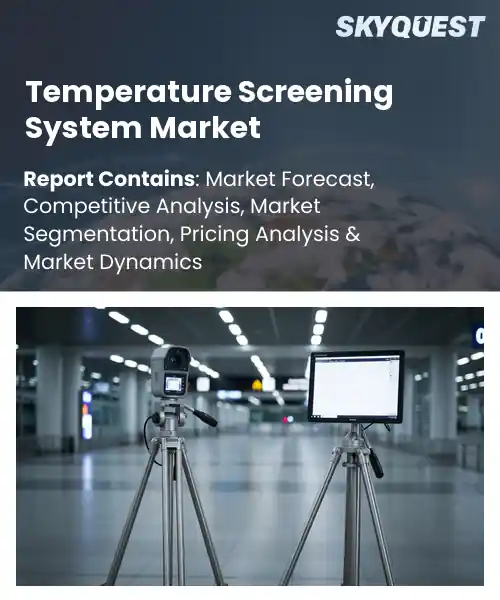
Temperature Screening System Market
Report ID: SQMIG45J2429
Report ID: SQMIG45J2429
[email protected]
USA +1 351-333-4748
Report ID:
SQMIG45J2429 |
Region:
Global |
Published Date: March, 2026
Pages:
157
|Tables:
95
|Figures:
76


Global Temperature Screening System Market size was valued at USD 1.56 Billion in 2024 and is poised to grow from USD 1.73 Billion in 2025 to USD 3.89 Billion by 2033, growing at a CAGR of 10.7% during the forecast period (2026-2033).
The primary driver of the temperature screening system market is public health surveillance demand following infectious disease outbreaks, which reshaped procurement priorities across healthcare, transportation, and corporate environments. Temperature screening systems are composed of a variety of integrated technologies including infrared sensors, thermal cameras, software analytics, and access control and provide an effective way to screen for elevated body temperature as an indication of fever, which allows for the early detection and thus reduction in the spread of transmission and a maintained continuity of operation/operations. The market has also expanded significantly due to both the SARS and COVID-19 pandemic through the deployment of kiosks and thermal cameras at airports, hospitals and workplace entrances by government entities and private sector companies demonstrating how crises provide a basis for accelerating adoption.
Building on that adoption, the key trend driving the global temperature screening system sector is technological advancement in sensor accuracy and analytics, because higher reliability reduces false positives and operational disruption while enabling automated decision workflows. One example would be improvements in calibration and ML, which have reduced the impact of environmental sounds on airport thermal scanning processes, improving overall passenger throughput and reduced number of staff needed for this process. Enterprises will see cost savings and efficiencies and begin moving away from being considered a pilot to an enterprise deployment through this process. Vendors will have the opportunity to bundle access control with temperature screening and cloud reporting. As a result, there are new opportunities available for vendors in the manufacturing, education, and event industries as these industries make compliance and resiliency become increasingly strategic goals.
How is AI Improving Accuracy in the Temperature Screening System Market?
AI is improving accuracy in the temperature screening system market by combining thermal imaging with machine learning and computer vision to detect the right facial regions and compensate for environmental factors. Key aspects are automated subject detection, contextual calibration and continuous learning from diverse data. The current market is moving away from one size fits all threshold alerts toward systems that reduce false positives caused by sunlight, masks or rapid movement. Vendors increasingly use edge AI to fuse visual and thermal streams so readings are refined in real time. That makes screening more reliable in busy entrances, clinics and transport hubs and improves operator trust.
In May 2025, TempShield, an AI-enabled wearable device originally developed by AION Biosystems, has been deployed so that we can detect fevers earlier and produce better clinical outcomes. The launch of TempShield highlights that the use of AI-powered sensing and analytics increases the accuracy and efficiency of screening processes and supports broader implementation in both the healthcare and enterprise markets.
Market snapshot - (2026-2033)
Global Market Size
USD 1.56 Billion
Largest Segment
Infrared Thermometers
Fastest Growth
Thermal Cameras
Growth Rate
10.7% CAGR
To get more insights on this market click here to Request a Free Sample Report
Global temperature screening system market is segmented by product type, technology, end user and region. Based on product type, the market is segmented into infrared thermometers, thermal cameras, temperature scanners and others. Based on technology, the market is segmented into infrared thermography, thermopile sensor-based systems, thermal imaging systems and facial recognition integrated systems. Based on end user, the market is segmented into healthcare facilities, corporate offices, educational institutions, industrial & manufacturing sites, government & defense facilities and others. Based on region, the market is segmented into North America, Europe, Asia Pacific, Latin America and Middle East & Africa.
As per the global temperature screening system market growth, thermal cameras segment dominates because their ability to capture high-resolution thermal profiles over broad areas delivers reliable, non-contact temperature data that institutions trust for screening workflows in the temperature screening system market. False alarms are reduced due to built-in analytics and calibration routines, while integrated systems with access control/alerting automate responses which support procurement decisions and strengthen adoption across large buildings, where there is a need for continuous monitoring and accuracy.
However, infrared thermometers are emerging as the most rapidly expanding area in the temperature screening system market due to their portability, low deployment complexity, and suitability for point-of-care and decentralized screening. Their simplicity enables quick adoption by small organizations and front-line staff, while ongoing miniaturization and usability improvements widen use cases and create growth opportunities in consumer and workplace screening contexts.
Facial recognition integrated systems segment stands out because combining identity linkage with thermal detection enables targeted interventions and audit trails that appeal to security conscious buyers in the Temperature Screening System Market. Vendors address privacy concerns through on-device processing, anonymized templates, and consent workflows, which allows organizations to meet compliance expectations while preserving the operational benefits of identity-aware screening and encouraging broader enterprise adoption.
However, thermopile sensor-based systems are witnessing the strongest growth momentum as manufacturers push low-cost, low-power sensing into edge devices and wearables for ambient and individual monitoring. The ability of these systems to save both energy and time means they can be integrated quickly and easily into limited-space locations, enabling the creation of new applications and collaborative partnerships to enhance the marketplace as well as create new opportunities for high-volume, decentralized screening applications.
To get detailed segments analysis, Request a Free Sample Report
As per the global temperature screening system market share, North America dominates due to a confluence of advanced healthcare infrastructure, strong regulatory frameworks, and widespread acceptance of contactless screening technologies. The concentration of leading vendors, technology providers and an integrated procurement channel allow for rapid commercialization and continuous product improvement. The ability for organizations such as hospitals, transportation facilities, and corporate campuses to easily acquire all necessary equipment allows for widespread distribution and use of all technology. Institutions that are risk-averse have increased the rate of adoption due to the high level of emphasis placed on interoperability, data security and clinical credibility. Public and private sector collaboration has accelerated trials and scalability by enabling new products to be tested simultaneously and increasing the overall size of the product user base. Established maintenance and support ecosystems allow for long-term use of any product.
Temperature screening system market in United States is characterized by early adoption across healthcare and transportation sectors, supported by a dense network of suppliers and systems integrators. It's critical to have a demonstrated and validated level of accuracy in measurement solutions, have an interoperable solution that works with existing security and health records, and that have strong post-purchase support. In addition, conducting enterprise buyer large scale pilot programs drives product refinement while developing collaborative partnerships between manufacturer and lab institutions is critical to supporting rapid innovation.
Temperature screening system market in Canada is shaped by coordinated public procurement and provincial healthcare priorities, with emphasis on reliable performance and remote monitoring capabilities suited to dispersed populations. Local distributors and integrators place heavy importance on both ease of maintenance and deployment services. The need for vendor partnerships to meet requirements related to various sectors such as Transit and Education programs, will create demand for custom solutions, bilingual interfaces, and compliance with national data protection standards in order to supply trustful and community-sensitive implementations.
Based on global temperature screening system market regional forecast, Europe rapid expansion is driven by coordinated regulatory attention to public health preparedness, a strong focus on interoperability and data protection, and active procurement across transportation, healthcare, and critical infrastructure sectors. Regional standards organizations and trade associations provide a way for certification processes as a means of improving buyer confidence; while the competitive vendor market encourages solutions to be tailored for the many different applications they serve. The concentrated demand for scalable screening deployments due to increased cross-border travel and rapid urbanization has also led to greater innovation in small footprint and integrated analytics-based systems. Growing public consciousness as well as various mechanisms supporting the funding of these systems by institutional purchases will help drive the acquisition of such systems by both business enterprises as well as government entities. Collaboration between established industrial manufacturers of technology and technology startups in order to accelerate the commercialization of new, strong, and privacy compliant products suited for difficult multi-lingual and multi-jurisdictional applications.
Temperature screening system market in Germany benefits from a strong manufacturing base and rigorous technical standards that drive confidence among institutional buyers. Local engineering expertise supports development of solutions with emphasis on accuracy, reliability, and integration into building management systems. Validation and compliance of products are facilitated through vendor partnerships/relationships, research institutions and third-party certification bodies. The creation of an extensive service ecosystem (network) will allow for scalable deployment of solutions across hospitals, public transport and Industrial sites, thus strengthening Germany’s position as a centre of innovation.
Temperature screening system market in United Kingdom reflects strong private sector uptake and agile public procurement that prioritize ease of installation and compact solutions. Systems with a user-friendly interface, integrated analytics, and secure remote access to a transit hub, work place or retail store is what stakeholders are looking for. Partnering with innovator companies, integrators and service companies will speed up the rollout and support network; while ensuring that privacy and interoperability receive consideration for wider acceptance both nationally and by various types of organizations.
Temperature screening system market in France shows growing interest driven by public health prioritization and a preference for certified solutions tailored to healthcare and hospitality environments. Local systems integrators place an emphasis on bilingual interfaces along with national privacy frameworks ensuring trust for institutional clients. Also, blend startups with manufacturers to adapt designs to use in urban area compactness. Additionally, expansion of service networks and pilot deployments help support scaling throughout clinics, transit systems, and public spaces across the entire country.
As per global temperature screening system market regional outlook, Asia Pacific is strengthening its position through a combination of advanced sensor manufacturing, strong electronics ecosystems, and pragmatic deployment strategies tailored to high density urban environments. Regional vendors leverage expertise in thermal imaging, semiconductor components, and systems integration to produce compact, reliable solutions that meet diverse operational needs. Government and private sector initiatives in major markets support pilot programs in transportation nodes, healthcare facilities, and industrial sites, promoting interoperability and localized service models. Emphasis on miniaturization, energy efficiency, and seamless integration with digital health platforms enhances appeal across varied customer segments. Cross border collaboration and export orientation enable regional leaders to refine product offerings for both domestic use and international markets, elevating the overall competitiveness of Asia Pacific suppliers. Local after sales ecosystems improve lifecycle management and trust.
Temperature screening system market in Japan focuses on precision engineering and strict quality controls that yield reliable devices for clinical and industrial use. By using advanced sensor modules as well as secure software from suppliers, these tools can monitor, alert and manage data. Research institutions and electronic companies work together to develop innovative, compact and efficient designs. Large after sale service and distribution are established to ensure they can operate throughout health facilities, transit systems, manufacturing sites and corporations.
Temperature screening system market in South Korea leverages advanced sensor manufacturing and AI expertise to deliver compact, accurate screening solutions for urban settings. Machine learning is used by manufacturers to assist in detecting anomalies and to allow devices to connect to building management systems. They partner with system integrators so that there can be custom solutions created specifically for transit, hospital and corporate property applications. Strong after-sales support network, combined with educated end-users, allows organizations to adopt and develop market-specific products for worldwide markets.
To know more about the market opportunities by region and country, click here to
Buy The Complete Report
Expansion Of Healthcare Screening
Due to an increase in temperature screening systems in place at hospitals, clinics, and urgent care facilities, there has been a corresponding increase in demand for accurate and reliable non-contact temperature screening systems. The healthcare provider will need continued automated temperature screening to triage symptomatic individuals while minimizing the risk of cross-infection between patients, leading to the purchase of the appropriate screening equipment and associated installation and integration services to provide such automated screening capabilities. In addition to continuing to prioritize workflow efficiencies and patient safety, ongoing investment in temperature screening capabilities will continue to translate into growth of the marketplace and increased vendor interaction.
Rising Demand Across Industrial and Workplace Safety Applications
Increasing focus on employee health and operational continuity is boosting adoption of temperature screening systems in industrial and corporate settings. Organizations are deploying these systems to minimize workplace disruptions caused by illness outbreaks. Mandatory safety protocols and compliance requirements are further encouraging businesses to implement continuous temperature monitoring solutions across manufacturing units and office environments.
Accuracy Limitations In Varying Conditions
End-user and procurement team confidence in noncontact temperature screening devices may be compromised by environmental sensitivity and inherent inaccuracies, causing delays in their adoption. Reading inconsistencies due to variations in ambient temperature, air flows, surface emissivity, and subject positioning often require additional clinical assessments and operational workarounds to confirm the results. Therefore, having controlled environments for deployment and procedural controls will increase the buyer's perception of increased complexity and operating cost; thus, some buyers may be reluctant to purchase these products as well. The factors of uncertainty regarding reliability and cautionary overreliance on the screening outputs help to prevent rapid market expansion by reducing buyer willingness to replace long-established clinical practices.
Privacy Concerns and Data Handling
Organizational and public concerns related to privacy issues, including the collection of personal and health-related data, are hindering the use of temperature assessments in sensitive settings (e.g. hospitals, schools, stadiums, etc.). Requirements to manage, secure, and store collected data, as well as requiring buyers to obtain informed consent and have written policies clearly articulating how the collected data will be used, place heavy legal and administrative burdens on the buyer. The potential for reputational harm and the need to comply with evolving privacy standards also cause organizations to rethink or adopt a more cautious approach, resulting in delays in purchasing from some organizations and slow growth in other sectors of the market.
Request Free Customization of this report to help us to meet your business objectives.
Competition in the global temperature screening system market outlook is defined by consolidation, distribution channel deals, and product differentiation through AI and sensor accuracy. Large incumbents have executed major M&A moves, for example Teledyne's acquisition of FLIR in 2021. Vendors are also pursuing strategic alliances and rolling out their products as quickly as possible; for example, Megvii implemented multi-person screening technology driven by Artificial Intelligence (AI) and smaller vendors are trying to enter Enterprise or Education markets through distribution agreements with larger vendors.
SkyQuest’s ABIRAW (Advanced Business Intelligence, Research & Analysis Wing) is our Business Information Services team that Collects, Collates, Correlates, and Analyses the Data collected by means of Primary Exploratory Research backed by robust Secondary Desk research.
As per SkyQuest analysis, the global temperature screening system industry is driven primarily by heightened public health surveillance demand following infectious disease outbreaks, while continued technological advancement in sensor accuracy and analytics further accelerates adoption. The growth potential of this market is limited by the ability to provide accurate measurement across a variety of environments, thereby leading to inconsistent measurements and necessitating a second clinical measurement. The market for temperature screening systems is led by North America due to the availability of advanced healthcare infrastructure and the presence of strong vendor ecosystems, with thermal cameras representing the largest percentage of sales, due to their ability to monitor without being in contact with the body, provide high resolution and are capable of integrating analytics to detect fevers. Vendors who offer a combination of strong edge A.I., calibration routines and seamless access control integration will have the best opportunities to convert pilot deployments into large scale enterprise deployments within the global market.
| Report Metric | Details |
|---|---|
| Market size value in 2024 | USD 1.56 Billion |
| Market size value in 2033 | USD 3.89 Billion |
| Growth Rate | 10.7% |
| Base year | 2024 |
| Forecast period | (2026-2033) |
| Forecast Unit (Value) | USD Billion |
| Segments covered |
|
| Regions covered | North America (US, Canada), Europe (Germany, France, United Kingdom, Italy, Spain, Rest of Europe), Asia Pacific (China, India, Japan, Rest of Asia-Pacific), Latin America (Brazil, Rest of Latin America), Middle East & Africa (South Africa, GCC Countries, Rest of MEA) |
| Companies covered |
|
| Customization scope | Free report customization with purchase. Customization includes:-
|
To get a free trial access to our platform which is a one stop solution for all your data requirements for quicker decision making. This platform allows you to compare markets, competitors who are prominent in the market, and mega trends that are influencing the dynamics in the market. Also, get access to detailed SkyQuest exclusive matrix.
Table Of Content
Executive Summary
Market overview
Parent Market Analysis
Market overview
Market size
KEY MARKET INSIGHTS
COVID IMPACT
MARKET DYNAMICS & OUTLOOK
Market Size by Region
KEY COMPANY PROFILES
Methodology
For the Temperature Screening System Market, our research methodology involved a mixture of primary and secondary data sources. Key steps involved in the research process are listed below:
1. Information Procurement: This stage involved the procurement of Market data or related information via primary and secondary sources. The various secondary sources used included various company websites, annual reports, trade databases, and paid databases such as Hoover's, Bloomberg Business, Factiva, and Avention. Our team did 45 primary interactions Globally which included several stakeholders such as manufacturers, customers, key opinion leaders, etc. Overall, information procurement was one of the most extensive stages in our research process.
2. Information Analysis: This step involved triangulation of data through bottom-up and top-down approaches to estimate and validate the total size and future estimate of the Temperature Screening System Market.
3. Report Formulation: The final step entailed the placement of data points in appropriate Market spaces in an attempt to deduce viable conclusions.
4. Validation & Publishing: Validation is the most important step in the process. Validation & re-validation via an intricately designed process helped us finalize data points to be used for final calculations. The final Market estimates and forecasts were then aligned and sent to our panel of industry experts for validation of data. Once the validation was done the report was sent to our Quality Assurance team to ensure adherence to style guides, consistency & design.
Analyst Support
Customization Options
With the given market data, our dedicated team of analysts can offer you the following customization options are available for the Temperature Screening System Market:
Product Analysis: Product matrix, which offers a detailed comparison of the product portfolio of companies.
Regional Analysis: Further analysis of the Temperature Screening System Market for additional countries.
Competitive Analysis: Detailed analysis and profiling of additional Market players & comparative analysis of competitive products.
Go to Market Strategy: Find the high-growth channels to invest your marketing efforts and increase your customer base.
Innovation Mapping: Identify racial solutions and innovation, connected to deep ecosystems of innovators, start-ups, academics, and strategic partners.
Category Intelligence: Customized intelligence that is relevant to their supply Markets will enable them to make smarter sourcing decisions and improve their category management.
Public Company Transcript Analysis: To improve the investment performance by generating new alpha and making better-informed decisions.
Social Media Listening: To analyze the conversations and trends happening not just around your brand, but around your industry as a whole, and use those insights to make better Marketing decisions.
REQUEST FOR SAMPLE
 REQUEST FREE CUSTOMIZATION
Global Temperature Screening System Market size was valued at USD 1.56 Billion in 2024 and is poised to grow from USD 1.73 Billion in 2025 to USD 3.89 Billion by 2033, growing at a CAGR of 10.7% during the forecast period (2026-2033).
Competition in the global temperature screening system market is defined by consolidation, distribution channel deals, and product differentiation through AI and sensor accuracy. Large incumbents have executed major M&A moves, for example Teledyne's acquisition of FLIR in 2021. Vendors also pursue strategic partnerships and rapid product rollouts; Megvii deployed AI enabled multi person screening and smaller firms pursued distribution agreements to access enterprise and education channels. 'FLIR Systems', 'Thermo Fisher Scientific', 'Hikvision', 'Axis Communications', 'Body temperature screening solutions', 'Bosch Security Systems', 'ZKTeco', 'Honeywell', 'Dita Inc.', 'Thermal imaging solutions', 'Ametek', 'Siemens', 'Johnson Controls', 'Omron', 'SenseTime Technology', 'National Instruments', 'Safeway', 'EIZO', 'Amag Technology', 'Raytheon Technologies'
Growing deployment of temperature screening systems across hospitals, clinics, and urgent care centers increases demand for reliable, noncontact solutions. Healthcare providers seek continuous, automated screening to triage symptomatic individuals and reduce cross infection risk, prompting procurement of screening hardware and integration services. This institutional buying supports ecosystem expansion, encourages vendors to innovate for clinical environments, and strengthens distribution channels. As healthcare organizations prioritize workflow efficiency and patient safety, sustained investment in temperature screening capabilities reinforces market growth and vendor engagement.
Edge Ai Integration: Adoption of edge-based AI processing enables temperature screening devices to perform real-time analysis and decisioning at the point of capture. On-device intelligence reduces reliance on centralized infrastructure, lowers latency, and supports integration with access control, building management and HVAC systems. This trend promotes scalable deployments across distributed sites, simplifies data flows, and allows vendors to offer personalized alerting and workflow automation. Customers favor systems that effectively minimize bandwidth usage and provide deterministic, locally controlled screening outcomes while preserving operational continuity.
As per the global temperature screening system market share, North America dominates due to a confluence of advanced healthcare infrastructure, strong regulatory frameworks, and widespread acceptance of contactless screening technologies.


Want to customize this report? This report can be personalized according to your needs. Our analysts and industry experts will work directly with you to understand your requirements and provide you with customized data in a short amount of time. We offer $1000 worth of FREE customization at the time of purchase.
Feedback From Our Clients


 USA (+1) 351-333-4748

