Temperature Control Color Changing Materials Market
Report ID: SQMIG15E3393
Report ID: SQMIG15E3393
[email protected]
USA +1 351-333-4748
Report ID:
SQMIG15E3393 |
Region:
Global |
Published Date: March, 2026
Pages:
157
|Tables:
155
|Figures:
78


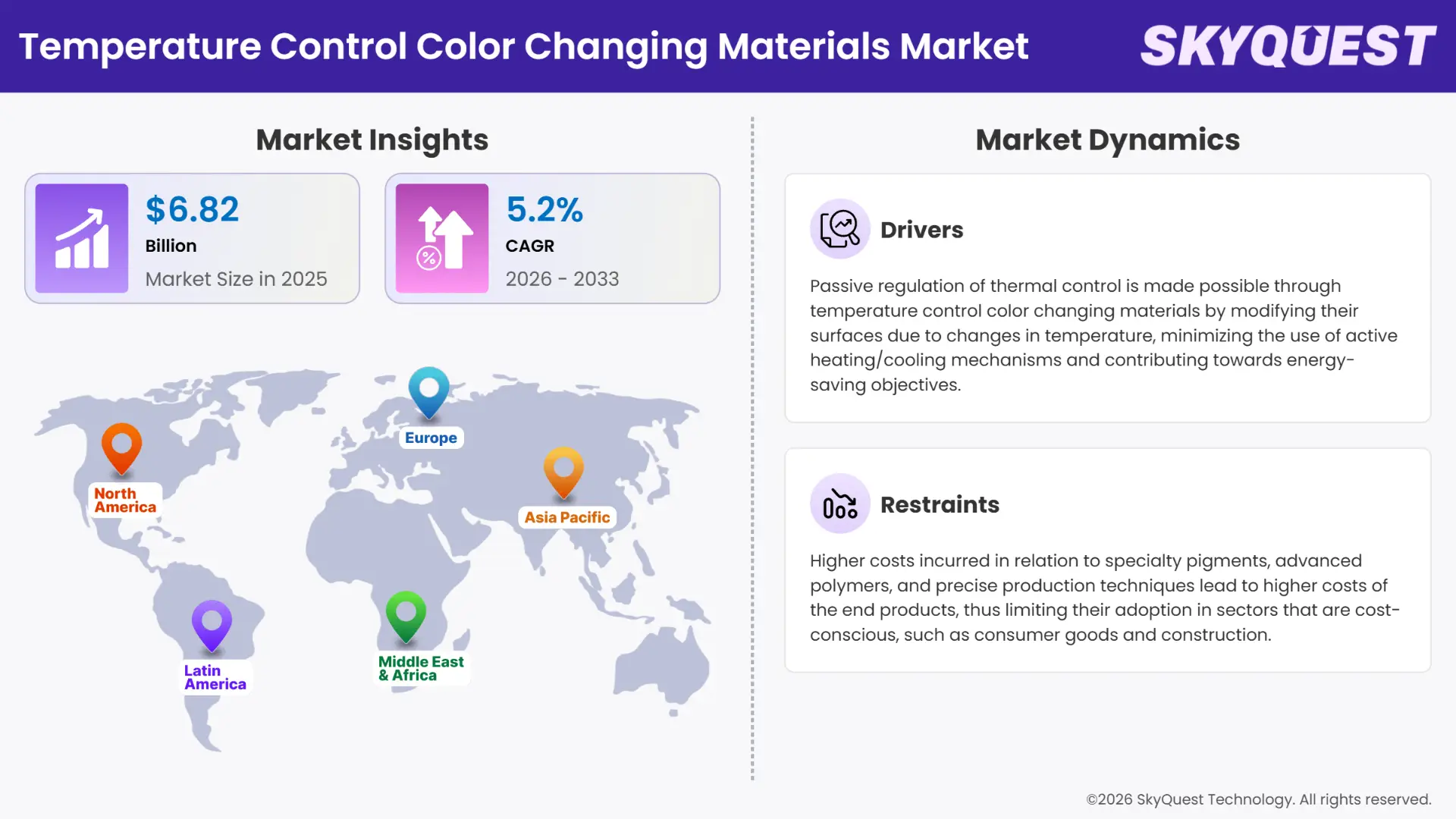
Global Temperature Control Color Changing Materials Market size was valued at USD 6.48 Billion in 2024 and is poised to grow from USD 6.82 Billion in 2025 to USD 10.23 Billion by 2033, growing at a CAGR of 5.2% during the forecast period (2026-2033).
Key Takeaways: Market Trends & Insights
Growing demand for smart materials, increasing adoption in safety and monitoring applications, rising use in consumer goods and packaging, advancements in thermochromic technologies, and emphasis on visual indicators are driving sales of temperature control color-changing materials.
Innovations in material technology, such as improved UV protection, adjustable transition points, and sustainable materials, are opening up new application possibilities. Rising applications in the medical industry for tracking temperature during transportation and consumer involvement through smart packaging and wearable textiles are also expected to uplift the sales of temperature control color changing materials. High demand for thermochromic materials in textiles, packaging, and healthcare applications is also creating new opportunities for temperature control color changing materials vendors in the long run. Growing demand for intuitive and real-time temperature monitoring solutions around the world coupled with increasing use of smart and functional materials is expected to primarily drive temperature control color-changing materials market growth. Demand for more attractive packaging and consumer goods is also boosting adoption of temperature control color changing materials.
On the contrary, high costs of advanced thermochromic materials, performance limitations under prolonged exposure, regulatory challenges, and durability concerns are predicted to impede temperature control color-changing materials market penetration across the forecast period.
How is AI Optimizing Performance in the Temperature-control Color-changing Materials Market?
With advancements in artificial intelligence, improvements are being realized in terms of productivity in the field of temperature control color changing materials market, which involve faster creation of formulations and enhanced manufacturing processes. The use of AI in conjunction with laboratory tests is used in creating safer and more durable materials, which is key amid rising demands for such materials in intelligent packaging, adaptive fabrics, among other uses, where color change consistency and durability are very important.
In August 2025, LCR Hallcrest LLC announced a partnership to integrate AI-driven analytics into product development. This helps optimize thermochromic formulations, improve quality control, speed up production, and reduce time to market for applications in packaging and textiles.
To get more insights on this market click here to Request a Free Sample Report
Global temperature control color changing materials market is segmented by material type, form, temperature range, color change property, application, and region. Based on material type, the market is segmented into Leuco Dyes, liquid crystals, inorganic materials, and polymers. Based on form, the market is segmented into microcapsules, inks & coatings, films & sheets, pigments & masterbatches, textiles & fibers, and other forms. Based on temperature range, the market is segmented into low temperature (0°C), C cold activation (0-15°C), ambient temperature (0-50°C), body temperature activation (25-37°C), warm activation (40-50°C), high temperature (>50°C), and others. Based on color change property, the market is segmented into reversible, irreversible, semi-reversible, and multi-color changing. Based on application, the market is segmented into packaging, food & beverage, temperature-sensitive products, smart labels & tags, and others. Based on region, the market is segmented into North America, Europe, Asia Pacific, Latin America, and Middle East & Africa.
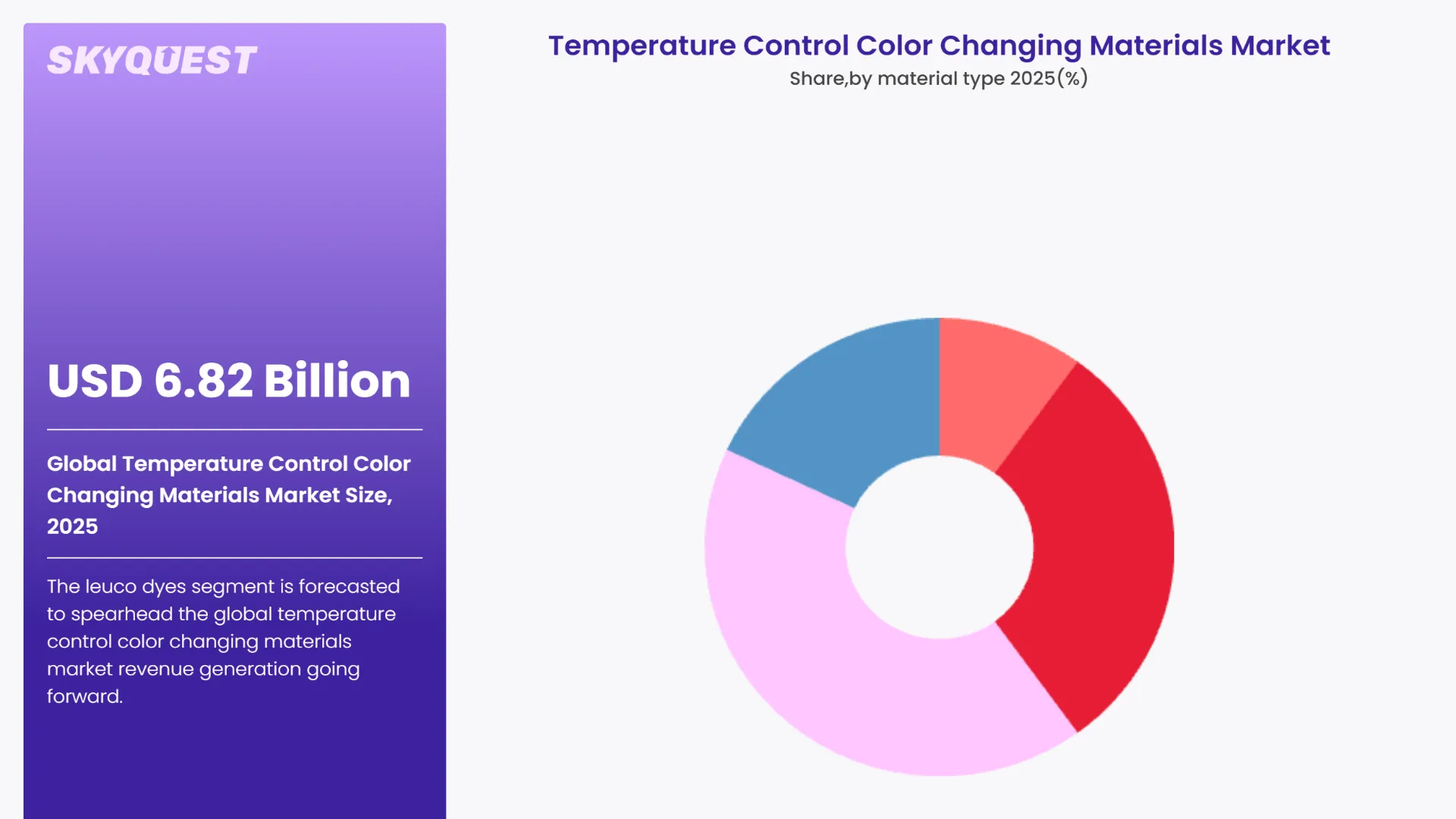
The leuco dyes segment is forecasted to spearhead the global temperature control color changing materials market revenue generation going forward. The ability of these dyes to offer versatile, reversible thermochromic behavior coupled with low material cost and straightforward integration helps this segment hold sway over others. The ability of these dyes to undergo micro-encapsulation allows the chromophore molecules to remain protected and compatible with various substrates, thus resulting in widespread use in packaging and other consumer products. The combination of these factors leads to the preference of leuco dye-based solutions by consumers of temperature indicators.
However, liquid crystals are emerging as the most rapidly expanding segment as per this temperature control color changing materials industry analysis. Their precise, tunable color transitions and fine temperature resolution for medical and sensor uses create new business scope. Improvements in liquid crystal ink technology have created more uses and increased the need for higher quality and accurate temperature sensors to develop innovative diagnostic and smart label systems.
The microcapsules segment is predicted to account for the highest global temperature control color changing materials market share going forward. Ability of microencapsulation to stabilize thermochromic cores, enable controlled activation, and extend lifecycle helps this segment maintain its dominance going forward. Migration and environmental resistance become minimized due to encapsulation, enhancing the durability in packaging applications, fabrics, and coatings and making the inclusion of such materials much easier in current production facilities. This has led to companies relying on microencapsulated components as a way of meeting requirements while serving as the default choice.
However, inks and coatings represent the most promising segment in terms of growth impetus due to growing demand for directly print-ready, functional surfaces for applications within the realm of intelligent packaging and labelling. The introduction of solvent-free and UV curable ink systems, along with their easy applicability on films and papers, is driving the trend towards wider adoption.
To get detailed segments analysis, Request a Free Sample Report
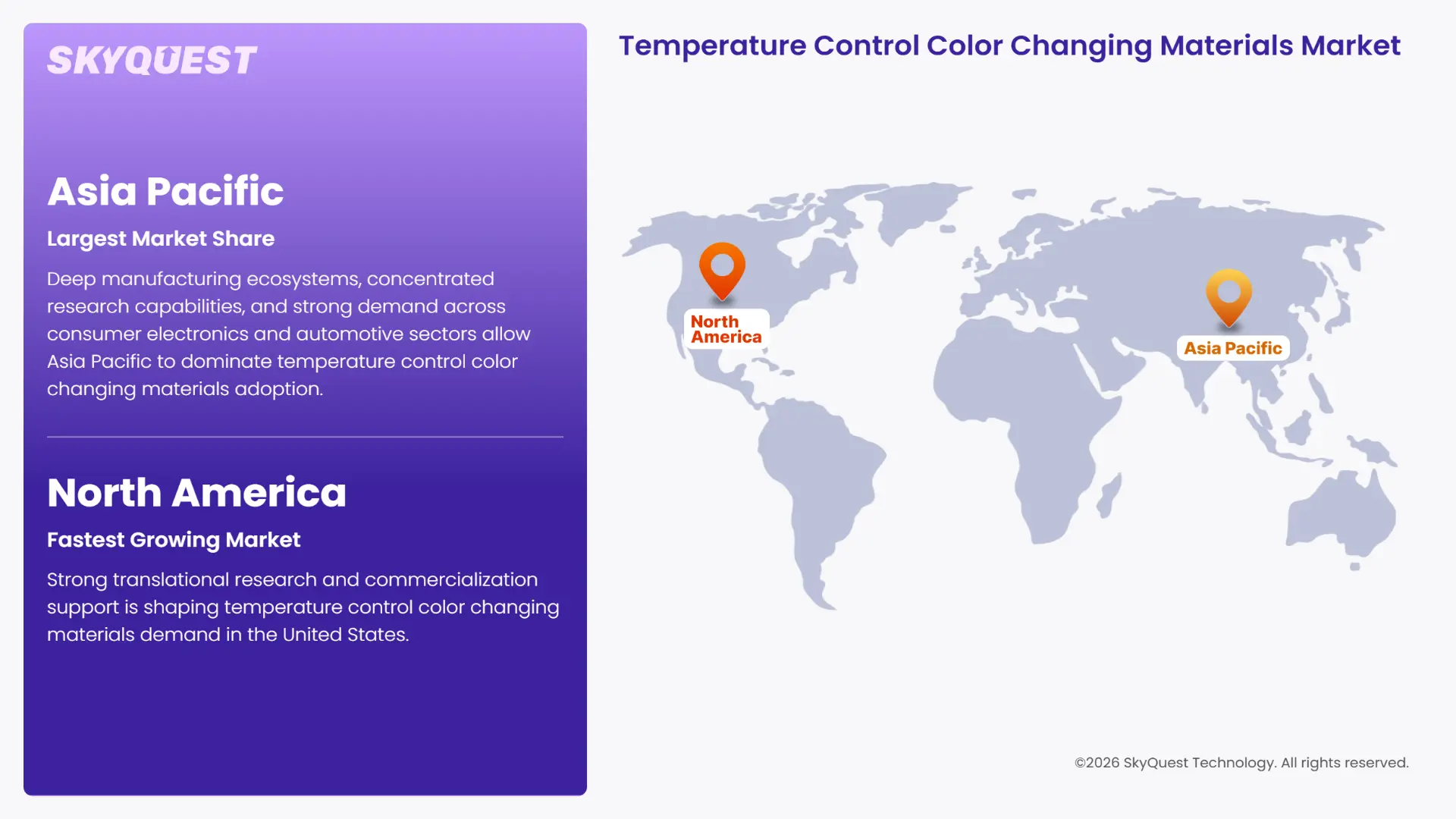
Deep manufacturing ecosystems, concentrated research capabilities, and strong demand across consumer electronics and automotive sectors allow Asia Pacific to dominate temperature control color changing materials adoption. Continued growth of private investment in the sector, in tandem with the development of new partnerships within the sector, has resulted in strong activity related to the development of temperature modifying colour changing materials. The successful introduction of temperature modifying colour changing materials into early grow markets such as smart textiles, packaging, and thermal sensing devices has generated demand that is driving innovative designs for products across multiple verticals. The strong regional design culture and focus on miniaturization in Asia Pacific also promote opportunities for design diversification. Collectively, this confluence of factors has developed an environment where innovation can be rapidly commercialised, supporting continued dominance of the Asia Pacific region in temperature modifying colour changing materials.
Deep materials research and precision manufacturing, with strong partnerships between industry and academia support steady demand for temperature control color changing materials in Japan. Microelectronics technology and advanced coatings knowledge is used for the creation of special products which react to the temperature changes. The use of high standards helps in achieving the reliable performance of the product, while the location near the original equipment manufacturers makes the innovations in smart textile applications possible.
Strong semiconductor and display manufacturing strengths with agile material development capabilities are shaping demand for temperature control color changing materials in South Korea. A synergistic alliance between suppliers and innovators facilitates quick prototyping and customization to meet regional OEM requirements. High-end performance, miniaturization, and finish standards are the key factors driving consumer electronics and niche industrial sectors. Strict test procedures guarantee quality for global distribution channels.
Rising collaboration between academic research, specialized startups, and established manufacturers is primarily influencing sales of temperature control color changing materials in this region. Companies working with product designers to integrate temperature responsive colors into the design of a product ensure they are using aesthetically pleasing and functional products. The increasing interest in sustainable and low energy products will increase the attractiveness of temperature changing products for the packaging and textile industries. These factors together with well-developed supply chains and investor interest will enable manufacturers to begin pilot programs to commercialize temperature changing products and develop long term relationships across industries supporting the growth of these types of products. Manufacturers interested in creating custom product solutions, using safe materials and being able to integrate temperature changing products into their current manufacturing processes have additional reasons to use these materials from their own business perspective.
Strong translational research and commercialization support is shaping temperature control color changing materials demand in the United States. Use of temperature control color changing materials is highest in healthcare devices, smart textiles, and high-tech packaging applications. Compliance and performance testing as well as scalable production draw in industry interest but increasing domestic demand for electronics and wearables is speeding up adoption of materials technology. Partnerships between material scientists, product designers, and manufacturers ensures the right solutions can be developed based on application needs.
Collaborative research infrastructure and niche manufacturing capabilities are shaping procurement of temperature control color changing materials across Canada. High demand for bespoke formulations in textile, packaging, and sensing applications is also creating new business scope. Developing dependable products with transparent supply chains and validating their performance requirements are essential for temperature control color changing materials companies in the country.
Emphasis on regulatory compliance, sustainability, and high-quality manufacturing practices are shaping sales of temperature control color changing materials in Europe. Aesthetic and functional value is enhanced by design led marketplaces and brand value associated with these products, while public and private research networks allow for pilot production and validation of new products. Investment in developing new manufacturing facilities and partnerships with brand owners helps to turn progress into commercialised products. Collectively, these components create a supply chain that is durable and establishes Europe as the epicenter of the sustainable engineering community producing application ready temperature responsive colour changing materials. Industry clusters that work together with research organisations and manufacturers across borders, enable rapid development of temperature responsive colour-changing inks that meet stringent criteria for environmentally safe and recyclable materials.
Specialty chemical production, precision engineering, and automotive supply chain integration are forecasted to boost the sales of temperature control color changing materials in Germany. temperature control color changing materials companies focus on sustainable sourcing of the material while maintaining high-quality standards required by domestic and global consumers. Partnerships between producers and R&D institutions ensure that the formulation is converted to materials for interior decoration and sensors.
Strong design orientation, creative industries, research institutions, and technology incubators are supporting high demand for temperature control color changing materials in the United Kingdom. Availability of prototyping laboratories and connections with clothes producers will aid in quick experimentation and development of solutions based on temperature changes. Focusing on aesthetics, utility, and collaborations with brands encourages adoption within fashion, technology textiles, and consumer goods.
Robust expertise in specialty chemicals, coatings, and textile finishing helps shape temperature control color changing materials demand across France. An emphasis on quality, functionality, and sustainability results in the creation of unique and high-end products. Strong connections between research labs, fashion designers, and speciality producers promote innovative applications in fashion and superior packaging.
To know more about the market opportunities by region and country, click here to
Buy The Complete Report
Rising Demand For Energy Efficiency
Expansion In Automotive Applications
High Production And Material Costs
Technical Integration And Durability Issues
Request Free Customization of this report to help us to meet your business objectives.
The competitive landscape is defined by incumbents and agile startups competing on smart packaging and cold chain solutions, driving partnerships and co development deals. Established pigment and ink firms struck printer and brand partnerships for application scale, for example LCR Hallcrest with Mimaki and Chromatic Technologies supplying beverage brands, while consumer product innovation such as Realme’s thermochromic phone panel accelerates adoption and invites new entrants like Useeble and Active Label.
SkyQuest’s ABIRAW (Advanced Business Intelligence, Research & Analysis Wing) is our Business Information Services team that Collects, Collates, Correlates, and Analyses the Data collected by means of Primary Exploratory Research backed by robust Secondary Desk research.
As per SkyQuest analysis, increasing demand for smart materials and increasing adoption in safety and temperature monitoring applications are anticipated to drive the demand for temperature control color-changing materials going forward. However, high costs of advanced thermochromic materials, durability limitations, and regulatory challenges are slated to slow down the adoption of temperature control color-changing materials in the future. Asia Pacific is slated to spearhead the demand for temperature control color-changing materials owing to strong presence of advanced manufacturing industries, high adoption in smart packaging and textiles, and increasing investments in functional materials. Advancements in AI-driven formulation design, development of durable and eco-friendly thermochromic materials, and integration into smart packaging and wearable technologies are anticipated to be key trends driving the temperature control color changing materials sector over the coming years.
| Report Metric | Details |
|---|---|
| Market size value in 2024 | USD 6.48 Billion |
| Market size value in 2033 | USD 10.23 Billion |
| Growth Rate | 5.2% |
| Base year | 2024 |
| Forecast period | 2026-2033 |
| Forecast Unit (Value) | USD Billion |
| Segments covered |
|
| Regions covered | North America (US, Canada), Europe (Germany, France, United Kingdom, Italy, Spain, Rest of Europe), Asia Pacific (China, India, Japan, Rest of Asia-Pacific), Latin America (Brazil, Rest of Latin America), Middle East & Africa (South Africa, GCC Countries, Rest of MEA) |
| Companies covered |
|
| Customization scope | Free report customization with purchase. Customization includes:-
|
To get a free trial access to our platform which is a one stop solution for all your data requirements for quicker decision making. This platform allows you to compare markets, competitors who are prominent in the market, and mega trends that are influencing the dynamics in the market. Also, get access to detailed SkyQuest exclusive matrix.
Table Of Content
Executive Summary
Market overview
Parent Market Analysis
Market overview
Market size
KEY MARKET INSIGHTS
COVID IMPACT
MARKET DYNAMICS & OUTLOOK
Market Size by Region
KEY COMPANY PROFILES
Methodology
For the Temperature Control Color Changing Materials Market, our research methodology involved a mixture of primary and secondary data sources. Key steps involved in the research process are listed below:
1. Information Procurement: This stage involved the procurement of Market data or related information via primary and secondary sources. The various secondary sources used included various company websites, annual reports, trade databases, and paid databases such as Hoover's, Bloomberg Business, Factiva, and Avention. Our team did 45 primary interactions Globally which included several stakeholders such as manufacturers, customers, key opinion leaders, etc. Overall, information procurement was one of the most extensive stages in our research process.
2. Information Analysis: This step involved triangulation of data through bottom-up and top-down approaches to estimate and validate the total size and future estimate of the Temperature Control Color Changing Materials Market.
3. Report Formulation: The final step entailed the placement of data points in appropriate Market spaces in an attempt to deduce viable conclusions.
4. Validation & Publishing: Validation is the most important step in the process. Validation & re-validation via an intricately designed process helped us finalize data points to be used for final calculations. The final Market estimates and forecasts were then aligned and sent to our panel of industry experts for validation of data. Once the validation was done the report was sent to our Quality Assurance team to ensure adherence to style guides, consistency & design.
Analyst Support
Customization Options
With the given market data, our dedicated team of analysts can offer you the following customization options are available for the Temperature Control Color Changing Materials Market:
Product Analysis: Product matrix, which offers a detailed comparison of the product portfolio of companies.
Regional Analysis: Further analysis of the Temperature Control Color Changing Materials Market for additional countries.
Competitive Analysis: Detailed analysis and profiling of additional Market players & comparative analysis of competitive products.
Go to Market Strategy: Find the high-growth channels to invest your marketing efforts and increase your customer base.
Innovation Mapping: Identify racial solutions and innovation, connected to deep ecosystems of innovators, start-ups, academics, and strategic partners.
Category Intelligence: Customized intelligence that is relevant to their supply Markets will enable them to make smarter sourcing decisions and improve their category management.
Public Company Transcript Analysis: To improve the investment performance by generating new alpha and making better-informed decisions.
Social Media Listening: To analyze the conversations and trends happening not just around your brand, but around your industry as a whole, and use those insights to make better Marketing decisions.
REQUEST FOR SAMPLE
 REQUEST FREE CUSTOMIZATION
Global Temperature Control Color Changing Materials Market size was valued at USD 6.48 Billion in 2024 and is poised to grow from USD 6.82 Billion in 2025 to USD 10.23 Billion by 2033, growing at a CAGR of 5.2% during the forecast period (2026-2033).
The competitive landscape is defined by incumbents and agile startups competing on smart packaging and cold chain solutions, driving partnerships and co development deals. Established pigment and ink firms struck printer and brand partnerships for application scale, for example LCR Hallcrest with Mimaki and Chromatic Technologies supplying beverage brands, while consumer product innovation such as Realme’s thermochromic phone panel accelerates adoption and invites new entrants like Useeble and Active Label. 'Chromatic Technologies', 'Olikrom', 'LCR Hallcrest', 'Matsui International Company', 'New Prismatic Enterprise', 'GEM'INNOV', 'Kolorjet', 'Smarol Industry', 'Hali Industrial', 'Fx Pigments', 'N.C.C-New Color Chemical', 'Moving Colors', 'Shanghai Caison Color Material Chem', 'H.W. Sands Corp.', 'Indestructible Paint', 'Thermographics', 'Merck KGaA', 'Sensient Technologies Corporation', 'DIC Corporation', 'BASF SE'
These materials enable passive thermal regulation by changing surface properties in response to temperature, which reduces reliance on active heating and cooling systems and aligns with broader energy efficiency goals. Architects, designers, and building managers favor solutions that improve occupant comfort while lowering operational burdens, and color changing materials offer both functional and aesthetic value. As awareness of energy conservation grows, demand rises for building envelopes and products that contribute to reduced energy use, encouraging manufacturers to invest in development, commercialization, and wider deployment.
Sustainable Material Adoption: Manufacturers increasingly prefer eco friendly thermochromic and phase change color materials that lower environmental impact and support sustainability commitments. Demand stems from consumer interest in recyclable, low toxicity formulations and from brands seeking green differentiation in product portfolios. Suppliers prioritize alternative chemistries and certifications to satisfy procurement criteria across industries such as textiles, packaging and surfaces. The trend fosters collaboration among material scientists, designers and regulators, improving transparency and enabling its broader adoption through validated supply chain practices and guidance.
Asia Pacific Dominate the Global Temperature Control Color Changing Materials Market.
The Leuco Dyes segment holds the largest market share due to its cost-effectiveness, versatility, and widespread use in thermochromic inks, coatings, packaging, and consumer products.
The market is segmented into Microcapsules, Inks & Coatings, Films & Sheets, Pigments & Masterbatches, Textiles & Fibers, and Other Forms, serving a wide range of industrial and consumer applications.
AI is helping manufacturers develop more durable and efficient formulations, optimize production processes, improve quality control, and accelerate product development for smart packaging, textiles, and other applications.


Want to customize this report? This report can be personalized according to your needs. Our analysts and industry experts will work directly with you to understand your requirements and provide you with customized data in a short amount of time. We offer $1000 worth of FREE customization at the time of purchase.
Feedback From Our Clients


 USA (+1) 351-333-4748

