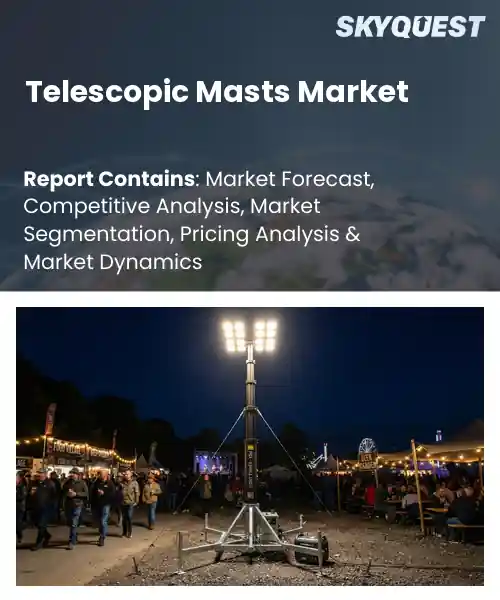
Telescopic Masts Market
Report ID: SQMIG20I3694
Report ID: SQMIG20I3694
[email protected]
USA +1 351-333-4748
Report ID:
SQMIG20I3694 |
Region:
Global |
Published Date: August, 2026
Pages:
157
|Tables:
146
|Figures:
78


Global Telescopic Masts Market size was valued at USD 2.18 Billion in 2024 and is poised to grow from USD 2.34 Billion in 2025 to USD 4.08 Billion by 2033, growing at a CAGR of 7.2% during the forecast period (2026-2033).
The global telescopic mast market supplies support structures for telecommunications, broadcasting, maritime and defense sectors. Its primary driver is the exponential growth of mobile data traffic, compelling operators to densify networks with small cells that require flexible mounting solutions. Historically, fixed steel towers dominated deployments, yet the 5G surge since 2019 forced vendors to adopt lightweight masts that can be erected on rooftops, lamp posts or vessels. For instance, a European carrier installed telescopic masts on 12,000 street‑furniture points, reducing installation time by 40 percent and cutting capital expense. This evolution underscores the market’s relevance in achieving significant cost‑effective coverage. A decisive factor shaping the telescopic mast market is demand for offshore wind and maritime surveillance assets. Renewable‑energy targets push wind farm developers to use masts that can be lowered for transport and raised on‑site without heavy‑lift vessels, shortening installation cycles and cutting OPEX. Manufacturers respond by adding hydraulic actuation and corrosion‑resistant composites, opening opportunities in Southeast Asia where shallow‑water projects grow. For example, a Japanese firm fitted floating turbines with telescopic masts, achieving a 25 % reduction in cable‑laying time and earlier grid interconnection. This cause‑effect chain shows how policy pressure and engineering adaptation expand market size and spur
How is AI enhancing deployment efficiency in the telescopic masts market?
AI is streamlining telescopic mast deployment by automating site assessment, optimizing load calculations, and coordinating real‑time rig operations. Machine‑learning models analyze terrain data and wind patterns to recommend the most efficient mast height and anchoring scheme, reducing manual engineering time. Predictive maintenance algorithms monitor hydraulic and pneumatic components, alerting crews before failures occur and minimizing downtime. Integrated vision systems guide robotic actuators during extension, ensuring precise alignment and faster erection. These capabilities collectively shorten project timelines, lower labor costs, and improve safety, reinforcing the market’s momentum as demand grows for flexible, high‑reach communication structures.In June 2024, a leading manufacturer introduced an AI‑enabled deployment platform, accelerating installation cycles and supporting the broader adoption of telescopic mast solutions.
Market snapshot - (2026-2033)
Global Market Size
USD 2.18 Billion
Largest Segment
Hydraulic Telescopic Masts
Fastest Growth
Pneumatic Telescopic Masts
Growth Rate
7.2% CAGR
To get more insights on this market click here to Request a Free Sample Report
Global telescopic masts market is segmented by mast type, material, height, application, end user and region. Based on mast type, the market is segmented into Pneumatic Telescopic Masts, Hydraulic Telescopic Masts and Manual Telescopic Masts. Based on material, the market is segmented into Aluminum, Steel and Composite. Based on height, the market is segmented into Up to 10 m, 10–20 m and Above 20 m. Based on application, the market is segmented into Communication, Surveillance, Lighting and Meteorological Monitoring. Based on end user, the market is segmented into Defense & Security, Telecommunications, Emergency Services and Industrial. Based on region, the market is segmented into North America, Europe, Asia Pacific, Latin America and Middle East & Africa.
Pneumatic Telescopic Masts segment dominates because they provide rapid deployment, lightweight handling, and low power consumption, which align with the increasing demand for mobile communication infrastructure. Their ability to extend quickly without extensive ground preparation meets the operational tempo of field teams, while the simplicity of air filled columns reduces maintenance complexity. These attributes foster strong preference among users seeking agile, cost effective solutions, reinforcing market leadership across global deployments.
Meanwhile, Hydraulic Telescopic Masts are witnessing the strongest growth momentum because advancements in fluid control technology enable higher load capacity and smoother extension, attracting sectors that require robust lifting capabilities. This progress fuels adoption in heavy duty surveillance and industrial monitoring, expanding market reach and creating opportunities for mast solutions.
Aluminum segment dominates because its high strength to weight ratio and corrosion resistance make it ideal for portable mast designs that need durability without excessive mass. Manufacturers value the ease of extrusion and recycling, which lowers lifecycle costs and supports sustainability goals. Consequently, users across communication and emergency services favor aluminum constructions, reinforcing its preference and cementing its leading position in the market for modern infrastructure development worldwide.
On the other hand, Composite segment is emerging as the key growth area because advances in fiber reinforcement enable stiffness while keeping weight minimal, attracting high tech surveillance and meteorological applications. This material’s thermal stability and performance drive adoption in environments where metals falter, accelerating market expansion and unlocking design possibilities for mast systems.
To get detailed segments analysis, Request a Free Sample Report
Asia Pacific dominance in the global telescopic masts market stems from a confluence of advanced manufacturing capabilities, deep engineering expertise, and a broad spectrum of end‑use applications. The region hosts world‑class shipbuilding and offshore infrastructure sectors that rely heavily on high‑performance extendable structures. Strong demand from telecommunications providers upgrading networks, combined with aggressive adoption of renewable energy installations, fuels continuous product development. Government initiatives that encourage industrial innovation and export competitiveness further reinforce the supply chain. Close proximity to key raw material sources and a culture of rapid prototyping enable manufacturers to deliver customized solutions efficiently, cementing the region’s leadership in both volume and technological sophistication. In addition, the region’s emphasis on collaborative research between academia and industry accelerates the integration of smart sensor technologies, enhancing operational safety and performance monitoring. This holistic ecosystem supports sustained market leadership.
Japan Telescopic Masts Market
Telescopic Masts Market in Japan benefits from a mature industrial base that prioritises precision engineering and reliability. Domestic manufacturers leverage advanced materials to meet stringent performance criteria for maritime, telecommunications and infrastructure projects. Strong collaboration with research institutions drives continuous innovation, while a focus on export quality positions Japanese solutions as preferred choices in global supply chains. The market’s emphasis on durability and customization aligns with the country’s high standards for safety and efficiency.
South Korea Telescopic Masts Market
Telescopic Masts Market in South Korea is propelled by rapid adoption of next generation wireless networks and a robust shipbuilding sector that demands high‑performance extendable structures. Government‑backed programs encourage domestic R&D, fostering integration of lightweight composites and smart monitoring systems. Local manufacturers emphasize speed‑to‑market and cost‑effective production, enabling them to serve both domestic infrastructure upgrades and export opportunities. The market’s agility and focus on technological advancement reinforce its competitive standing.
Europe’s rapid expansion of the telescopic masts market is underpinned by a strong commitment to sustainable infrastructure and advanced engineering capabilities across the continent. Growing deployment of offshore renewable energy installations, coupled with extensive upgrades to telecommunications networks, creates a steady demand for high‑precision, adaptable mast solutions. Regulatory frameworks that promote safety and environmental stewardship encourage manufacturers to integrate lightweight composites and smart monitoring technologies. Collaborative ecosystems linking research institutions, OEMs and end‑users accelerate product innovation and customization. Additionally, the region’s focus on circular economy principles drives the development of recyclable components, enhancing the overall value proposition and reinforcing Europe’s position as a hub for cutting‑edge telescopic mast technologies. The emphasis on cross‑border standardisation also facilitates market integration, allowing suppliers to serve multiple national projects with consistent quality. This coordinated approach strengthens the competitive landscape and supports sustained growth across the European market.
Germany Telescopic Masts Market
Telescopic Masts Market in Germany is anchored by world‑class engineering expertise and a strong industrial base that serves sectors such as renewable energy, telecommunications and heavy machinery. German manufacturers prioritize precision manufacturing and rigorous testing, ensuring high reliability for demanding applications. Close collaboration with research institutes accelerates the adoption of advanced composites and digital monitoring solutions. The market’s focus on quality, safety standards and sustainable production reinforces Germany’s leadership in the European telescopic mast landscape.
United Kingdom Telescopic Masts Market
Telescopic Masts Market in the United Kingdom is experiencing accelerated growth driven by ambitious offshore renewable projects and extensive telecommunications rollouts. British firms leverage a heritage of maritime engineering to deliver robust, adaptable mast systems suited to harsh marine environments. Government incentives promote the integration of lightweight materials and real‑time health monitoring, enhancing operational efficiency. Strong ties between academia and industry foster rapid prototyping, positioning the United Kingdom as a dynamic hub for innovative telescopic mast solutions.
France Telescopic Masts Market
Telescopic Masts Market in France is emerging as a focal point for infrastructure modernization and renewable energy expansion. French manufacturers combine sophisticated design capabilities with a growing emphasis on eco‑friendly materials, catering to both domestic and European projects. Collaborative initiatives between research laboratories and industrial partners accelerate the development of smart sensor integration and modular mast configurations. This progressive approach, coupled with supportive policy frameworks, positions France as an increasingly influential player in the continental telescopic mast sector.
North America is strengthening its position in the telescopic masts market through a combination of extensive infrastructure investment, advanced manufacturing capabilities and a focus on technological integration. The region’s expansive telecommunications networks and growing demand for resilient offshore installations drive continuous product refinement. Defense and aerospace sectors contribute to high‑performance requirements, prompting manufacturers to adopt lightweight alloys and embedded sensor technologies for real‑time condition monitoring. Collaborative ecosystems linking universities, research centers and industry accelerate innovation cycles, while a strong emphasis on safety standards ensures reliability across diverse applications. Additionally, the market benefits from a culture of rapid prototyping and scalable production, enabling swift response to evolving customer needs and reinforcing North America’s role as a leading hub for sophisticated telescopic mast solutions.
United States Telescopic Masts Market
Telescopic Masts Market in the United States is characterized by a robust ecosystem of original equipment manufacturers and a high demand across telecommunications, renewable energy and defense sectors. American firms prioritize integration of digital twins and predictive analytics to enhance performance and maintenance efficiency. Strong collaboration with research universities fuels rapid adoption of advanced composites and modular designs. This focus on innovation and scalability positions the United States as a pivotal driver of market evolution.
Canada Telescopic Masts Market
Telescopic Masts Market in Canada is driven by a strategic emphasis on remote communications, renewable energy projects and stringent safety regulations. Canadian manufacturers leverage expertise in cold‑climate engineering to produce mast systems that maintain reliability under extreme conditions. Partnerships with governmental research agencies promote the development of lightweight, corrosion‑resistant materials and integrated monitoring solutions. This commitment to durability and environmental stewardship enhances Canada’s reputation as a reliable supplier in the North American telescopic mast landscape.
To know more about the market opportunities by region and country, click here to
Buy The Complete Report
Growing Demand For Remote Operations
Adoption Of Lightweight Materials
High Initial Capital Investment
Stringent Safety And Regulatory Standards
Request Free Customization of this report to help us to meet your business objectives.
The competitive landscape of the global telescopic masts market is shaped by intense rivalry among manufacturers seeking to secure contracts with telecom operators and infrastructure developers. Companies are accelerating technology innovation by integrating lightweight composite materials and advanced pneumatic actuation, while pursuing strategic partnerships to expand distribution networks and enhance service offerings in emerging 5G deployments. Recent M&A activity includes acquisitions aimed at consolidating supply chains and broadening product portfolios to meet growing demand for rapid‑deployment mast solutions.
Top Player’s Company Profile
Recent Developments
SkyQuest’s ABIRAW (Advanced Business Intelligence, Research & Analysis Wing) is our Business Information Services team that Collects, Collates, Correlates, and Analyses the Data collected by means of Primary Exploratory Research backed by robust Secondary Desk research. As per SkyQuest analysis, the telescopic masts market is being propelled primarily by the growing demand for remote operations, which pushes industries such as offshore wind, mining and emergency services to seek quickly deployable, high‑reach solutions. A second driver is the widespread adoption of lightweight materials, especially aluminum and composites, that lower transport costs and enable longer extensions without sacrificing strength. The market’s most active segment is pneumatic telescopic masts, favored for rapid, low‑power deployment, while Asia Pacific remains the dominant region thanks to its strong manufacturing base and extensive telecom and renewable‑energy projects. However, high initial capital investment continues to restrain adoption, particularly among smaller operators who face budget and approval hurdles.
| Report Metric | Details |
|---|---|
| Market size value in 2024 | USD 2.18 Billion |
| Market size value in 2033 | USD 4.08 Billion |
| Growth Rate | 7.2% |
| Base year | 2024 |
| Forecast period | (2026-2033) |
| Forecast Unit (Value) | USD Billion |
| Segments covered |
|
| Regions covered | North America (US, Canada), Europe (Germany, France, United Kingdom, Italy, Spain, Rest of Europe), Asia Pacific (China, India, Japan, Rest of Asia-Pacific), Latin America (Brazil, Rest of Latin America), Middle East & Africa (South Africa, GCC Countries, Rest of MEA) |
| Companies covered |
|
| Customization scope | Free report customization with purchase. Customization includes:-
|
To get a free trial access to our platform which is a one stop solution for all your data requirements for quicker decision making. This platform allows you to compare markets, competitors who are prominent in the market, and mega trends that are influencing the dynamics in the market. Also, get access to detailed SkyQuest exclusive matrix.
Table Of Content
Executive Summary
Market overview
Parent Market Analysis
Market overview
Market size
KEY MARKET INSIGHTS
COVID IMPACT
MARKET DYNAMICS & OUTLOOK
Market Size by Region
KEY COMPANY PROFILES
Methodology
For the Telescopic Masts Market, our research methodology involved a mixture of primary and secondary data sources. Key steps involved in the research process are listed below:
1. Information Procurement: This stage involved the procurement of Market data or related information via primary and secondary sources. The various secondary sources used included various company websites, annual reports, trade databases, and paid databases such as Hoover's, Bloomberg Business, Factiva, and Avention. Our team did 45 primary interactions Globally which included several stakeholders such as manufacturers, customers, key opinion leaders, etc. Overall, information procurement was one of the most extensive stages in our research process.
2. Information Analysis: This step involved triangulation of data through bottom-up and top-down approaches to estimate and validate the total size and future estimate of the Telescopic Masts Market.
3. Report Formulation: The final step entailed the placement of data points in appropriate Market spaces in an attempt to deduce viable conclusions.
4. Validation & Publishing: Validation is the most important step in the process. Validation & re-validation via an intricately designed process helped us finalize data points to be used for final calculations. The final Market estimates and forecasts were then aligned and sent to our panel of industry experts for validation of data. Once the validation was done the report was sent to our Quality Assurance team to ensure adherence to style guides, consistency & design.
Analyst Support
Customization Options
With the given market data, our dedicated team of analysts can offer you the following customization options are available for the Telescopic Masts Market:
Product Analysis: Product matrix, which offers a detailed comparison of the product portfolio of companies.
Regional Analysis: Further analysis of the Telescopic Masts Market for additional countries.
Competitive Analysis: Detailed analysis and profiling of additional Market players & comparative analysis of competitive products.
Go to Market Strategy: Find the high-growth channels to invest your marketing efforts and increase your customer base.
Innovation Mapping: Identify racial solutions and innovation, connected to deep ecosystems of innovators, start-ups, academics, and strategic partners.
Category Intelligence: Customized intelligence that is relevant to their supply Markets will enable them to make smarter sourcing decisions and improve their category management.
Public Company Transcript Analysis: To improve the investment performance by generating new alpha and making better-informed decisions.
Social Media Listening: To analyze the conversations and trends happening not just around your brand, but around your industry as a whole, and use those insights to make better Marketing decisions.
REQUEST FOR SAMPLE
 REQUEST FREE CUSTOMIZATION


Want to customize this report? This report can be personalized according to your needs. Our analysts and industry experts will work directly with you to understand your requirements and provide you with customized data in a short amount of time. We offer $1000 worth of FREE customization at the time of purchase.
Feedback From Our Clients


 USA (+1) 351-333-4748

