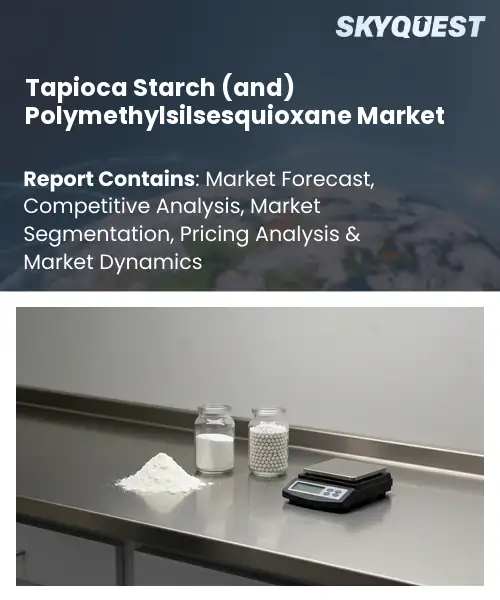
Tapioca Starch (and) Polymethylsilsesquioxane Market
Report ID: SQMIG25K2158
Report ID: SQMIG25K2158
[email protected]
USA +1 351-333-4748
Report ID:
SQMIG25K2158 |
Region:
Global |
Published Date: March, 2026
Pages:
157
|Tables:
91
|Figures:
76


Global Tapioca Starch (And) Polymethylsilsesquioxane Market size was valued at USD 4.8 Billion in 2024 and is poised to grow from USD 5.09 Billion in 2025 to USD 8.18 Billion by 2033, growing at a CAGR of 6.1% during the forecast period (2026-2033).
As a research analyst, I view the tapioca starch and polymethylsilsesquioxane markets as distinct but complementary segments that feed industrial value chains. Tapioca starch from cassava provides texturizing, bonding and biodegradable film functions across food, paper, textile and packaging sectors, and it expanded from a Southeast Asian staple into a global ingredient as demand for gluten free and sustainable sourcing rose. Polymethylsilsesquioxane, a silicon based organosilicon polymer, evolved with electronics and coatings industries to offer low dielectric films, hydrophobic coatings and cosmetic texturizers. Together they matter because manufacturers seek functional, regulatory compliant alternatives that spur R&D and production shifts globally.Building on that evolution, the dominant growth driver across both markets is shifting demand toward functionally superior, sustainable inputs, which creates clear cause and effect dynamics for producers and end users. As regulators curb single use plastics and brands seek clean label credentials, food and packaging manufacturers substitute tapioca based films and modified starches, prompting processors to invest in enzymatic and chemical modifications that enhance film strength and barrier properties. Simultaneously, relentless electronics miniaturization and higher cosmetic performance requirements push formulators toward polymethylsilsesquioxane for low k dielectrics, hydrophobic coatings and tactile modifiers, generating opportunities for specialty grade suppliers and collaborative R&D with fabs and consumer goods firms globally.
How can AI optimize supply chain efficiency in the tapioca starch and polymethylsilsesquioxane market?
AI can improve efficiency in the tapioca starch and polymethylsilsesquioxane markets by targeting demand forecasting, traceability, and process optimization. Tapioca starch supply is tied to seasonal cassava harvests and serves both food and industrial uses while polymethylsilsesquioxane is a specialty material for coatings and electronics so buyers need different quality and timing. Current markets are fragmented and face logistics pressure. AI driven forecasting, computer vision for quality control, supplier risk scoring, and dynamic routing help align production to demand and reduce waste. For instance AI can map harvest timing to production runs and refine PMSQ formulations to lower rework and speed shipments.Momentive, March 2025, showcased advanced silicone solutions at the European Coatings Show and signaled innovation in materials related to polymethylsilsesquioxane. Pairing such product work with AI enabled predictive logistics and quality analytics supports smoother supply and faster market adoption.
Market snapshot - (2026-2033)
Global Market Size
USD 4.8 Billion
Largest Segment
Tapioca Starch
Fastest Growth
Polymethylsilsesquioxane
Growth Rate
6.1% CAGR
To get more insights on this market click here to Request a Free Sample Report
Global tapioca starch (and) polymethylsilsesquioxane market is segmented by type, application, distribution channel and region. Based on type, the market is segmented into Tapioca Starch and Polymethylsilsesquioxane. Based on application, the market is segmented into Food and Beverage, Cosmetics, Pharmaceuticals, Industrial Applications, R&D Institutions and Others. Based on distribution channel, the market is segmented into Direct Sales and Indirect Sales. Based on region, the market is segmented into North America, Europe, Asia Pacific, Latin America and Middle East & Africa.
Tapioca Starch segment dominates because its natural rheological properties and clean label perception make it the preferred binder and texturizer across food, pharmaceutical, and industrial formulations. Its ease of sourcing and compatibility with existing processing technologies reduces formulation risk and accelerates adoption by manufacturers, creating stable demand. This ubiquity drives ingredient standardization and supply chain prioritization by formulators and distributors, reinforcing its role in tapioca starch and polymethylsilsesquioxane product portfolios.
However, polymethylsilsesquioxane is emerging as the most rapidly expanding option due to its ability to impart lightweight, water repellent and thermal stabilizing properties that enable cosmetic and industrial formulations. Advances in particle engineering and interest from care and specialty coatings developers accelerate adoption, opening higher margin niches and driving opportunities.
Indirect Sales segment dominates because channel partners, distributors, and formulation houses bridge technical expertise and market reach, enabling niche tapioca starch and polymethylsilsesquioxane blends to reach varied end use customers. Established distributor networks provide application support, inventory buffering, and bundled services that reduce procurement friction for manufacturers and brands. Their ability to coordinate cross application trials and supply chain logistics sustains product availability and underpins commercialization across complex formulation landscapes.
However, Direct Sales is rapidly expanding as manufacturers build technical sales teams and direct formulator relationships to capture margins and faster feedback. Closer collaboration, tailored supply agreements, and streamlined ordering accelerate iteration and time to market, enabling agile commercialization of advanced tapioca starch and polymethylsilsesquioxane formulations and creating new application development opportunities.
To get detailed segments analysis, Request a Free Sample Report
Asia Pacific commands the global market through a blend of abundant raw material availability, concentrated manufacturing expertise, and deep integration across key end use industries. Regional supply chains link cassava production centers with specialized starch processors and chemical formulators, creating efficient value streams that lower costs and accelerate innovation. Strong demand from packaging, personal care, and advanced coatings sectors sustains commercial scale, while local producers collaborate with technical partners to tailor polymethylsilsesquioxane blends for specific performance profiles. Strategic investments in application development, combined with flexible contract manufacturing and export orientation, reinforce market leadership. Regulatory frameworks that encourage ingredient substitution and product safety, coupled with established logistics networks, further amplify the region capacity to serve both domestic and international customers with responsive supply and technical support.
Tapioca Starch (and) Polymethylsilsesquioxane Market in Japan is shaped by demand for high performance formulations and rigorous quality expectations. Manufacturers prioritize material purity and consistency to meet stringent application requirements across electronics, personal care, and precision coatings. The market benefits from close collaboration between formulators and academic research centers, which accelerates specialty product development. Emphasis on traceability, supplier reliability, and tailored technical support sustains premium positioning and repeat business relationships.
Tapioca Starch (and) Polymethylsilsesquioxane Market in South Korea emphasizes application specific performance and fast product iteration to support dynamic electronics and cosmetics sectors. Local producers work closely with brand formulators to customize texture, durability, and surface properties, while contract manufacturers enable rapid scale up. Regulatory alignment and robust logistics support facilitate exports. Focus on innovation, responsiveness, and technical service strengthens supplier customer relationships and market responsiveness and long term partnerships.
North America is experiencing pronounced expansion driven by demand for functional ingredients that combine performance with sustainability credentials. End users in coatings, adhesives, personal care, and specialty manufacturing seek reliable additives that enhance texture, barrier properties, and surface performance while aligning with cleaner label and circularity objectives. Domestic formulators partner with material suppliers to co develop tailored polymethylsilsesquioxane formulations and modified starch systems that meet rigorous application and regulatory requirements. Flexible manufacturing networks and contract producers enable faster commercialization of niche products. Distribution channels focused on technical service and application support help convert innovation into commercial adoption. Investment in application research and pilot scale trials accelerates product refinement, while emphasis on traceability and compliance supports market acceptance among discerning buyers.
Tapioca Starch (and) Polymethylsilsesquioxane Market in United States is characterized by demand for highly tailored performance and rigorous regulatory compliance. Manufacturers and formulators prioritize innovation, working with material suppliers to optimize rheology, adhesion, and surface effects for advanced industrial and consumer applications. Strong application development capabilities, pilot testing infrastructure, and distribution networks that emphasize technical service accelerate adoption. Sustainability objectives and supply chain diversification influence sourcing and selection across sectors.
Tapioca Starch (and) Polymethylsilsesquioxane Market in Canada emphasizes sustainable sourcing and application driven partnerships with end users. Suppliers focus on niche specialty formulations for personal care, packaging, and industrial coatings, leveraging close collaboration with North American formulators. Flexible contract manufacturing and logistics networks support distribution, while regulatory alignment with major trading partners streamlines product acceptance. Emphasis on traceability, quality assurance, and tailored technical support helps convert innovation into reliable supply.
Europe is reinforcing its market position through a concerted emphasis on sustainable sourcing, stringent quality standards, and application driven innovation. Manufacturers across the region prioritize eco friendly ingredient profiles and traceability, aligning product portfolios with evolving regulatory expectations and corporate sustainability commitments. Strong technical institutes and collaborative industry networks support development of tailored polymethylsilsesquioxane and modified starch solutions for coatings, automotive, and premium personal care applications. Investment in downstream formulation capabilities, pilot scale testing, and robust certification pathways enhances market credibility. Cross border partnerships and sophisticated distribution channels enable efficient knowledge transfer and rapid application adoption. This combined focus on sustainability, technical excellence, and customer centric service strengthens the role of the region as a reliable source of high performance specialty ingredients.
Tapioca Starch (and) Polymethylsilsesquioxane Market in Germany is driven by engineering driven demand for consistent, high performance additives in coatings, adhesives, and automotive components. Suppliers emphasize rigorous quality management and compatibility with complex formulation matrices. Close ties between material developers and industrial end users enable co engineering of solutions that meet exacting performance and durability standards. Strong export orientation and established technical service networks support adoption across diverse industrial segments.
Tapioca Starch (and) Polymethylsilsesquioxane Market in United Kingdom reflects strong emphasis on formulation innovation and premium personal care applications. Academic and commercial research centers collaborate with industry to refine texture and sensory properties, while niche manufacturers deliver specialized blends for luxury cosmetics and high end coatings. Distribution partners provide technical guidance and sampling services to accelerate market trials. Sustainability considerations and brand driven quality expectations shape supplier selection and development.
Tapioca Starch (and) Polymethylsilsesquioxane Market in France is strongly influenced by sophisticated personal care and cosmetics demand for elegant textures and functional aesthetics. Suppliers work closely with luxury brands and formulation houses to achieve sensory refinement and stable performance in complex matrices. Emphasis on sustainable raw materials, regulatory compliance, and boutique scale innovation supports premium positioning. Technical service, sampling capabilities, and close client engagement underpin adoption among discerning formulators directly.
To know more about the market opportunities by region and country, click here to
Buy The Complete Report
Growth From Food Industry Applications
Innovation In Cosmetic Formulations
Raw Material Supply Variability
Regulatory and Environmental Concerns
Request Free Customization of this report to help us to meet your business objectives.
Competitive landscape is shaped by incumbents securing feedstock and specialty chemistry advantages through vertical integration, targeted M&A and technology deals. Examples include tapioca producers moving into bioplastic brands and POSS specialists consolidating to scale manufacturing capacity. Strategic partnerships and spin ins drive faster commercialisation and create intense competition for supply contracts and formulation exclusives.
Top Player’s Company Profile
Recent Developments
SkyQuest’s ABIRAW (Advanced Business Intelligence, Research & Analysis Wing) is our Business Information Services team that Collects, Collates, Correlates, and Analyses the Data collected by means of Primary Exploratory Research backed by robust Secondary Desk research. As per SkyQuest analysis, the global tapioca starch and polymethylsilsesquioxane market is propelled primarily by rising demand for functionally superior, sustainable inputs that support clean label and biodegradable formulations in food, packaging and personal care. A key driver is this sustainability-driven substitution, while a second driver is growing demand from electronics and cosmetics for PMSSQ’s low-dielectric and hydrophobic properties. A restraint is variability in cassava supply and tapioca feedstock quality, which complicates consistent production. Asia Pacific is the dominating region due to integrated cassava supply chains and manufacturing scale and the tapioca starch segment is the dominating segment given its versatility across food, pharmaceutical and industrial applications.
| Report Metric | Details |
|---|---|
| Market size value in 2024 | USD 4.8 Billion |
| Market size value in 2033 | USD 8.18 Billion |
| Growth Rate | 6.1% |
| Base year | 2024 |
| Forecast period | (2026-2033) |
| Forecast Unit (Value) | USD Billion |
| Segments covered |
|
| Regions covered | North America (US, Canada), Europe (Germany, France, United Kingdom, Italy, Spain, Rest of Europe), Asia Pacific (China, India, Japan, Rest of Asia-Pacific), Latin America (Brazil, Rest of Latin America), Middle East & Africa (South Africa, GCC Countries, Rest of MEA) |
| Companies covered |
|
| Customization scope | Free report customization with purchase. Customization includes:-
|
To get a free trial access to our platform which is a one stop solution for all your data requirements for quicker decision making. This platform allows you to compare markets, competitors who are prominent in the market, and mega trends that are influencing the dynamics in the market. Also, get access to detailed SkyQuest exclusive matrix.
Table Of Content
Executive Summary
Market overview
Parent Market Analysis
Market overview
Market size
KEY MARKET INSIGHTS
COVID IMPACT
MARKET DYNAMICS & OUTLOOK
Market Size by Region
KEY COMPANY PROFILES
Methodology
For the Tapioca Starch (and) Polymethylsilsesquioxane Market, our research methodology involved a mixture of primary and secondary data sources. Key steps involved in the research process are listed below:
1. Information Procurement: This stage involved the procurement of Market data or related information via primary and secondary sources. The various secondary sources used included various company websites, annual reports, trade databases, and paid databases such as Hoover's, Bloomberg Business, Factiva, and Avention. Our team did 45 primary interactions Globally which included several stakeholders such as manufacturers, customers, key opinion leaders, etc. Overall, information procurement was one of the most extensive stages in our research process.
2. Information Analysis: This step involved triangulation of data through bottom-up and top-down approaches to estimate and validate the total size and future estimate of the Tapioca Starch (and) Polymethylsilsesquioxane Market.
3. Report Formulation: The final step entailed the placement of data points in appropriate Market spaces in an attempt to deduce viable conclusions.
4. Validation & Publishing: Validation is the most important step in the process. Validation & re-validation via an intricately designed process helped us finalize data points to be used for final calculations. The final Market estimates and forecasts were then aligned and sent to our panel of industry experts for validation of data. Once the validation was done the report was sent to our Quality Assurance team to ensure adherence to style guides, consistency & design.
Analyst Support
Customization Options
With the given market data, our dedicated team of analysts can offer you the following customization options are available for the Tapioca Starch (and) Polymethylsilsesquioxane Market:
Product Analysis: Product matrix, which offers a detailed comparison of the product portfolio of companies.
Regional Analysis: Further analysis of the Tapioca Starch (and) Polymethylsilsesquioxane Market for additional countries.
Competitive Analysis: Detailed analysis and profiling of additional Market players & comparative analysis of competitive products.
Go to Market Strategy: Find the high-growth channels to invest your marketing efforts and increase your customer base.
Innovation Mapping: Identify racial solutions and innovation, connected to deep ecosystems of innovators, start-ups, academics, and strategic partners.
Category Intelligence: Customized intelligence that is relevant to their supply Markets will enable them to make smarter sourcing decisions and improve their category management.
Public Company Transcript Analysis: To improve the investment performance by generating new alpha and making better-informed decisions.
Social Media Listening: To analyze the conversations and trends happening not just around your brand, but around your industry as a whole, and use those insights to make better Marketing decisions.
REQUEST FOR SAMPLE
 REQUEST FREE CUSTOMIZATION


Want to customize this report? This report can be personalized according to your needs. Our analysts and industry experts will work directly with you to understand your requirements and provide you with customized data in a short amount of time. We offer $1000 worth of FREE customization at the time of purchase.
Feedback From Our Clients


 USA (+1) 351-333-4748

