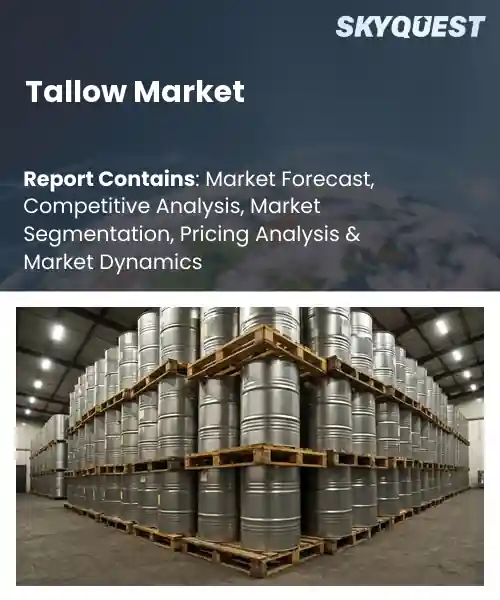
Tallow Market
Report ID: SQMIG20I2911
Report ID: SQMIG20I2911
[email protected]
USA +1 351-333-4748
Report ID:
SQMIG20I2911 |
Region:
Global |
Published Date: April, 2026
Pages:
157
|Tables:
87
|Figures:
76


Global Tallow Market size was valued at USD 2.84 Billion in 2024 and is poised to grow from USD 2.99 Billion in 2025 to USD 2.8 Billion by 2033, growing at a CAGR of 5.2% during the forecast period (2026-2033).
The primary driver of the tallow market is the link between global livestock output and industrial demand for rendered fats. Tallow, the rendered fat from cattle, serves as a feedstock for biodiesel, oleochemicals, animal feed, soap and personal care products so its availability influences multiple global value chains. Over time the market shifted from household uses like candles and soap toward industrial applications as rendering efficiency improved and international trade expanded significantly. For instance, biodiesel mandates during 2000s in Europe and North America converted surplus tallow into a strategic commodity, reshaping trade patterns and encouraging consolidation in the rendering sector.Building on those supply-demand dynamics, regulatory policies and sustainability mandates represent the key factor shaping the global tallow market because they translate environmental goals into steady industrial demand. When governments impose biodiesel blend mandates or limit palm oil in some uses, producers shift to tallow, increasing procurement, lifting prices and spurring investment in rendering and refining capacity. Consequently, trading firms secure long-term contracts, biodiesel plants purchase tallow methyl esters for blending and oleochemical manufacturers develop tallow-derived surfactants for cosmetics. This cascade opens opportunities for certified supply chains, traceability providers and regional processing hubs that lower transport emissions and improve margins.
How is AI optimizing supply chain forecasting in the tallow market?
AI optimizes tallow supply chain forecasting by combining demand sensing, time series models, and diverse data streams such as slaughter throughput, weather patterns, shipping status, and regulatory signals. Key aspects include predicting feedstock availability, estimating quality variation, and aligning allocations between biodiesel, oleochemical, and food customers. Today firms layer machine learning with digital twins and inventory optimization to smooth seasonal swings and policy driven shifts. In practice this means earlier rerouting of loads, smarter blending decisions at refineries, and tighter coordination with renderers and processors so supply matches demand with less waste and fewer stockouts.Darling Ingredients, March 2026, filed fiscal disclosures and highlighted operational priorities that support investment in digital traceability and forecasting tools which allow AI to better match tallow flows to renewable diesel and specialty markets, improving allocation and efficiency.
Market snapshot - (2026-2033)
Global Market Size
USD 2.84 Billion
Largest Segment
Food Grade (98%+ Purity)
Fastest Growth
Pharmaceutical/Research Grade
Growth Rate
5.2% CAGR
To get more insights on this market click here to Request a Free Sample Report
Global tallow market is segmented by product grade, application vertical (strategic drivers), distribution channel and region. Based on product grade, the market is segmented into Food Grade (98%+ Purity) and Pharmaceutical/Research Grade. Based on application vertical (strategic drivers), the market is segmented into Food & Beverage (Low-calorie Sweeteners/Confectionery) and Pharmaceuticals & Personal Care. Based on distribution channel, the market is segmented into B2B (Direct to Food/Drug Manufacturers) and Specialized Health & Retail Distributors. Based on region, the market is segmented into North America, Europe, Asia Pacific, Latin America and Middle East & Africa.
Food Grade (98%+ Purity) segment dominates because food manufacturers prefer high-purity tallow for its predictable functional properties, regulatory compliance, and compatibility with confectionery and fat-based formulations. Reliable purity reduces processing variability and supports consistent texture and shelf life, which drives adoption by large food producers and secures long-term procurement, reinforcing stable demand and supplier focus on meeting food-grade specifications and safety standards and market stability.
However, Pharmaceutical/Research Grade is the fastest growing area because stringent purity and traceability needs in drug formulation drive demand for highly refined tallow. Rising R&D into bio based excipients and specialty lipids, plus acceptance of premium pricing, spurs investment in purification technologies and creates new high-margin applications that broaden market opportunity.
Food & Beverage (Low-calorie Sweeteners/Confectionery) segment dominates because confectionery and sweetener formulators rely on tallow for its melting profile, flavor-carrying capability, and stability in hydrogenated or interesterified systems. Those functional benefits enable consistent mouthfeel and shelf life in cost-sensitive products, driving large-volume procurement by food manufacturers and embedding tallow into ingredient formulations and technical development pathways within the food value chain.
On the other hand, Pharmaceuticals & Personal Care is the fastest growing area as demand for bio based emollients and excipients rises in topical and therapeutic formulations. Advances in mild refining and clearer regulatory pathways enable novel formulations, prompting supplier investment in specialty fractions and unlocking higher value product opportunities in personal care and drug formulation.
To get detailed segments analysis, Request a Free Sample Report
Asia Pacific dominates the global tallow market due to a combination of abundant animal processing infrastructure, strategic port and logistics hubs, and vertically integrated downstream industries that capture value across the supply chain. Large rendering networks and established relationships between livestock producers and processors ensure steady feedstock availability, while proximity to major industrial consumers for oleochemicals, biodiesel, animal feed, and personal care ingredients supports demand. Policy frameworks in several countries incentivize renewable feedstock utilization and facilitate technology adoption for refining and esterification. Investment in modern processing facilities, strategic export orientation, and collaboration between producers and technology providers reinforce competitiveness. Regional consolidation and growing focus on traceability and sustainability enhance market credibility and attract investment into higher value applications. Close links with consumer markets in neighboring economies further strengthen domestic production incentives.
Tallow Market in Japan benefits from advanced rendering technology, close coordination with food processors, and strong demand from oleochemical and personal care manufacturers. Domestic producers emphasize product quality and traceability to meet stringent standards in high value applications. Integration with export logistics supports supply chain efficiency, while partnerships between processors and research institutions drive incremental processing improvements. Strategic focus on sustainability and certification enhances market access for premium tallow products.
Tallow Market in South Korea is supported by efficient rendering networks and close ties to consumer goods and cosmetics sectors. Processors prioritize technological upgrades and quality control to serve demanding downstream manufacturers. Collaboration between industry and institutes promotes processing innovation and product diversification. Strong logistics connectivity to regional buyers and emphasis on environmental compliance enhance competitiveness. Producers pursue certification and traceability measures to capture additional value in specialized tallow applications.
Rapid expansion of the tallow market in North America reflects a convergence of robust livestock processing infrastructure, strong downstream demand, and strategic investment in processing technologies. Integrated rendering networks linked to large meatpacking operations provide reliable feedstock streams, while growing interest from renewable fuel producers and chemical manufacturers drives demand for higher quality tallow fractions. Industry consolidation and strategic alliances enable scale efficiencies and supply chain optimization. Focus on sustainability, certification, and traceability increases market acceptance among environmentally conscious buyers, and investment in logistics and export channels opens access to regional and global markets. Research collaboration between industry and academia supports product development for specialized oleochemicals and high value applications. Market participants are increasingly adopting traceability systems and green processing methods to meet buyer expectations and reduce environmental footprint.
Tallow Market in United States is anchored by a large rendering network connected to extensive meat processing capacity. Producers focus on high quality tallow grades to supply renewable fuel makers, oleochemical manufacturers, and animal feed sector. Investment in modern refining and fractionation allows conversion into specialized feedstocks. Collaboration with logistics providers and certification bodies enhances readiness. Strategic consolidation and technology adoption support scale, efficiency, and access to higher value segments.
Tallow Market in Canada benefits from a distributed rendering sector serving meat processors and export channels. Producers emphasize traceability, sustainability, and quality to meet demanding downstream specifications for biofuels and specialty oleochemicals. Investment in logistics improves access to domestic and international buyers, while industry groups support standardization and certification efforts. Innovation in processing and partnerships with technology providers position the market to capture higher value opportunities across end use markets.
Europe is strengthening its tallow market position through a combination of stringent sustainability expectations, regulatory clarity around renewable feedstock use, and targeted investment in processing capabilities. Focus on traceability, certification, and environmental compliance elevates product acceptability for sensitive end uses such as cosmetics and specialty oleochemicals. Upgrading of rendering infrastructure and adoption of advanced fractionation techniques enable producers to deliver differentiated tallow grades tailored to high value applications. Cross border trade and established logistics corridors facilitate efficient redistribution across markets, while industry partnerships and research initiatives accelerate product innovation. Emphasis on circular economy principles and responsible sourcing underpins market credibility and attracts buyers seeking verified bio-based inputs. Regional centers of processing excellence support specialized tallow streams and facilitate collaboration with downstream manufacturers seeking secure, compliant feedstock sources. Enhanced certification schemes and industry codes promote harmonization across markets, reducing barriers to trade and enabling value capture in premium segments.
Tallow Market in Germany benefits from advanced industrial processing capacity and strong linkages to chemical supply chains. Producers emphasize strict environmental compliance, quality assurance, and traceability to meet demanding downstream specifications. Investment in modern fractionation and refining equipment enables production of specialized tallow intermediates for oleochemicals and industrial uses. Collaboration between processors, research institutions, and purchasers drives incremental innovation. Robust logistics networks support distribution across European markets and export channels.
Tallow Market in United Kingdom centers on strong sustainability and traceability standards. Rendering operators coordinate with food industry partners to secure consistent feedstock while meeting environmental and quality expectations from cosmetic and specialty chemical sectors. Investment in processing flexibility enables production of tailored tallow fractions for varied applications and uses. Engagement with certification schemes and trade networks supports market access and logistics infrastructure connects producers to regional and global buyers.
Tallow Market in France is driven by demand from cosmetics, specialty chemicals, and food applications that require high quality, traceable inputs. Rendering operators balance regional supply with investments in refining to deliver differentiated tallow grades tailored to industrial needs. Participation in certification initiatives and emphasis on sustainable sourcing bolster buyer confidence. Collaboration with institutes fosters process optimization and product innovation, while logistics support distribution to domestic and nearby European markets.
To know more about the market opportunities by region and country, click here to
Buy The Complete Report
Rising Demand From Food Industry
Growing Use In Biofuel Production
Environmental Sustainability Concerns
Competition From Plant Based Alternatives
Request Free Customization of this report to help us to meet your business objectives.
Competition in the global tallow market centers on retailers and ingredient specialists securing scarce supply and shelf space, driving retail rollouts, supply partnerships, and alternative fat innovation. For example, Masa expanded into Sprouts and Whole Foods and Tallow & Ash used crowdfunded capital to scale retail and product development; processors and bio based ingredient firms pursue conversion technologies and downstream supply agreements.
Top Player’s Company Profile
Recent Developments
SkyQuest’s ABIRAW (Advanced Business Intelligence, Research & Analysis Wing) is our Business Information Services team that Collects, Collates, Correlates, and Analyses the Data collected by means of Primary Exploratory Research backed by robust Secondary Desk research. As per SkyQuest analysis, regulatory policies and sustainability mandates are a key driver, translating environmental targets into consistent industrial demand for tallow, and growing use in biofuel production acts as a second driver by broadening end uses beyond food and personal care. Environmental sustainability concerns are a primary restraint, pressuring suppliers to enhance traceability and sourcing practices. Asia Pacific remains the dominating region thanks to extensive rendering infrastructure and integrated downstream industries, and Food Grade (98%+ Purity) is the dominating segment because food manufacturers favor its predictable functionality and compliance. Overall, market dynamics favor certified supply chains, specialty derivatives and digital traceability to capture higher value.
| Report Metric | Details |
|---|---|
| Market size value in 2024 | USD 2.84 Billion |
| Market size value in 2033 | USD 2.8 Billion |
| Growth Rate | 5.2% |
| Base year | 2024 |
| Forecast period | (2026-2033) |
| Forecast Unit (Value) | USD Billion |
| Segments covered |
|
| Regions covered | North America (US, Canada), Europe (Germany, France, United Kingdom, Italy, Spain, Rest of Europe), Asia Pacific (China, India, Japan, Rest of Asia-Pacific), Latin America (Brazil, Rest of Latin America), Middle East & Africa (South Africa, GCC Countries, Rest of MEA) |
| Companies covered |
|
| Customization scope | Free report customization with purchase. Customization includes:-
|
To get a free trial access to our platform which is a one stop solution for all your data requirements for quicker decision making. This platform allows you to compare markets, competitors who are prominent in the market, and mega trends that are influencing the dynamics in the market. Also, get access to detailed SkyQuest exclusive matrix.
Table Of Content
Executive Summary
Market overview
Parent Market Analysis
Market overview
Market size
KEY MARKET INSIGHTS
COVID IMPACT
MARKET DYNAMICS & OUTLOOK
Market Size by Region
KEY COMPANY PROFILES
Methodology
For the Tallow Market, our research methodology involved a mixture of primary and secondary data sources. Key steps involved in the research process are listed below:
1. Information Procurement: This stage involved the procurement of Market data or related information via primary and secondary sources. The various secondary sources used included various company websites, annual reports, trade databases, and paid databases such as Hoover's, Bloomberg Business, Factiva, and Avention. Our team did 45 primary interactions Globally which included several stakeholders such as manufacturers, customers, key opinion leaders, etc. Overall, information procurement was one of the most extensive stages in our research process.
2. Information Analysis: This step involved triangulation of data through bottom-up and top-down approaches to estimate and validate the total size and future estimate of the Tallow Market.
3. Report Formulation: The final step entailed the placement of data points in appropriate Market spaces in an attempt to deduce viable conclusions.
4. Validation & Publishing: Validation is the most important step in the process. Validation & re-validation via an intricately designed process helped us finalize data points to be used for final calculations. The final Market estimates and forecasts were then aligned and sent to our panel of industry experts for validation of data. Once the validation was done the report was sent to our Quality Assurance team to ensure adherence to style guides, consistency & design.
Analyst Support
Customization Options
With the given market data, our dedicated team of analysts can offer you the following customization options are available for the Tallow Market:
Product Analysis: Product matrix, which offers a detailed comparison of the product portfolio of companies.
Regional Analysis: Further analysis of the Tallow Market for additional countries.
Competitive Analysis: Detailed analysis and profiling of additional Market players & comparative analysis of competitive products.
Go to Market Strategy: Find the high-growth channels to invest your marketing efforts and increase your customer base.
Innovation Mapping: Identify racial solutions and innovation, connected to deep ecosystems of innovators, start-ups, academics, and strategic partners.
Category Intelligence: Customized intelligence that is relevant to their supply Markets will enable them to make smarter sourcing decisions and improve their category management.
Public Company Transcript Analysis: To improve the investment performance by generating new alpha and making better-informed decisions.
Social Media Listening: To analyze the conversations and trends happening not just around your brand, but around your industry as a whole, and use those insights to make better Marketing decisions.
REQUEST FOR SAMPLE
 REQUEST FREE CUSTOMIZATION


Want to customize this report? This report can be personalized according to your needs. Our analysts and industry experts will work directly with you to understand your requirements and provide you with customized data in a short amount of time. We offer $1000 worth of FREE customization at the time of purchase.
Feedback From Our Clients


 USA (+1) 351-333-4748

