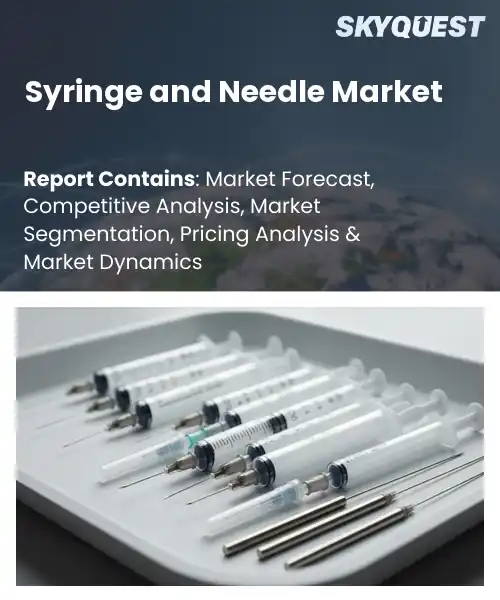
Syringe and Needle Market
Report ID: SQMIG35A3755
Report ID: SQMIG35A3755
[email protected]
USA +1 351-333-4748
Report ID:
SQMIG35A3755 |
Region:
Global |
Published Date: June, 2026
Pages:
157
|Tables:
144
|Figures:
78


Global Syringe And Needle Market size was valued at USD 28.49 Billion in 2024 and is poised to grow from USD 30.64 Billion in 2025 to USD 54.76 Billion by 2033, growing at a CAGR of 7.5% during the forecast period (2026-2033).
The syringe and needle market trends encompasses single-use and reusable devices used across healthcare, veterinary, and industrial applications, and it matters because these products are fundamental to drug delivery, immunization programs, and biosafety. Primary drivers include rising chronic disease prevalence, expanding vaccination campaigns, and stricter infection control regulations, which have elevated demand for safer disposable designs such as auto-disable and safety-engineered syringes. Historically the market shifted from glass reusable syringes toward plastic disposables during the late twentieth century as manufacturing scaled and costs fell, while outbreaks like HIV and hepatitis catalyzed regulatory reforms that accelerated adoption of safety features globally today.
Building on heightened safety awareness, technological innovation in syringe design constitutes a principal growth factor because manufacturers develop safety-engineered and smart syringes that reduce needlestick injuries and enable accurate dosing. Thus, hospitals and vaccination schemes reduce occupational exposure and improve patient outcomes, which encourage procurement contracts and government tenders in favor of certified products. The rise in home healthcare for chronic conditions also opens avenues for manufacturers to market connected devices that promote adherence, including simple auto-disable pens and prefilled syringes. These dynamics result in market consolidation and R&D investment. The scale economies created by this process further reduce the costs and increase the global access.
How is AI Improving Manufacturing Efficiency in the Syringe and Needle Market?
AI is making the inspection, maintenance and process control smarter and more consistent, which improves manufacturing efficiency in the syringe and needle market growth. Human inspectors can miss micro defects, but machine vision can find them. Predictive maintenance detects equipment wear before it causes line stops. Process optimization adjusts molding and assembly parameters to minimize scrap and stabilize output. Demand shifting towards prefilled syringes and safety devices makes supply chain analytics for better material planning and traceability important. The current state blends established sterile production with new digital layers and robotics so manufacturers can scale reliably while meeting strict quality and regulatory expectations.
BD May 2026, the company reported deploying AI vision systems on production lines to cut defects and raise throughput, demonstrating how automated inspection and data driven decision making supports reliable supply and lower rework which helps market growth.
Market snapshot - (2026-2033)
Global Market Size
USD 28.49 Billion
Largest Segment
Syringes
Fastest Growth
Syringes
Growth Rate
7.53% CAGR
To get more insights on this market click here to Request a Free Sample Report
Global syringe and needle market is segmented by product category, material type, application area, end-user, distribution channel and region. Based on product category, the market is segmented into syringes and needles. Based on material type, the market is segmented into plastic material, glass material and stainless steel material. Based on application area, the market is segmented into insulin administration, blood collection, vaccination programs, general surgery and others. Based on end-user, the market is segmented into hospitals & clinics, ambulatory surgical centers and homecare settings. Based on distribution channel, the market is segmented into direct and indirect. Based on region, the market is segmented into North America, Europe, Asia Pacific, Latin America and Middle East & Africa.
Plastic material segment dominates because low-cost molding and lightweight disposability enable mass manufacture and broad clinical adoption across syringe and needle product lines. Reduced risk of contamination, simplification of supply chain, increased placement of plastic products in adherence of single-use safety regulations will motivate institutional purchasers to select plastic products. The collaborative manufacturing and safety of these products will facilitate enhanced investment in developing plastic-based designs and sustain their high-volume and high-availability production.
On the other hand, there continues to be rapid growth in the glass Material sector as the prefilled syringe for biologic volume grows faster than any other area in the industry; this is fed by the increased need for sterile and chemically inert/ non-reactive barrels in which to deliver biologics. Advances in the manufacturing of siliconized and/or coated glass, regulatory support of the more complicated therapies, and the increasing acceptance of prefilled syringes by pharmaceutical developers and manufacturers will stimulate innovations and create premiere market opportunities across the various advanced delivery formats.
The hospitals & clinics segment holds a major share owing to centralized procurement and high volumes of procedures leading to high demand for various types of syringe and needles. This results in manufacturers emphasizing on reliability and safety features for clinical applications. Institutional buying criteria are focused on compatibility with hospital workflows, staff training, and regulatory compliance, which drives product specifications to standardized and safety-engineered designs. This institutional influence accelerates the adoption of proven technologies and favors suppliers who meet demanding clinical performance criteria.
However, the fastest growing area is emerging as homecare settings as the rise in chronic disease management and self-injection therapies drive demand for user friendly, prefilled and safety enhanced devices. Innovations including simplified designs, patient education programs and digital adherence tools are paving the way for homecare applications, new commercial avenues and manufacturers to adapt products for nonclinical use.
To get detailed segments analysis, Request a Free Sample Report
A number of factors have contributed to North America's dominance in the global syringe and needle market share, including a highly developed and well-functioning healthcare system, strong domestic manufacturing capabilities, and robust regulatory frameworks that emphasize safety and quality. Ongoing innovation in both US-based and non-US-based medical device companies continues to push forward with the development of innovative, safety engineered syringes and use of new materials. Well-established and developed distribution and procurement networks are in place for rapid market entry and growth. High levels of emphasis on infection control within both clinical and the community support the continued adoption of single-use and safety devices. Collaboration between industry, clinical research organizations, and regulatory authorities facilitates product validation and access to market. Post-market surveillance and extensive training programs for healthcare providers provide clinicians with a sense of confidence and security, ultimately adding resilience to the market itself. Also, the development of reimbursement policies that support new technology commercialisation provides an industry that is competitive with a base of domestic manufacturing and is attractive to global collaborators/consolidators.
Syringe and needle market forecast in United States is a mature one with a large manufacturing presence, a high level of safety devices, and integrated supply chains. Quality and innovation are favored by high clinician awareness and institutional purchasing practices. Strong regulatory oversight and active postmarket surveillance provide confidence in device performance. Collaborations with research institutions speed up product development and clinical validation. Large and established distribution networks guarantee availability in hospital and community care settings.
Syringe and needle market outlook in Canada demonstrates a well organized healthcare environment with emphasis on safety and quality. Procurement policies and centralized purchasing support uptake of safety engineered devices. Local distributors and manufacturers collaborate to maintain consistent supply across urban and remote care settings. Focus on training and compliance with regulatory standards reinforces clinician confidence. Strengthening ties between hospitals, care providers, and suppliers promotes adoption of innovative syringe and needle solutions.
The Asia Pacific is witnessing rapid growth fueled by the convergence of factors that are driving the demand for syringe and needle products in the clinical and community settings. The rising incidence of chronic conditions is driving demand for routine injectable therapies, while increasing immunization campaigns and greater emphasis on preventive care are driving demand for reliable injection devices. Regional manufacturers are ramping up production and moving toward international quality standards, supported by foreign direct investment and strategic alliances with global device companies. Modernization of regulations and harmonized standards facilitate the market entry and acceptance of products. Increased access to healthcare services through urbanization and the expansion of primary care networks and the transition to outpatient and home care settings fuel demand for user friendly, safety engineered syringes. This dynamic environment merges capacity building, policy support and evolving care models to accelerate market development.
Syringe and needle market regional outlook in Japan is a highly advanced, multi-faceted ecosystem, focused on safe products, safe production methods and safe use by clinicians. Japanese manufacturers and foreign manufacturers work together to develop high quality syringes and safety engineered needles. The regulatory framework is also stringent, and quality control measures ensure that syringes are reliable. Advanced design features are preferred by clinicians; hospitals implement these advanced design features into their purchasing decisions. Devices are continuously being developed as a result of investments in device innovation, along with proper training of the healthcare professional is key to maintaining a safe culture and high level of user satisfaction.
Syringe and needle market regional forecast in South Korea combines advanced manufacturing capabilities with adoption of safety technologies and innovation. Domestic firms work with overseas partners to improve product design and boost production capacity. Regulatory alignment with international standards and quality control practices helps to promote market credibility. Distribution networks ensure the supply; hospital systems and private providers focus on procuring safety engineered devices. Research collaboration and production efficiency are presented as the bedrock of competitive positioning in the region.
The coordinated effort that Europe is making to strengthen/coordinate its regulatory compliance through both high quality productions and collaborative innovation (both between industry and clinical stakeholders) is emphasized through their stated goals: Regulatory compliance, high quality production, and collaborative innovation (between both clinical and industrial stakeholders). In particular established medical device producers and specialized producers are continuing to improve their processes to create safety engineered syringes with environmentally sensitive packaging to accommodate the evolving dynamics of procurement/availability. Furthermore, compliance with higher quality standards via regulatory structures and oversight by the notified body will facilitate acceptance of quality production across borders, which will enhance trade opportunities. Through utilization of both public and private procurement processes, identification of safety performance documentation will benefit the reimbursability of products through their lifecycle. Simultaneously, investments made in R&D collaborations with academic institutions will support continued improvements in materials and designs for devices. As clinicians receive educational and training opportunities related to product safety, they will be more likely to utilize certified products in their practice. By creating the aforementioned elements within a product ecosystem and emphasizing patient safety, reliability of products, and sustainable business development, Europe will create an overall quality product and market.
Syringe and needle market penetration in Germany is underpinned by a robust medical technology sector that is recognized for its manufacturing and quality systems. Domestic suppliers with international partnerships manufacture high quality syringes and safety needles for domestic and export markets. Hospitals focus on the documented track record of safety and lifecycle considerations, so certified devices are preferred. Clinical research centers facilitate product testing and refinement. Existing logistics networks enable a dependable supply chain across care settings.
Syringe and needle market analysis in United Kingdom is influenced by centralized purchasing practices in addition to a focus on safety (and patient safety) in the public healthcare sector. This includes an emphasis on choosing suppliers that provide evidence of proven safety records before selecting suppliers for the devices they will use. Syringes and safety needles are supplied by local (UK) manufacturers and by certified suppliers from abroad. National guidelines based on national standards from clinical networks / supply chains and professional associations drive the adoption of these devices. Investment in training and the use of standardized protocols help to ensure that syringes and needles can be administered safely and consistently used by all providers who provide care through care pathways.
Syringe and needle industry France is also positively impacted by the integration of the healthcare system with the use of best practices to control the risk of infection. The purchasing process for syringes and safety needles emphasizes the need for minimum certification before a supplier is approved to supply the products. Products are developed and clinically evaluated through collaboration between suppliers and manufacturers in multiple locations throughout France with support from research regions focused on developing new materials and improving the ergonomics of the design of the product. A shared emphasis on training and quality assurance and efficient distribution of approved syringe and needle products provides broad access to approved products by all care sites.
To know more about the market opportunities by region and country, click here to
Buy The Complete Report
Rising Prevalence Of Chronic Diseases
Expansion Of Vaccination Programs
Stringent Regulatory Requirements
Concerns Over Medical Waste Disposal
Request Free Customization of this report to help us to meet your business objectives.
Syringes and needles incumbents differentiate and consolidate through technology to shape the competitive landscape, pursuing acquisitions, targeted partnerships and device digitization to secure share. For example, the major players have responded to the regulatory traceability and safety mandates by acquisitions and integration of smart injection tracking and microneedle development, leading to faster product launches and selective capacity investments.
Top Player’s Company Profile
Recent Developments in the Syringe and Needle Market
SkyQuest’s ABIRAW (Advanced Business Intelligence, Research & Analysis Wing) is our Business Information Services team that Collects, Collates, Correlates, and Analyses the Data collected by means of Primary Exploratory Research backed by robust Secondary Desk research. As per SkyQuest analysis, the global syringe and needle market is driven primarily by the rising prevalence of chronic diseases which increases long term demand for injectable therapies, and further supported by expanding vaccination programs that create steady volume requirements. Growth is propelled by innovation in safety engineered and plastic disposable designs, with plastic material dominating due to low cost, scalability and alignment with single use protocols. Stringent regulatory requirements present a key restraint, adding compliance costs and longer approval timelines. North America remains the dominant region thanks to advanced manufacturing, strong regulatory frameworks and established procurement channels that accelerate adoption of certified, safety focused devices.
| Report Metric | Details |
|---|---|
| Market size value in 2024 | USD 28.49 Billion |
| Market size value in 2033 | USD 54.76 Billion |
| Growth Rate | 7.53% |
| Base year | 2024 |
| Forecast period | (2026-2033) |
| Forecast Unit (Value) | USD Billion |
| Segments covered |
|
| Regions covered | North America (US, Canada), Europe (Germany, France, United Kingdom, Italy, Spain, Rest of Europe), Asia Pacific (China, India, Japan, Rest of Asia-Pacific), Latin America (Brazil, Rest of Latin America), Middle East & Africa (South Africa, GCC Countries, Rest of MEA) |
| Companies covered |
|
| Customization scope | Free report customization with purchase. Customization includes:-
|
To get a free trial access to our platform which is a one stop solution for all your data requirements for quicker decision making. This platform allows you to compare markets, competitors who are prominent in the market, and mega trends that are influencing the dynamics in the market. Also, get access to detailed SkyQuest exclusive matrix.
Table Of Content
Executive Summary
Market overview
Parent Market Analysis
Market overview
Market size
KEY MARKET INSIGHTS
COVID IMPACT
MARKET DYNAMICS & OUTLOOK
Market Size by Region
KEY COMPANY PROFILES
Methodology
For the Syringe and Needle Market, our research methodology involved a mixture of primary and secondary data sources. Key steps involved in the research process are listed below:
1. Information Procurement: This stage involved the procurement of Market data or related information via primary and secondary sources. The various secondary sources used included various company websites, annual reports, trade databases, and paid databases such as Hoover's, Bloomberg Business, Factiva, and Avention. Our team did 45 primary interactions Globally which included several stakeholders such as manufacturers, customers, key opinion leaders, etc. Overall, information procurement was one of the most extensive stages in our research process.
2. Information Analysis: This step involved triangulation of data through bottom-up and top-down approaches to estimate and validate the total size and future estimate of the Syringe and Needle Market.
3. Report Formulation: The final step entailed the placement of data points in appropriate Market spaces in an attempt to deduce viable conclusions.
4. Validation & Publishing: Validation is the most important step in the process. Validation & re-validation via an intricately designed process helped us finalize data points to be used for final calculations. The final Market estimates and forecasts were then aligned and sent to our panel of industry experts for validation of data. Once the validation was done the report was sent to our Quality Assurance team to ensure adherence to style guides, consistency & design.
Analyst Support
Customization Options
With the given market data, our dedicated team of analysts can offer you the following customization options are available for the Syringe and Needle Market:
Product Analysis: Product matrix, which offers a detailed comparison of the product portfolio of companies.
Regional Analysis: Further analysis of the Syringe and Needle Market for additional countries.
Competitive Analysis: Detailed analysis and profiling of additional Market players & comparative analysis of competitive products.
Go to Market Strategy: Find the high-growth channels to invest your marketing efforts and increase your customer base.
Innovation Mapping: Identify racial solutions and innovation, connected to deep ecosystems of innovators, start-ups, academics, and strategic partners.
Category Intelligence: Customized intelligence that is relevant to their supply Markets will enable them to make smarter sourcing decisions and improve their category management.
Public Company Transcript Analysis: To improve the investment performance by generating new alpha and making better-informed decisions.
Social Media Listening: To analyze the conversations and trends happening not just around your brand, but around your industry as a whole, and use those insights to make better Marketing decisions.
REQUEST FOR SAMPLE
 REQUEST FREE CUSTOMIZATION
Global Syringe And Needle Market size was valued at USD 28.49 Billion in 2024 and is poised to grow from USD 30.64 Billion in 2025 to USD 54.76 Billion by 2033, growing at a CAGR of 7.53% during the forecast period (2026-2033).
Consolidation and technology differentiation shape the competitive landscape for syringes and needles, with incumbents pursuing acquisitions, targeted partnerships and device digitization to secure share. For example, major players have pursued acquisitions and integrated smart injection tracking and microneedle development to respond to regulatory traceability and safety mandates, prompting faster product launches and selective capacity investments. 'Becton Dickinson', 'Cardinal Health', 'Terumo Corporation', 'B. Braun SE', 'Nipro Corporation', 'Smiths Group', 'Gerresheimer AG', 'Schott AG', 'Baxter International', 'Fresenius SE', 'Ypsomed Holding', 'Novo Nordisk', 'Owen Mumford', 'Retractable Technologies', 'Revolutions Medical', 'Amsino International', 'Medline Industries', 'Owens & Minor', 'Allison Medical', 'Exelint International'
Chronic diseases requiring injectable therapies create sustained demand for syringes and needles, because patients often need frequent and ongoing administration of medications. The need for reliable delivery devices supports expansion of manufacturing and distribution, while preference for single use products reduces infection risk and encourages procurement by hospitals and home care providers. As long term treatment regimens grow, health systems prioritize device safety and compatibility with therapeutic formulations, which in turn drives investment in production capacity and product availability across care settings.
Homecare And Self Administration: The shift toward outpatient care and patient managed therapy is driving demand for syringes and needles designed for ease of use, safety, and portability. Manufacturers are prioritizing ergonomic designs, prefilled formats, simplified administration steps, and packaging that supports layperson use. This trend encourages partnerships with pharmaceutical companies, development of instructional materials, and device adaptations for chronic conditions. Market innovation focuses on improving patient adherence and convenience while reducing the burden on institutional settings and enabling broader access to injectable therapies.
Why does North America Dominate the Global Syringe and Needle Market? |@12


Want to customize this report? This report can be personalized according to your needs. Our analysts and industry experts will work directly with you to understand your requirements and provide you with customized data in a short amount of time. We offer $1000 worth of FREE customization at the time of purchase.
Feedback From Our Clients


 USA (+1) 351-333-4748

