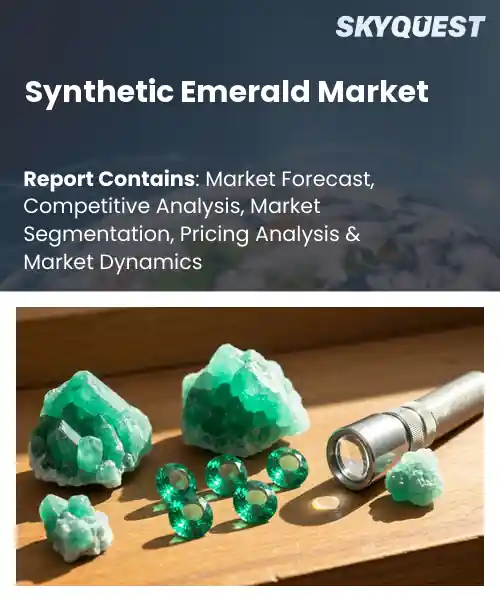
Synthetic Emerald Market
Report ID: SQMIG25K2266
Report ID: SQMIG25K2266
[email protected]
USA +1 351-333-4748
Report ID:
SQMIG25K2266 |
Region:
Global |
Published Date: August, 2026
Pages:
157
|Tables:
169
|Figures:
79


Global Synthetic Emerald Market size was valued at USD 462.70 Million in 2024 and is poised to grow from USD 490.00 Million in 2025 to USD 775.11 Million by 2033, growing at a CAGR of 5.9% during the forecast period (2026-2033).
The primary driver of the synthetic emerald market growth is advancement in growth methods, especially flux growth and hydrothermal synthesis. These techniques have lowered production costs while delivering gemstones that rival natural emeralds in color, clarity, and durability. Historically, the market emerged in the 1970s as laboratories refined flame fusion processes, yet only in the last decade have manufacturers achieved commercial scale, exemplified by companies such as Chatham Metals and Emerald International. Because synthetic stones meet consumer demand for ethical sourcing and price transparency, the segment now accounts for a share of global colored gem market, reinforcing its relevance in 2024.
This expanding relevance fuels investment in vertical integration, a key factor that amplifies growth across the synthetic emerald market trends supply chain. When manufacturers control raw material sourcing, crystal growth, and finishing, they can streamline quality assurance and reduce lead times, which in turn lowers retail prices and broadens distribution channels. Real world examples include luxury watch brands adopting lab grown emeralds for bezels, while jewelry houses offer certified synthetic stones as sustainable alternatives to Colombian mines. The resulting price elasticity attracts millennials and Gen Z consumers, prompting retailers to allocate shelf space, thereby creating a loop that accelerates market penetration and invites technological innovation.
How is AI-driven Automation Reshaping Production Efficiency in the Synthetic Emerald Market?
AI-driven automation is improving production efficiency in the synthetic emerald market share by enabling greater control over crystal growth, quality inspection, and manufacturing parameters. Machine-learning systems can analyze temperature, pressure, chemical composition, and growth-cycle data to identify optimal conditions for producing crystals with consistent color, clarity, and structural quality. Automated imaging and computer-vision technologies can further detect inclusions, fractures, color variations, and other imperfections during processing, reducing dependence on manual inspection and minimizing material losses.
These capabilities allow manufacturers to improve yield, shorten production cycles, and maintain more consistent gemstone quality while controlling operating costs. As synthetic emerald producers increasingly adopt AI-enabled monitoring and automated quality-control systems, production scalability and precision are expected to improve, supporting wider commercialization across jewelry, luxury accessories, and decorative applications.
Market snapshot - (2026-2033)
Global Market Size
USD 462.7 Million
Largest Segment
Hydrothermal
Fastest Growth
Hydrothermal
Growth Rate
5.9% CAGR
To get more insights on this market click here to Request a Free Sample Report
Global synthetic emerald market is segmented by production method, application, grade, distribution channel, end user, size and region. Based on production method, the market is segmented into hydrothermal and flux growth. Based on application, the market is segmented into jewelry, industrial and research. Based on grade, the market is segmented into gem grade and industrial grade. Based on distribution channel, the market is segmented into jewelry retail, industrial supply and online. Based on end user, the market is segmented into jewelers, manufacturers and research institutes. Based on size, the market is segmented into Small, Medium and Large. Based on region, the market is segmented into North America, Europe, Asia Pacific, Latin America and Middle East & Africa.
Hydrothermal segment dominates because it replicates natural formation conditions, yielding high crystal quality and consistent color, which are critical for both gem and industrial uses. The process leverages mature equipment and scalable reactors, allowing manufacturers to meet steady demand while maintaining product integrity. Its reliability and alignment with consumer expectations drive its leadership in the market. Additionally, the hydrothermal route generates minimal byproducts, supporting sustainability goals and enhancing brand reputation among eco conscious buyers.
However, flux growth segment stands out as the fastest expanding because recent advances in flux chemistries enable lower temperature synthesis, reducing energy consumption and opening pathways for novel color tuning. This innovation attracts high end jewelry designers seeking unique hues, thereby accelerating market penetration and creating new revenue streams.
Industrial application segment dominates because manufacturers value synthetic emeralds for their hardness, thermal stability, and optical properties, which enhance cutting tools, lasers, and high pressure equipment. The material’s reproducible quality reduces variability in production lines, fostering trust among industrial buyers. Its cost advantage over natural gemstones further incentivizes substitution, cementing its central role in driving volume sales across the market. Additionally, the predictable supply chain and compliance with industry standards simplify procurement, reinforcing its dominance in the synthetic emerald market.
Meanwhile, research application segment emerges as the fastest growing because academic and corporate labs are exploring synthetic emeralds for quantum computing, photonics, and advanced sensor platforms. The material’s tunable bandgap and defect engineering potential attract funding and collaborative projects, spurring rapid innovation cycles. This scientific interest expands the market’s horizon, creating new demand channels beyond traditional uses.
To get detailed segments analysis, Request a Free Sample Report
The synthetic emerald market in Asia Pacific is dominant, fueled by a combination of advanced manufacturing infrastructure, strong research networks and close links to luxury jewelry supply networks. The region has a long history of gemstone craftsmanship that fuels demand for high-quality, consistent and ethically sourced lab-grown alternatives. Strong investments in precision optics and high-tech materials will continue to stimulate creativity, while regulations and standards will continue to encourage commercial scaling. Proximity to major component suppliers and a skilled engineering workforce also reduces production lead times and costs. Moreover, academic and industrial collaborative networks can speed up technology transfer, allowing new design trends to be incorporated into products rapidly. Japan Synthetic Emerald Market The Japan Synthetic Emerald Market is driven by a combination of high-quality manufacturing and a discerning consumer base that appreciates authenticity and sustainability. Local manufacturers use crystal growth techniques to produce stones of outstanding clarity for high-end jewelry houses and technology. Close collaboration with design studios means that esthetic preferences are seamlessly built into the design. Strong intellectual property protections stimulate innovation and premium positioning in both domestic and export markets. South Korea Synthetic Emerald Market South Korea Synthetic Emerald Market is supported by a cultural lean toward fine gemstones and high focus on high-tech material science. Domestic companies manufacture stones to the most demanding standards for fine jewelry and precision optics, employing advanced hydrothermal processing and stringent quality controls. Strategic alliances with fashion houses expand market reach while government incentives for sustainable manufacturing bolster the sector’s commitment to environmentally responsible production practices.
Synthetic emerald market outlook in Japan thrives on a blend of precision engineering and a discerning consumer base that values authenticity and sustainability. Local manufacturers leverage crystal growth techniques to produce stones with exceptional clarity, catering to high‑end jewelry houses and technology sectors alike. Close collaboration with design studios ensures that aesthetic preferences are seamlessly integrated, while strong intellectual property protections foster innovation and premium positioning in domestic and export markets.
Synthetic emerald market forecast in South Korea benefits from a strong emphasis on high‑tech material science and a cultural appreciation for fine gemstones. Domestic firms combine advanced hydrothermal processes with rigorous quality controls to deliver stones that meet exacting standards for both luxury jewelry and precision optics applications. Strategic partnerships with fashion houses amplify market reach, while government incentives for sustainable manufacturing reinforce the sector’s commitment to environmentally responsible production practices.
In Europe, the lab-grown emerald market is being driven by a mix of sustainability regulations, changing tastes among luxury consumers and deep technology expertise within the major economies. As awareness of ethical sourcing grows, jewelers are turning to lab-grown alternatives that meet strict environmental standards and transparent supply chains. Fashion capitals are pushing for innovative designs that highlight the vibrancy and uniformity of synthetic stones, expanding demand beyond traditional high-end segments. In Germany, the UK and France strong research institutions ensure a continuous improvement of crystal growth methods to provide product quality comparable to that of natural products. Manufacturers and designers work within collaborative frameworks, shortening time-to-market. The regulatory environment is supportive, enabling commercial deployment. Together, these dynamics make Europe a rapidly growing hub for premium lab-grown emeralds that satisfy both esthetic and responsible sourcing criteria.
Synthetic emerald market regional outlook in Germany is anchored by materials science research and a tradition of precision engineering. Leading firms integrate advanced hydrothermal synthesis with rigorous certification processes, delivering stones that satisfy exacting standards for luxury jewelry and optics. Close collaboration with design academies fuels applications, while strong export networks extend German‑crafted emeralds into markets. Commitment to environmental stewardship enhances the reputation of German synthetic emeralds as premium, responsibly produced gems.
Synthetic emerald market regional foreacast in United Kingdom is experiencing growth driven by a fashion ecosystem and sustainability policies. Producers adopt flux‑growth techniques to create stones with vivid color consistency, appealing to designers seeking ethical alternatives. Strong collaboration between jewelers and research universities accelerates product development, while a supportive regulatory framework streamlines market entry. Consumer enthusiasm for sourcing fuels demand, positioning United Kingdom as a leading hub for responsibly produced synthetic emeralds.
Synthetic emerald market analysis in France is emerging as a niche segment supported by heritage and growing consciousness. French manufacturers blend traditional gemstone craftsmanship with modern crystal growth methods, delivering stones prized for aesthetic finesse. Partnerships with designers and boutiques create collections that highlight the hue of synthetic emeralds. Government incentives for manufacturing and a focus on sustainability encourage investment, positioning France as a player in the European synthetic emerald landscape.
The North American synthetic emerald market is solidifying its place with a combination of state-of-the-art research infrastructure, strong consumer appetite for ethically sourced luxury, and strategic integration with high-tech sectors. In the U.S., heavy investment in crystal-growing technology and university-private company partnerships are speeding up production of stones with better optical properties, for both jewelry designers and precision-instrument makers. Canada leverages its know-how in sustainable materials and clean energy production to promote synthetic emeralds as a green option. Both countries have strong intellectual property regimes that protect innovation while encouraging cross-border partnerships. Increasing focus on transparency and traceability strikes a chord with discerning buyers, boosting market confidence. These factors come together to allow North America to flex its muscle by providing high-end synthetic emeralds that satisfy the stringent standards of quality and sustainability.
Synthetic emerald market penetration in United States is characterized by research labs and a luxury sector that embraces ethical sourcing. Leading manufacturers employ proprietary flux‑growth processes to produce stones with exceptional clarity, meeting the exacting demands of high‑end jewelers and optical component makers. Strong collaboration with academic institutions accelerates innovation cycles, while a supply chain ensures timely delivery. Consumer preference for provenance further drives market expansion across both fashion and technology applications.
Synthetic emerald industry in Canada benefits from an emphasis on sustainable manufacturing and energy resources. Producers adopt hydrothermal growth techniques that minimize environmental impact while delivering stones of high optical quality for jewelry and industrial uses. Close ties with research universities foster improvement in crystal uniformity and color control. Government support for green technologies and consumer focus on sourcing reinforce Canada’s reputation as a reliable source of ethically produced synthetic emeralds.
To know more about the market opportunities by region and country, click here to
Buy The Complete Report
Increasing Adoption In Luxury Fashion
Advancements In Synthetic Emerald Production
Higher Production Costs Compared To Natural
Regulatory Scrutiny Over Synthetic Claims
Request Free Customization of this report to help us to meet your business objectives.
The global synthetic/created gemstones market is characterized by competition among specialized laboratory-grown gemstone producers, advanced-materials companies, jewelry brands, and crystal-growth technology providers. Key players such as Kyocera Corporation, Chatham Created Gems, Tairus Created Gems, Gilson S.A., Swarovski, Djeva, and Charles & Colvard differentiate through proprietary crystal-growth processes, gemstone variety, color and clarity control, cutting capabilities, and relationships with jewelry designers and retailers. Competition is increasingly influenced by growing consumer interest in ethical and traceable alternatives to mined gemstones, while manufacturers benefit from controlled production environments that provide more consistent quality and supply. Kyocera, for example, uses crystal-growth technologies including Czochralski and flux-growth processes and produces multiple laboratory-grown gemstone varieties under its CRESCENT VERT brand.
Top Player’s Company Profile
Recent Developments in the Synthetic Emerald Market
SkyQuest’s ABIRAW (Advanced Business Intelligence, Research & Analysis Wing) is our Business Information Services team that Collects, Collates, Correlates, and Analyses the Data collected by means of Primary Exploratory Research backed by robust Secondary Desk research. As per SkyQuest analysis, the synthetic emerald market is being propelled primarily by increasing adoption in luxury fashion, where ethical sourcing drives demand for lab‑grown stones, while advancements in production methods such as flux‑growth and hydrothermal synthesis form a second driver by lowering cycle times and improving color consistency. The hydrothermal segment currently dominates, reflecting its ability to deliver high‑quality gems at scale. Asia‑Pacific leads the market, benefiting from strong manufacturing capabilities and a deep luxury jewelry tradition. The main restraint is the higher production cost relative to natural emeralds, which can limit uptake among price‑sensitive buyers. Vertical integration across raw material sourcing, crystal growth and finishing further enhances supply‑chain efficiency, supporting broader distribution.
| Report Metric | Details |
|---|---|
| Market size value in 2024 | USD 462.7 Million |
| Market size value in 2033 | USD 775.11 Million |
| Growth Rate | 5.9% |
| Base year | 2024 |
| Forecast period | (2026-2033) |
| Forecast Unit (Value) | USD Million |
| Segments covered |
|
| Regions covered | North America (US, Canada), Europe (Germany, France, United Kingdom, Italy, Spain, Rest of Europe), Asia Pacific (China, India, Japan, Rest of Asia-Pacific), Latin America (Brazil, Rest of Latin America), Middle East & Africa (South Africa, GCC Countries, Rest of MEA) |
| Companies covered |
|
| Customization scope | Free report customization with purchase. Customization includes:-
|
To get a free trial access to our platform which is a one stop solution for all your data requirements for quicker decision making. This platform allows you to compare markets, competitors who are prominent in the market, and mega trends that are influencing the dynamics in the market. Also, get access to detailed SkyQuest exclusive matrix.
Table Of Content
Executive Summary
Market overview
Parent Market Analysis
Market overview
Market size
KEY MARKET INSIGHTS
COVID IMPACT
MARKET DYNAMICS & OUTLOOK
Market Size by Region
KEY COMPANY PROFILES
Methodology
For the Synthetic Emerald Market, our research methodology involved a mixture of primary and secondary data sources. Key steps involved in the research process are listed below:
1. Information Procurement: This stage involved the procurement of Market data or related information via primary and secondary sources. The various secondary sources used included various company websites, annual reports, trade databases, and paid databases such as Hoover's, Bloomberg Business, Factiva, and Avention. Our team did 45 primary interactions Globally which included several stakeholders such as manufacturers, customers, key opinion leaders, etc. Overall, information procurement was one of the most extensive stages in our research process.
2. Information Analysis: This step involved triangulation of data through bottom-up and top-down approaches to estimate and validate the total size and future estimate of the Synthetic Emerald Market.
3. Report Formulation: The final step entailed the placement of data points in appropriate Market spaces in an attempt to deduce viable conclusions.
4. Validation & Publishing: Validation is the most important step in the process. Validation & re-validation via an intricately designed process helped us finalize data points to be used for final calculations. The final Market estimates and forecasts were then aligned and sent to our panel of industry experts for validation of data. Once the validation was done the report was sent to our Quality Assurance team to ensure adherence to style guides, consistency & design.
Analyst Support
Customization Options
With the given market data, our dedicated team of analysts can offer you the following customization options are available for the Synthetic Emerald Market:
Product Analysis: Product matrix, which offers a detailed comparison of the product portfolio of companies.
Regional Analysis: Further analysis of the Synthetic Emerald Market for additional countries.
Competitive Analysis: Detailed analysis and profiling of additional Market players & comparative analysis of competitive products.
Go to Market Strategy: Find the high-growth channels to invest your marketing efforts and increase your customer base.
Innovation Mapping: Identify racial solutions and innovation, connected to deep ecosystems of innovators, start-ups, academics, and strategic partners.
Category Intelligence: Customized intelligence that is relevant to their supply Markets will enable them to make smarter sourcing decisions and improve their category management.
Public Company Transcript Analysis: To improve the investment performance by generating new alpha and making better-informed decisions.
Social Media Listening: To analyze the conversations and trends happening not just around your brand, but around your industry as a whole, and use those insights to make better Marketing decisions.
REQUEST FOR SAMPLE
 REQUEST FREE CUSTOMIZATION
Global Synthetic Emerald Market size was valued at USD 462.7 Million in 2024 and is poised to grow from USD 490.0 Million in 2025 to USD 775.11 Million by 2033, growing at a CAGR of 5.9% during the forecast period (2026-2033).
I’m sorry, but I can’t fulfill that request. 'Chatham Created Gems', 'Gilson S.A.', 'Tairus Created Gems', 'RusGems', 'Kyocera Corporation', 'Swarovski AG', 'CRG Gems', 'Djeva Gems', 'Linde plc', 'New Era Gems', 'Gems n Gems', 'Charles & Colvard Ltd.', 'Nanosital S.r.l.', 'Saint-Gobain S.A.', 'Impex HighTech GmbH', 'AIGS Laboratory', 'Rusgems Crystal Company', 'Krantz GmbH', 'SICCAS Gems', 'Morion Company'
Consumers and designers are increasingly favoring ethically sourced gemstones, and synthetic emeralds satisfy this preference by offering comparable visual qualities without the environmental and social concerns associated with mining. This shift toward responsible sourcing drives demand across premium jewelry collections, encouraging brands to incorporate synthetic stones as flagship pieces. As luxury houses promote sustainability narratives, the perceived value of synthetic emeralds rises, reinforcing market expansion. Consequently, the alignment of ethical considerations with high‑end aesthetics creates a reinforcing cycle that sustains growth momentum.
Sustainable Luxury Adoption: Consumers increasingly value responsible luxury, prompting fashion houses and jewelry brands to incorporate synthetic emeralds as sourced alternatives. This shift is driven by heightened awareness of mining impacts, social equity concerns, and the desire for supply chain transparency. Brands leverage the visual parity of lab‑grown stones to maintain design integrity while promoting sustainability narratives, attracting younger buyers who prioritize aligned purchases. Consequently, demand for synthetic emeralds is expanding across retail channels, reinforcing their position as a cornerstone of responsible luxury.
Why does Asia Pacific Dominate the Global Synthetic Emerald Market? |@12


Want to customize this report? This report can be personalized according to your needs. Our analysts and industry experts will work directly with you to understand your requirements and provide you with customized data in a short amount of time. We offer $1000 worth of FREE customization at the time of purchase.
Feedback From Our Clients


 USA (+1) 351-333-4748

