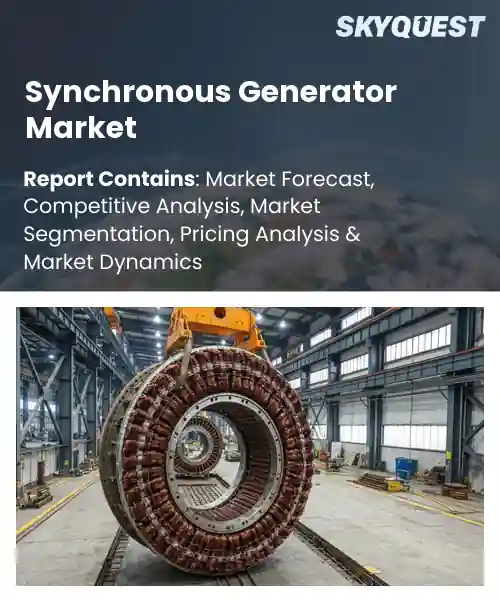
Synchronous Generator Market
Report ID: SQMIG20D2669
Report ID: SQMIG20D2669
[email protected]
USA +1 351-333-4748
Report ID:
SQMIG20D2669 |
Region:
Global |
Published Date: June, 2026
Pages:
157
|Tables:
152
|Figures:
78


Global Synchronous Generator Market size was valued at USD 2.1 Billion in 2024 and is poised to grow from USD 2.17 Billion in 2025 to USD 2.79 Billion by 2033, growing at a CAGR of 3.2% during the forecast period (2026-2033).
The synchronous generator market centers on machines that convert mechanical rotation into grid-synchronized alternating current, underpinning power generation in thermal, hydro, and renewables. Its primary driver is the enduring demand for reliable, grid-compatible generation capacity as utilities and industries require frequency and voltage control for stability. Historically the market matured from large steam and hydro installations to modular designs for gas and offshore wind, exemplified by utility upgrades in Europe and Asia that replaced older units with higher-efficiency models. This evolution matters because synchronous machines provide inertia and reactive power support, critical for integrating variable renewables while maintaining grid security.
A pivotal factor shaping the global synchronous generator market is grid decarbonization policies that accelerate renewable penetration, which in turn increases demand for synchronous machines to stabilize frequency through inertia provision. As wind and solar displace conventional spinning generation, operators procure synchronous condensers or retrofit generators to deliver reactive power and short-circuit strength, exemplified by large U.S. and Australian projects where retired turbines now serve grid support roles. This sequence creates growth for manufacturers offering compact, low-maintenance designs, and opens opportunities in microgrids and industrial standby systems where synchronous generators ensure power quality, enabling cost-effective integration of intermittent resources worldwide.
How is IoT enhancing predictive maintenance in the synchronous generator market?
IoT is transforming predictive maintenance for synchronous generators by combining continuous condition monitoring with edge analytics and cloud based machine learning to surface early fault indicators. Key aspects include vibration and thermal sensing, insulation and rotor monitoring, digital twin models and automated anomaly detection that convert raw signals into prioritized work orders. The current state shows OEMs and service providers embedding connectivity into new units and retrofitting critical assets to reduce unplanned outages. Market demand for reliability and tighter grid integration makes predictive maintenance a strategic differentiator. Real world examples range from remote vibration sensing to automated alerting that shortens diagnostic cycles and improves technician efficiency.
Generac March 2026, announced new high capacity diesel generators with built in Generac Link Manager for real time monitoring and proactive notifications, enabling IoT driven predictive maintenance that reduces diagnostic time and streamlines parts dispatch while supporting higher fleet availability and more efficient field service.
Market snapshot - (2026-2033)
Global Market Size
USD 2.1 Billion
Largest Segment
Non-Salient Pole (Cylindrical Rotor) Synchronous Generator
Fastest Growth
Permanent Magnet Synchronous Generator
Growth Rate
3.2% CAGR
To get more insights on this market click here to Request a Free Sample Report
Global synchronous generator market is segmented by type, power rating, cooling type, mounting type, end use industry and region. Based on type, the market is segmented into Salient Pole Synchronous Generator, Non-Salient Pole (Cylindrical Rotor) Synchronous Generator, Brushless Synchronous Generator, Permanent Magnet Synchronous Generator and Others. Based on power rating, the market is segmented into Low Power (Up to 1 MW), Medium Power (1 MW – 100 MW) and High Power (Above 100 MW). Based on cooling type, the market is segmented into Air-Cooled, Hydrogen-Cooled, Water-Cooled and Hybrid Cooling Systems. Based on mounting type, the market is segmented into Horizontal and Vertical. Based on end use industry, the market is segmented into Power Generation (Thermal Power Plants), Hydropower Plants, Nuclear Power Plants, Renewable Energy (Wind, Solar Hybrid Systems), Oil & Gas, Marine, Industrial Manufacturing and Others. Based on region, the market is segmented into North America, Europe, Asia Pacific, Latin America and Middle East & Africa.
Salient Pole Synchronous Generator segment dominates because its low-speed compatibility and mechanical robustness make it the preferred choice for a wide range of stationary and hydro-driven applications. Its field-excited design provides flexible reactive power control and simpler maintenance pathways, which drives operator confidence and long operational lifetimes. Large installed bases, established manufacturing practices, and proven coupling with slow-turning prime movers collectively sustain high demand and continued specification in new projects.
However, Permanent Magnet Synchronous Generator is recording the strongest growth because compactness, high power density, and absence of excitation systems suit renewable and distributed applications. Rising use in direct-drive wind and hybrid systems accelerates innovation in lightweight, low-maintenance designs and opens new supplier opportunities for modular, efficient generators tailored to modern electrification needs.
Medium Power (1 MW – 100 MW) segment leads because it aligns with the capacity needs of a broad set of utility and industrial applications that demand both scalability and cost-effective performance. Manufacturers optimize designs for this range to balance thermal management, excitation systems, and mechanical robustness, which simplifies procurement decisions. Widespread retrofit projects, standardized frame sizes, and compatibility with multiple prime movers drive continued preference among asset owners and project engineers.
However, Low Power (Up to 1 MW) is emerging fastest as microgrids, distributed energy, and backup systems demand compact, modular generators. Ease of installation, rapid commissioning, and compatibility with inverter controls fuel adoption in remote and industrial applications. This trend prompts innovation in lightweight designs and standardized interfaces, creating openings for small-scale manufacturers and integrators.
To get detailed segments analysis, Request a Free Sample Report
Asia Pacific commands the global synchronous generator market because the region combines concentrated manufacturing capability with extensive power system demand and a diverse generation mix. Established industrial clusters and original equipment manufacturers support steady production and component supply, while utilities and independent producers drive adoption across thermal, hydroelectric and renewable hybrid deployments. Policy emphasis on electrification and grid resilience complements investments in transmission and distributed energy resources, creating sustained market pull. Local engineering expertise and competitive cost structures enable both domestic deployment and export orientation. Close collaboration between manufacturers, utilities and research institutions accelerates technology adaptation, servicing networks and aftermarket offerings. Together, these strengths create a self-reinforcing ecosystem that favors scale, innovation and wide application of synchronous generator solutions across commercial and utility segments.
Synchronous Generator Market in Japan benefits from a sophisticated manufacturing base and strong integration between OEMs and utilities. High emphasis on reliability and grid stability has fostered demand for advanced designs adapted to combined cycle and renewable complementarity. Local firms prioritize quality, aftersales service and tailored engineering, supporting long operational lifecycles and retrofit activity. Collaboration with research institutions and focus on efficiency improvements sustain technological leadership and niche export opportunities.
Synchronous Generator Market in South Korea is shaped by strong heavy industry demand and a focus on high performance rotating machinery. Manufacturers emphasize modularity, rapid scalability and integration with industrial applications and grid support functions. Industrial conglomerates and specialized suppliers invest in testing and customization capability, enabling tailored solutions for thermal, marine and renewable hybrid projects. Aftermarket services and training reinforce enduring customer relationships and regional supply chain operational resilience.
Rapid expansion in Europe reflects a combination of regulatory ambition for cleaner energy, intensive grid modernization and a market willingness to invest in reliable rotating equipment. National strategies emphasizing system stability and inertia compensation have elevated the role of synchronous solutions alongside inverter based assets, prompting upgrades, retrofits and hybrid configurations. Strong supply chains, specialized engineering firms and service providers support complex project delivery and aftermarket ecosystems. Cross border interconnections and merchant operators create demand for flexible, durable machines that can interface with diverse generation portfolios. Policy frameworks and financing mechanisms that prioritize resilience and decarbonization encourage utilities and industrial end users to pursue synchronous options as part of broader system optimization and long term asset management. Collaborative research and strong ties between industry and academia further accelerate technology improvements and support export oriented strategies that strengthen European firms in international markets.
Synchronous Generator Market in Germany is characterized by mature industrial ecosystem with engineering expertise favoring advanced, high reliability machines. Utilities and heavy industry prioritize lifecycle management, retrofit programs and local manufacturing content. Strong testing facilities and supplier networks enable complex customization for grid stability and large scale applications. Focus on efficiency, robustness and compliance with stringent operational standards sustains demand for premium synchronous solutions and supports global export manufacturing activity.
Synchronous Generator Market in United Kingdom is experiencing expansion driven by grid modernization and integration of scale renewable generation requiring inertia and stability solutions. Utilities, system operators and project developers are accelerating retrofit and hybrid approaches, combining synchronous machines with power electronics. Local supply chains and engineering firms are scaling service offerings and deployment capabilities. Market momentum is reinforced by policy focus on system resilience and investment for infrastructure upgrades.
Synchronous Generator Market in France is emerging as operators manage nuclear generation alongside rising renewable inputs, creating demand for synchronous solutions that enhance grid flexibility and inertia. Utilities and engineering firms focus on refurbishment and integration to maintain compatibility with evolving networks. Local manufacturers and service providers are building tailored offerings for retrofit and lifecycle support. Policy emphasis on reliability supports growing interest from broader public and private infrastructure stakeholders.
North America is strengthening its position through strategic investment in grid resilience, modernization and diversified generation portfolios that create tangible need for synchronous technologies. Utilities, industrial customers and independent power producers emphasize reliability, black start capability and rotational inertia that support stable integration of variable resources. Domestic manufacturing capacity, coupled with specialized engineering services and certification frameworks, enables tailored solutions and accelerated project execution. A robust aftermarket ecosystem and strong vocational training programs reinforce operational readiness and lifecycle maintenance. Cross sector collaboration among suppliers, utilities and research institutions promotes innovation in materials, testing protocols and hybrid configurations, positioning the region as both a major consumer and developer of advanced synchronous generator solutions. Policy measures that prioritize energy security and incentives for resilience investments are supporting procurement activity, while integrated supply chain strategies and export oriented collaboration with international partners expand market reach and technological exchange.
Synchronous Generator Market in United States is driven by utility modernization programs, industrial demand and focus on resilient power architectures for critical facilities. Domestic manufacturers and engineering firms deliver customized machines and comprehensive aftermarket services, while testing and certification regimes support deployment in stringent operational environments. Collaboration with research labs and investment in advanced controls and materials advances performance. The market benefits from integrated supply chains and vendor utility partnerships.
Synchronous Generator Market in Canada is shaped by regional diversity and needs of remote grids, mining and hydro systems that demand rugged, reliable machines. Suppliers emphasize modular designs, cold weather testing and lifecycle services suited to harsh operational contexts. Collaboration between manufacturers, utilities and agencies supports retrofit activity and capacity building. A technical workforce and access to North American supply chains help position Canadian firms for regional projects and exports.
To know more about the market opportunities by region and country, click here to
Buy The Complete Report
Rising Renewable Energy Integration
Aging Power Infrastructure Replacement
High Initial Capital Requirements
Stringent Environmental Regulations Compliance
Request Free Customization of this report to help us to meet your business objectives.
Competition in the synchronous generator market centers on incumbent OEMs and new entrants competing to supply grid stability hardware and retrofit services as renewable penetration rises. Major strategies include turnkey project wins and partnerships, M&A for aftermarket services, and technology tie ups, for example Siemens Energy pairing synchronous condensers with battery storage in Ireland, GE Vernova delivering turnkey syncon sites in New York, and Quinbrook investing in a syncon portfolio.
Top Player’s Company Profile
Recent Developments
SkyQuest’s ABIRAW (Advanced Business Intelligence, Research & Analysis Wing) is our Business Information Services team that Collects, Collates, Correlates, and Analyses the Data collected by means of Primary Exploratory Research backed by robust Secondary Desk research. As per SkyQuest analysis, the global synchronous generator market is propelled primarily by rising renewable energy integration, which increases demand for inertia and reactive power support, and further supported by replacement of aging power infrastructure. However, high initial capital requirements for large rotating machines limit some procurement and slow deployment. Asia Pacific leads the market thanks to strong manufacturing capacity and extensive power system demand, while salient pole synchronous generators remain the dominant segment due to their robustness and suitability for low-speed and hydro applications. Manufacturers focusing on compact, low-maintenance designs stand to benefit as operators pursue retrofits, digitalization and hydrogen-compatible solutions to bolster grid resilience.
| Report Metric | Details |
|---|---|
| Market size value in 2024 | USD 2.1 Billion |
| Market size value in 2033 | USD 2.79 Billion |
| Growth Rate | 3.2% |
| Base year | 2024 |
| Forecast period | (2026-2033) |
| Forecast Unit (Value) | USD Billion |
| Segments covered |
|
| Regions covered | North America (US, Canada), Europe (Germany, France, United Kingdom, Italy, Spain, Rest of Europe), Asia Pacific (China, India, Japan, Rest of Asia-Pacific), Latin America (Brazil, Rest of Latin America), Middle East & Africa (South Africa, GCC Countries, Rest of MEA) |
| Companies covered |
|
| Customization scope | Free report customization with purchase. Customization includes:-
|
To get a free trial access to our platform which is a one stop solution for all your data requirements for quicker decision making. This platform allows you to compare markets, competitors who are prominent in the market, and mega trends that are influencing the dynamics in the market. Also, get access to detailed SkyQuest exclusive matrix.
Table Of Content
Executive Summary
Market overview
Parent Market Analysis
Market overview
Market size
KEY MARKET INSIGHTS
COVID IMPACT
MARKET DYNAMICS & OUTLOOK
Market Size by Region
KEY COMPANY PROFILES
Methodology
For the Synchronous Generator Market, our research methodology involved a mixture of primary and secondary data sources. Key steps involved in the research process are listed below:
1. Information Procurement: This stage involved the procurement of Market data or related information via primary and secondary sources. The various secondary sources used included various company websites, annual reports, trade databases, and paid databases such as Hoover's, Bloomberg Business, Factiva, and Avention. Our team did 45 primary interactions Globally which included several stakeholders such as manufacturers, customers, key opinion leaders, etc. Overall, information procurement was one of the most extensive stages in our research process.
2. Information Analysis: This step involved triangulation of data through bottom-up and top-down approaches to estimate and validate the total size and future estimate of the Synchronous Generator Market.
3. Report Formulation: The final step entailed the placement of data points in appropriate Market spaces in an attempt to deduce viable conclusions.
4. Validation & Publishing: Validation is the most important step in the process. Validation & re-validation via an intricately designed process helped us finalize data points to be used for final calculations. The final Market estimates and forecasts were then aligned and sent to our panel of industry experts for validation of data. Once the validation was done the report was sent to our Quality Assurance team to ensure adherence to style guides, consistency & design.
Analyst Support
Customization Options
With the given market data, our dedicated team of analysts can offer you the following customization options are available for the Synchronous Generator Market:
Product Analysis: Product matrix, which offers a detailed comparison of the product portfolio of companies.
Regional Analysis: Further analysis of the Synchronous Generator Market for additional countries.
Competitive Analysis: Detailed analysis and profiling of additional Market players & comparative analysis of competitive products.
Go to Market Strategy: Find the high-growth channels to invest your marketing efforts and increase your customer base.
Innovation Mapping: Identify racial solutions and innovation, connected to deep ecosystems of innovators, start-ups, academics, and strategic partners.
Category Intelligence: Customized intelligence that is relevant to their supply Markets will enable them to make smarter sourcing decisions and improve their category management.
Public Company Transcript Analysis: To improve the investment performance by generating new alpha and making better-informed decisions.
Social Media Listening: To analyze the conversations and trends happening not just around your brand, but around your industry as a whole, and use those insights to make better Marketing decisions.
REQUEST FOR SAMPLE
 REQUEST FREE CUSTOMIZATION
Global Synchronous Generator Market size was valued at USD 2.1 Billion in 2024 and is poised to grow from USD 2.17 Billion in 2025 to USD 2.79 Billion by 2033, growing at a CAGR of 3.2% during the forecast period (2026-2033).
Competition in the synchronous generator market centers on incumbent OEMs and new entrants competing to supply grid stability hardware and retrofit services as renewable penetration rises. Major strategies include turnkey project wins and partnerships, M&A for aftermarket services, and technology tie ups, for example Siemens Energy pairing synchronous condensers with battery storage in Ireland, GE Vernova delivering turnkey syncon sites in New York, and Quinbrook investing in a syncon portfolio. 'ABB Ltd.', 'Siemens Energy AG', 'General Electric Company', 'Mitsubishi Electric Corporation', 'Hitachi Ltd.', 'Toshiba Corporation', 'WEG S.A.', 'Cummins Inc.', 'Caterpillar Inc.', 'Kirloskar Electric Company Limited', 'Andritz AG', 'Hyundai Electric & Energy Systems Co., Ltd.', 'Meidensha Corporation', 'Brush Group', 'Nidec Corporation', 'CG Power and Industrial Solutions Limited', 'Bharat Heavy Electricals Limited', 'Shanghai Electric Group Company Limited', 'Dongfang Electric Corporation', 'Alstom SA'
Increasing deployment of intermittent renewable energy sources necessitates synchronous generators to provide grid stability, inertia, and frequency support, enabling higher renewable penetration without compromising reliability. Manufacturers and system operators prioritize synchronous machines because they can seamlessly interact with renewables to smooth variability and maintain power quality, which drives investment in modern generator designs and upgrades. This supportive role fosters demand for both new units and retrofits, encouraging technology development and supply chain expansion as stakeholders seek proven mechanical and electrical solutions for stable grid operation.
Digitalization And Predictive Maintenance: Adoption of advanced sensor arrays, IoT connectivity, and machine-learning analytics is reshaping how synchronous generators are monitored and serviced. Real-time condition monitoring enables condition-based maintenance strategies, reducing unplanned downtime and extending equipment life. Manufacturers and operators prioritize integrated digital platforms that consolidate performance data, diagnostics, and remote diagnostics to optimize asset utilization. This trend fosters service-oriented business models, driving aftermarket revenue streams and closer supplier-operator collaborations focused on lifecycle performance rather than one-time equipment sales globally.
Why does Asia Pacific Dominate the Global Synchronous Generator Market? |@12


Want to customize this report? This report can be personalized according to your needs. Our analysts and industry experts will work directly with you to understand your requirements and provide you with customized data in a short amount of time. We offer $1000 worth of FREE customization at the time of purchase.
Feedback From Our Clients


 USA (+1) 351-333-4748

