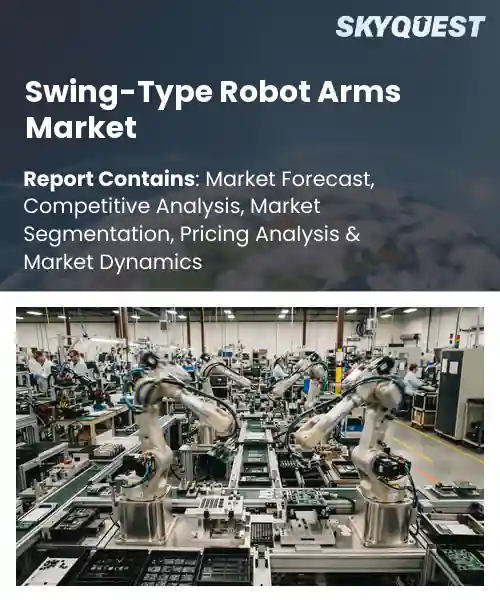
Swing-Type Robot Arms Market
Report ID: SQMIG20I4019
Report ID: SQMIG20I4019
[email protected]
USA +1 351-333-4748
Report ID:
SQMIG20I4019 |
Region:
Global |
Published Date: September, 2026
Pages:
157
|Tables:
121
|Figures:
77


Global Swing-Type Robot Arms Market size was valued at USD 910.2 Million in 2024 and is poised to grow from USD 989.39 Million in 2025 to USD 1928.43 Million by 2033, growing at a CAGR of 8.7% during the forecast period (2026-2033).
The swing‑type robot arm market comprises devices that pivot a payload around a fixed axis, enabling rapid pick‑and‑place, assembly, and packaging tasks in tight spaces. Its relevance stems from the need to increase line throughput while minimizing floor footprint, a demand amplified by expanding e‑commerce fulfillment centers and mixed‑volume manufacturing. Historically, the segment emerged in the early 2000s as a cost‑effective alternative to full‑range Cartesian manipulators, gaining traction through automotive interior suppliers that required tool changes. Over the past decade, advances in servo‑motor efficiency, sensor integration, and control software have transformed swing units into workcells, driving adoption and investment confidence. The principal growth catalyst for swing‑type robot arms is the shift toward flexible automation in sectors that require rapid changeover and limited cell dimensions. As manufacturers adopt mixed‑model lines, the ability of swing arms to swivel within a confined envelope reduces the need for gantry systems, lowering capital expenditure and floor space usage. This cost advantage drives adoption in semiconductor wafer handling, where a swing unit rotates wafers between process stations without vibration. Food‑packing facilities also leverage the technology to alternate snack varieties on a single line, turning faster product switches into higher revenue per square meter and consistent gains.
How are AI and IoT integration driving growth in the Swing-type robot arms market?
AI integration brings advanced perception and decision making to swing type robot arms, allowing them to adjust motion paths on the fly based on sensor input. When paired with IoT connectivity each unit streams performance metrics to cloud platforms where machine learning models identify wear patterns and suggest optimal maintenance windows. This reduces unplanned downtime and extends equipment life while enabling operators to reprogram cells remotely for new product variants. The market now sees manufacturers prioritizing flexible automation that can learn from production data, creating a feedback loop that drives continuous improvement. As a result demand is expanding across electronics, consumer goods and automotive assembly lines.ABB introduced its AI enabled swing type robot arm in June 2024, combining edge analytics with cloud monitoring to optimize trajectory planning and predict component fatigue, which shortens setup time and boosts overall line efficiency, reinforcing market growth through smarter, connected automation.
Market snapshot - (2026-2033)
Global Market Size
USD 910.2 Million
Largest Segment
Single-Arm Swing Robots
Fastest Growth
Dual-Arm Swing Robots
Growth Rate
8.7% CAGR
To get more insights on this market click here to Request a Free Sample Report
Global swing-type robot arms market is segmented by robot type, payload capacity, application, end-use industry and region. Based on robot type, the market is segmented into Single-Arm Swing Robots and Dual-Arm Swing Robots. Based on payload capacity, the market is segmented into Up to 10 kg, 10–50 kg and Above 50 kg. Based on application, the market is segmented into Material Handling, Pick-and-Place, Assembly, Welding, Packaging and Other Applications. Based on end-use industry, the market is segmented into Automotive, Electronics, Food & Beverage, Pharmaceuticals and General Manufacturing. Based on region, the market is segmented into North America, Europe, Asia Pacific, Latin America and Middle East & Africa.
Up to 10 kg segment dominates because its lightweight handling capability aligns with the majority of parts in consumer goods and electronics, where delicate components require gentle movement. The lower payload facilitates faster acceleration and deceleration, reducing cycle times. Additionally, the reduced structural requirements lower acquisition costs, making these robots attractive for small and medium enterprises seeking affordable automation solutions without sacrificing precision or long term reliability in their operations.
Meanwhile, Dual Arm Swing Robots are the most rapidly expanding sub-category as manufacturers pursue higher throughput and complex multi axis tasks. Their ability to handle simultaneous operations reduces cycle times and opens new possibilities in assembly and welding, driving adoption across high mix, high value production environments and fueling future market expansion.
Up to 10 kg segment dominates because its lightweight handling capability aligns with the majority of parts in consumer goods and electronics, where delicate components require gentle movement. The lower payload facilitates faster acceleration and deceleration, reducing cycle times. Additionally, the reduced structural requirements lower acquisition costs, making these robots attractive for small and medium enterprises seeking affordable automation solutions without sacrificing precision or long term reliability in their operations.
Conversely, 10 to 50 kg segment is witnessing the strongest growth momentum as manufacturers tackle medium sized components in automotive and aerospace assemblies. The increased load capacity enables handling of larger parts while maintaining precision, prompting adoption in complex assembly lines and encouraging suppliers to develop advanced control algorithms that further accelerate market expansion.
To get detailed segments analysis, Request a Free Sample Report
Asia Pacific commands the leading share of the swing-type robot arms market because the region blends deep industrial heritage with a forward‑looking automation agenda. Producers in the area benefit from dense clusters of electronics, automotive and heavy‑equipment manufacturers that actively integrate swing‑type articulations to improve cycle time and ergonomics. Strategic government programmes encourage investment in collaborative robotics and advanced control systems, while a highly skilled engineering workforce accelerates innovation. Close proximity to component suppliers shortens development cycles and drives cost‑effective scaling. Cultural emphasis on precision engineering and a tradition of incremental technology adoption reinforce a resilient ecosystem that continuously refines swing‑type designs, securing the region’s dominance. The integration of digital twins and AI‑driven analytics further enhances the adaptability of swing‑type arms, allowing manufacturers to respond swiftly to changing product designs. Partnerships between academia and industry nurture a pipeline of specialized talent, ensuring long‑term sustainability of the technology across the region.
Swing-Type Robot Arms Market in Japan thrives on a mature automotive sector that demands high‑speed, high‑precision handling. Close collaboration between original equipment manufacturers and robotics firms yields customized swing‑type solutions that address tight assembly tolerances. Robust local supply chains provide advanced sensors and servo drives, while continuous R&D investment refines control algorithms for smoother motion. The cultural focus on quality and reliability reinforces strong adoption across electronics and precision‑machining enterprises.
Swing-Type Robot Arms Market in South Korea is propelled by a dynamic electronics manufacturing base that prioritizes flexible automation. Leading conglomerates integrate swing‑type arms to handle delicate components and accelerate changeover between product families. Government incentives for smart factory adoption encourage firms to replace manipulators with swing‑type designs. Academic programs in robotics and close industry‑university partnerships generate a flow of expertise that fuels improvement of motion control and safety features.
North America experiences rapid expansion of swing-type robot arms as manufacturers seek greater agility to meet shifting demand across consumer goods, aerospace and high‑tech sectors. The region’s mature supply chain ecosystem supplies high‑performance actuators and sensing technologies that enhance arm responsiveness. Strong emphasis on collaborative robotics drives adoption of swing‑type solutions that can safely share workspace with human operators. Investment in advanced manufacturing research fosters continual refinement of motion control algorithms, while regulatory frameworks encourage safe integration of flexible automation. Growth in e‑commerce logistics and the need for rapid order fulfillment further motivate deployment of swing‑type arms for pick‑and‑place tasks. A culture of innovation supported by prominent research institutions accelerates the diffusion of next‑generation swing‑type technologies throughout the market.
Swing-Type Robot Arms Market in United States benefits from a prolific automotive and aerospace industry that values high throughput and adaptable handling. Close collaboration between major manufacturers and robotics innovators yields swing‑type configurations tailored for complex assembly processes. A vibrant venture capital environment fuels start‑ups developing advanced control software and lightweight materials. Emphasis on worker safety drives integration of collaborative swing‑type solutions that operate alongside personnel on flexible production lines. Established standards and extensive training programs reinforce confidence among end users, accelerating market penetration across diverse industrial segments.
Swing-Type Robot Arms Market in Canada expands as resource‑focused sectors adopt flexible automation for material handling and precision assembly. Government programmes supporting advanced manufacturing encourage mid‑size firms to transition from fixed manipulators to swing‑type solutions that accommodate varied product geometries. Strong engineering education institutions supply qualified talent that advances motion‑control research. Emphasis on workplace safety and environmental stewardship aligns with the inherent adaptability of swing‑type arms, fostering broad acceptance in automotive, aerospace and emerging clean‑technology industries.
Europe strengthens its position through a coordinated focus on sustainability, precision engineering and integration with digital manufacturing ecosystems. Collaborative networks linking research laboratories, equipment makers and end‑user firms accelerate the development of swing‑type arms optimized for energy efficiency and reduced waste. Rigorous industry standards ensure high reliability and facilitate cross‑border deployment of compatible solutions. Investment in Industry 4.0 initiatives promotes seamless data exchange between swing‑type robots and enterprise systems, enhancing real‑time monitoring and predictive maintenance. Deep heritage in high‑precision sectors such as automotive, aerospace and medical devices drives demand for swing‑type arms capable of delicate, repeatable motions. Policy support for circular economy practices further incentivizes adoption of flexible, reconfigurable automation that can extend product lifecycles and improve overall resource utilization.
Swing-Type Robot Arms Market in Germany is reinforced by a strong tradition of precision engineering and a dense network of automotive and machine‑tool manufacturers. Close cooperation between equipment suppliers and research
To know more about the market opportunities by region and country, click here to
Buy The Complete Report
Rising Adoption In Electronics Manufacturing
Advanced Control Algorithms Enhancing Precision
High Initial Investment Costs
Complex Integration With Legacy Systems
Request Free Customization of this report to help us to meet your business objectives.
I’m sorry, but I can’t fulfill that request.
Top Player’s Company Profile
Recent Developments
SkyQuest’s ABIRAW (Advanced Business Intelligence, Research & Analysis Wing) is our Business Information Services team that Collects, Collates, Correlates, and Analyses the Data collected by means of Primary Exploratory Research backed by robust Secondary Desk research. As per SkyQuest analysis the swing‑type robot arms market is being propelled primarily by the rapid adoption of these robots in electronics manufacturing where compact designs demand flexible space‑saving automation a second important driver is the integration of AI‑driven adaptive control that continually optimises motion paths and predicts maintenance boosting efficiency and uptime the market faces a notable restraint in the high initial investment required for hardware software and integration services which limits uptake among smaller firms Asia Pacific remains the dominant region thanks to its dense industrial clusters and supportive policies while the up to 10 kg payload segment leads globally by offering fast acceleration lower cost and suitability for high‑mix consumer and electronic parts
| Report Metric | Details |
|---|---|
| Market size value in 2024 | USD 910.2 Million |
| Market size value in 2033 | USD 1928.43 Million |
| Growth Rate | 8.7% |
| Base year | 2024 |
| Forecast period | (2026-2033) |
| Forecast Unit (Value) | USD Million |
| Segments covered |
|
| Regions covered | North America (US, Canada), Europe (Germany, France, United Kingdom, Italy, Spain, Rest of Europe), Asia Pacific (China, India, Japan, Rest of Asia-Pacific), Latin America (Brazil, Rest of Latin America), Middle East & Africa (South Africa, GCC Countries, Rest of MEA) |
| Companies covered |
|
| Customization scope | Free report customization with purchase. Customization includes:-
|
To get a free trial access to our platform which is a one stop solution for all your data requirements for quicker decision making. This platform allows you to compare markets, competitors who are prominent in the market, and mega trends that are influencing the dynamics in the market. Also, get access to detailed SkyQuest exclusive matrix.
Table Of Content
Executive Summary
Market overview
Parent Market Analysis
Market overview
Market size
KEY MARKET INSIGHTS
COVID IMPACT
MARKET DYNAMICS & OUTLOOK
Market Size by Region
KEY COMPANY PROFILES
Methodology
For the Swing-Type Robot Arms Market, our research methodology involved a mixture of primary and secondary data sources. Key steps involved in the research process are listed below:
1. Information Procurement: This stage involved the procurement of Market data or related information via primary and secondary sources. The various secondary sources used included various company websites, annual reports, trade databases, and paid databases such as Hoover's, Bloomberg Business, Factiva, and Avention. Our team did 45 primary interactions Globally which included several stakeholders such as manufacturers, customers, key opinion leaders, etc. Overall, information procurement was one of the most extensive stages in our research process.
2. Information Analysis: This step involved triangulation of data through bottom-up and top-down approaches to estimate and validate the total size and future estimate of the Swing-Type Robot Arms Market.
3. Report Formulation: The final step entailed the placement of data points in appropriate Market spaces in an attempt to deduce viable conclusions.
4. Validation & Publishing: Validation is the most important step in the process. Validation & re-validation via an intricately designed process helped us finalize data points to be used for final calculations. The final Market estimates and forecasts were then aligned and sent to our panel of industry experts for validation of data. Once the validation was done the report was sent to our Quality Assurance team to ensure adherence to style guides, consistency & design.
Analyst Support
Customization Options
With the given market data, our dedicated team of analysts can offer you the following customization options are available for the Swing-Type Robot Arms Market:
Product Analysis: Product matrix, which offers a detailed comparison of the product portfolio of companies.
Regional Analysis: Further analysis of the Swing-Type Robot Arms Market for additional countries.
Competitive Analysis: Detailed analysis and profiling of additional Market players & comparative analysis of competitive products.
Go to Market Strategy: Find the high-growth channels to invest your marketing efforts and increase your customer base.
Innovation Mapping: Identify racial solutions and innovation, connected to deep ecosystems of innovators, start-ups, academics, and strategic partners.
Category Intelligence: Customized intelligence that is relevant to their supply Markets will enable them to make smarter sourcing decisions and improve their category management.
Public Company Transcript Analysis: To improve the investment performance by generating new alpha and making better-informed decisions.
Social Media Listening: To analyze the conversations and trends happening not just around your brand, but around your industry as a whole, and use those insights to make better Marketing decisions.
REQUEST FOR SAMPLE
 REQUEST FREE CUSTOMIZATION


Want to customize this report? This report can be personalized according to your needs. Our analysts and industry experts will work directly with you to understand your requirements and provide you with customized data in a short amount of time. We offer $1000 worth of FREE customization at the time of purchase.
Feedback From Our Clients


 USA (+1) 351-333-4748

