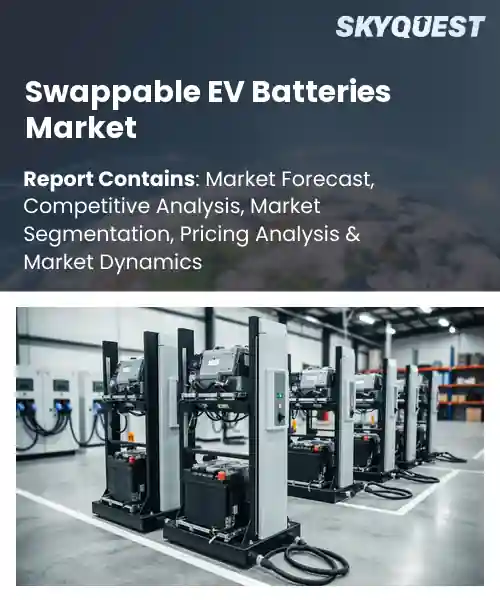
Swappable EV Batteries Market
Report ID: SQMIG25A2641
Report ID: SQMIG25A2641
[email protected]
USA +1 351-333-4748
Report ID:
SQMIG25A2641 |
Region:
Global |
Published Date: February, 2026
Pages:
157
|Tables:
116
|Figures:
77


Global Swappable EV Batteries Market size was valued at USD 740 Million in 2024 and is poised to grow from USD 910 Million in 2025 to USD 4,800 Million by 2033, growing at a CAGR of 23.1% during the forecast period (2026-2033).
An urgent reduction of charging downtime and persistent range anxiety is the primary driver of the global swappable EV batteries market share, reshaping consumer expectations and fleet economics. By replacing depleted packs with fully charged units, swappable systems combine hardware, network operations, and new service models that shorten vehicle downtime and increase utilization. The market matters because it separates vehicle ownership from battery lifecycle responsibility, lowering upfront costs, and smoothing total cost of ownership in urban and commercial fleets. It began with scooter ecosystems like Gogoro in Taiwan and progressed to passenger car pilots like NIO in China, supported by investment.
A key trend driving global swappable EV batteries sector growth is the emergence of interoperable standards and service ecosystems, since compatibility among batteries, swapping stations, and vehicle platforms reduces transaction friction and fragmentation. When manufacturers and infrastructure providers align on form factors, communications, and safety requirements, economies of scale lower manufacturing costs and permit network density that makes swapping economically viable for taxis and delivery fleets. Consequently, operators experience higher vehicle utilization and predictable operating expenses, enabling battery as a service that finances batteries separately and facilitates lifecycle management, recycling, and second life energy storage opportunities that further improve unit economics and attract investment.
How will IoT-Enabled Battery Monitoring Impact the Growth of the Swappable EV Batteries Market?
IoT enabled battery monitoring collects real time charge and health data from each swappable pack and feeds cloud analytics to operators. This creates clear visibility across swap stations and mobile fleets. Today the swappable battery market is growing where network operators and battery makers cooperate to scale infrastructure. The IoT system provides an increased reliability of inventory management and reduces the need for maintenance on existing equipment. As such, both fleet operators and ride hailing services experience decreased downtime as well as increased levels of consistency in terms of battery performance. Shared data also helps build trust with consumers and supports flexible business models that focus on service quality and battery life rather than ownership.
Market snapshot - 2026-2033
Global Market Size
USD 0.74 Billion
Largest Segment
Lithium-ion
Fastest Growth
Lithium-ion
Growth Rate
23.1% CAGR
To get more insights on this market click here to Request a Free Sample Report
The swappable EV batteries market is segmented by battery type, capacity, application, service type and region. Based on battery type, the market is segmented into lead acid, lithium-ion, and others. Based on capacity, the market is segmented into < 5 kWh and > 5 kWh. Based on application, the market is segmented into two-wheeler, passenger cars, light commercial vehicles and three-wheeler. Based on service type, the market is segmented into subscription model and pay-per-use model. Based on region, the market is segmented into North America, Europe, Asia Pacific, Latin America and Middle East & Africa.
Based on the global swappable EV batteries market forecast, lithium-ion segment dominates because its high energy density and mature management systems match the operational needs of swap ecosystems, delivering longer usable range and reliable cycle life per pack. Having a well-established scale for manufacturing and familiar supply chain reduce friction for integration of manufacturers and users/dealers, which facilitates standardization of modular battery designs. This stability in the market also reduces perceived risk to make investments in infrastructure, speeds up the rollout of stations, and provides a basis to increase coordination across all vehicle applications within the ecosystem.
Lead-acid batteries are expected to witness notable growth in the global swappable EV batteries market due to their low cost, established recycling infrastructure, and widespread availability. Because battery swapping models prioritize affordability and quick replacement, fleet operators in emerging markets adopt lead-acid systems for two- and three-wheelers, thereby accelerating deployment of cost-efficient swapping networks.
Subscription model segment dominates because recurring revenue aligns operator incentives with long-term battery health management and network reliability, reducing upfront cost barriers for users. Stable income can lead to the ability of investing in dense swap infrastructure, periodic maintenance, and interoperable standards. Constructing close working relationships with OEM’s (Original Equipment Manufacturer) and fleet operators enhances utilization of the asset, which extends its useful life and provides a solid business case for widespread deployment of swap network systems across many different types of vehicles.
However, pay-per-use model is witnessing the strongest growth momentum because flexible microtransaction pricing and app-based access attract occasional riders and urban commuters. Through the use of on-demand swap technology, entry barriers are lowered, thereby encouraging the trial use of private and light commercial vehicles. This leads to higher throughput at stations. Additionally, these factors allow for multiple monetization strategies to be developed and for swap networks to expand rapidly.
To get detailed segments analysis, Request a Free Sample Report
As per the global swappable EV batteries market analysis, Asia Pacific dominance reflects a confluence of industrial capability, coordinated policy direction, and concentrated consumer demand that together create an enabling environment for swappable solutions. Throughout the area, substantial automotive and electronics manufacturing plants enable quick delivery of modular battery systems and permit large scale mass production (Q3). There are also extensive supply chain networks allowing for cost effective sourcing of both the components to be assembled into the modular battery systems as well as the services needed to get the systems built and operating.
Japan Swappable EV Batteries Market
Swappable EV batteries market in Japan is characterized by deep integration between legacy automakers and advanced battery developers, with emphasis on reliability, safety, and system standardization. Industry players pursue coordinated trials with urban transit operators and utility partners to align swapping infrastructure with grid management objectives. The market narrative centers on engineering excellence, incremental innovation in connector and pack design, and strategic alliances that target fleet electrification and last mile logistics, reinforcing technology credibility among conservative commercial operators.
South Korea Swappable EV Batteries Market
Swappable EV batteries market in South Korea benefits from a vibrant electronics supplier base and nimble automotive manufacturers that drive rapid iteration of battery exchange technologies. The main goal for high throughput exchange stations and tight integration with telematics and fleet management platforms is to ensure optimal operational uptime via high volume exchange station throughput. Together, battery manufacturers, network operators and mobility providers are collaborating to provide commercial pilot projects. In addition to this, the export focus also supports the development of solutions that will meet different international interoperability requirements and service model expectations.
Rapid expansion in Europe is driven by a blend of regulatory impetus, fleet electrification needs, and a unique urban landscape that favors modular energy solutions. Policymakers and municipal authorities are encouraging alternatives to conventional charging to reduce downtime for commercial vehicles and to manage urban curb space more efficiently, prompting interest in battery swap models for taxis, delivery fleets, and public transit. European energy companies and grid operators engage with swapping concepts to balance renewable generation and offer new flexibility services. Local manufacturing and supplier networks support pilot ecosystems, while cross-industry consortia work on interoperability and safety standards that lower barriers to wider adoption.
Germany Swappable EV Batteries Market
Swappable EV batteries market in Germany centers on leveraging a strong engineering and supplier ecosystem to deliver robust, industrial-grade swapping solutions for commercial and municipal fleets. By working with vehicle OEM's, component Manufacturers", and energy companies as well as possibilities for standardized interfaces between all organizations, scalable stations can be deployed in combination with traditional EV chargers for high usage applications; where battery swapping will fit into the existing fleet depot and maintenance framework.
United Kingdom Swappable EV Batteries Market
Swappable EV batteries market regional outlook in United Kingdom is notable for rapid experimental deployment driven by urban fleet needs and supportive local policy frameworks. Urban mobility businesses and operators are focusing on providing solutions for reducing vehicle downtime and improving operation efficiency in high-density urban spaces. Many startups in this market are working with service fleet operators and energy providers to develop commercial models; meanwhile, local governments often support live trials demonstrating that battery swapping is a more efficient way to operate than curbside charging for high-mileage vehicles.
France Swappable EV Batteries Market
Swappable EV batteries market regional forecast in France is emerging through a mix of entrepreneurial activity and strategic interest from large energy groups seeking grid integration opportunities. The overall environment focuses on how users experience exchange processes (elevated station designs in urban areas), and on developing meaningful and mutually beneficial partnerships between new businesses and legacy companies/industries to demonstrate feasibility for more widespread use than just the initial testable market.
North America is advancing its position through a pragmatic combination of technology innovation, commercial pilot programs, and targeted investment in segment-specific use cases. The market emphasizes operational models for commercial fleets and public transit where extended vehicle uptime yields clear economic benefits, prompting experiments with depot-based swapping and modular battery architectures that support heavy duty usage patterns. To integrate swapping into fleet management systems and depot electrification strategies, startups and traditional car manufacturers partner with energy companies and logistics companies. Domestic supply chain resilience and the establishment of standards will reduce the friction of deploying these systems, while regional pilots will test and validate business models that can eventually be deployed more widely in urban areas and intercity transport corridors.
United States Swappable EV Batteries Market
Swappable EV batteries market outlook in United States is driven by experimentation across commercial fleet and public transit segments where operators seek to minimize downtime and total cost of operation. The investment is being made in depot integration, software orchestration, and exchange station design to enable large scale logistics operations. Partnerships between technology start-ups, fleet operators, and utility companies help to validate in the real world and emphasize local supply chain development as well as engagement with regulators to move from pilot test to greater commercial deployments in certain high use segments.
Canada Swappable EV Batteries Market
Swappable EV batteries market forecast in Canada is characterized by targeted pilots that align with regional mobility needs and long distance fleet operations, emphasizing reliability in varied climate conditions and integration with renewable energy sources. Energy providers, providers of transportation solutions and universities are collaborating to test the practicality of depot swapping for Multiple Use Mobility (MUM) solutions outlined in the previous section. The key features of the current environment in MUM are pragmatic testing for operational resilience, providing solutions to the most dispersed populations and to specialized business-to-business (B2B) solutions, while adding to the current electric vehicle (EV) charging infrastructure.
To know more about the market opportunities by region and country, click here to
Buy The Complete Report
Increasing Urban EV Adoption
Supportive Government Policies
Significant Infrastructure Investment Requirements
Battery Standardization Challenges
Request Free Customization of this report to help us to meet your business objectives.
Competitive dynamics in the global swappable EV batteries market outlook center on network scale and interoperability, with firms using partnerships, strategic investments and technology upgrades to secure ecosystems. As an example, Gogoro has established partnerships with global OEMs (original equipment manufacturers) while Nio has built out its battery-swap network and obtained next-generation battery packs. Indian businesses have taken in significant funding to help them scale their station networks and get commercial partnerships to commercialize.
Ecosystem Partnerships Accelerate Networks
Digital Platforms Optimize Utilization
SkyQuest’s ABIRAW (Advanced Business Intelligence, Research & Analysis Wing) is our Business Information Services team that Collects, Collates, Correlates, and Analyses the Data collected by means of Primary Exploratory Research backed by robust Secondary Desk research.
As per SkyQuest analysis, a key driver for the global swappable EV batteries industry is the urgent need to reduce charging downtime and persistent range anxiety, while a second driver is the emergence of interoperable standards and service ecosystems that lower friction and enable scale. Considerable infrastructure investment in establishing dense swap station networks is a significant barrier to market entry. In Asia Pacific, the market is dominated by countries with strong battery manufacturing ecosystems, and where pilot projects are coordinated and urban demand is high. Asia Pacific has also established itself as the leader of the lithium-ion segment of the swap station market by providing a superior energy density value proposition. Having developed mature management systems for lithium-ion, and building to scale with manufacturing capacity that supports swap station ecosystems.
| Report Metric | Details |
|---|---|
| Market size value in 2024 | USD 740 Million |
| Market size value in 2033 | USD 4,800 Million |
| Growth Rate | 23.1% |
| Base year | 2024 |
| Forecast period | 2026-2033 |
| Forecast Unit (Value) | USD Million |
| Segments covered |
|
| Regions covered | North America (US, Canada), Europe (Germany, France, United Kingdom, Italy, Spain, Rest of Europe), Asia Pacific (China, India, Japan, Rest of Asia-Pacific), Latin America (Brazil, Rest of Latin America), Middle East & Africa (South Africa, GCC Countries, Rest of MEA) |
| Companies covered |
|
| Customization scope | Free report customization with purchase. Customization includes:-
|
To get a free trial access to our platform which is a one stop solution for all your data requirements for quicker decision making. This platform allows you to compare markets, competitors who are prominent in the market, and mega trends that are influencing the dynamics in the market. Also, get access to detailed SkyQuest exclusive matrix.
Table Of Content
Executive Summary
Market overview
Parent Market Analysis
Market overview
Market size
KEY MARKET INSIGHTS
COVID IMPACT
MARKET DYNAMICS & OUTLOOK
Market Size by Region
KEY COMPANY PROFILES
Methodology
For the Swappable EV Batteries Market, our research methodology involved a mixture of primary and secondary data sources. Key steps involved in the research process are listed below:
1. Information Procurement: This stage involved the procurement of Market data or related information via primary and secondary sources. The various secondary sources used included various company websites, annual reports, trade databases, and paid databases such as Hoover's, Bloomberg Business, Factiva, and Avention. Our team did 45 primary interactions Globally which included several stakeholders such as manufacturers, customers, key opinion leaders, etc. Overall, information procurement was one of the most extensive stages in our research process.
2. Information Analysis: This step involved triangulation of data through bottom-up and top-down approaches to estimate and validate the total size and future estimate of the Swappable EV Batteries Market.
3. Report Formulation: The final step entailed the placement of data points in appropriate Market spaces in an attempt to deduce viable conclusions.
4. Validation & Publishing: Validation is the most important step in the process. Validation & re-validation via an intricately designed process helped us finalize data points to be used for final calculations. The final Market estimates and forecasts were then aligned and sent to our panel of industry experts for validation of data. Once the validation was done the report was sent to our Quality Assurance team to ensure adherence to style guides, consistency & design.
Analyst Support
Customization Options
With the given market data, our dedicated team of analysts can offer you the following customization options are available for the Swappable EV Batteries Market:
Product Analysis: Product matrix, which offers a detailed comparison of the product portfolio of companies.
Regional Analysis: Further analysis of the Swappable EV Batteries Market for additional countries.
Competitive Analysis: Detailed analysis and profiling of additional Market players & comparative analysis of competitive products.
Go to Market Strategy: Find the high-growth channels to invest your marketing efforts and increase your customer base.
Innovation Mapping: Identify racial solutions and innovation, connected to deep ecosystems of innovators, start-ups, academics, and strategic partners.
Category Intelligence: Customized intelligence that is relevant to their supply Markets will enable them to make smarter sourcing decisions and improve their category management.
Public Company Transcript Analysis: To improve the investment performance by generating new alpha and making better-informed decisions.
Social Media Listening: To analyze the conversations and trends happening not just around your brand, but around your industry as a whole, and use those insights to make better Marketing decisions.
REQUEST FOR SAMPLE
 REQUEST FREE CUSTOMIZATION
Global Swappable Ev Batteries Market size was valued at USD 0.74 Billion in 2024 and is poised to grow from USD 0.91 Billion in 2025 to USD 4.8 Billion by 2033, growing at a CAGR of 23.1% during the forecast period (2026-2033).
Contemporary Amperex Technology Co., Limited, NIO Inc., GOGORO INC., SUN Mobility Private Ltd., Bounce, Honda Motor Co., Ltd., Silence Urban Ecomobility, ONiON Mobility, Shell Recharge Solutions, EVBox, Ample, Batteroo, Electromotus, Greenway Infrastructure, Ternary Energy, Hero Electric Vehicles, Plugsurfing, City Transformer, Ziggy, ChargePoint
The key driver of the Swappable EV Batteries Market is the growing need for quick and efficient EV charging solutions. Battery swapping eliminates long charging times, improves vehicle uptime, and supports large-scale adoption of electric vehicles, especially in commercial fleets and urban mobility systems.
A key market trend in the Swappable EV Batteries Market is the growing adoption of battery-as-a-service (BaaS) models and expansion of swapping station networks. Additionally, increasing focus on battery standardization and smart connectivity technologies is enabling more efficient and scalable EV energy ecosystems.
Asia-Pacific accounted for the largest share in the Swappable EV Batteries Market, driven by rapid EV adoption, supportive government policies, and expanding battery swapping infrastructure across major economies like China and India.


Want to customize this report? This report can be personalized according to your needs. Our analysts and industry experts will work directly with you to understand your requirements and provide you with customized data in a short amount of time. We offer $1000 worth of FREE customization at the time of purchase.
Feedback From Our Clients


 USA (+1) 351-333-4748

