
Surgical Robots Market
Report ID: SQMIG35A3093
Report ID: SQMIG35A3093
sales@skyquestt.com
USA +1 351-333-4748
Report ID:
SQMIG35A3093 |
Region:
Global |
Published Date: August, 2025
Pages:
193
|Tables:
90
|Figures:
71


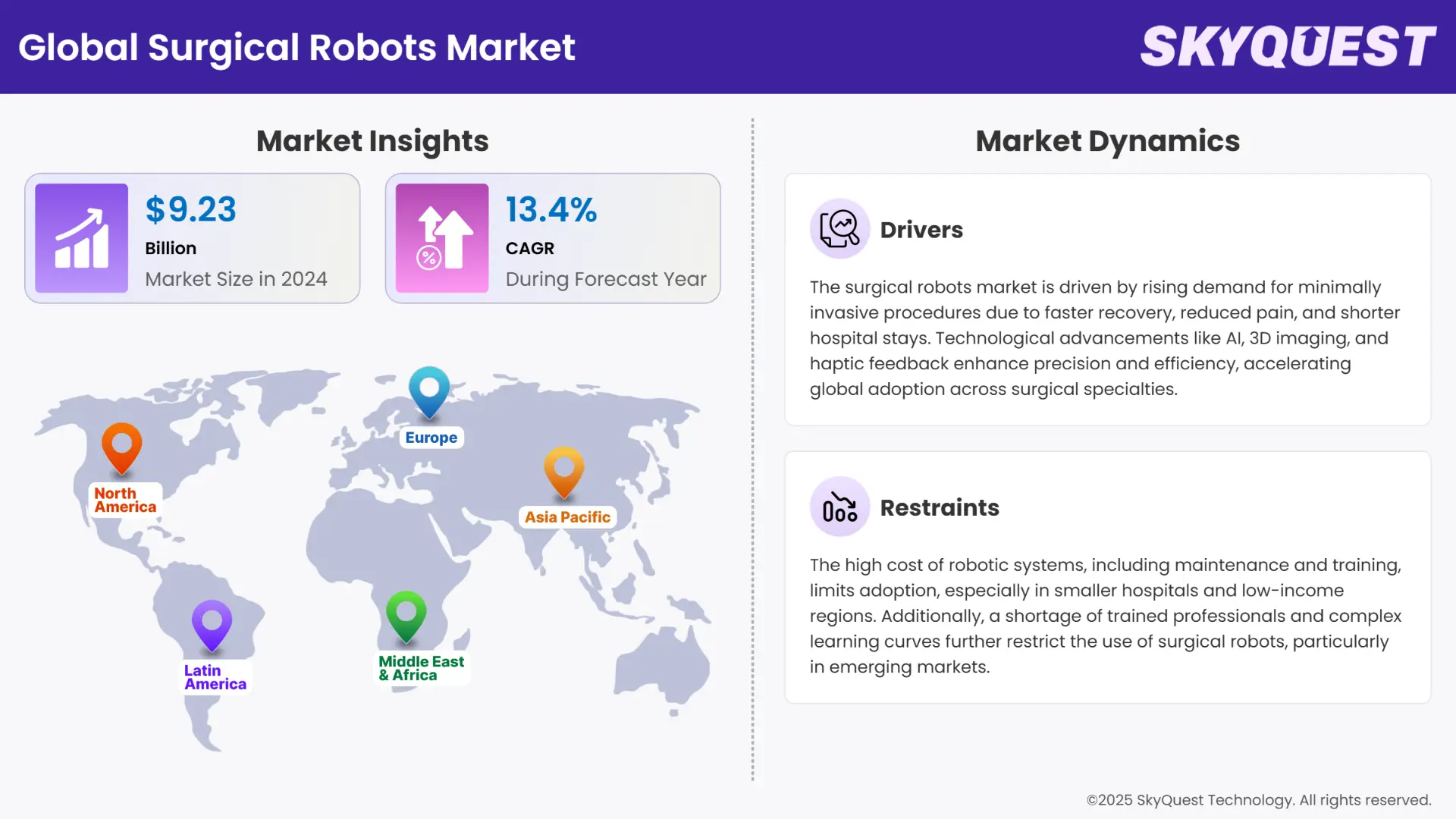
Global Surgical Robots Market size was valued at USD 8.73 Billion in 2024 and is poised to grow from USD 9.9 Billion in 2025 to USD 27.08 Billion by 2033, growing at a CAGR of 13.4% in the forecast period (2026–2033).
The global surgical robots market is undergoing rapid transformation, driven by the convergence of advanced technologies and the evolving needs of modern healthcare systems. Surgical robots are increasingly being adopted for their ability to enhance surgical precision, reduce human error, and minimize patient trauma during complex procedures. These systems offer numerous benefits such as smaller incisions, reduced blood loss, shorter hospital stays, and faster recovery times, making them highly attractive in minimally invasive surgery (MIS).
Hospitals and surgical centers are investing heavily in robotic-assisted platforms to meet the rising demand for improved clinical outcomes, particularly in fields like urology, gynecology, orthopedics, and general surgery. In addition, the global shortage of skilled surgeons and the need for standardized surgical procedures are encouraging the adoption of robotic technologies in both developed and developing countries. Emerging markets are seeing increased penetration due to expanding healthcare infrastructure and greater awareness of robotic solutions.
What are the Most Notable AI Developments in Surgical Robotics in 2024?
Artificial intelligence is playing a transformative role in the growth of the surgical robots market, enhancing system capabilities, surgeon performance, and patient outcomes.
Additionally, platforms like Asensus Surgical’s AugmentOR Portal are using AI to analyze real-time surgical video and sensor data to identify errors, provide feedback, and help standardize surgical quality across institutions. Commercial systems are also evolving Intuitive Surgical soft-launched the da Vinci 5 system in mid-2024 with improved precision and AI support, capturing a significant surgical robots market share of U.S. robotic installations.
To get more insights on this market click here to Request a Free Sample Report
Global surgical robots market is segmented into offering, application, end user and region. Based on offering, the market is segmented into instruments & accessories, robotic systems and services. Based on application, the market is segmented into general surgery, gynecological surgery, orthopedic surgery, urological surgery, neurosurgery, microsurgery, otological surgery and other applications. Based on end user, the market is segmented into hospitals & clinics, and ambulatory surgery centers. Based on region, the market is segmented into North America, Asia-Pacific, Europe, Latin America, and Middle East & Africa.
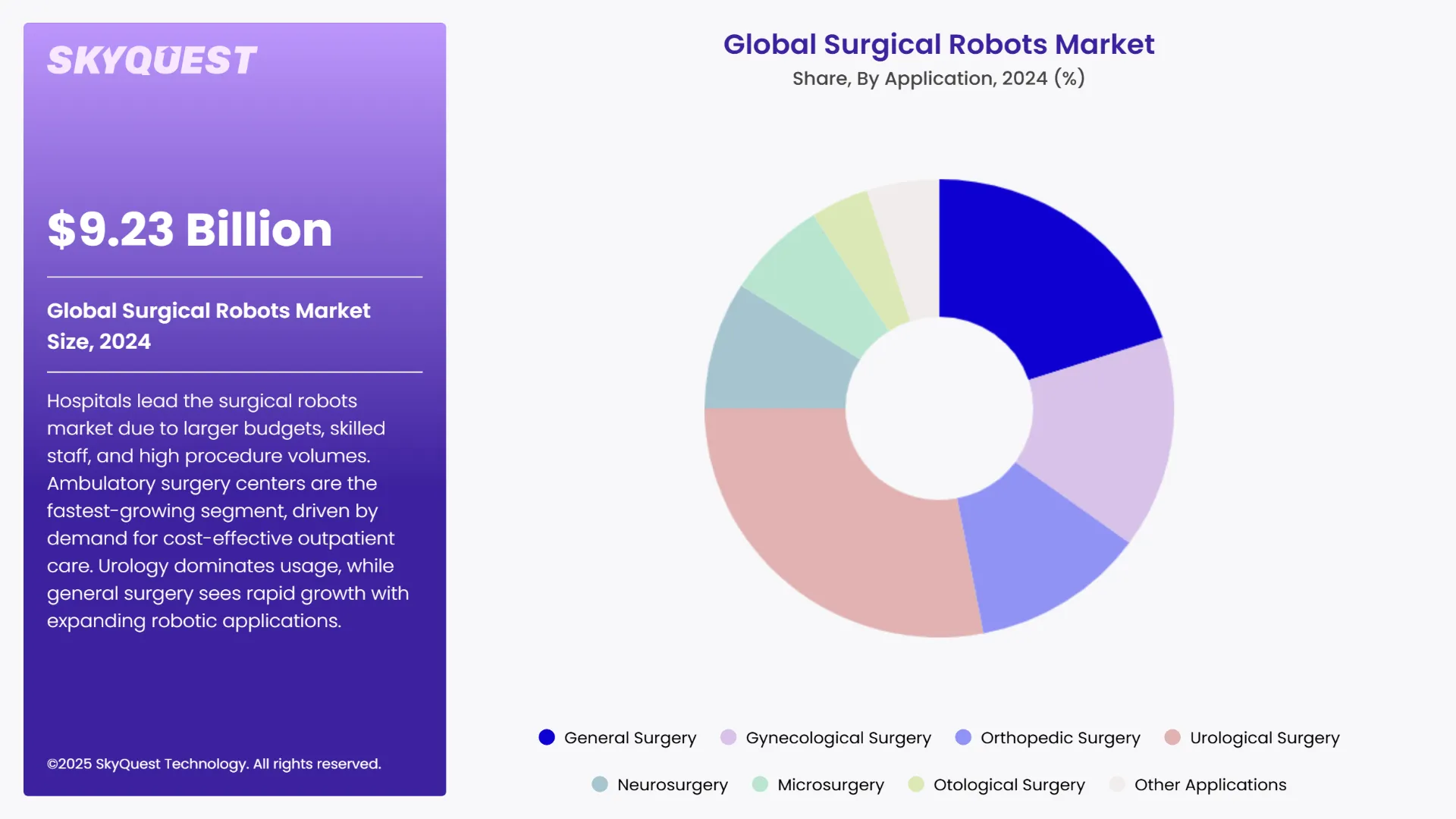
As per the global surgical robots market outlook, hospitals and clinics dominate the market, accounting for the largest share of installations and procedure volumes globally. These institutions are well-equipped to invest in high-cost surgical systems due to their larger budgets, access to skilled surgical teams, and a higher influx of complex cases. Robotic surgery is increasingly integrated into routine hospital workflows for procedures in cardiology, urology, gynecology, and oncology. The presence of large surgical departments, advanced operating theaters, and established training infrastructure makes hospitals the preferred setting for both patients and manufacturers.
As per global surgical robots market forecast, ambulatory surgery centers are emerging as the fastest-growing segment in the market. With healthcare systems globally shifting toward cost-effective, outpatient-based care, ASCs are increasingly adopting compact and procedure-specific robotic systems. Recent technological advancements have made robotic platforms more portable and affordable, allowing ASCs to perform minimally invasive surgeries in same-day settings with enhanced precision and safety.
The urological surgery segment dominates the global surgical robots market. This segment was among the first to adopt robotic assistance, especially due to the complexity and precision required in urologic interventions. Robotic systems provide superior visualization, enhanced dexterity, and improved access to deep pelvic areas, significantly reducing complications and recovery times. As a result, robotic prostatectomy has become the gold standard in many developed healthcare systems. High procedural volume, strong clinical evidence, and reimbursement support further reinforce urology's leadership in robotic adoption.
As per the global surgical robots market analysis, general surgery is the fastest-growing application segment in the market. With expanding indications and advancements in robotic technology, more general surgical procedures—such as hernia repair, cholecystectomy, bariatric surgery, and colon resections are performed robotically. In 2024, many hospitals expanded their robotic programs to include general surgery due to its procedural diversity and large case volumes. The growing preference for minimally invasive techniques, combined with rising surgeon training and platform versatility, is accelerating growth in this segment.
To get detailed segments analysis, Request a Free Sample Report
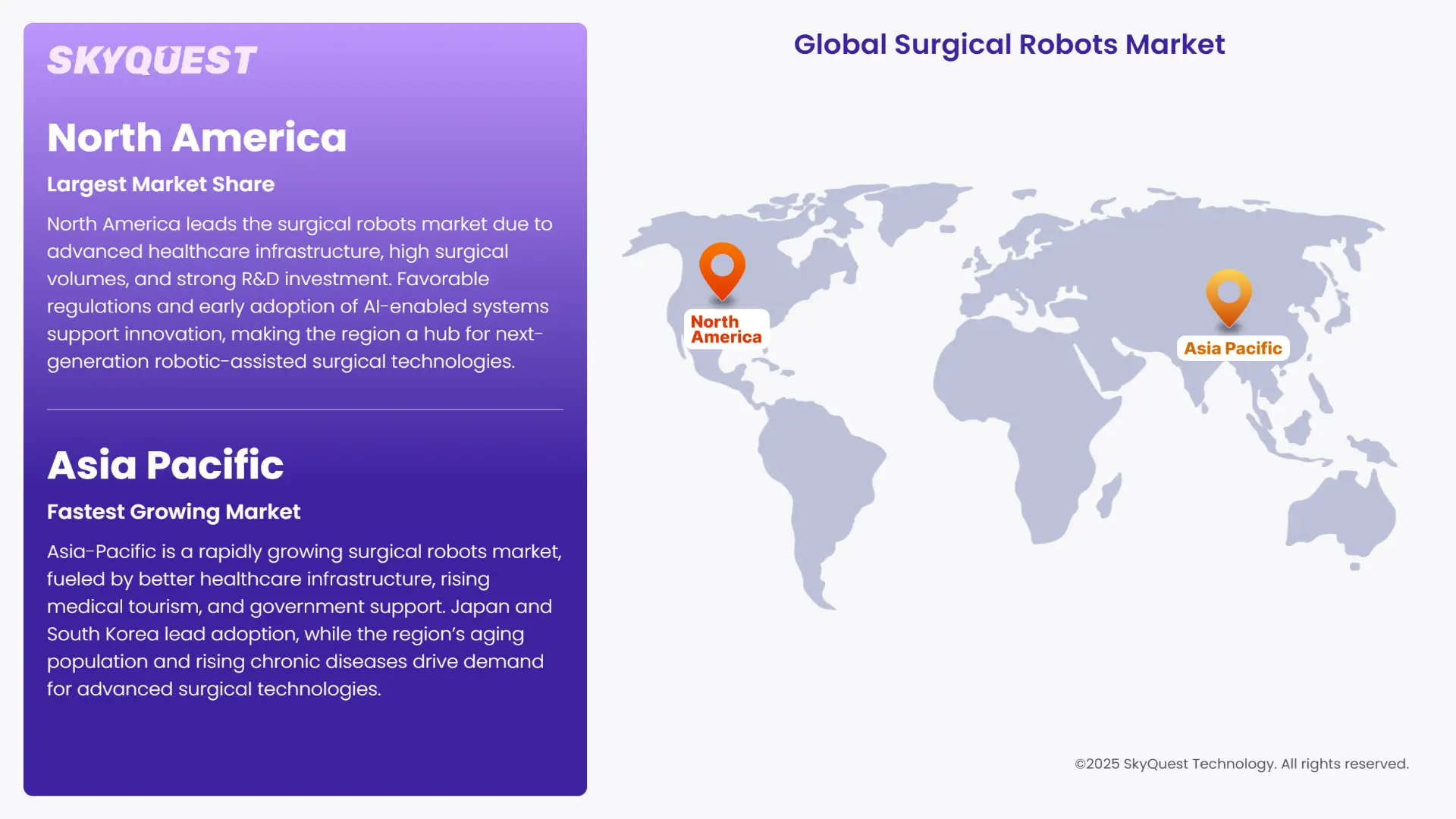
As per regional outlook, North America is the largest and most mature market, characterized by widespread adoption, significant R&D investment, and a high concentration of global market leaders. The region benefits from strong healthcare infrastructure, high surgical volumes, and favorable regulatory environments that facilitate the introduction of next-generation robotic systems. Continuous innovation and early access to AI-enabled surgical platforms have positioned North America at the forefront of robotic-assisted surgery.
As per regional analysis, the U.S. remains the largest surgical robots market globally, driven by early adoption, strong reimbursement structures, and constant innovation from domestic leaders like Intuitive Surgical and Stryker. In 2024, the launch of next-generation systems with integrated AI and improved ergonomics further accelerated adoption among large hospital chains. A growing geriatric population, high surgical volumes, and favorable FDA approval pathways continue to support growth in this market.
Canada is witnessing steady growth in robotic-assisted surgeries, especially in oncology and urology. Government investments in digital healthcare infrastructure and increasing collaborations between hospitals and robotic system manufacturers are boosting deployment. Though adoption is slower than in the U.S., Canadian healthcare institutions are gradually expanding their robotic surgery programs, particularly in urban teaching hospitals.
Asia-Pacific is one of the fastest-growing regions in the surgical robots market, driven by improving healthcare infrastructure, rising medical tourism, and growing government support for high-precision surgical technologies. Countries such as Japan and South Korea are leading the regional adoption, leveraging their strong technological ecosystems and public health investments. Asia-Pacific also presents large-scale opportunities due to its aging population and increasing prevalence of chronic diseases requiring surgical interventions.
As per industry analysis, Japan is a major player in Asia’s robotic surgery landscape, supported by its strong manufacturing base and government funding for medtech innovation. In 2024, the country expanded insurance coverage for additional robotic procedures, particularly in gastrointestinal and prostate surgeries. Local companies are also developing competitive systems to reduce dependence on imported platforms, further fueling surgical robots market expansion.
South Korea is rapidly adopting surgical robotics across its leading hospitals and academic centers. Strong government support for AI and robotics integration, coupled with a tech-savvy population, has made South Korea one of the most dynamic markets in Asia. In 2024, several hospitals introduced AI-integrated systems for precision in orthopedic and neurosurgical applications.
Europe is a highly promising region for surgical robotics, supported by advanced medical facilities, high surgeon skill levels, and a growing focus on minimally invasive procedures. The region shows significant activity in both procurement and local development of robotic platforms, especially in Germany, the U.K., and Italy. Many European nations are integrating robotic surgery into national healthcare systems, aided by EU funding and academic-industry collaborations.
The U.K. market is expanding as the National Health Service (NHS) increases funding for digitized and robotic surgery programs. There is growing demand for robotic systems in public hospitals, particularly in oncology and gynecology. In 2024, several NHS Trusts adopted cost-effective systems designed for day-care surgeries, signaling a push toward outpatient robotic interventions.
Germany leads the European market with its advanced healthcare infrastructure and high spending on surgical innovation. The country is a hub for both the usage and development of robotic systems, with several hospitals participating in clinical trials and pilot projects for AI-enhanced surgery. In 2024, robotic systems for minimally invasive thoracic and colorectal procedures gained popularity across major surgical centers.
Italy is showing steady growth in robotic surgery adoption, particularly in specialized surgical centers and university hospitals. Urologic and gynecologic procedures dominate the robotic surgery space. In 2024, new private-public partnerships facilitated the procurement of advanced surgical robots, especially in northern regions, improving nationwide access to precision surgery.
To know more about the market opportunities by region and country, click here to
Buy The Complete Report
Rising Demand for Minimally Invasive Procedures
Technological Advancements in Robotic Systems
High Cost of Robotic Systems and Procedures
Limited Availability of Trained Professionals
Request Free Customization of this report to help us to meet your business objectives.
The surgical robots industry is highly competitive and innovation-driven, with key players actively pursuing strategic initiatives such as mergers, acquisitions, product launches, and AI integration to strengthen their market position. Intuitive Surgical continues to lead the market with its da Vinci platform, and in 2024, the company introduced the da Vinci 5 system with enhanced precision and haptic feedback, capturing significant hospital adoption across North America.
As per market strategies, Medtronic, aiming to challenge Intuitive’s dominance, expanded its Hugo™ robotic platform into additional international markets while focusing on affordability and modularity. Stryker adopted an aggressive expansion strategy in 2024 by acquiring MOLLI Surgical in July and Artelon earlier the same month, strengthening its capabilities in soft tissue and oncology-focused robotics.
A new wave of startups is reshaping the surgical robots market by introducing innovative, cost-effective, and compact robotic solutions aimed at making advanced surgical technologies more accessible. These emerging players are focusing on modular systems tailored for smaller hospitals and outpatient centers, offering greater flexibility and easier integration compared to traditional large-scale platforms.
SkyQuest’s ABIRAW (Advanced Business Intelligence, Research & Analysis Wing) is our Business Information Services team that Collects, Collates, Correlates, and Analyses the Data collected by means of Primary Exploratory Research backed by robust Secondary Desk research.
As per SkyQuest analysis, the surgical robots market has expanded rapidly, which is driven by minimal invasive processes, increases surgically accurate requirements and increases the demand for continuous technological innovation. Robot assisted surgery is widely adopted in specialties such as urology, gynecology, orthopedics and general surgery, due to the ability to increase accuracy, reduce recovery time and improve the general clinical outcome. Major companies introduce the next generation platforms with smarter, more autonomous functions, while the emerging markets use to meet the growing health care need to increase cost-effective, locally developed systems to meet increasing healthcare needs. Despite high capital costs and a limited pool of trained professionals, the market approach is still positive, supported by strong R&D activity and integration of AI-operated analysis into surgical workflows. Technological advancements are driving the global surgical robot market due to their growing adoption by hospitals and decreasing needs for invasive procedures.
| Report Metric | Details |
|---|---|
| Market size value in 2024 | USD 8.73 Billion |
| Market size value in 2033 | USD 27.08 Billion |
| Growth Rate | 13.4% |
| Base year | 2024 |
| Forecast period | 2026-2033 |
| Forecast Unit (Value) | USD Billion |
| Segments covered |
|
| Regions covered | North America (US, Canada), Europe (Germany, France, United Kingdom, Italy, Spain, Rest of Europe), Asia Pacific (China, India, Japan, Rest of Asia-Pacific), Latin America (Brazil, Rest of Latin America), Middle East & Africa (South Africa, GCC Countries, Rest of MEA) |
| Companies covered |
|
| Customization scope | Free report customization with purchase. Customization includes:-
|
To get a free trial access to our platform which is a one stop solution for all your data requirements for quicker decision making. This platform allows you to compare markets, competitors who are prominent in the market, and mega trends that are influencing the dynamics in the market. Also, get access to detailed SkyQuest exclusive matrix.
Table Of Content
Executive Summary
Market overview
Parent Market Analysis
Market overview
Market size
KEY MARKET INSIGHTS
COVID IMPACT
MARKET DYNAMICS & OUTLOOK
Market Size by Region
KEY COMPANY PROFILES
Methodology
For the Surgical Robots Market, our research methodology involved a mixture of primary and secondary data sources. Key steps involved in the research process are listed below:
1. Information Procurement: This stage involved the procurement of Market data or related information via primary and secondary sources. The various secondary sources used included various company websites, annual reports, trade databases, and paid databases such as Hoover's, Bloomberg Business, Factiva, and Avention. Our team did 45 primary interactions Globally which included several stakeholders such as manufacturers, customers, key opinion leaders, etc. Overall, information procurement was one of the most extensive stages in our research process.
2. Information Analysis: This step involved triangulation of data through bottom-up and top-down approaches to estimate and validate the total size and future estimate of the Surgical Robots Market.
3. Report Formulation: The final step entailed the placement of data points in appropriate Market spaces in an attempt to deduce viable conclusions.
4. Validation & Publishing: Validation is the most important step in the process. Validation & re-validation via an intricately designed process helped us finalize data points to be used for final calculations. The final Market estimates and forecasts were then aligned and sent to our panel of industry experts for validation of data. Once the validation was done the report was sent to our Quality Assurance team to ensure adherence to style guides, consistency & design.
Analyst Support
Customization Options
With the given market data, our dedicated team of analysts can offer you the following customization options are available for the Surgical Robots Market:
Product Analysis: Product matrix, which offers a detailed comparison of the product portfolio of companies.
Regional Analysis: Further analysis of the Surgical Robots Market for additional countries.
Competitive Analysis: Detailed analysis and profiling of additional Market players & comparative analysis of competitive products.
Go to Market Strategy: Find the high-growth channels to invest your marketing efforts and increase your customer base.
Innovation Mapping: Identify racial solutions and innovation, connected to deep ecosystems of innovators, start-ups, academics, and strategic partners.
Category Intelligence: Customized intelligence that is relevant to their supply Markets will enable them to make smarter sourcing decisions and improve their category management.
Public Company Transcript Analysis: To improve the investment performance by generating new alpha and making better-informed decisions.
Social Media Listening: To analyze the conversations and trends happening not just around your brand, but around your industry as a whole, and use those insights to make better Marketing decisions.
REQUEST FOR SAMPLE
 REQUEST FREE CUSTOMIZATION
Global Surgical Robots Market size was valued at USD 8.73 Billion in 2024 and is poised to grow from USD 9.9 Billion in 2025 to USD 27.08 Billion by 2033, growing at a CAGR of 13.4% in the forecast period (2026–2033).
The surgical robots industry is highly competitive and innovation-driven, with key players actively pursuing strategic initiatives such as mergers, acquisitions, product launches, and AI integration to strengthen their market position. Intuitive Surgical continues to lead the market with its da Vinci platform, and in 2024, the company introduced the da Vinci 5 system with enhanced precision and haptic feedback, capturing significant hospital adoption across North America. 'Intuitive Surgical', 'Medtronic', 'Stryker Corporation', 'Zimmer Biomet', 'Smith+Nephew', 'CMR Surgical', 'Asensus Surgical', 'Johnson & Johnson (Ethicon)', 'Renishaw plc', 'THINK Surgical', 'Siemens Healthineers', 'Karl Storz'
One of the primary drivers propelling the surgical robots market is the growing preference for minimally invasive surgeries (MIS). Patients and healthcare providers alike favor MIS due to advantages such as smaller incisions, reduced pain, quicker recovery times, and shorter hospital stays. Surgical robots enhance these benefits by providing unparalleled precision, better control, and improved visualization for surgeons. This demand is particularly strong in areas like gynecology, urology, and general surgery, where robotic systems enable complex procedures with lower complication risks. The push for patient-centered care and reduced healthcare costs further amplifies the adoption of robotic-assisted MIS worldwide.
Integration of Artificial Intelligence and Automation: AI integration is one of the most transformative market trends shaping the surgical robots market. From preoperative planning to intraoperative guidance and post-surgical analytics, AI is being used to improve accuracy, automate decision-making, and enhance learning for both systems and surgeons. In 2024, AI-trained robots demonstrated capabilities such as autonomous suturing and gallbladder removal in animal models, marking a major step toward intelligent surgical automation. AI is also enabling platforms like Asensus Surgical’s AugmentOR to evaluate surgical performance and reduce variability across surgeons.
As per regional outlook, North America is the largest and most mature market, characterized by widespread adoption, significant R&D investment, and a high concentration of global market leaders. The region benefits from strong healthcare infrastructure, high surgical volumes, and favorable regulatory environments that facilitate the introduction of next-generation robotic systems. Continuous innovation and early access to AI-enabled surgical platforms have positioned North America at the forefront of robotic-assisted surgery.


Want to customize this report? This report can be personalized according to your needs. Our analysts and industry experts will work directly with you to understand your requirements and provide you with customized data in a short amount of time. We offer $1000 worth of FREE customization at the time of purchase.
Feedback From Our Clients


 USA (+1) 351-333-4748

