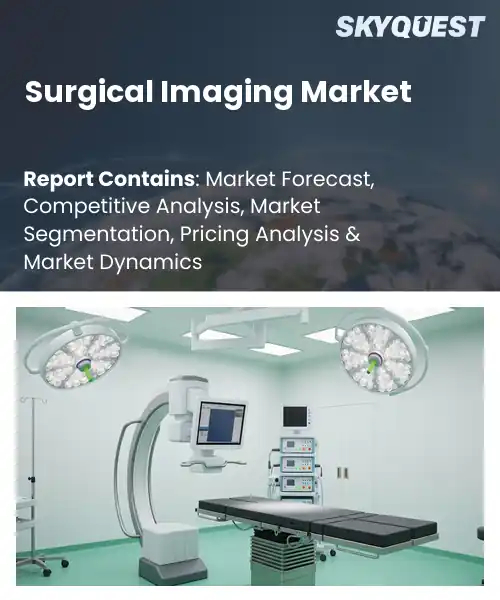
Surgical Imaging Market
Report ID: SQMIG35A3912
Report ID: SQMIG35A3912
[email protected]
USA +1 351-333-4748
Report ID:
SQMIG35A3912 |
Region:
Global |
Published Date: June, 2026
Pages:
157
|Tables:
148
|Figures:
78


Global Surgical Imaging Market size was valued at USD 4.9 Billion in 2024 and is poised to grow from USD 5.21 Billion in 2025 to USD 8.56 Billion by 2033, growing at a CAGR of 6.4% during the forecast period (2026-2033).
Primary driver of the surgical imaging market is the rising demand for minimally invasive and image-guided procedures, which improves patient outcomes while reducing hospital stays and costs. Real-time visibility of anatomical structures using surgical imaging technologies is achieved through the use of intra operative fluoroscopy, endoscopy, ultrasound, and intra operative magnetic resonance imaging and computed tomography. This domain matters because precise imaging reduces complications and enables complex interventions that were once impossible, such as image-guided tumor resections and spinal navigation. Over the last two decades the market developed from 2D fluoroscopic imaging toward high-resolution 3D and hybrid OR solutions, exemplified by adoption of cone-beam CT and integrated surgical suites.
An accelerating key factor is technological convergence, where improvements in detector sensitivity, real-time 3D reconstruction, and AI-driven image interpretation reduce procedure time and increase diagnostic confidence, thereby incentivizing hospitals to invest. In many cases, surgical navigation of joint replacements has decreased the misalignment of the joint, which has resulted in an overall reduction in postoperative complications. Additionally, the favorable reimbursement structures and increased capital expenditure budgets allow for the growth of surgical navigation systems as a result of increased utilization, particularly in emerging markets, due to both the use of portable systems and tele-guided surgical imaging; providing opportunities for vendors to generate new revenue through increased patient access and the ability to train surgeons in the use of these systems.
How is AI Enhancing Diagnostic Accuracy in the Global Surgical Imaging Market?
AI has enhanced diagnostic precision through better imaging and automatic recognition of tissues during surgery. For example, machine learning algorithms integrate preoperative imaging with real-time surgical imaging to direct removal of tissue and locate questionable margins. AI will also be integrated with optical coherence tomography, fluorescent imaging, intraoperative ultrasound and 3D reconstruction to standardize results and improve speed and accuracy in decision making. The market is moving toward tighter integration of imaging software with surgical platforms and toward broader clinical acceptance as regulators and health systems evaluate real world performance and workflow benefits.
In March 2026, Perimeter Medical Imaging AI received regulatory approval for an AI enabled intraoperative OCT device that assists margin assessment during cancer surgery. This innovation boosts diagnostic accuracy by providing real time high resolution tissue assessment and by creating procedural data that refines AI models and improves operating room efficiency.
Market snapshot - (2026-2033)
Global Market Size
USD 4.9 Billion
Largest Segment
C-arm Systems
Fastest Growth
Ultrasound
Growth Rate
6.4% CAGR
To get more insights on this market click here to Request a Free Sample Report
Global surgical imaging market is segmented by technology, application, modality, end-user, sales channel and region. Based on technology, the market is segmented into c-arm systems, computed tomography, magnetic resonance imaging, ultrasound and others. Based on application, the market is segmented into orthopedic surgery, cardiovascular surgery, neurosurgery, gynecological surgery and others. Based on modality, the market is segmented into portable systems, fixed systems and others. Based on end-user, the market is segmented into hospitals, ambulatory surgical centers and others. Based on sales channel, the market is segmented into direct institutional sales, medical equipment wholesalers and others. Based on region, the market is segmented into North America, Europe, Asia Pacific, Latin America and Middle East & Africa.
C-arm systems segment dominates because C-arm technology provides unmatched intraoperative fluoroscopic flexibility, enabling surgeons to obtain real-time images without moving the patient. Its dominance is driven by seamless integration into hybrid operating rooms, strong compatibility with navigation and robotics, and established clinician familiarity that reduces procedural disruption. These factors encourage institutional purchasing and training investments, which in turn reinforce clinical preference and extensive utilization across a wide range of surgical specialties.
However, ultrasound segment is emerging as the fastest-growing area due to miniaturization, improved resolution, and expanding interventional uses. These factors enable point-of-care guidance, broaden soft-tissue and vascular applications, and spur new low-cost imaging services that drive adoption and stimulate innovation.
Fixed systems segment dominates because fixed imaging installations deliver higher power, superior image quality, and consistent integration with operating room infrastructure that support complex, high-acuity procedures. Hospitals have a preference for strong, interchangeable operating room systems to accommodate the growth of independently developed dedicated operating rooms and hybrid operating rooms where multiple disciplines work together to deliver patient care. This operational functionality enables hospitals to utilize equipment that performs consistently to help create and implement standard procedures, train staff on them, and provide them with high operational efficiency and low clinical use supported by their operational effectiveness.
However, portable systems segment is emerging fastest as demand for bedside and point-of-care imaging grows, driven by compact hardware, wireless connectivity, and simplified workflows. These devices expand access in constrained OR layouts and ambulatory environments, enable rapid turnover between cases, and open new service models, stimulating vendor investment and accelerating adoption across surgical specialties.
To get detailed segments analysis, Request a Free Sample Report
North American dominance stems from an ecosystem that combines advanced clinical infrastructure, concentrated vendor presence, and a culture of early adoption. The need for advanced imaging systems is continuously increasing due to the growing number of hospitals and special surgical centers that use imaging to improve workflow when performing complex and minimally invasive procedures. A robust innovation pipeline driven by both academic medical centers and private companies facilitates rapid product development and clinical validation. As reimbursement models increasingly support image-guided surgical procedures, and more capital is available for technology purchases, more favorable procurement cycles exist. Well-developed clinical training programs and multidisciplinary care pathways create strong ties between imaging and surgical practice, while the location of many medtech manufacturers fosters cooperation and accelerates the launch of new products and services into the market.
Surgical Imaging Market in the United States is characterized by extensive clinical adoption and a dense network of advanced hospitals and academic centers that drive innovation. Surgical workflows at hospitals and specialty clinics prioritize high-end imaging integration into their workflow process as well as have an active vendor presence for collaboration on research activities. Furthermore there is a strong emphasis on minimally invasive surgical procedures, translational research, and private sector investment; creating ongoing demand for next generation imaging technologies among multiple specialty areas.
Surgical Imaging Market in Canada emphasizes coordinated adoption across public hospital systems and specialty centers, guided by provincial procurement and clinical networks. The support and emphasis placed on clinician education and technology assessment are intended to ensure that image guided surgical procedures are incorporated into currently developed pathways in a thoughtful, considered way. The emphasis on accessibility, cross-disciplinary coordination of care and interoperability between imaging platforms will guide the approach to how these devices are purchased and then implemented in different regions.
Expansion in Europe is propelled by a combination of strong medtech manufacturing, coordinated regional healthcare systems, and increasing integration of image guided techniques into standard surgical pathways. The Collaborative cross border activities between clinics, research institutions and industry will accelerate both the technology transfer process and clinic validation of new surgical devices. Majority of the current policy priorities of improving surgical outcomes and investment in the digital infrastructure to help facilitate the adoption of surgical devices have improved significantly over the past few years. The variety of vendor options available to hospitals increases flexibility in terms of purchasing surgical devices. There are also reimbursement codes and government manufacturing contracts for those hospitals looking to obtain new surgical devices. The increasing comfort level of clinicians with minimally invasive and hybrid surgical procedures supports the continued growth of the market in Western Europe. Harmonization of regulatory processes in different countries reduces barriers to entry and allows for a more efficient multi-national commercial roll-out of new surgical devices.
Surgical Imaging Market Germany benefits from a robust industrial base of medical device manufacturers and a dense network of specialized surgical centers that champion advanced imaging adoption. Partnerships among clinical investigators, hospitals, and OEMs enable validation of clinical utility and improvement of products. The focus on precision surgery through well-defined hospital procurement processes, combined with the availability of capabilities for local manufacture of tailored imaging systems, allows for the availability of these systems and training for clinicians' adoption of image guided interventions.
Surgical Imaging Market United Kingdom exhibits rapid expansion driven by clinical innovation within healthcare settings and an active ecosystem of medtech startups and academic centers. Through streamlined regulatory processes as well as by funding comprehensive translational studies, hospitals are able to begin conducting clinical evaluations earlier. Collaborative financing strategies will help establish pilot projects, support clinician education, and foster industry partnerships to expedite adoption throughout the continuum of care and into clinical evaluation.
Surgical Imaging Market France is emerging through coordinated efforts between public hospitals, centers of excellence, and national research institutes that prioritize improving surgical outcomes. The use of collaborative pilots and educational programs for clinicians is intended to facilitate acceptance, while vendor partnerships help to promote vendors adapting their products to fit local clinical requirements. There is significant effort towards documenting quality of care, conducting centralized evaluations and enhancing interdisciplinary cooperation to help the imaging marketplace mature.
Asia Pacific is advancing its role through expanding clinical capabilities, increased local manufacturing, and closer collaboration between hospitals and technology companies. Imaging solutions are being developed by regional players based on their strong medical and electronic device manufacturing industries. The development of these solutions is based on local cost constraints and workflow requirements. Investment in clinician training, the creation of centres of excellence, and the integration of imaging technology into minimally invasive surgery and robotic surgery will contribute to the clinical uptake of these solutions. Additionally, cross-border research collaboration and partnerships with global vendors will help to accelerate adaptation of products and alignment with regulatory requirements, while increasing demand for high-quality surgical procedures and an increase in public health initiatives will result in a larger number of image-enabled systems installed in major urban areas.
Surgical Imaging Market Japan benefits from established device manufacturers, strong clinical research infrastructure, and integration of imaging with surgical robotics. Hospitals focus on high quality and accurate imaging (high fidelity) technology to enhance complex procedures. Partnerships between universities and the industry conduct thorough evaluations of equipment in order to create improved products. The emphasis on interoperability, clinician training and production quality that succeeds within Japan's medical device sector, enhances the sophistication and reliability of Japanese medical devices utilized within Japan as well as overseas.
Surgical Imaging Market South Korea is propelled by electronics and medtech manufacturing expertise, domestic vendors, and proactive hospital adoption. Compact, cost-effective imaging systems that integrate into digital surgical workflows and robotic systems are what the market wants right now–Public/private collaboration, export orientation and fast iteration cycles support product development/validation. Innovation is driven by training for clinicians who are working with established companies to support and develop products that meet the needs of regional clients.
To know more about the market opportunities by region and country, click here to
Buy The Complete Report
Rising Demand For Minimally Invasive Procedures
Integration With Image Guided Systems
High Capital Investment Requirements
Regulatory Approval and Compliance
Request Free Customization of this report to help us to meet your business objectives.
The competitive landscape in global surgical imaging is defined by a race to embed real-time AI-driven overlays and augmented reality navigation into operating room workflows, pushing incumbents to pursue targeted acquisitions, corporate-startup partnerships and dedicated innovation centers. Examples include Barco’s surgical AI integration projects, GE Healthcare incubating imaging startups in innovation hubs, and public R&D and SBIR awards that accelerate startup competitiveness.
Top Player’s Company Profile
Recent Developments
SkyQuest’s ABIRAW (Advanced Business Intelligence, Research & Analysis Wing) is our Business Information Services team that Collects, Collates, Correlates, and Analyses the Data collected by means of Primary Exploratory Research backed by robust Secondary Desk research.
As per SkyQuest analysis, the global surgical imaging market is propelled primarily by rising demand for minimally invasive and image guided procedures, while technological convergence including AI driven real time reconstruction and improved detectors acts as a second key driver enhancing adoption and procedural confidence. Growth is tempered by high capital investment requirements that limit procurement in smaller hospitals and slow wider deployment. North America remains the dominant region due to advanced clinical infrastructure, strong vendor presence and favorable reimbursement, and C arm systems continue to dominate the technology segment because of their intraoperative versatility and integration with hybrid operating rooms. Overall the market favors integrated, interoperable imaging solutions.
| Report Metric | Details |
|---|---|
| Market size value in 2024 | USD 4.9 Billion |
| Market size value in 2033 | USD 8.56 Billion |
| Growth Rate | 6.4% |
| Base year | 2024 |
| Forecast period | (2026-2033) |
| Forecast Unit (Value) | USD Billion |
| Segments covered |
|
| Regions covered | North America (US, Canada), Europe (Germany, France, United Kingdom, Italy, Spain, Rest of Europe), Asia Pacific (China, India, Japan, Rest of Asia-Pacific), Latin America (Brazil, Rest of Latin America), Middle East & Africa (South Africa, GCC Countries, Rest of MEA) |
| Companies covered |
|
| Customization scope | Free report customization with purchase. Customization includes:-
|
To get a free trial access to our platform which is a one stop solution for all your data requirements for quicker decision making. This platform allows you to compare markets, competitors who are prominent in the market, and mega trends that are influencing the dynamics in the market. Also, get access to detailed SkyQuest exclusive matrix.
Table Of Content
Executive Summary
Market overview
Parent Market Analysis
Market overview
Market size
KEY MARKET INSIGHTS
COVID IMPACT
MARKET DYNAMICS & OUTLOOK
Market Size by Region
KEY COMPANY PROFILES
Methodology
For the Surgical Imaging Market, our research methodology involved a mixture of primary and secondary data sources. Key steps involved in the research process are listed below:
1. Information Procurement: This stage involved the procurement of Market data or related information via primary and secondary sources. The various secondary sources used included various company websites, annual reports, trade databases, and paid databases such as Hoover's, Bloomberg Business, Factiva, and Avention. Our team did 45 primary interactions Globally which included several stakeholders such as manufacturers, customers, key opinion leaders, etc. Overall, information procurement was one of the most extensive stages in our research process.
2. Information Analysis: This step involved triangulation of data through bottom-up and top-down approaches to estimate and validate the total size and future estimate of the Surgical Imaging Market.
3. Report Formulation: The final step entailed the placement of data points in appropriate Market spaces in an attempt to deduce viable conclusions.
4. Validation & Publishing: Validation is the most important step in the process. Validation & re-validation via an intricately designed process helped us finalize data points to be used for final calculations. The final Market estimates and forecasts were then aligned and sent to our panel of industry experts for validation of data. Once the validation was done the report was sent to our Quality Assurance team to ensure adherence to style guides, consistency & design.
Analyst Support
Customization Options
With the given market data, our dedicated team of analysts can offer you the following customization options are available for the Surgical Imaging Market:
Product Analysis: Product matrix, which offers a detailed comparison of the product portfolio of companies.
Regional Analysis: Further analysis of the Surgical Imaging Market for additional countries.
Competitive Analysis: Detailed analysis and profiling of additional Market players & comparative analysis of competitive products.
Go to Market Strategy: Find the high-growth channels to invest your marketing efforts and increase your customer base.
Innovation Mapping: Identify racial solutions and innovation, connected to deep ecosystems of innovators, start-ups, academics, and strategic partners.
Category Intelligence: Customized intelligence that is relevant to their supply Markets will enable them to make smarter sourcing decisions and improve their category management.
Public Company Transcript Analysis: To improve the investment performance by generating new alpha and making better-informed decisions.
Social Media Listening: To analyze the conversations and trends happening not just around your brand, but around your industry as a whole, and use those insights to make better Marketing decisions.
REQUEST FOR SAMPLE
 REQUEST FREE CUSTOMIZATION
Global Surgical Imaging Market size was valued at USD 4.9 Billion in 2024 and is poised to grow from USD 5.21 Billion in 2025 to USD 8.56 Billion by 2033, growing at a CAGR of 6.4% during the forecast period (2026-2033).
The competitive landscape in global surgical imaging is defined by a race to embed real-time AI-driven overlays and augmented reality navigation into operating room workflows, pushing incumbents to pursue targeted acquisitions, corporate-startup partnerships and dedicated innovation centers. Examples include Barco’s surgical AI integration projects, GE Healthcare incubating imaging startups in innovation hubs, and public R&D and SBIR awards that accelerate startup competitiveness. 'GE HealthCare', 'Philips Healthcare', 'Siemens Healthineers', 'Medtronic', 'Stryker', 'Olympus', 'Smith & Nephew', 'Fujifilm Holdings', 'Canon Medical Systems', 'Mindray Medical', 'Globus Medical', 'Brainlab', 'Trivitron Healthcare', 'Skanray Technologies', 'Arthrex', 'Nanjing Perlov Medical', 'Zimmer Biomet', 'Shimadzu', 'Hologic', 'Orthofix'
Advancements in minimally invasive surgical techniques have increased the reliance on high resolution, real time imaging to guide delicate procedures, thereby fueling demand for surgical imaging systems. Surgeons and operating teams increasingly prefer visualization that enhances precision and reduces tissue trauma, which encourages hospitals to invest in advanced imaging platforms. This preference supports wider adoption as institutions seek to improve patient outcomes and surgical efficiency. As a result, manufacturers prioritize development of integrated imaging solutions that address clinical workflow and usability needs.
Image Guided Minimally Invasive: Surgeons increasingly favor image guided minimally invasive techniques, driving demand for integrated intraoperative imaging platforms that provide high fidelity visualization and navigational support. Vendors are focusing on compact, modality agnostic systems that streamline operating room workflows and enable real time tissue differentiation without extending procedure times. This trend emphasizes ergonomics, interoperability with surgical tools, and hybrid suites that support percutaneous and endoscopic approaches. Hospitals prioritize solutions that enhance surgical precision, reduce recovery impact, and support multidisciplinary collaboration across specialties and institutional adoption.
Why does North America Dominate the Global Surgical Imaging Market? |@12


Want to customize this report? This report can be personalized according to your needs. Our analysts and industry experts will work directly with you to understand your requirements and provide you with customized data in a short amount of time. We offer $1000 worth of FREE customization at the time of purchase.
Feedback From Our Clients


 USA (+1) 351-333-4748

