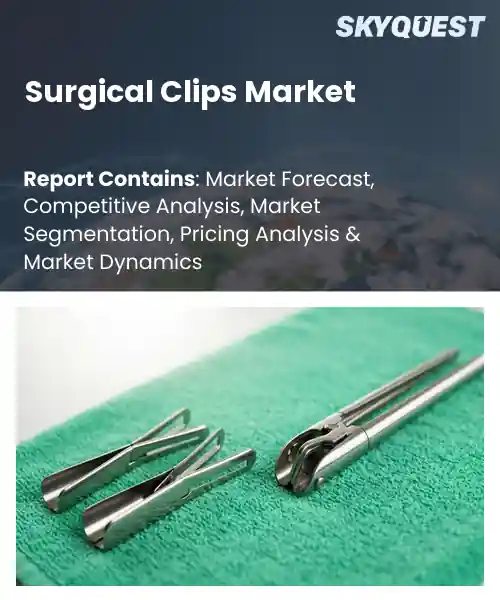
Surgical Clips Market
Report ID: SQMIG35A4000
Report ID: SQMIG35A4000
[email protected]
USA +1 351-333-4748
Report ID:
SQMIG35A4000 |
Region:
Global |
Published Date: June, 2026
Pages:
157
|Tables:
147
|Figures:
78


Global Surgical Clips Market size was valued at USD 483.5 Million in 2024 and is poised to grow from USD 530.83 Million in 2025 to USD 1120.63 Million by 2033, growing at a CAGR of 9.79% during the forecast period (2026-2033).
As a research analyst the primary driver of the surgical clips market is the global rise in operative procedures combined with a shift toward minimally invasive techniques. Surgical clips consist of small metallic or polymer fasteners used for vessel ligation and tissue approximation, and the market matters because clips shorten operative time, reduce blood loss and improve reproducibility relative to manual suturing. Over recent decades clinicians moved from conventional open sutures to titanium and absorbable polymer clips as laparoscopy and endoscopy expanded; for example laparoscopic cholecystectomy and bariatric procedures increasingly rely on clip systems, prompting device innovation and broader adoption.
Building on that innovation, the principal growth factor now centers on material and applicator advancements that enable safer, faster hemostasis and compatibility with robotic platforms. As manufacturers introduced absorbable polymer clips and ergonomically designed single-use appliers surgeons can ligate vessels in confined laparoscopic and robotic fields with reduced artifact on imaging and lower long-term foreign-body reaction, which in turn drives hospital procurement committees to favor clip systems for efficiency. Real-world cases in bariatric, colorectal and vascular surgery illustrate fewer intraoperative conversions and shorter operating time, creating market opportunities in emerging economies and for partnerships between device makers and health systems.
How is AI transforming the surgical clips market?
AI is transforming the surgical clips market, making imaging guidance workflows smarter and integrating them with robotic systems. Key components include AI powered surgical video analytics that identify ideal clip placement AI assisted navigation that stabilizes deployment and data powered feedback loops that refine device selection. The state of the art shows an increasing integration of AI in robotic platforms and surgical analytics with maturing research in vision language models and action recognition. The trends are moving clips from simple disposables to key components of a connected surgical ecosystem that improves procedural consistency, aids surgeon training, and increases the demand for interoperable clip designs.
June 2026 Medtronic announced a strategic collaboration with KARL STORZ to add AI-enabled visualization and workflow tools to its AiBLE ENT ecosystem. That development enables surgeons to place clips more accurately and streamlines device selection and inventory so the market is more efficient and the product is adopted more clinically.
Market snapshot - (2026-2033)
Global Market Size
USD 483.5 Million
Largest Segment
Titanium Clips
Fastest Growth
Dissolvable Magnesium Alloy Clips
Growth Rate
9.79% CAGR
To get more insights on this market click here to Request a Free Sample Report
Global surgical clips market is segmented by material type, application, product focus, component focus, sales channel and region. Based on material type, the market is segmented into Titanium Clips, Polymer Clips, Dissolvable Magnesium Alloy Clips and Others. Based on application, the market is segmented into General Surgery, Cardiovascular Surgery, Gynecological Surgery, Urology and Others. Based on product focus, the market is segmented into Hemostatic Clips, Vascular Clips and Others. Based on component focus, the market is segmented into Surgical Clip Applicators, Clip Removal Tools and Others. Based on sales channel, the market is segmented into Direct Institutional Sales, Medical Equipment Wholesalers and Others. Based on region, the market is segmented into North America, Europe, Asia Pacific, Latin America and Middle East & Africa.
The Titanium Clips segment is leading the market with their established biocompatibility and mechanical robustness, making them the preferred option for a variety of surgical operations, resulting in a high degree of clinician acceptance and purchasing. Long term clinical trust lowers the barriers for adoption of new applications, which leads manufacturers to focus on titanium designs and tooling integration. This built ecosystem encourages supply chain maturity and iterative product refinements, based on cumulative feedback, procedural familiarity and compatibility with existing surgical workflows and instruments, to cement titanium’s leadership.
However, polymer clips are a rapidly growing field due to advances in polymer materials to meet specific requirements such as adjustable flexibility, decreased imaging artifacts, and low cost. Compatibility with minimally invasive instruments and the emergence of absorbable polymer formulations accelerates adoption in procedures seeking adaptable devices, spurring new suppliers and product innovation.
The Hemostatic Clips segment is expected to dominate the market owing to the requirement of quick vessel control, hence required for a wide variety of procedures anchoring buying decisions and clinical protocols. As design enhancements continue to improve grip, accuracy of delivery and tissue compatibility, hospitals are standardizing their hemostatic clip inventory, building surgeon confidence and decreasing intra-operative risk. With this clinical focus, manufacturers develop customized applicators and training support to be competitive in the market.
Vascular Clips is also the fastest growing area due to demand for specialized vascular procedures and new delivery systems for accurate placement in delicate vessels. Surgeons want minimal trauma and the use of novel low profile designs and endovascular compatibility is driving adoption and creating opportunities for niche products and expanded clinical applications.
To get detailed segments analysis, Request a Free Sample Report
North America is the dominant contributor to the global surgical clips market owing to well established healthcare infrastructure, early adoption of surgical innovation and mature reimbursement ecosystems that support device procurement. A dense network of tertiary hospitals and specialized surgical centers, plus leading medical device manufacturers, speed up adoption of advanced clip technologies. Robust clinical research activity, active engagement by surgeons in product evaluation, and simplified regulatory pathways allow for faster market entry and iterative improvements. Consolidated supply chains, broad training programs for minimally invasive techniques and a strong focus on quality and patient safety enhance market leadership even more. Strategic partnerships between device makers and healthcare providers, along with targeted investment in surgical education, are fueling healthy demand for both traditional and disposable clip systems. Clinician confidence is underpinned by strong post market surveillance.
U.S. Surgical Clips Market is driven by advanced hospital systems, deep physician engagement and large volume of procedures. Extensive training programs and a desire for minimally invasive approaches facilitate adaptation of the new clip designs. Good distribution networks and collaborative clinical evaluation are in place to speed uptake. Product improvement is driven by competition among suppliers, while established reimbursement frameworks and a focus on patient safety maintain stable demand in core surgical specialties in key markets.
Canadian Surgical Clips Market is flourishing on the back of integrated healthcare delivery models across provinces and centers of surgical excellence with focus on safety and standardization. Emerging clip technologies will be taken up and tested through clinician networks and collaborative procurement. Regional training and focus on minimally invasive techniques helped to spread the use of advanced devices. The guiding principles for decision making at hospital level are the simplicity of the supply chain, and clinical outcomes and cost effectiveness through partnerships between international manufacturers and local distributors.
Europe is experiencing the rapid expansion of surgical clips market due to the robust clinical expertise, active medical technology industry and integrated healthcare delivery models that promote the adoption of surgical innovations. Established clinical trial networks and pan-regional regulatory alignment support market access and evidence generation for new clip designs. Hospitals and specialist centres are focusing on minimally invasive procedures, and this is generating demand for advanced clip systems that will boost efficiency and outcomes. Local manufacturers are well mixed with international suppliers, making for competitive product development and local production. Further accelerating adoption and market depth across European healthcare markets are procurement strategies balancing cost containment with clinical quality and increasing outpatient surgical capacity and cross border knowledge exchange between surgeons. All of these elements combine to create an environment that is conducive to continuous innovation.
The Germany Surgical Clips Market is propelled by a highly developed medical technology manufacturing base, and a close collaboration between industry and clinical research. The evaluation of advanced clip systems is supported by high standards of surgical training and hospital accreditation. The demand for a wide variety of clip solutions is underpinned by the focus on engineering precision and product quality. Partnerships with hospitals speed up the iterative design improvements. Efficient procurement and export production underpin Germany’s position in the broader European landscape.
The Surgical Clips Market in the United Kingdom is witnessing fast adoption owing to the increasing ambulatory surgery capacity, active private provider networks and focus on procedural efficiency. Clinician led evaluations and regional procurement consortia provide routes for novel clip technologies. Strong training programs and academic hospitals speed up clinical adoption. Focus on cost effective solutions without compromising on quality outcomes drives adoption and collaboration between manufacturers and surgical teams drives localized innovation.
France Surgical Clips Market is expected to grow due to the increasing number of surgical procedures and the increasing number of product approvals. Development of clinical guidelines and regional centers of excellence encourage evaluation of new clip technologies. Greater interaction between local medical technology companies and clinical stakeholders leads to more practical solutions. Cost conscious, standardized procurement processes and a focus on procedural safety support the diffusion of the technology. Research collaboration with the academic hospitals helps build evidence and clinician confidence within national networks.
Asia Pacific is consolidating its position in surgical clips market with combination of growing surgical infrastructure, growing local manufacturing capability and growing clinical expertise. Investment in minimally invasive surgery programs and surgeon training. Good environment for established and new clip technologies. Regulatory pathways are becoming more defined, which is providing more clarity on the path to device approval and post-market surveillance. Global suppliers have strategic partnerships with regional manufacturers to transfer technology and locally adapt products to meet cost and clinical requirements. The region is moving beyond its status as a price-sensitive market, with a growing emphasis on outpatient procedures, efficient surgical workflows, and active participation in multicenter clinical assessments, positioning itself as a key player in product development and regional supply chains.
Japan’s surgical clips market is driven by advanced medical device innovation and precision manufacturing standards. Clinicians and industry can work together to rigorously test and adopt refined clip technologies. The need for these systems is driven by integration of specialized clip systems into advanced surgical platforms and the focus on efficiency of procedures. Today Japan is a leading developer and early user in regional and global device networks and employs targeted product development and international partnerships.
Persistence Market Research South Korea Surgical Clips Market, Clinical feedback enables fast product improvement and acceptance of new clip designs. Concentrate on quality cost effective solutions in line with procurement priorities Export orientation and collaboration with foreign medtech companies to improve market access. Steady uptake and innovation are underpinned by surgeon training and specialised centres.
To know more about the market opportunities by region and country, click here to
Buy The Complete Report
Rising Minimally Invasive Surgeries
Advancements In Clip Materials
Limited Surgeon Training Access
Supply Chain And Cost Volatility
Request Free Customization of this report to help us to meet your business objectives.
Johnson & Johnson, Teleflex Incorporated, B. Braun, Boston Scientific and Meril Life Sciences are leading the surgical clips market and competing with each other by providing advanced titanium and polymer ligating clips, ergonomic applicators and minimally invasive surgery solutions. The market is still a little consolidated with innovation focusing on clip security, biocompatibility, imaging compatibility and laparoscopic procedures. The primary competitive force is presented by established manufacturers, given the few validated startups dedicated solely to surgical clips that have emerged since 2019.
SkyQuest’s ABIRAW (Advanced Business Intelligence, Research & Analysis Wing) is our Business Information Services team that Collects, Collates, Correlates, and Analyses the Data collected by means of Primary Exploratory Research backed by robust Secondary Desk research.
The major factors driving the global surgical clips market are the growing number of operative volumes and a shift to minimally invasive procedures driving the demand for efficient vessel ligation and tissue approximation, as per SkyQuest’s analysis. Another driver is continuous innovation in materials and applicators such as absorbable polymers and compatibility with robotic and digital platforms, which expands the clinical use cases. Limited access to surgeon training remains a significant barrier that can slow adoption of newer systems. North America continues to remain the market leader due to its well-established healthcare infrastructure and early adoption of new technologies. Titanium clips hold the leading position in the segment, owing to long-standing clinical trust and proven biocompatibility.
| Report Metric | Details |
|---|---|
| Market size value in 2024 | USD 483.5 Million |
| Market size value in 2033 | USD 1120.63 Million |
| Growth Rate | 9.79% |
| Base year | 2024 |
| Forecast period | (2026-2033) |
| Forecast Unit (Value) | USD Million |
| Segments covered |
|
| Regions covered | North America (US, Canada), Europe (Germany, France, United Kingdom, Italy, Spain, Rest of Europe), Asia Pacific (China, India, Japan, Rest of Asia-Pacific), Latin America (Brazil, Rest of Latin America), Middle East & Africa (South Africa, GCC Countries, Rest of MEA) |
| Companies covered |
|
| Customization scope | Free report customization with purchase. Customization includes:-
|
To get a free trial access to our platform which is a one stop solution for all your data requirements for quicker decision making. This platform allows you to compare markets, competitors who are prominent in the market, and mega trends that are influencing the dynamics in the market. Also, get access to detailed SkyQuest exclusive matrix.
Table Of Content
Executive Summary
Market overview
Parent Market Analysis
Market overview
Market size
KEY MARKET INSIGHTS
COVID IMPACT
MARKET DYNAMICS & OUTLOOK
Market Size by Region
KEY COMPANY PROFILES
Methodology
For the Surgical Clips Market, our research methodology involved a mixture of primary and secondary data sources. Key steps involved in the research process are listed below:
1. Information Procurement: This stage involved the procurement of Market data or related information via primary and secondary sources. The various secondary sources used included various company websites, annual reports, trade databases, and paid databases such as Hoover's, Bloomberg Business, Factiva, and Avention. Our team did 45 primary interactions Globally which included several stakeholders such as manufacturers, customers, key opinion leaders, etc. Overall, information procurement was one of the most extensive stages in our research process.
2. Information Analysis: This step involved triangulation of data through bottom-up and top-down approaches to estimate and validate the total size and future estimate of the Surgical Clips Market.
3. Report Formulation: The final step entailed the placement of data points in appropriate Market spaces in an attempt to deduce viable conclusions.
4. Validation & Publishing: Validation is the most important step in the process. Validation & re-validation via an intricately designed process helped us finalize data points to be used for final calculations. The final Market estimates and forecasts were then aligned and sent to our panel of industry experts for validation of data. Once the validation was done the report was sent to our Quality Assurance team to ensure adherence to style guides, consistency & design.
Analyst Support
Customization Options
With the given market data, our dedicated team of analysts can offer you the following customization options are available for the Surgical Clips Market:
Product Analysis: Product matrix, which offers a detailed comparison of the product portfolio of companies.
Regional Analysis: Further analysis of the Surgical Clips Market for additional countries.
Competitive Analysis: Detailed analysis and profiling of additional Market players & comparative analysis of competitive products.
Go to Market Strategy: Find the high-growth channels to invest your marketing efforts and increase your customer base.
Innovation Mapping: Identify racial solutions and innovation, connected to deep ecosystems of innovators, start-ups, academics, and strategic partners.
Category Intelligence: Customized intelligence that is relevant to their supply Markets will enable them to make smarter sourcing decisions and improve their category management.
Public Company Transcript Analysis: To improve the investment performance by generating new alpha and making better-informed decisions.
Social Media Listening: To analyze the conversations and trends happening not just around your brand, but around your industry as a whole, and use those insights to make better Marketing decisions.
REQUEST FOR SAMPLE
 REQUEST FREE CUSTOMIZATION
Global Surgical Clips Market size was valued at USD 483.5 Million in 2024 and is poised to grow from USD 530.83 Million in 2025 to USD 1120.63 Million by 2033, growing at a CAGR of 9.79% during the forecast period (2026-2033).
I cannot verify two real startups founded in or after 2019 that are specifically focused on surgical clips. Do you want me to proceed by using verified companies founded before 2019 that launched clip products recently, or include verified startups founded since 2019 that work in adjacent ligation or clip applier technologies? Reply with 1 for the first option or 2 for the second option. 'B. Braun', 'Boston Scientific', 'Johnson & Johnson', 'Medtronic', 'Grena', 'Teleflex', 'Ackermann Instrument', 'Edwards Lifesciences', 'LeMaitre Vascular', 'Scanlan International', 'Peters Surgical', 'Vitalitec', 'Aesculap', 'Symmetry Surgical', 'Purple Surgical', 'Applied Medical', 'Mizuho', 'KLS Martin', 'Integra LifeSciences', 'Sinomed'
Minimally invasive procedures favor faster recovery and smaller incisions, increasing reliance on surgical clips for vessel ligation and tissue approximation. Surgeons prefer devices that simplify intracorporeal maneuvers and reduce operative time, so clips become integral to procedure protocols. As clinical practice shifts toward laparoscopic and robotic approaches, demand for reliable clip systems that accommodate limited access and deliver consistent closure grows. This adoption encourages manufacturers to expand product lines and supports market expansion by aligning device design with evolving surgical workflows and clinician preferences.
Patient-Centric Device Design: The industry is moving toward devices engineered around patient outcomes and comfort, emphasizing smaller profiles, enhanced biocompatibility, and reduced foreign-body sensation. Manufacturers prioritize usability for diverse patient populations and long-term tissue integration, collaborating with clinicians to refine clip geometries and materials that support healing while minimizing discomfort. Regulatory and reimbursement environments further encourage solutions that improve recovery experiences, prompting product roadmaps focused on lifecycle considerations, patient feedback, and evidence of improved quality of life rather than solely procedural metrics.
Why does North America Dominate the Global Surgical Clips Market? |@12


Want to customize this report? This report can be personalized according to your needs. Our analysts and industry experts will work directly with you to understand your requirements and provide you with customized data in a short amount of time. We offer $1000 worth of FREE customization at the time of purchase.
Feedback From Our Clients


 USA (+1) 351-333-4748

