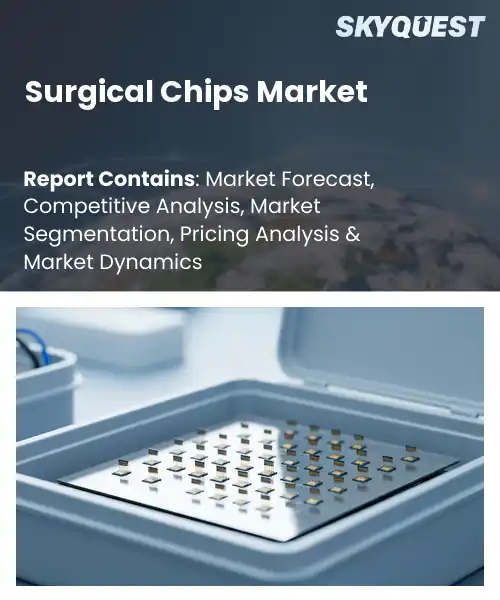
Surgical Chips Market
Report ID: SQMIG35A3940
Report ID: SQMIG35A3940
[email protected]
USA +1 351-333-4748
Report ID:
SQMIG35A3940 |
Region:
Global |
Published Date: June, 2026
Pages:
157
|Tables:
182
|Figures:
79


Global Surgical Chips Market size was valued at USD 951.1 Million in 2024 and is poised to grow from USD 1022.43 Million in 2025 to USD 1823.49 Million by 2033, growing at a CAGR of 7.5% during the forecast period (2026-2033).
The global surgical chips market comprises miniature electronic modules that embed sensors, processors, and communication units within surgical instruments to enable real‑time data acquisition and decision support. Consequently, hospitals have begun replacing conventional tools with devices, illustrated by the 2022 rollout of new scalpel systems in academic centers.
The next pivotal factor driving the global surgical chips market is the convergence of Artificial Intelligence with intra‑operative analytics, which transforms raw sensor streams into actionable insights that surgeons can act upon instantly. As hospitals integrate predictive algorithms into chip‑enabled devices, operating rooms experience lower error rates and higher throughput, encouraging procurement budgets to prioritize instrument suites.
How is AI-enabled automation reshaping the surgical chips market?
AI-enabled automation is driving a shift in the surgical chips market by embedding intelligent decision‑making directly into implantable devices. Manufacturers are integrating machine‑learning algorithms that can interpret physiological signals in real time, allowing chips to adjust therapy parameters without surgeon intervention. This capability is reducing procedure times and improving patient outcomes, as chips become more responsive to intra‑operative changes. The trend is also encouraging tighter collaboration between hardware engineers and software developers, creating ecosystems where data analytics and device design co‑evolve. As hospitals adopt more minimally invasive techniques, the demand for smarter, self‑optimizing chips is accelerating, positioning AI as a core differentiator for next‑generation surgical solutions.
In May 2026, a leading surgical chip manufacturer announced an AI‑driven automation platform, highlighting how intelligent chips can streamline workflow and enhance precision, thereby supporting market growth.
Market snapshot - (2026-2033)
Global Market Size
USD 951.1 Million
Largest Segment
Hemostatic Gelatin Chips
Fastest Growth
Drug-Eluting Surgical Chips
Growth Rate
7.5% CAGR
To get more insights on this market click here to Request a Free Sample Report
Global surgical chips market is segmented by product type, material type, application, function, end user, distribution channel and region. Based on product type, the market is segmented into Bone Wax Chips, Hemostatic Gelatin Chips, Collagen-Based Surgical Chips, Antimicrobial Surgical Chips, Drug-Eluting Surgical Chips and Others. Based on material type, the market is segmented into Collagen, Gelatin, Oxidized Regenerated Cellulose, Synthetic Polymers and Others. Based on application, the market is segmented into Orthopedic Surgery, General Surgery, Neurosurgery, Cardiovascular Surgery, Dental & Maxillofacial Surgery and Others. Based on function, the market is segmented into Hemostasis, Infection Control, Drug Delivery, Tissue Regeneration and Others. Based on end user, the market is segmented into Hospitals, Ambulatory Surgical Centers, Specialty Clinics and Others. Based on distribution channel, the market is segmented into Direct Sales, Medical Device Distributors and Others. Based on region, the market is segmented into North America, Europe, Asia Pacific, Latin America and Middle East & Africa.
Collagen-based surgical chips segment dominates with large surgical chips market share because its inherent biocompatibility and natural hemostatic properties align closely with surgeon preferences for safe, effective bleeding control. The material’s ability to integrate seamlessly with tissue encourages rapid adoption across diverse procedures, while its proven track record reduces regulatory uncertainty. Consequently, manufacturers prioritize collagen formulations, reinforcing its leadership in the surgical chips market. Its cost-effectiveness and well‑established supply chain further embed it in hospital procurement strategies.
As per surgical chips market outlook, drug-eluting surgical chips segment emerges as the most rapidly expanding area because they combine hemostasis with localized therapeutic delivery, meeting growing demand for efficiency and outcomes. Innovations in controlled release technology and expanding indications in oncology and orthopedics fuel adoption, positioning these chips as catalysts for market growth and revenue streams.
As per surgical chips market forecast, collagen material segment dominates because its biological origin provides innate hemostatic action and excellent tissue compatibility, which surgeons trust for reliable bleed control. The material’s capacity to swell and form a stable matrix quickly seals vascular sites, while its long‑standing clinical validation lowers adoption barriers. Consequently, manufacturers prioritize collagen‑based formulations, reinforcing its preeminence within the material landscape of surgical chips. Its cost-effectiveness and well‑established supply chain further embed it in hospital procurement strategies.
Synthetic polymers material segment is witnessing the strongest growth momentum because they enable engineering of degradability, mechanical strength and drug‑loading capacity, meeting surgical demands. Ongoing innovations in polymer chemistry and regulatory encouragement for resorbable solutions expand their applicability across minimally invasive procedures, propelling rapid market uptake and opening new avenues for product differentiation.
To get detailed segments analysis, Request a Free Sample Report
North America has an ecosystem of top-tier research institutions and long-established medical device manufacturers to provide a smooth path from discovery to clinical acceptance. Strong reimbursement policies encourage hospitals to use sophisticated surgical chip technologies, while a highly controlled environment ensures product quality and patient safety. The region's wide network of specialized hospitals and academic centers fosters early acceptance and a culture of ongoing professional growth accelerates surgeon skill. Strategic alliances between technology corporations and medical service providers further enhance the market’s scope, making North America a hub of demand and supply excellence.
As per surgical chips market regional outlook, United States is propelled by a vast network of research universities and venture capital that fuels rapid product development. A mature regulatory pathway provides clarity for innovators, encouraging swift market entry. Hospital systems prioritize value‑based care, leading to adoption of technologies that improve procedural efficiency and patient outcomes. Strong physician advocacy groups champion the benefits of minimally invasive solutions, reinforcing market momentum across diverse clinical settings.
As per surgical chips market regional forecast, Canada is shaped by a publicly funded healthcare system that emphasizes cost‑effectiveness and clinical efficacy. National health agencies support evidence‑based adoption, encouraging hospitals to integrate advanced chip platforms that demonstrate clear patient benefits. Collaborative research programs between universities and industry foster localized innovation, while regulatory alignment with international standards simplifies product access. The focus on equitable care ensures that cutting‑edge surgical technologies reach a broad patient base across the country.
As per surgical chips industry analysis, European expansion is facilitated by the harmonized regulatory frameworks, which make cross-border product approvals a breeze, allowing manufacturers to scale efficiently, according to the surgical chips industry report. Significant government and private investment in precision medicine and digital health fosters an environment that is conducive to the deployment of advanced surgical chips. Clinical demand is driven by an aging population and increasing expectations for minimally invasive procedures, and the maturity of technology is accelerated by joint research consortia among prominent universities. Reimbursement rules that reward interventions focused on outcomes further incentivise hospitals to embrace breakthrough chip solutions, cementing Europe as a fast-growing market for surgical technologies.
Germany is characterized by a dense concentration of medical engineering firms and a rigorous quality culture. The country’s leading research hospitals serve as early adopters, generating robust clinical evidence that guides broader implementation. Strong export orientation encourages continuous product refinement, while industry standards emphasize interoperability and patient safety. Collaborative clusters linking academia, device manufacturers, and health insurers create a supportive ecosystem that propels market leadership.
United Kingdom is accelerated by a health system that prioritizes innovation through dedicated funding streams and fast‑track approval pathways. National health service initiatives promote the integration of technologies that reduce surgical length of stay and improve postoperative outcomes. Academic medical centers collaborate closely with biotech firms, fostering rapid prototyping and clinical validation. The emphasis on value‑based procurement drives adoption across both urban and regional hospitals.
France benefits from a strong tradition of biomedical research and a centralized healthcare structure that facilitates coordinated technology rollout. Governmental health agencies support pilot programs that assess clinical benefits, encouraging wider uptake once efficacy is demonstrated. Partnerships between French medical device clusters and multinational corporations enable technology transfer and local manufacturing, enhancing market accessibility and fostering emerging growth.
Asia Pacific is on the rise on the back of increasing surgical volumes, government initiatives and a booming biotech ecosystem focused on high-precision therapies. The nations of the region invest considerably in research infrastructure, which encourages local innovation and attracts multinational partnerships. Demand is also rising as patients become more aware of minimally invasive treatments. Hospitals are looking for solutions to make workflow more efficient and reduce post-operative problems. Strategic steps to build up domestic manufacturing capacity will cut dependency on imports, improve supply chain resilience, and put the region on the map as a rising leader in surgical chip technology.
Japan is propelled by a culture of meticulous clinical evaluation and a healthcare system that values long‑term patient outcomes. Advanced research institutions collaborate closely with device manufacturers to refine chip designs that align with Japanese surgical techniques. Government support for medical technology innovation enhances funding for clinical trials, while hospitals adopt solutions that demonstrably shorten recovery times, reinforcing market growth.
South Korea is driven by rapid digitalization of hospitals and strong governmental incentives for high‑technology healthcare solutions. Aggressive investment in research and development cultivates a pipeline of locally engineered chip platforms tailored to regional surgical practices. The emphasis on integrating data analytics with surgical tools encourages hospitals to adopt advanced chip systems that improve precision and operational efficiency.
To know more about the market opportunities by region and country, click here to
Buy The Complete Report
Growing Adoption of Robotic Systems
Advancements In Sensor Integration
High Initial Capital Expenditure
Regulatory Approval Complexity
Request Free Customization of this report to help us to meet your business objectives.
The competitive landscape of the global surgical chips industry is shaped by aggressive M&A activity, strategic partnerships with device manufacturers, and rapid tech innovation, exemplified by recent acquisitions of chip‑design firms by leading medtech groups and collaborations that integrate AI‑driven analytics into surgical instruments, accelerating product differentiation and market entry.
SkyQuest’s ABIRAW (Advanced Business Intelligence, Research & Analysis Wing) is our Business Information Services team that Collects, Collates, Correlates, and Analyses the Data collected by means of Primary Exploratory Research backed by robust Secondary Desk research.
As per SkyQuest analysis, the global surgical chips market growth is being propelled primarily by the rapid adoption of robotic surgical systems which enhance precision and drive demand for chip‑enabled instruments while advances in sensor integration further boost functionality and appeal. The market is led by North America, where strong research ecosystems and reimbursement support accelerate uptake. Collagen‑based surgical chips remain the dominant segment due to their proven hemostatic performance and cost‑effectiveness. However, high initial capital expenditure for chip platforms poses a notable restraint, slowing adoption in cost‑sensitive institutions. A second driver is AI‑enabled automation that embeds intelligent decision‑making into devices, expanding clinical value and market momentum. The global surgical chips market trend driven by the increasing volume of surgical procedures, rising prevalence of chronic diseases and growing demand for advanced hemostatic products in operating rooms.
| Report Metric | Details |
|---|---|
| Market size value in 2024 | USD 951.1 Million |
| Market size value in 2033 | USD 1823.49 Million |
| Growth Rate | 7.5% |
| Base year | 2024 |
| Forecast period | (2026-2033) |
| Forecast Unit (Value) | USD Million |
| Segments covered |
|
| Regions covered | North America (US, Canada), Europe (Germany, France, United Kingdom, Italy, Spain, Rest of Europe), Asia Pacific (China, India, Japan, Rest of Asia-Pacific), Latin America (Brazil, Rest of Latin America), Middle East & Africa (South Africa, GCC Countries, Rest of MEA) |
| Companies covered |
|
| Customization scope | Free report customization with purchase. Customization includes:-
|
To get a free trial access to our platform which is a one stop solution for all your data requirements for quicker decision making. This platform allows you to compare markets, competitors who are prominent in the market, and mega trends that are influencing the dynamics in the market. Also, get access to detailed SkyQuest exclusive matrix.
Table Of Content
Executive Summary
Market overview
Parent Market Analysis
Market overview
Market size
KEY MARKET INSIGHTS
COVID IMPACT
MARKET DYNAMICS & OUTLOOK
Market Size by Region
KEY COMPANY PROFILES
Methodology
For the Surgical Chips Market, our research methodology involved a mixture of primary and secondary data sources. Key steps involved in the research process are listed below:
1. Information Procurement: This stage involved the procurement of Market data or related information via primary and secondary sources. The various secondary sources used included various company websites, annual reports, trade databases, and paid databases such as Hoover's, Bloomberg Business, Factiva, and Avention. Our team did 45 primary interactions Globally which included several stakeholders such as manufacturers, customers, key opinion leaders, etc. Overall, information procurement was one of the most extensive stages in our research process.
2. Information Analysis: This step involved triangulation of data through bottom-up and top-down approaches to estimate and validate the total size and future estimate of the Surgical Chips Market.
3. Report Formulation: The final step entailed the placement of data points in appropriate Market spaces in an attempt to deduce viable conclusions.
4. Validation & Publishing: Validation is the most important step in the process. Validation & re-validation via an intricately designed process helped us finalize data points to be used for final calculations. The final Market estimates and forecasts were then aligned and sent to our panel of industry experts for validation of data. Once the validation was done the report was sent to our Quality Assurance team to ensure adherence to style guides, consistency & design.
Analyst Support
Customization Options
With the given market data, our dedicated team of analysts can offer you the following customization options are available for the Surgical Chips Market:
Product Analysis: Product matrix, which offers a detailed comparison of the product portfolio of companies.
Regional Analysis: Further analysis of the Surgical Chips Market for additional countries.
Competitive Analysis: Detailed analysis and profiling of additional Market players & comparative analysis of competitive products.
Go to Market Strategy: Find the high-growth channels to invest your marketing efforts and increase your customer base.
Innovation Mapping: Identify racial solutions and innovation, connected to deep ecosystems of innovators, start-ups, academics, and strategic partners.
Category Intelligence: Customized intelligence that is relevant to their supply Markets will enable them to make smarter sourcing decisions and improve their category management.
Public Company Transcript Analysis: To improve the investment performance by generating new alpha and making better-informed decisions.
Social Media Listening: To analyze the conversations and trends happening not just around your brand, but around your industry as a whole, and use those insights to make better Marketing decisions.
REQUEST FOR SAMPLE
 REQUEST FREE CUSTOMIZATION
Global Surgical Chips Market size was valued at USD 951.1 Million in 2024 and is poised to grow from USD 1022.43 Million in 2025 to USD 1823.49 Million by 2033, growing at a CAGR of 7.5% during the forecast period (2026-2033).
The competitive landscape of the global surgical chips market is shaped by aggressive M&A activity, strategic partnerships with device manufacturers, and rapid tech innovation, exemplified by recent acquisitions of chip‑design firms by leading medtech groups and collaborations that integrate AI‑driven analytics into surgical instruments, accelerating product differentiation and market entry. 'Johnson & Johnson MedTech', 'Baxter International', 'Becton, Dickinson and Company (BD)', 'Medtronic plc', 'B. Braun SE', 'Integra LifeSciences', 'Stryker Corporation', 'Zimmer Biomet', 'Smith & Nephew', 'Teleflex Incorporated', 'Coloplast A/S', 'Pfizer Hospital Products', 'Biocomposites Ltd.', 'BoneSupport AB', 'Orthofix Medical', 'Anika Therapeutics', 'Aesculap (B. Braun)', 'SeaSpine Holdings', 'Kerecis', 'Aroa Biosurgery'
The increasing adoption of robotic surgical platforms enables precise instrument manipulation, reducing intra‑operative errors and shortening procedure times. Surgeons benefit from enhanced visualization and ergonomics, which improve patient outcomes and encourage broader clinical acceptance. Hospitals view the technology as a strategic investment that differentiates their services and attracts high‑margin cases. This positive perception drives procurement cycles, prompting manufacturers to expand product portfolios and support services, thereby reinforcing market expansion across diverse healthcare systems worldwide and regional collaborations with academic institutions.
Ai‑Driven Surgical Navigation: AI-powered surgical navigation chips are reshaping operating rooms by delivering real‑time imaging fusion, predictive tissue behavior models, and automated instrument guidance, enabling surgeons to anticipate anatomical variations and reduce cognitive load. This intelligence layer enhances procedural accuracy, shortens operative times, and supports minimally invasive techniques, fostering broader adoption of complex surgeries across institutions. As hospitals prioritize outcome‑driven care, demand for chips that embed machine‑learning algorithms and continuously update from aggregated case data is accelerating through collaborative clinical ecosystems worldwide globally.
Why does North America Dominate the Global Surgical Chips Market? |@12


Want to customize this report? This report can be personalized according to your needs. Our analysts and industry experts will work directly with you to understand your requirements and provide you with customized data in a short amount of time. We offer $1000 worth of FREE customization at the time of purchase.
Feedback From Our Clients


 USA (+1) 351-333-4748

