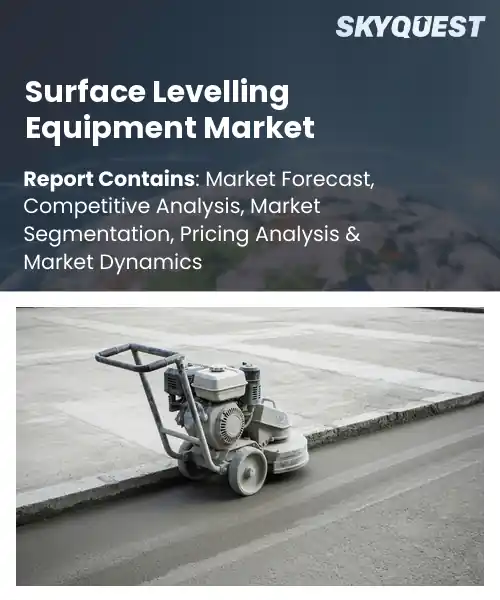
Surface Levelling Equipment Market
Report ID: SQMIG20G2128
Report ID: SQMIG20G2128
[email protected]
USA +1 351-333-4748
Report ID:
SQMIG20G2128 |
Region:
Global |
Published Date: May, 2026
Pages:
157
|Tables:
118
|Figures:
77


Global Surface Levelling Equipment Market size was valued at USD 2.52 Billion in 2024 and is poised to grow from USD 2.67 Billion in 2025 to USD 4.22 Billion by 2033, growing at a CAGR of 5.81% during the forecast period (2026-2033).
The surface levelling equipment industry revolves around machinery and tech that makes sure surfaces are flat and even, for both construction and industrial use, and the main push behind it is the ramping up of demand for quicker, more precise project delivery across infrastructure as well as commercial and residential works. Now, as urban growth keeps rising and stricter tolerance expectations show up, while labor shortages are also sitting in the mix, contractors lean more on mechanized solutions to keep schedules tight, cut spend, and still meet tougher regulatory and performance obligations.
Building on that shift to mechanization, the strongest driver for the surface levelling equipment market penetration is rapid technological integration, where lasers, GPS, sensors, and connectivity get stitched together so the equipment can deliver measurable productivity gains and also reduce material waste. For example, when a laser-guided screed brings surface variance down, slab rework tends to fall, timelines get shorter, and labor requirements ease, so owners are more willing to buy higher-capability machines or just rent from providers, which increases overall adoption. In addition, telematics supports preventive maintenance and fleet optimization, that lowers lifecycle costs and helps larger contractors justify growing their fleets. Together these trends open room for manufacturers to sell upgrades, subscription services, and retrofit kits, especially in emerging markets and outside the core regions.
Automation is boosting accuracy and efficiency by combining exact sensing with automated controls and digital workflows. A big part of it is laser guidance and adaptive machine control, along with real time monitoring, which helps keep grades consistent and limits the usual human wobble. Right now, many suppliers are already adding automated grade set features and diagnostic tools, so operators can reach specification in fewer passes and produce less rework. The main drivers are the need for higher floor flatness, faster project turnover, and the simple fact that skilled labor can be hard to secure, so automated setups feel more compelling. This can be seen in practice with laser guided screeds that include machine control suites and integrated scanning, which helps smooth the handoff between survey teams and paving crews.
Market snapshot - (2026-2033)
Global Market Size
USD 2.52 Billion
Largest Segment
Laser Screeds
Fastest Growth
Laser Screeds
Growth Rate
5.81% CAGR
To get more insights on this market click here to Request a Free Sample Report
The global surface levelling equipment market is segmented by product type, application, end use, distribution and region. Based on product type, the market is segmented into Laser Screeds, Power Screeds, Vibrating Screeds and Concrete Leveling Systems. Based on application, the market is segmented into Concrete Flooring, Road Construction and Airport & Industrial Floors. Based on end-use, the market is segmented into Residential Construction, Commercial Construction and Infrastructure. Based on distribution, the market is segmented into Direct Sales, Equipment Rental and Distributors. Based on region, the market is segmented into North America, Europe, Asia Pacific, Latin America and Middle East & Africa.
As per the surface levelling equipment market analysis, the Laser Screeds segment dominates because contractors like the way they can deliver high-precision flatness and fairly consistent surface profiles across big pours, which in turn cuts down on rework and lowers labor intensity in the market. Their mix with laser guidance and automation helps them move faster and stay repeatable, so flooring specialists and owners start specifying them; you can also say the perceived lifecycle cost benefits, and proven performance on industrial and airport floors, keeps demand going and keeps suppliers focused on this tech.
However, the Power Screeds category is expanding quicker, mostly because there is demand for compact finishing that is also cost-effective on small to mid-sized jobs, where maneuverability matters and where lower capital intensity is a deciding factor. Continuous tweaks in engine efficiency and electric power options, along with rental availability and contractor training, is basically speeding adoption and making new installation opportunities show up more often.
According to the surface levelling equipment market forecast, the Equipment Rental segment tends to lead because it removes upfront capital barriers for contractors. That means they can get access to advanced levelling machines for intermittent jobs, or for project-specific needs, throughout the Surface Levelling Equipment Market. Rental providers often bundle maintenance, transport and operator training, which boosts equipment utilization and speeds up procurement cycles. This operational flexibility makes contractors more willing to try these systems, and it also supports manufacturers, because there is steady fleet demand, and service contracts. And then it feeds into faster innovation feedback loops.
On the other hand, the Distributors category is predicted to have the largest surface levelling equipment market share, largely because they can offer localized inventory, technical support, and even integrated financing, which reduces procurement friction for contractors. Improved digital ordering, value-added options like on-site commissioning and spare parts logistics, and tighter OEM partnerships are helping them reach further. In the end, that’s creating recurring revenue streams, which makes equipment adoption accelerate.
To get detailed segments analysis, Request a Free Sample Report
As per the surface levelling equipment market regional forecast, Asia Pacific is leading the market, mostly because there’s this crowded mix of advanced manufacturing clusters, and ongoing building and infrastructure motion and big pull from precision electronics and automotive production. Local original equipment manufacturers and component suppliers bring together integrated solutions that match the regional manufacturing rhythms, and with automation and digital control getting used everywhere, productivity grows and the machines get more capable, more refined. There are also lower manufacturing costs and helpful industrial rules , so domestic sourcing stays attractive and export minded supply chains keep moving. With so many suppliers nearby and a trained workforce, deployment happens faster, and aftermarket service is quicker too, which keeps the regional leadership steady. Then cross border trading and regional cooperation push technology sharing and scale benefits , so firms can keep investing in newer platforms and higher capability machines across different end uses. Supplier rivalry stays intense, so product refinement never really slows down.
Japan Surface Levelling Equipment Market
The Surface Levelling Equipment industry in Japan is driven by demand for high precision, and compact equipment that fits advanced electronics and automotive workflows. Domestic manufacturers lean into innovation, quality control and tight alignment with factory automation, even when space gets limited. Ongoing maintenance and aftermarket coverage supports longer lifecycles while machine builders and system integrators collaborate closely to craft solutions optimized for limited floor space, and for strict process tolerances. Exports also back up this whole specialization path , pushing technology and know how forward.
South Korea Surface Levelling Equipment Market
The Surface Levelling Equipment sector in South Korea benefits from how linked it is to automotive, shipbuilding, and electronics clusters. Here the demand tends to focus on rugged design and adjustable setups for heavy industry and precision assembly lines. Local suppliers often team up with system integrators and research organizations, they tune solutions to match production scale and efficiency targets. There’s strong domestic engineering ability , along with concentrated development work, which helps advanced control and sensing tech get adapted quickly across many industrial settings.
The North American surface levelling equipment market penetration is driving rapidly because infrastructure renewal is ongoing, construction work stays busy, and manufacturing requirements increasingly demand precision and productivity, like right now. Growth is helped by a broad rental and service ecosystem that lowers the adoption hurdle and makes flexible project deployment more realistic. When providers deliver strong aftermarket support , and integrated solution bundles, uptime and total lifecycle value look better for buyers. Automation takeup , sensor integration, and remote diagnostics also fit with local efficiency goals and labor optimization priorities. Contractor partnerships with equipment manufacturers and tech companies help speed up customization for different project styles, while sustainability and operational cost control keep encouraging investment in improved levelling platforms. Procurement from both public and private sectors tends to reinforce standardized specifications , and that widens market access.
United States Surface Levelling Equipment Market
The Surface Levelling Equipment Market in the United States is shaped by huge infrastructure commitments, high levels of construction, and manufacturing centers that need accuracy. A mature rental space and dealership networks make it easier to get equipment and cover more locations. Providers often stress integrated tech bundles, including sensor based control and remote monitoring, so contractors can push for efficiency and reduce downtime. Collaboration with engineering and construction firms supports tailored options for commercial, civil, and mixed project requirements.
Canada Surface Levelling Equipment Market
Surface Levelling Equipment Market in Canada ties back to infrastructure upkeep, resource related projects , and construction efforts across very different climates. Buyers usually choose equipment that’s built for durability, cold weather handling, and easier movement to remote working areas. Local distributors and contractor networks give tailored support, and rental choices that fit dispersed job sites. Suppliers generally focus on solid service arrangements and equipment configurations that blend operational resilience with efficiency for contractors, even when environmental conditions get rough.
Europe seems to be gaining more weight in the surface levelling equipment market, mostly by leaning into precision engineering, tough regulatory expectations, and a noticeable push for energy savvy sustainable approaches. Companies tend to concentrate on high quality parts and modular design, so they can back retrofit and modernization efforts in older buildings and infrastructure, you know those sectors that are already mature. When research bodies, OEMs and contractors work close together it speeds up take-up of digital controls, sensor fusion, and predictive maintenance. Cross border trade, more or less unified standards, and well built aftermarket networks help products stay available and service stays consistent. In specialized advanced manufacturing hubs, teams can craft more tuned solutions for automotive, aerospace, and civil engineering use cases, which basically reinforces Europe as a premium and technically advanced origin for levelling platforms. Also investment in training, certification and circular economy routines boosts lifecycle value, and it creates differentiation across different national markets.
Germany Surface Levelling Equipment Market
In Germany, the surface levelling equipment market is all about precision, durability, and smooth integration with Industry four point zero. Equipment demand comes from automotive and machinery segments that want tight tolerances, and steady rugged output. Local vendors often focus on quality components, modular systems, and after sales engineering assistance, so problems can be handled quickly. Partnerships with research institutes and system integrators help unlock customized solutions, improve process efficiency, support retrofits, and keep everything aligned with strict industrial requirements across sectors.
United Kingdom Surface Levelling Equipment Market
In the United Kingdom, the surface levelling equipment market is influenced by urban regeneration and ongoing infrastructure refurbishments. Contractors prefer adaptable equipment for retrofit jobs, especially when worksites are constrained and space is limited. Suppliers tend to provide service packages, training, and certification, to match both contractor needs and regulatory expectations. Using digital control systems and putting energy efficiency front and center is also aligned with wider industry goals. Distributor channels and rental providers further make advanced levelling platforms easier to access for different civil and building situations.
France Surface Levelling Equipment Market
In France, surface levelling equipment demand blends aerospace, rail, and civil engineering project needs with public infrastructure programs. Choices of equipment usually emphasize precision and the ability to adapt for specialist applications, while sustainability objectives stay in view too. Suppliers coordinate with contractors and engineering consultancies to back complicated project specifications and maintenance routines. Strong aftermarket support helps keep equipment performing well over time. Cross sector collaboration, and export oriented thinking, refines product fit for local national projects, and for international buyer requirements as well.
To know more about the market opportunities by region and country, click here to
Buy The Complete Report
Drivers
Demand From Construction Sector
Technological Advancements In Equipment
Restraints
High Initial Capital Requirement
Limited Skilled Workforce Availability
Request Free Customization of this report to help us to meet your business objectives.
The competitive landscape is shaped by OEM consolidation, targeted IP takeovers, and technology partnerships that speed up product differentiation and field automation. This can be witnessed in cases like Caterpillar acquiring screed intellectual property to broaden paver options, Trimble forming autonomy partnerships so surveying and grade control sit together smoothly, and Somero deploying VR training with ForgeFX to reduce operator skill hurdles and shorten adoption cycles.
Top Player’s Company Profile
Recent Developments in the Surface Levelling Equipment Market
SkyQuest’s ABIRAW (Advanced Business Intelligence, Research & Analysis Wing) is our Business Information Services team that Collects, Collates, Correlates, and Analyses the Data collected by means of Primary Exploratory Research backed by robust Secondary Desk research.
As per SkyQuest analysis, the global surface levelling equipment market is steadily expanding, and one key driver is the accelerating need for faster and more precise project delivery across infrastructure, commercial, and residential segments. Still, one restraint remains the high upfront capital requirement for advanced equipment, which can make direct purchases harder for smaller contractors. The dominating region is Asia Pacific, largely backed by intense construction activity and strong local manufacturing. The main segment is laser screeds, because they give that precision, and the efficiency on larger pours goes up fast. One more factor is the quick tech integration of lasers, sensors, telematics, and automation; this really boosts output, cuts down rework, and it helps the rental and retrofit business models, smoothly.
| Report Metric | Details |
|---|---|
| Market size value in 2024 | USD 2.52 Billion |
| Market size value in 2033 | USD 4.22 Billion |
| Growth Rate | 5.81% |
| Base year | 2024 |
| Forecast period | (2026-2033) |
| Forecast Unit (Value) | USD Billion |
| Segments covered |
|
| Regions covered | North America (US, Canada), Europe (Germany, France, United Kingdom, Italy, Spain, Rest of Europe), Asia Pacific (China, India, Japan, Rest of Asia-Pacific), Latin America (Brazil, Rest of Latin America), Middle East & Africa (South Africa, GCC Countries, Rest of MEA) |
| Companies covered |
|
| Customization scope | Free report customization with purchase. Customization includes:-
|
To get a free trial access to our platform which is a one stop solution for all your data requirements for quicker decision making. This platform allows you to compare markets, competitors who are prominent in the market, and mega trends that are influencing the dynamics in the market. Also, get access to detailed SkyQuest exclusive matrix.
Table Of Content
Executive Summary
Market overview
Parent Market Analysis
Market overview
Market size
KEY MARKET INSIGHTS
COVID IMPACT
MARKET DYNAMICS & OUTLOOK
Market Size by Region
KEY COMPANY PROFILES
Methodology
For the Surface Levelling Equipment Market, our research methodology involved a mixture of primary and secondary data sources. Key steps involved in the research process are listed below:
1. Information Procurement: This stage involved the procurement of Market data or related information via primary and secondary sources. The various secondary sources used included various company websites, annual reports, trade databases, and paid databases such as Hoover's, Bloomberg Business, Factiva, and Avention. Our team did 45 primary interactions Globally which included several stakeholders such as manufacturers, customers, key opinion leaders, etc. Overall, information procurement was one of the most extensive stages in our research process.
2. Information Analysis: This step involved triangulation of data through bottom-up and top-down approaches to estimate and validate the total size and future estimate of the Surface Levelling Equipment Market.
3. Report Formulation: The final step entailed the placement of data points in appropriate Market spaces in an attempt to deduce viable conclusions.
4. Validation & Publishing: Validation is the most important step in the process. Validation & re-validation via an intricately designed process helped us finalize data points to be used for final calculations. The final Market estimates and forecasts were then aligned and sent to our panel of industry experts for validation of data. Once the validation was done the report was sent to our Quality Assurance team to ensure adherence to style guides, consistency & design.
Analyst Support
Customization Options
With the given market data, our dedicated team of analysts can offer you the following customization options are available for the Surface Levelling Equipment Market:
Product Analysis: Product matrix, which offers a detailed comparison of the product portfolio of companies.
Regional Analysis: Further analysis of the Surface Levelling Equipment Market for additional countries.
Competitive Analysis: Detailed analysis and profiling of additional Market players & comparative analysis of competitive products.
Go to Market Strategy: Find the high-growth channels to invest your marketing efforts and increase your customer base.
Innovation Mapping: Identify racial solutions and innovation, connected to deep ecosystems of innovators, start-ups, academics, and strategic partners.
Category Intelligence: Customized intelligence that is relevant to their supply Markets will enable them to make smarter sourcing decisions and improve their category management.
Public Company Transcript Analysis: To improve the investment performance by generating new alpha and making better-informed decisions.
Social Media Listening: To analyze the conversations and trends happening not just around your brand, but around your industry as a whole, and use those insights to make better Marketing decisions.
REQUEST FOR SAMPLE
 REQUEST FREE CUSTOMIZATION
Global Surface Levelling Equipment Market size was valued at USD 2.52 Billion in 2024 and is poised to grow from USD 2.67 Billion in 2025 to USD 4.22 Billion by 2033, growing at a CAGR of 5.81% during the forecast period (2026-2033).
The competitive landscape is shaped by OEM consolidation, targeted IP acquisitions, and technology partnerships that speed product differentiation and field automation. Examples include Caterpillar acquiring screed intellectual property to broaden paver options, Trimble forming autonomy partnerships to integrate surveying and grade control, and Somero deploying VR training with ForgeFX to reduce operator skill barriers and shorten adoption cycles. 'Somero Enterprises', 'Allen Engineering', 'Wagman Metal Products', 'Wacker Neuson', 'Atlas Copco', 'Multiquip Inc.', 'BrandSafway', 'Husqvarna Construction Products', 'MBW Inc.', 'Barikell', 'Laserguide International', 'Lura Laser Leveling', 'Ligchine International', 'Minnich Manufacturing', 'Bartell Industries', 'Whiteman Industries', 'Portable Material Handling', 'Power Curbers & Power Pavers', 'Terex Corporation', 'JCB Ltd.'
The expanding construction and infrastructure activities worldwide have increased demand for precise and efficient surface levelling equipment, as contractors seek consistent quality and faster project completion. Preference for mechanized levelling arises from the need to reduce manual rework and ensure uniform surface profiles, which supports adoption of advanced machines. Manufacturers respond with more reliable, easy to operate solutions that align with contractor priorities. Consequently, this sector acts as a steady source of requirement and investment for market growth through continuous equipment replacement and specification upgrades.
Automation And Robotics Integration: Manufacturers are increasingly integrating advanced automation and robotics into surface levelling equipment to enhance consistency, precision, and throughput. Collaborative robots and adaptive control systems enable repeatable adjustments while reducing reliance on manual interventions. Integration with sensor feedback and closed loop controls supports higher quality surface finishes and faster changeovers, fostering flexible production lines that accommodate varied substrates. This trend drives demand for interoperable systems, vendor partnerships, and service offerings focused on system integration, commissioning, and lifecycle optimization across end users.
Why does Asia Pacific Dominate the Global Surface Levelling Equipment Market? |@12


Want to customize this report? This report can be personalized according to your needs. Our analysts and industry experts will work directly with you to understand your requirements and provide you with customized data in a short amount of time. We offer $1000 worth of FREE customization at the time of purchase.
Feedback From Our Clients


 USA (+1) 351-333-4748

