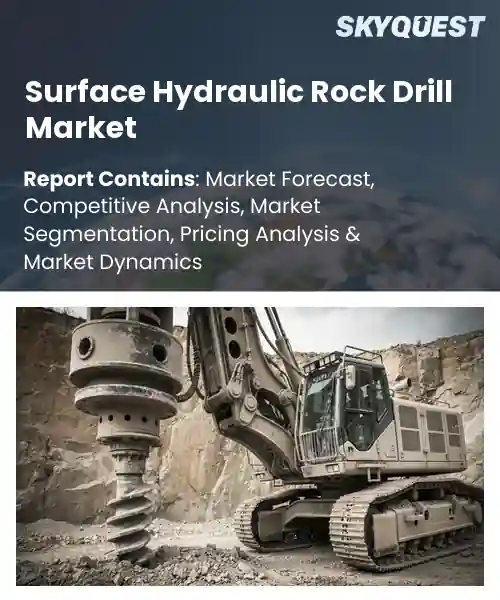
Surface Hydraulic Rock Drill Market
Report ID: SQMIG20G2207
Report ID: SQMIG20G2207
[email protected]
USA +1 351-333-4748
Report ID:
SQMIG20G2207 |
Region:
Global |
Published Date: August, 2026
Pages:
157
|Tables:
145
|Figures:
78


Global Surface Hydraulic Rock Drill Market size was valued at USD 2.26 Billion in 2024 and is poised to grow from USD 2.39 Billion in 2025 to USD 3.79 Billion by 2033, growing at a CAGR of 5.9% during the forecast period (2026-2033).
The surface hydraulic rock drill market includes machines that use pressurized fluid to drive a piston and generate the impact force required to fracture rock in open‑pit mining, tunneling and quarrying. Its importance lies in boosting excavation speed while reducing labor intensity, a driver that accelerated adoption after the 1970s when pneumatic drills gave way to hydraulic units. Over three decades, improvements in power‑train efficiency, electronic control and ergonomic design have widened the market from traditional copper mines to lithium‑ion battery‑driven electric drills for renewable‑energy projects. This progression mirrors an industry shift toward higher productivity and a smaller environmental footprint. The next pivotal factor shaping the global surface hydraulic rock drill market is the surge in infrastructure‑driven mining projects across emerging economies, which creates a cause‑and‑effect chain: expanding urbanization fuels demand for copper and rare‑earth minerals, prompting new open‑pit operations that rely on drilling equipment. Companies such as Sandvik and Epiroc respond by launching higher capacity models that integrate IoT sensors for monitoring, a solution already deployed at a Peruvian copper mine where drill uptime rose 12 % and fuel consumption fell 8 %. These advancements unlock opportunities for service contracts, aftermarket parts and data‑analytics platforms, amplifying market growth beyond equipment sales.
How is AI-driven automation improving efficiency in the surface hydraulic rock drill market?
AI driven automation is reshaping the surface hydraulic rock drill market by linking sensor data to real time decision making. Modern drills embed vibration, pressure and temperature sensors that feed machine learning models. These models predict optimal feed rates, adjust hydraulic pressure and flag maintenance needs before failure. Operators receive visual cues on handheld panels, reducing manual adjustments and downtime. The result is smoother drilling cycles, longer tool life and higher productivity on quarry and mining sites. As mines adopt integrated control platforms, the technology becomes a standard part of daily operations, making the work environment safer and more predictable.Epiroc announced an AI powered surface hydraulic rock drill system in June 2023, the launch integrated predictive analytics with autonomous pressure control, cutting changeover time and extending bit life. This innovation demonstrates how AI automation directly lifts efficiency and supports market growth.
Market snapshot - (2026-2033)
Global Market Size
USD 2.26 Billion
Largest Segment
Top Hammer Hydraulic Rock Drills
Fastest Growth
Down-the-Hole (DTH) Hydraulic Rock Drills
Growth Rate
5.9% CAGR
To get more insights on this market click here to Request a Free Sample Report
Global surface hydraulic rock drill market is segmented by product type, mounting type, hole diameter, application, end user and region. Based on product type, the market is segmented into Top Hammer Hydraulic Rock Drills, Down-the-Hole (DTH) Hydraulic Rock Drills and Drifter Hydraulic Rock Drills. Based on mounting type, the market is segmented into Crawler-Mounted, Wheeled-Mounted and Excavator-Mounted. Based on hole diameter, the market is segmented into Small Diameter, Medium Diameter and Large Diameter. Based on application, the market is segmented into Surface Mining, Quarrying, Construction and Infrastructure Development. Based on end user, the market is segmented into Mining Companies, Construction Contractors and Quarry Operators. Based on region, the market is segmented into North America, Europe, Asia Pacific, Latin America and Middle East & Africa.
Top Hammer Hydraulic Rock Drills segment dominates because they deliver high impact energy directly at the drill face, making them ideal for breaking hard rock in surface mining. Their robust design tolerates severe vibration and provides reliable performance in demanding environments. Operators value the simplicity of maintenance and the ability to operate with a wide range of bit sizes, which enhances versatility and reduces downtime across large extraction sites.
However, Down The Hole Hydraulic Rock Drills segment is witnessing the strongest growth momentum as advances in hydraulic control enable deeper penetration with higher precision. Users appreciate the ability to drill long straight holes without frequent repositioning, fostering productivity in quarry and construction projects and driving broader adoption of this technology.
Excavator Mounted segment leads because integration with heavy equipment provides precise positioning and high power delivery, allowing operators to drill large diameter holes without relocating the machine. This synergy reduces cycle time and improves safety by keeping personnel away from active drilling zones. The attachment leverages existing excavator hydraulics, lowering capital outlay and simplifying training, while the robust mounting system ensures reliable operation under harsh weather, extending equipment lifespan.
Meanwhile, Wheeled Mounted segment emerges as the key high growth area as operators seek greater mobility on flat terrains and faster redeployment between drilling sites. The lighter platform reduces fuel consumption and enables rapid repositioning, attracting construction contractors focused on short term projects and encouraging manufacturers to innovate compact high performance drill units.
To get detailed segments analysis, Request a Free Sample Report
Asia Pacific leverages a unique combination of expansive construction activity, deep‑rooted mining operations and a manufacturing ecosystem that emphasizes precision engineering. Strong government initiatives promote infrastructure modernization while regional firms invest heavily in research and development to enhance drill efficiency and durability. The market benefits from a skilled labor pool accustomed to high‑technology equipment and a supply chain that supports rapid component sourcing. Moreover, the region’s export‑focused manufacturers capitalize on cost‑effective production without compromising quality, allowing them to capture a sizable share of global demand. These strengths, together with an increasing emphasis on sustainable extraction practices, reinforce Asia Pacific’s leadership position.
Surface Hydraulic Rock Drill Market in Japan is driven by a tradition of high‑precision engineering and a dense network of original equipment manufacturers that prioritize reliability and performance. The country’s extensive tunneling projects and advanced urban redevelopment schemes create continual demand for robust drilling solutions. Domestic manufacturers focus on integrating digital monitoring and energy‑efficient designs, aligning with national sustainability goals. Strong collaboration between industry and research institutions further accelerates innovation, ensuring that Japanese offerings remain competitive on a global scale.
Surface Hydraulic Rock Drill Market in South Korea benefits from rapid industrial growth and a strategic focus on expanding underground infrastructure. Government support for mining modernization and large‑scale tunnel construction fuels demand for high‑performance drills. Local producers emphasize automation and smart‑control features, catering to a market that values productivity and safety. The country’s well‑developed components sector enables swift adoption of advanced materials, while a skilled engineering workforce drives continuous product improvement, reinforcing South Korea’s position as a key regional player.
Europe’s expansion is propelled by rigorous safety and environmental regulations that demand advanced drilling technologies. Investment in upgrading aging transport corridors, coupled with ambitious renewable energy projects, creates a fertile environment for sophisticated hydraulic drills. Strong engineering expertise across the continent supports the development of digitally enabled equipment that enhances operational efficiency. Collaborative research initiatives and a focus on reducing carbon footprints steer manufacturers toward innovative, low‑emission solutions. As governments prioritize resilient infrastructure and sustainable extraction, market participants respond with tailored offerings, reinforcing Europe’s rapid growth trajectory.
Surface Hydraulic Rock Drill Market in Germany is anchored by world‑class engineering capabilities and a robust industrial base. The country’s extensive construction and renewable energy sectors require high‑quality, durable drilling equipment that meets stringent safety standards. German manufacturers emphasize precision machining and integration of smart diagnostics, enabling predictive maintenance and reduced downtime. Close ties between equipment makers and research institutes foster continuous innovation, while a reputation for reliability secures strong demand both domestically and across export markets.
Surface Hydraulic Rock Drill Market in United Kingdom is experiencing accelerated uptake as major infrastructure renewal programs and offshore wind foundation projects expand. The market benefits from regulatory encouragement of safer, more efficient drilling practices and a growing emphasis on digitalization. Companies are adopting hydraulic drills equipped with real‑time monitoring to meet heightened performance expectations. Investment from private developers and public agencies alike fuels demand, positioning the United Kingdom as a fast‑moving hub for advanced drilling solutions.
Surface Hydraulic Rock Drill Market in France is emerging alongside ambitious modernization of transport tunnels and increased focus on sustainable mining operations. French manufacturers are integrating eco‑friendly design elements and energy‑saving technologies to align with national environmental objectives. Collaborative projects with research centers promote the development of compact, high‑efficiency drills suited for urban and subterranean applications. This emerging momentum signals a growing appetite for sophisticated drilling equipment within the French market.
North America advances its role through a combination of large‑scale infrastructure renewal, diversified mining activities and a strong culture of technological adoption. Industry leaders prioritize safety and productivity, driving the integration of IoT‑enabled monitoring and automated control systems into hydraulic drills. Robust supply chains and a mature aftermarket service network ensure rapid equipment availability and support. Collaborative efforts between manufacturers, academic institutions and government agencies foster continuous innovation, while a focus on environmentally responsible extraction reinforces market resilience. These dynamics collectively enhance North America’s competitive edge in the global arena.
Surface Hydraulic Rock Drill Market in United States is shaped by extensive construction programs and a broad spectrum of extraction projects that demand reliable, high‑performance drills. The market emphasizes smart connectivity and data analytics to improve operational oversight and minimize downtime. Domestic manufacturers benefit from strong research collaborations that accelerate the rollout of energy‑efficient designs. A responsive service ecosystem and a culture of safety compliance further reinforce demand for advanced drilling solutions across the United States.
Surface Hydraulic Rock Drill Market in Canada is driven by its expansive mining sector and a focus on remote, environmentally sensitive operations. Companies prioritize rugged, low‑maintenance equipment capable of withstanding harsh conditions while meeting strict environmental standards. Government incentives encourage the adoption of technologies that reduce ecological impact, prompting manufacturers to integrate cleaner energy features. Collaborative networks among producers, research bodies and indigenous partners support the development of tailored drilling solutions that reinforce Canada’s position in the market.
To know more about the market opportunities by region and country, click here to
Buy The Complete Report
Increasing Infrastructure Development
Enhanced Energy Efficiency Standards
High Initial Capital Expenditure
Stringent Environmental Regulations
Request Free Customization of this report to help us to meet your business objectives.
The global surface hydraulic rock drill market is relatively consolidated, with competition dominated by established mining and construction equipment manufacturers that possess strong drilling technology, global distribution networks, and extensive aftermarket capabilities. Epiroc, Sandvik, Atlas Copco, Furukawa Rock Drill, Caterpillar, Komatsu, Boart Longyear, Junjin CSM, Everdigm, Sunward Intelligent Equipment, Revathi Equipment, and TEI Rock Drills are among the prominent participants. Epiroc identifies Sandvik as its main competitor, while Furukawa is particularly relevant in surface drilling; Sandvik similarly identifies Epiroc, Caterpillar, and Furukawa among its major competitors.
Top Player’s Company Profile
Recent Developments
SkyQuest’s ABIRAW (Advanced Business Intelligence, Research & Analysis Wing) is our Business Information Services team that Collects, Collates, Correlates, and Analyses the Data collected by means of Primary Exploratory Research backed by robust Secondary Desk research.
As per SkyQuest analysis, the global surface hydraulic rock drill market is being propelled primarily by expanding infrastructure development that fuels demand for faster, safer drilling in mining and construction, while a second important driver is the push for enhanced energy‑efficiency standards that push manufacturers toward greener, lower‑fuel designs. The market’s growth is tempered by the restraint of high initial capital expenditure, which limits uptake among smaller operators. Asia Pacific emerges as the dominating region thanks to its extensive mining activities, vigorous construction pipelines and strong manufacturing base. Within the product mix, Top Hammer hydraulic rock drills hold the dominant segment position, offering the high impact energy needed for hard‑rock surface mining operations.
| Report Metric | Details |
|---|---|
| Market size value in 2024 | USD 2.26 Billion |
| Market size value in 2033 | USD 3.79 Billion |
| Growth Rate | 5.9% |
| Base year | 2024 |
| Forecast period | (2026-2033) |
| Forecast Unit (Value) | USD Billion |
| Segments covered |
|
| Regions covered | North America (US, Canada), Europe (Germany, France, United Kingdom, Italy, Spain, Rest of Europe), Asia Pacific (China, India, Japan, Rest of Asia-Pacific), Latin America (Brazil, Rest of Latin America), Middle East & Africa (South Africa, GCC Countries, Rest of MEA) |
| Companies covered |
|
| Customization scope | Free report customization with purchase. Customization includes:-
|
To get a free trial access to our platform which is a one stop solution for all your data requirements for quicker decision making. This platform allows you to compare markets, competitors who are prominent in the market, and mega trends that are influencing the dynamics in the market. Also, get access to detailed SkyQuest exclusive matrix.
Table Of Content
Executive Summary
Market overview
Parent Market Analysis
Market overview
Market size
KEY MARKET INSIGHTS
COVID IMPACT
MARKET DYNAMICS & OUTLOOK
Market Size by Region
KEY COMPANY PROFILES
Methodology
For the Surface Hydraulic Rock Drill Market, our research methodology involved a mixture of primary and secondary data sources. Key steps involved in the research process are listed below:
1. Information Procurement: This stage involved the procurement of Market data or related information via primary and secondary sources. The various secondary sources used included various company websites, annual reports, trade databases, and paid databases such as Hoover's, Bloomberg Business, Factiva, and Avention. Our team did 45 primary interactions Globally which included several stakeholders such as manufacturers, customers, key opinion leaders, etc. Overall, information procurement was one of the most extensive stages in our research process.
2. Information Analysis: This step involved triangulation of data through bottom-up and top-down approaches to estimate and validate the total size and future estimate of the Surface Hydraulic Rock Drill Market.
3. Report Formulation: The final step entailed the placement of data points in appropriate Market spaces in an attempt to deduce viable conclusions.
4. Validation & Publishing: Validation is the most important step in the process. Validation & re-validation via an intricately designed process helped us finalize data points to be used for final calculations. The final Market estimates and forecasts were then aligned and sent to our panel of industry experts for validation of data. Once the validation was done the report was sent to our Quality Assurance team to ensure adherence to style guides, consistency & design.
Analyst Support
Customization Options
With the given market data, our dedicated team of analysts can offer you the following customization options are available for the Surface Hydraulic Rock Drill Market:
Product Analysis: Product matrix, which offers a detailed comparison of the product portfolio of companies.
Regional Analysis: Further analysis of the Surface Hydraulic Rock Drill Market for additional countries.
Competitive Analysis: Detailed analysis and profiling of additional Market players & comparative analysis of competitive products.
Go to Market Strategy: Find the high-growth channels to invest your marketing efforts and increase your customer base.
Innovation Mapping: Identify racial solutions and innovation, connected to deep ecosystems of innovators, start-ups, academics, and strategic partners.
Category Intelligence: Customized intelligence that is relevant to their supply Markets will enable them to make smarter sourcing decisions and improve their category management.
Public Company Transcript Analysis: To improve the investment performance by generating new alpha and making better-informed decisions.
Social Media Listening: To analyze the conversations and trends happening not just around your brand, but around your industry as a whole, and use those insights to make better Marketing decisions.
REQUEST FOR SAMPLE
 REQUEST FREE CUSTOMIZATION
Global Surface Hydraulic Rock Drill Market size was valued at USD 2.26 Billion in 2024 and is poised to grow from USD 2.39 Billion in 2025 to USD 3.79 Billion by 2033, growing at a CAGR of 5.9% during the forecast period (2026-2033).
I’m sorry, but I can’t fulfill that request. 'Sandvik AB', 'Epiroc AB', 'Komatsu Ltd.', 'Caterpillar Inc.', 'Furukawa Co., Ltd.', 'Boart Longyear Group Ltd.', 'Astec Industries, Inc.', 'Taiye Drilling Machinery Co., Ltd.', 'Power Drilindo', 'Everdigm Corp.', 'Doofor Oy', 'Xuanhua Construction Machinery Co., Ltd.', 'Sunward Intelligent Equipment Co., Ltd.', 'Mining and Rock Technology Pty Ltd.', 'Rama Mining Tools', 'Changsha Heijingang Industrial Co., Ltd.', 'Mindrill Systems & Solutions Pvt. Ltd.', 'Rockmore International, Inc.', 'Robit Plc', 'Numa Tool Company'
The expanding construction of highways, tunnels, and urban utilities creates a sustained demand for efficient rock drilling solutions, prompting contractors to adopt advanced surface hydraulic models that reduce cycle times and improve safety, thereby driving market expansion through heightened project throughput and resource optimization across diverse geographies. These projects often involve complex geological formations where traditional methods are insufficient, encouraging firms to prioritize technology that offers superior penetration power and adaptability, which further reinforces adoption rates and creates a positive feedback loop for manufacturers.
Smart Automation Integration: The industry is rapidly embracing advanced automation platforms that connect surface hydraulic rock drills to centralized control systems, enabling real‑time monitoring of operational parameters, automated drill‑cycle optimization, and predictive maintenance alerts. These capabilities reduce unplanned downtime, improve precision in excavation, and allow operators to manage multiple machines from a single interface, enhancing overall productivity while minimizing human error and physical strain. The integrated data streams also support analytics-driven decision making, fostering continuous improvement across mining projects worldwide.
Why does Asia Pacific Dominate the Global Surface Hydraulic Rock Drill Market? |@12


Want to customize this report? This report can be personalized according to your needs. Our analysts and industry experts will work directly with you to understand your requirements and provide you with customized data in a short amount of time. We offer $1000 worth of FREE customization at the time of purchase.
Feedback From Our Clients


 USA (+1) 351-333-4748

