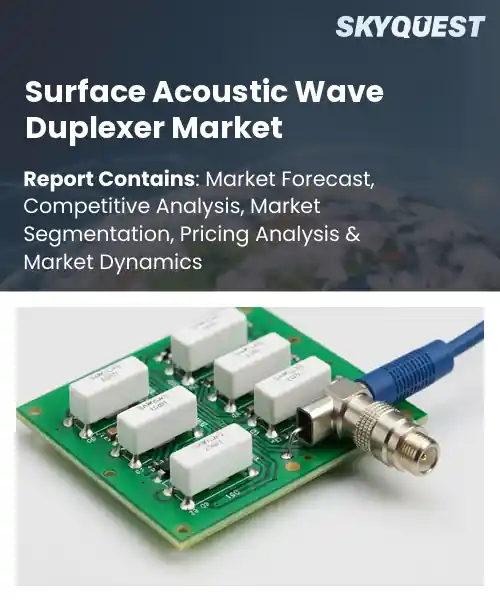
Surface Acoustic Wave Duplexer Market
Report ID: SQMIG45H2332
Report ID: SQMIG45H2332
[email protected]
USA +1 351-333-4748
Report ID:
SQMIG45H2332 |
Region:
Global |
Published Date: August, 2026
Pages:
157
|Tables:
120
|Figures:
77


Global Surface Acoustic Wave Duplexer Market size was valued at USD 5.28 Billion in 2024 and is poised to grow from USD 5.75 Billion in 2025 to USD 11.38 Billion by 2033, growing at a CAGR of 8.9% during the forecast period (2026-2033).
The global surface acoustic wave (SAW) duplexer market revolves around compact devices that separate transmit and receive paths in mobile transceivers, thereby enabling two‑way communication without interference. Its importance stems from the escalating demand for high‑frequency radios in 5G smartphones, IoT sensors, and automotive radar, where traditional duplexers are too bulky or lossy. Historically, SAW duplexers emerged in the late 1990s for digital cellular phones, but their footprint and insertion‑loss improvements have accelerated as semiconductor fabs adopted thinner piezoelectric substrates and lithography.
Consequently, the market has expanded from niche equipment suppliers to an arena dominated by a handful of manufacturers. The rollout of 5G millimeter‑wave (mmWave) handsets drives the SAW duplexer market because they need high‑isolation front‑ends to sustain gigabit data rates. As network operators densify sites and add beamforming arrays, manufacturers adopt SAW solutions that deliver low insertion loss while occupying less than a square centimeter of PCB area. This advantage yields longer battery life for smartphones and enables automotive radars to meet safety‑critical latency targets. Consequently, component suppliers are investing in new piezoelectric materials such as lithium niobate on insulator, opening opportunities for differentiated products and higher margins in a future market projected to exceed US$1.2 billion by 2028.
How is AI Integration Reshaping the Surface Acoustic Wave Duplexer Market?
AI integration is reshaping the Surface acoustic wave duplexer market by automating design, improving performance prediction, and enabling rapid customization. Machine learning models analyze material properties and acoustic behavior, allowing engineers to iterate designs faster than traditional trial and error methods. Real time optimization tools help balance insertion loss, isolation, and size, making products more suitable for compact 5G and IoT devices. The market now sees a shift from manual tuning to data driven workflows, which shortens development cycles and lowers cost. As manufacturers adopt these intelligent platforms, they gain a competitive edge and respond more quickly to evolving wireless standards.
In June 2023, Qorvo introduced an AI enhanced design platform for SAW duplexers, streamlining layout and reducing time to market, which accelerates growth and efficiency. The system leverages predictive modeling to fine tune acoustic filters, cutting prototype iterations and enabling manufacturers to meet demanding 5G antenna requirements with greater speed.
Market snapshot - (2026-2033)
Global Market Size
USD 5.28 Billion
Largest Segment
Mid Band
Fastest Growth
High Band
Growth Rate
8.9% CAGR
To get more insights on this market click here to Request a Free Sample Report
Global surface acoustic wave duplexer market is segmented by frequency band, material, application, end user and region. Based on frequency band, the market is segmented into low band, mid band and high band. Based on material, the market is segmented into lithium tantalate, lithium niobate and quartz. Based on application, the market is segmented into smartphones, tablets, wearable devices, automotive electronics and industrial communication equipment. Based on end user, the market is segmented into consumer electronics, automotive, telecommunications and industrial. Based on region, the market is segmented into North America, Europe, Asia Pacific, Latin America and Middle East & Africa.
Mid band segment dominates because it aligns with the prevailing RF allocation strategies of modern mobile standards, enabling designers to achieve optimal filter performance while maintaining compact form factors. The convergence of 5G rollout and legacy network support concentrates acoustic wave component development around this band, driving supplier investment and fostering mature fabrication processes. Consequently, manufacturers prioritize Mid Band designs to satisfy high volume demand across diverse handset platforms Globally.
However, high band segment is witnessing the strongest growth momentum because millimeter wave communications and automotive radar require ultra wide bandwidth filters, prompting designers to adopt SAW duplexers in frequencies. Ongoing research into low loss substrate technologies accelerates adoption, creating opportunities for component suppliers and expanding the market’s future scope.
Smartphones segment dominates because mobile handsets continue to drive the bulk of SAW duplexer shipments, requiring highly integrated, low loss filters to support simultaneous transmit receive operations in dense spectrum environments. Device manufacturers prioritize miniaturization and power efficiency, prompting extensive adoption of acoustic wave technology in mainstream smartphones. This translates into sustained supplier focus on performance optimization, economies of scale, and refinement of production yields for this volume application across global markets.
Meanwhile, wearable devices segment emerges as the key high growth area because health monitoring gadgets and ultra compact wearables push designers to seek miniaturized duplexers with low power consumption. Advances in flexible piezoelectric materials and integration techniques enable SAW components to fit constrained form factors, spurring adoption and opening revenue streams for manufacturers.
To get detailed segments analysis, Request a Free Sample Report
Asia Pacific is the global leader in the surface acoustic wave duplexer market, owing to its advanced manufacturing capabilities, strong R&D ecosystem, and significant demand from the telecommunications and IoT sectors. The region has well established semiconductor supply chains, which allows SAW components to be manufactured in high volumes and at low cost. Japan and South Korea have large technology parks that encourage collaboration between device makers and research institutes to accelerate innovation in filter design and integration techniques. Furthermore, the rapid deployment of high-frequency wireless services in emerging economies is generating a steady flow of orders, reinforcing the region’s export focus. Government incentives to boost next-generation connectivity further cement Asia Pacific’s competitive advantage in this niche market. The presence of multinational consumer electronic companies also promotes integrated SAW duplexer solutions to be used in multiple product lines.
Surface acoustic wave duplexer market outlook in Japan benefits from a heritage of precision engineering and a well‑established semiconductor ecosystem. Domestic manufacturers leverage close ties with leading research universities to refine filter performance for high‑frequency applications. The country’s aggressive deployment of next‑generation mobile networks drives demand for compact, high‑performance duplexer modules, while export‑focused strategies tap into global supply chains. This combination sustains Japan’s role as a technology anchor in the sector.
Surface acoustic wave duplexer market forecast in South Korea draws strength from an electronics supply chain and government support for wireless infrastructure. Local firms benefit from close collaboration with chipset designers, enabling customization of SAW duplexer solutions for 5G and mmWave applications. Emphasis on miniaturization and power efficiency aligns with consumer device trends, while export initiatives expand market reach across neighboring Asian economies. Together these factors reinforce South Korea’s competitive position.
North America is witnessing rapid growth of the Surface Acoustic Wave Duplexer market due to aggressive investment in high-frequency communication infrastructure and a thriving ecosystem of semiconductor innovators. Device manufacturers are working closely with leading mobile network operators to address the increasing need for smaller, low-loss filters to support the growing 5G and future 6G rollouts. A robust intellectual property environment promotes ongoing development of SAW technologies and an environment of rapid prototyping accelerates the time-to-market for new duplexer designs. Also, the presence of large consumer electronics assemblers creates a continuous downstream pull for integrated solutions, cementing the region's role as a development hub and a significant consumption market for advanced acoustic components. Supportive regulatory policies that enable spectrum allocation, together with a robust talent pool in microwave engineering, also support the growth trajectory of the market across the United States and Canada.
Surface acoustic wave duplexer market regional outlook in the United States is driven by a concentration of research universities and an environment that fuels start‑ups focused on RF components. Partnerships between semiconductor fabs and telecom operators accelerate the translation of breakthroughs into commercial duplexer products. The country’s deployment of urban networks creates a persistent need for high‑performance, miniaturized filters, while export activities position the United States as a technology supplier to markets.
Surface acoustic wave duplexer market regional forecast in Canada benefits from a collaborative research framework that links academic institutions with specialized RF firms. Government programs supporting innovation in low‑power communication technologies encourage the development of energy‑efficient SAW duplexers suited for IoT and remote sensing applications. Proximity to U.S. telecom hubs facilitates cross‑border technology exchange, while a growing domestic demand for high‑frequency broadband services drives adoption of advanced filter solutions across multiple sectors.
The European continent is focusing on sustainable device engineering and deep integration with the mature telecom infrastructure of the European continent that is helping to strengthen the European region’s position in the surface acoustic wave duplexer market. Development of high-precision SAW filters for emerging 5G and industrial IoT applications is accelerated through collaborations between universities, research institutes and key industry players. With a strong environmental compliance focus, the drive for ongoing innovation in low-loss, energy-efficient duplexer designs aligns with Europe’s wider green-technology agenda. The presence of global equipment manufacturers and a robust standards ecosystem ensures that European solutions meet high performance standards, facilitating their use in domestic networks and export markets. This multi-faceted approach reinforces Europe’s position as a hub for state-of-the-art acoustic component technology.
Surface acoustic wave duplexer market analysis in Germany benefits from an engineering tradition and a network of automotive and industrial manufacturers requiring high‑frequency filtering solutions. Partnerships between leading semiconductor firms and research universities foster the development of precision SAW components optimized for communications and automotive radar. Government incentives supporting Industry 4.0 initiatives encourage the integration of duplexers into manufacturing equipment, while export activities extend German expertise to European and global telecom operators.
Surface acoustic wave duplexer market penetration in the United Kingdom is propelled by an aerospace and defense sector that demands reliable, high‑performance SAW filters for communication and radar systems. Collaborative projects between defense research establishments and semiconductor specialists accelerate the creation of duplexer modules suitable for environments. The country’s focus on transformation across telecom networks drives adoption of low‑loss, miniaturized acoustic components, while export collaborations with Commonwealth nations broaden market reach.
Surface acoustic wave duplexer industry in France benefits from a telecommunications research community and governmental support for innovation. Partnerships between research agencies and leading semiconductor firms foster the design of SAW duplexers for mobile and line networks. Emphasis on manufacturing drives the adoption of low‑loss acoustic components, aligning with France’s commitment to green technology. Export initiatives targeting African and European partners further expand the country’s influence in the acoustic‑filter landscape.
To know more about the market opportunities by region and country, click here to
Buy The Complete Report
Increasing Demand for 5G Infrastructure
Advancements in Miniaturization Technologies
High Production Cost Challenges
Stringent Regulatory Compliance Requirements
Request Free Customization of this report to help us to meet your business objectives.
The SAW duplexer market is highly competitive, with established RF component manufacturers competing on low insertion loss, high isolation, miniaturization, temperature stability, frequency selectivity, and high-volume manufacturing capabilities. Companies such as Murata, TDK, Taiyo Yuden, Qorvo, Broadcom, Skyworks Solutions, KYOCERA, Qualcomm, Tai-Saw Technology, WISOL, and Partron serve applications spanning smartphones, wireless infrastructure, IoT devices, automotive electronics, and other RF systems. Competition is increasingly focused on developing compact, high-performance RF filtering solutions that support increasingly crowded frequency bands and higher integration levels. Manufacturers are also strengthening their positions through new product development, customer collaborations, manufacturing investments, and portfolio expansion, particularly as 5G/5G-Advanced and connected-device applications increase demand for sophisticated RF front-end components.
Top Player’s Company Profile
Recent Developments in the Surface Acoustic Wave Duplexer Market
SkyQuest’s ABIRAW (Advanced Business Intelligence, Research & Analysis Wing) is our Business Information Services team that Collects, Collates, Correlates, and Analyses the Data collected by means of Primary Exploratory Research backed by robust Secondary Desk research. As per SkyQuest analysis, the global SAW duplexer market is being propelled primarily by the rising demand for 5G infrastructure, which requires high‑frequency, low‑loss filters, while a second catalyst comes from rapid advances in miniaturization that enable integration into compact smartphones, wearables and IoT modules. However, the high production cost of precise lithography and specialized substrates acts as a notable restraint, limiting adoption in cost‑sensitive segments. Asia‑Pacific currently leads the market, benefiting from mature semiconductor supply chains and strong telecom demand, and the Mid‑Band frequency segment dominates, aligning with prevailing mobile‑network allocations and driving the bulk of volume shipments globally today.
| Report Metric | Details |
|---|---|
| Market size value in 2024 | USD 5.28 Billion |
| Market size value in 2033 | USD 11.38 Billion |
| Growth Rate | 8.9% |
| Base year | 2024 |
| Forecast period | (2026-2033) |
| Forecast Unit (Value) | USD Billion |
| Segments covered |
|
| Regions covered | North America (US, Canada), Europe (Germany, France, United Kingdom, Italy, Spain, Rest of Europe), Asia Pacific (China, India, Japan, Rest of Asia-Pacific), Latin America (Brazil, Rest of Latin America), Middle East & Africa (South Africa, GCC Countries, Rest of MEA) |
| Companies covered |
|
| Customization scope | Free report customization with purchase. Customization includes:-
|
To get a free trial access to our platform which is a one stop solution for all your data requirements for quicker decision making. This platform allows you to compare markets, competitors who are prominent in the market, and mega trends that are influencing the dynamics in the market. Also, get access to detailed SkyQuest exclusive matrix.
Table Of Content
Executive Summary
Market overview
Parent Market Analysis
Market overview
Market size
KEY MARKET INSIGHTS
COVID IMPACT
MARKET DYNAMICS & OUTLOOK
Market Size by Region
KEY COMPANY PROFILES
Methodology
For the Surface Acoustic Wave Duplexer Market, our research methodology involved a mixture of primary and secondary data sources. Key steps involved in the research process are listed below:
1. Information Procurement: This stage involved the procurement of Market data or related information via primary and secondary sources. The various secondary sources used included various company websites, annual reports, trade databases, and paid databases such as Hoover's, Bloomberg Business, Factiva, and Avention. Our team did 45 primary interactions Globally which included several stakeholders such as manufacturers, customers, key opinion leaders, etc. Overall, information procurement was one of the most extensive stages in our research process.
2. Information Analysis: This step involved triangulation of data through bottom-up and top-down approaches to estimate and validate the total size and future estimate of the Surface Acoustic Wave Duplexer Market.
3. Report Formulation: The final step entailed the placement of data points in appropriate Market spaces in an attempt to deduce viable conclusions.
4. Validation & Publishing: Validation is the most important step in the process. Validation & re-validation via an intricately designed process helped us finalize data points to be used for final calculations. The final Market estimates and forecasts were then aligned and sent to our panel of industry experts for validation of data. Once the validation was done the report was sent to our Quality Assurance team to ensure adherence to style guides, consistency & design.
Analyst Support
Customization Options
With the given market data, our dedicated team of analysts can offer you the following customization options are available for the Surface Acoustic Wave Duplexer Market:
Product Analysis: Product matrix, which offers a detailed comparison of the product portfolio of companies.
Regional Analysis: Further analysis of the Surface Acoustic Wave Duplexer Market for additional countries.
Competitive Analysis: Detailed analysis and profiling of additional Market players & comparative analysis of competitive products.
Go to Market Strategy: Find the high-growth channels to invest your marketing efforts and increase your customer base.
Innovation Mapping: Identify racial solutions and innovation, connected to deep ecosystems of innovators, start-ups, academics, and strategic partners.
Category Intelligence: Customized intelligence that is relevant to their supply Markets will enable them to make smarter sourcing decisions and improve their category management.
Public Company Transcript Analysis: To improve the investment performance by generating new alpha and making better-informed decisions.
Social Media Listening: To analyze the conversations and trends happening not just around your brand, but around your industry as a whole, and use those insights to make better Marketing decisions.
REQUEST FOR SAMPLE
 REQUEST FREE CUSTOMIZATION
Global Surface Acoustic Wave Duplexer Market size was valued at USD 5.28 Billion in 2024 and is poised to grow from USD 5.75 Billion in 2025 to USD 11.38 Billion by 2033, growing at a CAGR of 8.9% during the forecast period (2026-2033).
The SAW duplexer market is shaped by aggressive M&A, strategic OEM partnerships, and rapid tech roll‑outs; Qorvo’s 2023 joint development with Samsung on 5G‑grade duplexers and Skyworks’ 2024 acquisition of a niche SAW filter firm to broaden its portfolio illustrate this intensity, while NXP’s collaboration with Qualcomm on integrated RF front‑ends accelerates product differentiation and supply‑chain resilience. 'Murata Manufacturing Co., Ltd.', 'TDK Corporation', 'Taiyo Yuden Co., Ltd.', 'KYOCERA Corporation', 'Qorvo, Inc.', 'Broadcom Inc.', 'Skyworks Solutions, Inc.', 'Qualcomm Incorporated', 'Abracon LLC', 'API Technologies Corp.', 'Tai-Saw Technology Co., Ltd.', 'Raltron Electronics Corporation', 'WISOL Co., Ltd.', 'Shenzhen Microgate Technology Co., Ltd.', 'Vectron International, Inc.', 'Golledge Electronics Ltd.', 'Oscilent Corporation', 'QST Corporation', 'Partron Co., Ltd.', 'Infineon Technologies AG'
The rollout of 5G networks requires high‑frequency, low‑loss signal processing components, and surface acoustic wave duplexers provide the necessary filtering and isolation capabilities. Their ability to operate efficiently at microwave frequencies aligns with the performance criteria of 5G base stations, prompting manufacturers to integrate these devices into new equipment designs. Consequently, telecom operators and device makers are actively seeking SAW duplexers, which fuels demand and encourages suppliers to expand production capacities and innovate product offerings to meet evolving standards and enable autonomous vehicles, IoT, and smart city solutions.
5G Integration Accelerates Adoption: With the rollout of 5G networks, demand for high‑frequency, low‑loss components has surged, positioning surface acoustic wave (SAW) duplexers as critical enablers for dense antenna arrays and massive MIMO deployments. Manufacturers are adapting designs to meet tighter bandwidth and linearity requirements, while telecom operators seek compact solutions that simplify front‑end architecture. This convergence accelerates product development cycles, fosters strategic partnerships, and expands the addressable market beyond traditional cellular equipment into emerging private‑networks and industrial IoT sectors and future‑proof connectivity solutions.
Why does Asia Pacific Dominate the Global Surface Acoustic Wave Duplexer Market? |@12


Want to customize this report? This report can be personalized according to your needs. Our analysts and industry experts will work directly with you to understand your requirements and provide you with customized data in a short amount of time. We offer $1000 worth of FREE customization at the time of purchase.
Feedback From Our Clients


 USA (+1) 351-333-4748

