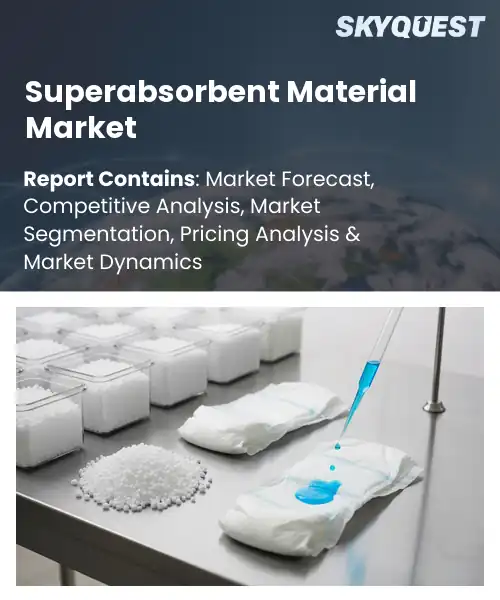
Superabsorbent Material Market
Report ID: SQMIG15E3411
Report ID: SQMIG15E3411
[email protected]
USA +1 351-333-4748
Report ID:
SQMIG15E3411 |
Region:
Global |
Published Date: April, 2026
Pages:
157
|Tables:
88
|Figures:
76


Global Superabsorbent Material Market size was valued at USD 10.82 Billion in 2024 and is poised to grow from USD 11.5 Billion in 2025 to USD 10.8 Billion by 2033, growing at a CAGR of 6.3% during the forecast period (2026-2033).
Superabsorbent materials are crosslinked polymers capable of absorbing and retaining many times their weight in fluids, and they underpin products from baby diapers and feminine hygiene pads to wound dressings and agricultural water-retention agents. The primary driver of this market is expanding demand for personal and medical hygiene driven by population growth, urbanization and rising disposable incomes, which increases unit penetration and premiumization in emerging markets. Historically, the industry evolved from early acrylic-based SAPs used in the 1970s into higher-capacity, thinner formulations that enabled slim diapers, while contemporary research focuses on biodegradability and performance, responding to regulatory and sustainability pressures.Building on hygiene-driven demand, the key factor shaping global growth is technological and sustainability innovation because regulatory pressure and consumer preference for lower environmental footprint force suppliers to reformulate traditional acrylic SAPs into bio-based or degradable variants, which in turn spurs R&D investment and premium product launches. As a consequence, manufacturers capture new opportunities in compostable diapers, agricultural soil additives that reduce irrigation frequency, and advanced wound-care dressings that improve healing outcomes by managing exudate; these use cases demonstrate how innovation raises production costs but allows higher margins, localized production, and partnerships across supply chains and logistics to scale adoption.
How is AI optimizing manufacturing efficiency in the superabsorbent material market?
AI optimizes manufacturing efficiency in the superabsorbent material market by improving process control, accelerating formulation screening, and enabling predictive maintenance. Key aspects include data driven optimization of reactor conditions, model guided formulation design, and real time quality monitoring. The current state shows manufacturers adopting machine learning to reduce variability, shorten scale up cycles, and adapt recipes toward lower environmental impact. In a market that values consistent absorbency and supply reliability, AI helps anticipate equipment issues, guide raw material substitution, and speed troubleshooting. Examples range from property prediction tools that suggest polymer architectures to sensor driven control loops that maintain product consistency during large scale production.BASF February 2025, its HySorb B 6610 ZeroPCF launch highlights industry moves toward sustainable SAPs and shows how AI driven process control and materials informatics speed scale up and improve yield to support market growth, while reducing time to commercial production and enabling more efficient use of feedstocks.
Market snapshot - (2026-2033)
Global Market Size
USD 10.82 Billion
Largest Segment
Slip-in Shin Guards
Fastest Growth
Ankle Shin Guards (Full Protection)
Growth Rate
6.3% CAGR
To get more insights on this market click here to Request a Free Sample Report
Global superabsorbent material market is segmented by product design, target sports vertical, distribution channel and region. Based on product design, the market is segmented into Slip-in Shin Guards and Ankle Shin Guards (Full Protection). Based on target sports vertical, the market is segmented into Football/Soccer (Primary Revenue Driver), Combat Sports (MMA/Muay Thai) and Others (Hockey & Field Sports). Based on distribution channel, the market is segmented into Specialty Sports Stores and Online Retail & Marketplace Platforms. Based on region, the market is segmented into North America, Europe, Asia Pacific, Latin America and Middle East & Africa.
Slip-in Shin Guards segment dominates because its low-profile, comfort-first design aligns with athlete preferences for lightweight, breathable protection, driving broad adoption of thin, flexible superabsorbent textiles in apparel and protective gear. Manufacturers concentrate R&D and sourcing on materials that deliver moisture management without bulk, which strengthens supplier relationships and standardizes product specifications tailored to these material properties.
However, Ankle Shin Guards (Full Protection) are the fastest growing area due to rising demand for comprehensive protection that also manages moisture and odor. Innovations in multilayer superabsorbent composites and integrated padding allow these guards to deliver impact resistance and superior sweat control, creating premiumized product lines and fresh opportunities for material developers and equipment brands.
Football/Soccer segment dominates because high participation and intense play cycles create persistent demand for moisture-managing materials across socks, shin guards, and training wear, prompting large-scale procurement of durable, breathable superabsorbent fibers and coatings. Equipment makers prioritize materials that withstand repeated use and laundering, leading suppliers to optimize formulations for longevity and comfort that support steady commercial adoption.
Meanwhile, Combat Sports (MMA/Muay Thai) are the fastest growing area as intense training and competition heighten the need for compact, high-performance superabsorbent solutions in gloves, wraps, and padding. Advances in quick-drying composites and odor-control chemistries enable longer, hygienic use, unlocking niche premium products and opening pathways for specialized material innovation and market entry.
To get detailed segments analysis, Request a Free Sample Report
Asia Pacific dominates the global superabsorbent material market due to an interplay of robust manufacturing capabilities, concentrated chemical value chains, and close integration with major hygiene and medical product manufacturers. Large regional production clusters enable cost efficiencies and scale, while strong research networks in key markets support continuous material refinement and specialty formulations. Export orientation and well-established supply corridors amplify regional output to international markets. Consumer demand dynamics, urbanization trends, and rising quality expectations drive innovation, prompting suppliers to prioritize performance, skin compatibility, and sustainability attributes that align with both domestic and global product requirements.
Superabsorbent Material Market in Japan is characterized by advanced material research, close collaboration between chemical manufacturers and hygiene producers, and strong emphasis on product quality and safety. Demand centers on high-performance personal care and medical applications, prompting specialized grades and functional enhancements. Japan market benefits from sophisticated manufacturing infrastructure, active innovation ecosystems, an export orientation that supports technology diffusion across the broader Asia Pacific region, and integrated supply chains.
Superabsorbent Material Market in South Korea reflects rapid adoption of high-performance formulations driven by strong partnerships between petrochemical producers and hygiene brands. Focus on miniaturization, skin safety, and multifunctional additives supports diverse applications in personal care and medical sectors. South Korea market leverages efficient production processes, targeted R&D programs, and export linkages to neighboring markets, fostering competitiveness and enabling incremental material innovations tailored to premium and technical product segments worldwide.
Rapid expansion of the superabsorbent material market in North America is driven by concentrated demand from hygiene, adult care, and medical sectors combined with a well-developed innovation ecosystem. Manufacturers and brand owners collaborate closely to commercialize specialty grades that offer improved absorption, skin compatibility, and sustainability credentials. Investment in cleaner production methods and alternative feedstocks is shaping product portfolios, while robust distribution networks and procurement practices support wide adoption across mainstream and niche applications. Regulatory clarity and emphasis on product safety further encourage suppliers to develop differentiated materials that meet stringent performance and environmental expectations, reinforcing North America position as a leading development and commercialization hub.
Superabsorbent Material Market in United States is driven by demand for advanced hygiene and medical applications, with emphasis on specialty grades, sustainability initiatives, and high-performance formulations. Strong links between material producers and brand manufacturers support rapid product development and commercialization. United States market benefits from large industrial infrastructure, diversified end use sectors, and active investment in process innovation that enhances material functionality and supports adoption across healthcare and consumer segments.
Superabsorbent Material Market in Canada focuses on technical performance and environmental credentials, with manufacturers responding to demand for bio-based alternatives and improved material life cycle profiles. Collaboration among domestic producers, academic centers, and international partners drives applied research and piloting of novel chemistries. Canada market emphasizes reliable supply chains, regulatory compliance, and niche applications in healthcare and specialty hygiene that benefit from localized production and targeted material differentiation strategies globally.
Europe is strengthening its role in the superabsorbent material market through a combination of regulatory pressure toward sustainability, concentrated research investment, and active industrial collaboration. Manufacturers are prioritizing circular economy principles, development of bio-based feedstocks, and enhancement of end of life management to meet evolving policy and customer expectations. Established chemical companies and specialized SMEs work with research institutions to advance high-performance and lower-impact formulations. Cross-border partnerships and standardization efforts also enable quicker scale-up of innovative solutions tailored to medical, hygiene, and technical applications, reinforcing Europe position as a center for sustainable material development and application-driven innovation.
Superabsorbent Material Market in Germany is anchored by advanced chemical engineering capabilities, strong industrial clusters, and a focus on sustainable production methods. Demand from medical, hygiene, and technical sectors stimulates development of high-performance and specialty grades. Germany market is characterized by integration of research institutions with manufacturers, rigorous quality standards, and an emphasis on circular economy principles that encourage material innovations aligned with regulatory expectations and industrial competitiveness and scalability.
Superabsorbent Material Market in United Kingdom is influenced by strong research capabilities, creative product development, and collaboration between chemical specialists and consumer brands. Focus on premium hygiene products, niche medical solutions, and sustainable material alternatives drives targeted innovation. United Kingdom market benefits from flexible manufacturing capacity, access to international supply chains, and a regulatory environment that supports technical validation and commercialization of advanced superabsorbent formulations for specialty end uses markets.
Superabsorbent Material Market in France emphasizes technological refinement, sustainability targets, and close ties between material developers and healthcare manufacturers. Demand for comfortable, skin-friendly, and environmentally responsible products encourages tailored chemistries and process improvements. France market leverages research networks, specialty chemical expertise, and strategic partnerships that enable piloting of innovative formulations and support transition toward materials with reduced environmental footprint and enhanced performance in medical and personal care applications and scalability.
To know more about the market opportunities by region and country, click here to
Buy The Complete Report
Rising Demand For Hygiene Products
Expansion Of Agricultural Applications
Environmental Concerns Over Disposal
Volatile Raw Material Availability
Request Free Customization of this report to help us to meet your business objectives.
The competitive landscape in the global superabsorbent material market is being reshaped by strategic divestitures, capacity investments and circularity partnerships that shift bargaining power toward buyers seeking sustainable solutions. Incumbents are divesting or reconfiguring SAP assets while funding pilot lines and recycling routes. For example Evonik completed the sale of its superabsorbents business to ICIG and Sumitomo Seika commissioned a dedicated SAP pilot plant to advance recyclable grades.
Top Player’s Company Profile
Recent Developments
SkyQuest’s ABIRAW (Advanced Business Intelligence, Research & Analysis Wing) is our Business Information Services team that Collects, Collates, Correlates, and Analyses the Data collected by means of Primary Exploratory Research backed by robust Secondary Desk research. As per SkyQuest analysis, a key driver is rising demand for hygiene products, which fuels adoption of higher performance superabsorbents and premiumization. A second driver is expanding agricultural applications that increase use for soil water retention and drought resilience. A restraint is environmental concerns over polymer persistence and disposal, prompting reformulation costs and regulatory scrutiny. The dominating region is Asia Pacific, supported by concentrated manufacturing, integrated value chains and strong export orientation. The dominating segment is Football/Soccer within sports-related applications, reflecting high participation and persistent need for moisture-managing materials across apparel and protective gear. Overall, sustainability-driven innovation will shape future growth and competitiveness.
| Report Metric | Details |
|---|---|
| Market size value in 2024 | USD 10.82 Billion |
| Market size value in 2033 | USD 10.8 Billion |
| Growth Rate | 6.3% |
| Base year | 2024 |
| Forecast period | (2026-2033) |
| Forecast Unit (Value) | USD Billion |
| Segments covered |
|
| Regions covered | North America (US, Canada), Europe (Germany, France, United Kingdom, Italy, Spain, Rest of Europe), Asia Pacific (China, India, Japan, Rest of Asia-Pacific), Latin America (Brazil, Rest of Latin America), Middle East & Africa (South Africa, GCC Countries, Rest of MEA) |
| Companies covered |
|
| Customization scope | Free report customization with purchase. Customization includes:-
|
To get a free trial access to our platform which is a one stop solution for all your data requirements for quicker decision making. This platform allows you to compare markets, competitors who are prominent in the market, and mega trends that are influencing the dynamics in the market. Also, get access to detailed SkyQuest exclusive matrix.
Table Of Content
Executive Summary
Market overview
Parent Market Analysis
Market overview
Market size
KEY MARKET INSIGHTS
COVID IMPACT
MARKET DYNAMICS & OUTLOOK
Market Size by Region
KEY COMPANY PROFILES
Methodology
For the Superabsorbent Material Market, our research methodology involved a mixture of primary and secondary data sources. Key steps involved in the research process are listed below:
1. Information Procurement: This stage involved the procurement of Market data or related information via primary and secondary sources. The various secondary sources used included various company websites, annual reports, trade databases, and paid databases such as Hoover's, Bloomberg Business, Factiva, and Avention. Our team did 45 primary interactions Globally which included several stakeholders such as manufacturers, customers, key opinion leaders, etc. Overall, information procurement was one of the most extensive stages in our research process.
2. Information Analysis: This step involved triangulation of data through bottom-up and top-down approaches to estimate and validate the total size and future estimate of the Superabsorbent Material Market.
3. Report Formulation: The final step entailed the placement of data points in appropriate Market spaces in an attempt to deduce viable conclusions.
4. Validation & Publishing: Validation is the most important step in the process. Validation & re-validation via an intricately designed process helped us finalize data points to be used for final calculations. The final Market estimates and forecasts were then aligned and sent to our panel of industry experts for validation of data. Once the validation was done the report was sent to our Quality Assurance team to ensure adherence to style guides, consistency & design.
Analyst Support
Customization Options
With the given market data, our dedicated team of analysts can offer you the following customization options are available for the Superabsorbent Material Market:
Product Analysis: Product matrix, which offers a detailed comparison of the product portfolio of companies.
Regional Analysis: Further analysis of the Superabsorbent Material Market for additional countries.
Competitive Analysis: Detailed analysis and profiling of additional Market players & comparative analysis of competitive products.
Go to Market Strategy: Find the high-growth channels to invest your marketing efforts and increase your customer base.
Innovation Mapping: Identify racial solutions and innovation, connected to deep ecosystems of innovators, start-ups, academics, and strategic partners.
Category Intelligence: Customized intelligence that is relevant to their supply Markets will enable them to make smarter sourcing decisions and improve their category management.
Public Company Transcript Analysis: To improve the investment performance by generating new alpha and making better-informed decisions.
Social Media Listening: To analyze the conversations and trends happening not just around your brand, but around your industry as a whole, and use those insights to make better Marketing decisions.
REQUEST FOR SAMPLE
 REQUEST FREE CUSTOMIZATION


Want to customize this report? This report can be personalized according to your needs. Our analysts and industry experts will work directly with you to understand your requirements and provide you with customized data in a short amount of time. We offer $1000 worth of FREE customization at the time of purchase.
Feedback From Our Clients


 USA (+1) 351-333-4748

