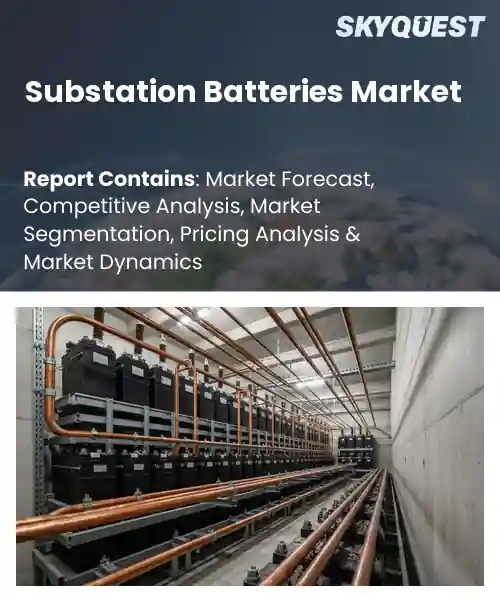
Substation Batteries Market
Report ID: SQMIG20E2231
Report ID: SQMIG20E2231
[email protected]
USA +1 351-333-4748
Report ID:
SQMIG20E2231 |
Region:
Global |
Published Date: July, 2026
Pages:
157
|Tables:
119
|Figures:
77


Global Substation Batteries Market size was valued at USD 102.32 Billion in 2024 and is poised to grow from USD 111.59 Billion in 2025 to USD 223.33 Billion by 2033, growing at a CAGR of 9.06% during the forecast period (2026-2033).
The substation batteries market provides storage devices that help deliver reliable power to transmission and distribution substations. Its significance is that it is needed to keep voltage stability and support control systems in case of outages, making it a critical component of resilience. In the past, the market has evolved from lead-acid units in the 1970’s to lithium-ion and flow-type solutions as utilities required more autonomy and less maintenance. European transmission operators started using lithium-ion packs in 2018 to replace old lead-acid banks, reducing downtime by 30 percent and extending the service life. This trend points to the main driver: the growing demand for uninterrupted power in sophisticated networks.
The substation batteries market is driven mostly by the growing integration of renewable energy. Intermittent generation requires frequency response and backup during transitions on the grid. When wind and solar farms connect to networks, utilities install battery banks to buffer voltage swings, to prevent load shedding and to protect equipment. In 2022, a U.S. utility installed a 50 MWh lithium-ion system that cut diesel generator use by 40% and paid for itself in four years. This need pushes manufacturers to develop cells and modular designs, offering OEMs a chance to gain market share as regulators incentivize storage with attractive tariffs.
How is AI Influencing Efficiency In The Substation Batteries Market?
AI is transforming how substation batteries operate by introducing predictive analytics, real‑time monitoring and autonomous control. It allows operators to predict charge-discharge patterns, detect early faults, and balance loads automatically. The technology also optimizes energy consumption by adapting charging speed to grid conditions and extending battery life with smarter cycle management. With the market for high-tech Li-ion and solid-state batteries growing, AI-based platforms are needed to guarantee reliability and safety. These capabilities can reduce downtime, lower maintenance costs, and improve overall system efficiency, making substation storage more attractive for utilities and renewable integration.
Siemens introduced an AI-driven battery management system in May 2026 that predicts degradation and dynamically balances load across multiple units, reducing idle time and extending service life. This innovation is an example of how smart control can directly enhance efficiency and accelerate the growth of the substation batteries market.
Market snapshot - (2026-2033)
Global Market Size
USD 102.32 Billion
Largest Segment
Lead-Acid Batteries
Fastest Growth
Lithium-Ion Batteries
Growth Rate
9.06% CAGR
To get more insights on this market click here to Request a Free Sample Report
Global substation batteries market is segmented by battery type, voltage, application, end user and region. Based on battery type, the market is segmented into Lead-Acid Batteries, Lithium-Ion Batteries, Nickel-Cadmium Batteries and Flow Batteries. Based on voltage, the market is segmented into Low Voltage (< 500V), Medium Voltage (500V – 1 kV) and High Voltage (> 1 kV). Based on application, the market is segmented into Grid Stability & Frequency Regulation, DC Control Systems Backup, Emergency Power Supply and Renewable Energy Integration. Based on end user, the market is segmented into Electric Utilities, Industrial Substations and Transmission & Distribution Operators. Based on region, the market is segmented into North America, Europe, Asia Pacific, Latin America and Middle East & Africa.
The Lead Acid Batteries segment is dominant owing to its long track record of proven reliability that aligns with the conservative risk profile of substation operators and its relative low upfront cost that supports capital intensive infrastructure projects. The mature manufacturing ecosystem of the technology provides predictable performance and easy maintenance to lower operational complexity. So utilities favor it for baseline backup and routine power quality support, reinforcing its market leadership. It’s also recyclable and can handle extreme temperature swings, which makes it even more attractive for long-term asset strategies.
Meanwhile, the Lithium Ion Batteries segment is seeing the highest growth momentum as rapid advancements in energy density and cycle life are enabling small-scale installations that can meet the increased spatial constraints of modern substations. The drive for cleaner operation and falling cost of cell manufacture is accelerating adoption, opening up new opportunities for advanced grid support functions.
High Voltage segment dominates due to its capability to give large power bursts which is a key requirement for substations to maintain robustness of the system during fault conditions. The intrinsic design of the High Voltage segment is well suited to the electrical architecture of high capacity networks. It can handle a large current and still remain stable, so it doesn't need much support equipment, which is why it's the default choice for primary backup and grid support applications. Its proven performance in extreme load variations also supports regulatory compliance and operator confidence.
The Medium Voltage segment on the other hand is turning into a high growth area as the growing distributed renewable sources require battery units that fit the 500 to 1000 volt envelope for easier connection with power converters. This voltage band is a key target for market growth, due to the high demand for compact substations with modular and scalable units.
To get detailed segments analysis, Request a Free Sample Report
The region’s dominance is a result of a combination of advanced manufacturing ecosystems, strong governmental commitment to grid modernization and a robust supply chain for high-performance battery components. Regional manufacturers have deep expertise in lithium-ion and emerging battery chemistries that enable rapid product iteration and cost efficiencies. Policy frameworks focus on integrating renewables and resilience, making battery-backed substations a key element of grid stability for utilities. Cooperation speeds up the uptake of technology by research organisations, equipment suppliers and utility operators and large infrastructure projects create sustained demand. Asia Pacific is clearly leading the global substation batteries market, driven by technical capability, supportive regulation and strategic investment.
Utilities in Japan have historically prioritized reliability and disaster resilience, leading them to include energy storage in critical substations and encouraging the substation batteries market in Japan. The country’s investment in advanced battery chemistries is consistent with its broader commitment to a low‑carbon energy transformation. Manufacturers and research institutes collaborate to enable continuous innovation and market trust is increased through high safety standards. These combined factors support the creation of a mature ecosystem that enables broad deployment of battery solutions across the national grid.
The South Korea Substation Batteries market is driven by a highly integrated electronics market, which provides state-of-the-art battery components and management systems. Government initiatives are prompting utilities to adopt storage solutions for voltage regulation and fault ride-through as part of grid modernization and renewable integration. Strong local manufacturing capabilities lead to rapid scalability and cost competitiveness. Utility operators are teaming up with tech companies to deploy battery-enhanced substations at a quicker pace, solidifying the country’s stance as a major player in leading the region’s market.
The rapid expansion in North America is propelled by an aggressive shift toward renewable generation, heightened reliability expectations, and evolving regulatory incentives that favor grid flexibility. Utilities are increasingly recognizing battery storage as essential for managing intermittency, smoothing peak loads, and providing ancillary services. A vibrant ecosystem of technology providers, engineering firms, and financing entities accelerates project delivery, while collaborative standards development reduces integration barriers. The focus on resilience, especially in the face of extreme weather events, further amplifies demand for battery‑powered substations as a means to safeguard critical infrastructure and maintain service continuity across the continent.
Substation Batteries Market in the United States reflects a strong emphasis on grid reliability and a progressive policy environment that encourages storage integration. Utilities are deploying batteries to enhance fault tolerance, support renewable curtailment, and provide fast response support during outages. A mature supply chain with domestic manufacturing capabilities and extensive research initiatives underpins innovation, while private‑sector investment fuels rapid project execution. This ecosystem sustains a vibrant market characterized by continual adoption of advanced battery technologies.
Substation Batteries Market in Canada is shaped by a national agenda focused on clean energy transition and the need to address vast, remote transmission corridors. Battery storage is leveraged to improve voltage stability, extend asset life, and mitigate the impacts of harsh climatic conditions. Collaborative frameworks between provincial utilities and technology partners accelerate the integration of storage solutions within substations, while government programs support pilot projects that demonstrate resilience benefits. These dynamics foster a growing market attentive to both environmental and reliability objectives.
Europe is strengthening its position through coordinated policy directives that prioritize decarbonization, grid resilience, and cross‑border electricity exchange. The region’s emphasis on standardization and interoperable technologies facilitates seamless integration of battery systems into existing substation infrastructure. Leading research institutions and a competitive manufacturing base drive advancements in battery efficiency and safety, while public‑private partnerships fund demonstrator projects that showcase the value of storage for ancillary services. The collective focus on sustainability, innovation, and regulatory alignment ensures Europe continues to expand its influence in the global substation batteries sector.
Substation Batteries Market in Germany is underpinned by a strong engineering tradition and a commitment to the Energiewende strategy. Batteries are deployed to support renewable integration, provide grid balancing, and enhance system stability. Close collaboration between utilities, equipment manufacturers, and research institutes accelerates technology transfer, while a robust regulatory framework incentivizes storage adoption at substations across the country.
Substation Batteries Market in the United Kingdom benefits from national targets for net‑zero emissions and a focus on modernizing ageing infrastructure. Battery integration is employed to improve fault ride‑through capabilities, reduce reliance on conventional peaking plants, and enable greater renewable dispatch. Partnerships between system operators and innovative battery providers drive pilot deployments that inform wider rollout strategies.
Substation Batteries Market in France is driven by a strategic emphasis on grid flexibility and the integration of offshore wind resources. Batteries are utilized to provide frequency regulation, voltage support, and rapid response during network disturbances. Collaborative initiatives between French utilities, technology firms, and research agencies foster the development of customized storage solutions that align with the country’s energy transition goals.
To know more about the market opportunities by region and country, click here to
Buy The Complete Report
Increasing Renewable Energy Integration
Policy Support for Decarbonization
High Initial Capital Expenditure
Regulatory Uncertainty and Standards
Request Free Customization of this report to help us to meet your business objectives.
The competitive landscape of the global substation batteries market is shaped by rapid technological innovation and aggressive capital deployment, driving firms to secure niche advantages. Companies such as Form Energy, Sinergy Flow and BTRY AG are racing to commercialize multi‑day iron‑air, flow‑type and ultra‑thin solid‑state solutions, respectively, leveraging sizable seed rounds and strategic product‑scale initiatives to outpace rivals and capture emerging grid‑storage contracts.
SkyQuest’s ABIRAW (Advanced Business Intelligence, Research & Analysis Wing) is our Business Information Services team that Collects, Collates, Correlates, and Analyses the Data collected by means of Primary Exploratory Research backed by robust Secondary Desk research.
As per SkyQuest analysis, the global substation batteries market is propelled chiefly by the surge in renewable energy integration, which compels utilities to install storage for voltage stability and quick response. A second strong driver is expanding policy support for decarbonisation that offers incentives and tax credits, further accelerating adoption. The market is presently led by Asia Pacific, where robust manufacturing and proactive grid‑modernisation programmes fuel demand. Lead‑acid batteries remain the dominant segment owing to their proven reliability and lower upfront cost. Nonetheless, high initial capital expenditure continues to restrain broader rollout, prompting utilities to seek financing solutions before committing to large‑scale projects.
| Report Metric | Details |
|---|---|
| Market size value in 2024 | USD 102.32 Billion |
| Market size value in 2033 | USD 223.33 Billion |
| Growth Rate | 9.06% |
| Base year | 2024 |
| Forecast period | (2026-2033) |
| Forecast Unit (Value) | USD Billion |
| Segments covered |
|
| Regions covered | North America (US, Canada), Europe (Germany, France, United Kingdom, Italy, Spain, Rest of Europe), Asia Pacific (China, India, Japan, Rest of Asia-Pacific), Latin America (Brazil, Rest of Latin America), Middle East & Africa (South Africa, GCC Countries, Rest of MEA) |
| Companies covered |
|
| Customization scope | Free report customization with purchase. Customization includes:-
|
To get a free trial access to our platform which is a one stop solution for all your data requirements for quicker decision making. This platform allows you to compare markets, competitors who are prominent in the market, and mega trends that are influencing the dynamics in the market. Also, get access to detailed SkyQuest exclusive matrix.
Table Of Content
Executive Summary
Market overview
Parent Market Analysis
Market overview
Market size
KEY MARKET INSIGHTS
COVID IMPACT
MARKET DYNAMICS & OUTLOOK
Market Size by Region
KEY COMPANY PROFILES
Methodology
For the Substation Batteries Market, our research methodology involved a mixture of primary and secondary data sources. Key steps involved in the research process are listed below:
1. Information Procurement: This stage involved the procurement of Market data or related information via primary and secondary sources. The various secondary sources used included various company websites, annual reports, trade databases, and paid databases such as Hoover's, Bloomberg Business, Factiva, and Avention. Our team did 45 primary interactions Globally which included several stakeholders such as manufacturers, customers, key opinion leaders, etc. Overall, information procurement was one of the most extensive stages in our research process.
2. Information Analysis: This step involved triangulation of data through bottom-up and top-down approaches to estimate and validate the total size and future estimate of the Substation Batteries Market.
3. Report Formulation: The final step entailed the placement of data points in appropriate Market spaces in an attempt to deduce viable conclusions.
4. Validation & Publishing: Validation is the most important step in the process. Validation & re-validation via an intricately designed process helped us finalize data points to be used for final calculations. The final Market estimates and forecasts were then aligned and sent to our panel of industry experts for validation of data. Once the validation was done the report was sent to our Quality Assurance team to ensure adherence to style guides, consistency & design.
Analyst Support
Customization Options
With the given market data, our dedicated team of analysts can offer you the following customization options are available for the Substation Batteries Market:
Product Analysis: Product matrix, which offers a detailed comparison of the product portfolio of companies.
Regional Analysis: Further analysis of the Substation Batteries Market for additional countries.
Competitive Analysis: Detailed analysis and profiling of additional Market players & comparative analysis of competitive products.
Go to Market Strategy: Find the high-growth channels to invest your marketing efforts and increase your customer base.
Innovation Mapping: Identify racial solutions and innovation, connected to deep ecosystems of innovators, start-ups, academics, and strategic partners.
Category Intelligence: Customized intelligence that is relevant to their supply Markets will enable them to make smarter sourcing decisions and improve their category management.
Public Company Transcript Analysis: To improve the investment performance by generating new alpha and making better-informed decisions.
Social Media Listening: To analyze the conversations and trends happening not just around your brand, but around your industry as a whole, and use those insights to make better Marketing decisions.
REQUEST FOR SAMPLE
 REQUEST FREE CUSTOMIZATION
Global Substation Batteries Market size was valued at USD 102.32 Billion in 2024 and is poised to grow from USD 111.59 Billion in 2025 to USD 223.33 Billion by 2033, growing at a CAGR of 9.06% during the forecast period (2026-2033).
The competitive landscape of the global substation batteries market is shaped by rapid technological innovation and aggressive capital deployment, driving firms to secure niche advantages. Companies such as Form Energy, Sinergy Flow and BTRY AG are racing to commercialize multi‑day iron‑air, flow‑type and ultra‑thin solid‑state solutions, respectively, leveraging sizable seed rounds and strategic product‑scale initiatives to outpace rivals and capture emerging grid‑storage contracts. 'ABB Ltd.', 'Eaton Corporation', 'Exide Technologies', 'EnerSys', 'GS Yuasa Corporation', 'Saft Groupe S.A. (TotalEnergies)', 'C&D Technologies Inc.', 'General Electric (GE Vernova)', 'Siemens AG', 'Samsung SDI', 'LG Energy Solution', 'BYD Company Ltd.', 'Fluence Energy', 'Nidec ASI', 'Panasonic Energy', 'Varta AG', 'Hitachi Energy', 'Electrovaya Inc.', 'International Battery Company', 'REPOWER Technologies'
The shift toward renewable generation creates a need for reliable energy storage at substations, ensuring smooth power delivery despite intermittency. Batteries provide rapid response capabilities, grid stability, and support for voltage regulation, which are essential as solar and wind penetration rises. Utilities thus prioritize battery deployment to safeguard reliability, reduce outage risk, and meet regulatory expectations for clean energy integration, driving robust demand for advanced substation battery solutions across multiple regions, including both urban and remote grid sections, to enhance overall network resilience.
Grid Modernization Drives Demand: Utility operators are accelerating the replacement of legacy power‑conversion equipment with advanced, digitally‑enabled substations, creating a robust demand for high‑performance battery systems. These batteries provide reliable backup, facilitate seamless transition to renewable integration, and support remote monitoring through smart‑grid communication protocols. As operators prioritize resilience and real‑time data analytics, battery manufacturers are embedding predictive health diagnostics and modular designs, enabling faster deployment and reduced lifecycle costs across diverse transmission networks worldwide while meeting stakeholder expectations for sustainability and operational excellence.
Why does Asia Pacific Dominate the Global Substation Batteries Market? |@12


Want to customize this report? This report can be personalized according to your needs. Our analysts and industry experts will work directly with you to understand your requirements and provide you with customized data in a short amount of time. We offer $1000 worth of FREE customization at the time of purchase.
Feedback From Our Clients


 USA (+1) 351-333-4748

