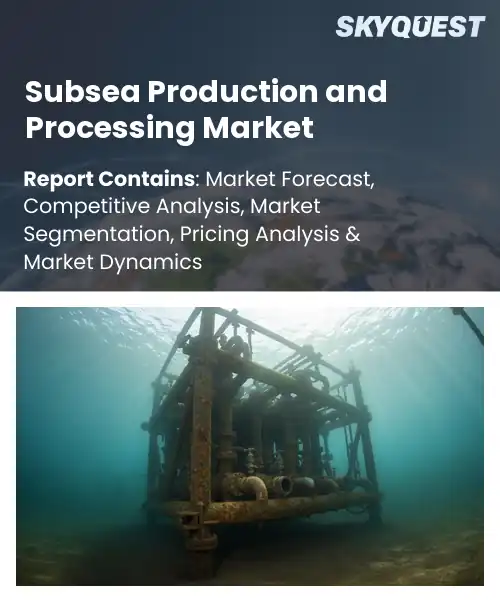
Subsea Production and Processing Market
Report ID: SQMIG10B2188
Report ID: SQMIG10B2188
[email protected]
USA +1 351-333-4748
Report ID:
SQMIG10B2188 |
Region:
Global |
Published Date: June, 2026
Pages:
157
|Tables:
205
|Figures:
80


Global Subsea Production And Processing Market size was valued at USD 20.4 Billion in 2024 and is poised to grow from USD 22.13 Billion in 2025 to USD 42.51 Billion by 2033, growing at a CAGR of 8.5% during the forecast period (2026-2033).
The subsea production and processing industry encompasses equipment and services that enable extraction, separation, and treatment of hydrocarbons on the ocean floor, bypassing surface platforms. Its significance lies in unlocking reserves located in deepwater fields, where conventional rigs are economically impractical.
Advances such as subsea trees, manifold systems, and flowlines allowed operators like Shell and Petrobras to increase recovery rates while reducing footprint, cementing subsea processing as a cornerstone of offshore development. Rising demand for low carbon energy is a catalyst shaping the subsea production and processing market because it forces operators to maximize recovery from existing offshore assets rather than invest in onshore projects. This pressure drives adoption of subsea compression, solar‑powered pumps, and digital twins that extend well life and reduce emissions. For example, Equinor’s subsea gas‑lift system in the North Sea has cut venting by 30%, translating into cost savings and compliance. Consequently, equipment suppliers such as TechnipFMC and Caterpillar are expanding modular product lines, while service firms are investing in platforms, unlocking revenue streams and reinforcing the market’s trajectory.
How is AI-driven automation improving efficiency in the subsea production and processing market?
AI‑driven automation is reshaping subsea production by turning vast data streams into actionable insights. Machine learning models analyze sensor feeds to predict equipment wear before a failure occurs, enabling condition‑based maintenance that cuts unplanned shutdowns. Real‑time optimization of flow paths adjusts pumps and valves on the fly, boosting hydrocarbon recovery while using less energy. Autonomous underwater vehicles equipped with visual AI inspect pipelines and structures, reducing the need for divers and speeding up inspection cycles. Digital twins simulate the entire subsea network, allowing operators to test scenarios virtually and adopt the most efficient operating set‑points. Together these tools raise reliability, lower operating costs and support the market’s push toward greener, more resilient offshore production.
TechnipFMC in June 2025, launched its next generation all electric subsea production system that embeds AI‑controlled valve sequencing and dynamic flow optimization, demonstrably shortening response times and enhancing overall plant efficiency.
Market snapshot - (2026-2033)
Global Market Size
USD 20.4 Billion
Largest Segment
Subsea Production Systems
Fastest Growth
Subsea Processing Systems
Growth Rate
8.5% CAGR
To get more insights on this market click here to Request a Free Sample Report
Global subsea production and processing market is segmented by product type, subsea production systems, subsea processing systems, water depth, field development type, application, end user and region. Based on product type, the market is segmented into Subsea Production Systems and Subsea Processing Systems. Based on subsea production systems, the market is segmented into Subsea Trees, Wellheads, Manifolds, Flowlines and Pipelines, Umbilicals, Risers, Control Systems, Connectors and Junction Systems and Others. Based on subsea processing systems, the market is segmented into Subsea Boosting Systems, Subsea Compression Systems, Subsea Separation Systems, Subsea Water Injection Systems, Subsea Gas Treatment Systems and Others. Based on water depth, the market is segmented into Shallow Water, Deepwater and Ultra-Deepwater. Based on field development type, the market is segmented into Greenfield Developments and Brownfield Developments. Based on application, the market is segmented into Oil Production, Natural Gas Production and Oil and Gas Production. Based on end user, the market is segmented into National Oil Companies (NOCs), Independent Oil Companies (IOCs) and Independent Exploration & Production Companies. Based on region, the market is segmented into North America, Europe, Asia Pacific, Latin America and Middle East & Africa.
Subsea trees segment dominates because they serve as the primary control interface between the well and surface facilities, integrating safety valves, sensors, and choke functions within a compact subsea package. Their essential function in managing high pressure environments compels operators to emphasize reliability and redundancy, which drives continued investment in advanced tree designs. Ongoing focus on production uptime and strict environmental standards further entrenches trees as the core element of the subsea production and processing market.
As per subsea production and processing market outlook, manifolds segment emerges as the fastest expanding area because modular flow distribution enables flexible tie backs and multiple well integration, meeting the rise of complex field architectures. Innovation in flow control and material durability accelerates adoption, positioning manifolds as a catalyst for broader subsea system deployment and future market growth.
As per subsea production and processing market forecast, subsea boosting systems segment leads because they enhance reservoir drawdown by providing localized pressure increase, allowing efficient oil and gas recovery from marginal wells. Their ability to operate without surface compressors reduces infrastructure footprint and lowers cost effective deepwater development. Advances in electric motor technology and reliable hydraulic controls boost reliability, making boosting systems a cornerstone of subsea processing strategies. Integration with digital monitoring platforms also supports predictive maintenance, further enhancing operational uptime.
On the other hand, subsea compression systems segment is witnessing the strongest growth momentum because rising offshore gas production requires compact energy efficient compression near the wellhead. Electrification and advanced turbine designs lower emissions and boost efficiency, leading operators to retrofit fields and launch gas centric projects, driving market expansion.
To get detailed segments analysis, Request a Free Sample Report
As per subsea production and processing market regional outlook, Asia Pacific combines deep technical expertise with a robust supply chain that supports complex subsea projects. The region benefits from mature offshore energy activities, strong engineering talent, and a concentration of original equipment manufacturers that drive innovation in subsea systems. Collaborative ecosystems between oil and gas operators, research institutions, and technology providers foster rapid adoption of advanced processing solutions. Strategic investments in digitalization and low‑carbon initiatives further enhance the region’s appeal, positioning it as a hub for both mature and emerging subsea applications. These strengths collectively reinforce Asia Pacific’s leadership in the global market.
Japan leverages a legacy of precision engineering and extensive maritime infrastructure. Domestic energy firms prioritize reliability and safety, driving demand for highly integrated subsea processing modules. Coordination with leading research universities nurtures cutting‑edge technologies such as autonomous inspection and advanced materials. Consequently, Japan sustains a reputation for delivering sophisticated, high‑performance subsea solutions that meet stringent regulatory standards.
As per subsea production and processing market regional forecast, South Korea is propelled by a strong manufacturing base and aggressive technology adoption. The nation’s shipbuilding and heavy industry sectors provide a solid foundation for fabricating robust subsea components. Government initiatives encourage collaboration between petrochemical companies and equipment makers, accelerating development of compact, energy‑efficient processing units. This environment fosters rapid scaling of subsea capabilities aligned with regional offshore exploration efforts.
As per subsea production and processing industry analysis, North America experiences expansion driven by extensive offshore reserves and a push toward energy transition that emphasizes low‑carbon subsea solutions. Industry players prioritize integrated processing to reduce surface infrastructure and enhance environmental stewardship. Strong financial capacity and a culture of innovation encourage investment in digital monitoring, advanced materials, and modular designs. Collaborative frameworks among operators, service firms, and research institutions accelerate the deployment of next‑generation subsea technologies, reinforcing the region’s position as a dynamic growth market.
United States benefits from a mature offshore sector and extensive research capabilities. Leading energy corporations focus on maximizing recovery while minimizing environmental impact, prompting adoption of sophisticated processing systems. Partnerships with technology innovators foster rapid integration of real‑time data analytics and autonomous subsea operations. This synergy supports a resilient market that consistently advances subsea processing performance.
Canada is shaped by abundant offshore resources along the Atlantic basin and a strong emphasis on sustainable development. Companies prioritize modular processing solutions that mitigate logistical challenges in remote locations. Indigenous knowledge and collaborative research initiatives contribute to robust environmental assessments, encouraging responsible subsea operations. This approach sustains a steady demand for advanced processing technologies tailored to the region’s unique conditions.
Europe advances its position through coordinated policy frameworks that promote decarbonization and technological excellence in subsea processing. The region’s deep offshore fields and emerging renewable marine projects drive demand for integrated processing platforms. Collaborative research programs across universities and industry accelerate development of high‑efficiency subsea equipment. Emphasis on standardization and cross‑border partnerships enables European firms to leverage collective expertise, enhancing competitiveness on the global stage. This strategic focus on innovation, sustainability, and cooperation solidifies Europe’s evolving role in the market.
Germany draws on a strong engineering tradition and a vibrant industrial ecosystem. Germany firms emphasize precision manufacturing and robust quality standards, delivering reliable subsea processing units. Integration of digital twins and predictive maintenance aligns with the country’s focus on operational excellence. These capabilities support a growing portfolio of offshore projects that demand high‑performance processing solutions.
United Kingdom benefits from a historic offshore sector and a forward‑looking energy strategy. Collaborative clusters of oil and gas operators, technology innovators, and research institutions accelerate the deployment of advanced subsea processing concepts. Emphasis on low‑emission technologies and offshore wind integration encourages diversification of subsea applications, reinforcing the United Kingdom’s influential market presence.
France is driven by a blend of mature offshore activity and ambitious offshore renewable initiatives. French engineering firms prioritize modular, lightweight processing designs suitable for deep‑water environments. Close cooperation with academic research centers fosters innovation in subsea energy conversion and environmental monitoring. This synergy positions France as a key contributor to the evolving European subsea landscape.
To know more about the market opportunities by region and country, click here to
Buy The Complete Report
Increasing Deepwater Exploration Activities
Digital Integration and Real‑Time Monitoring
High Capital Expenditure Requirements
Regulatory and Environmental Compliance Challenges
Request Free Customization of this report to help us to meet your business objectives.
The subsea production and processing industry is intensifying as leading oil‑service firms pursue strategic M&A and joint‑development agreements to broaden their technology portfolios and secure long‑term contracts. Recent consolidations, such as the acquisition of a specialized subsea flow‑control provider and partnerships linking digital twins with offshore platforms, are driving competitive differentiation and expanding service capabilities.
SkyQuest’s ABIRAW (Advanced Business Intelligence, Research & Analysis Wing) is our Business Information Services team that Collects, Collates, Correlates, and Analyses the Data collected by means of Primary Exploratory Research backed by robust Secondary Desk research.
As per SkyQuest analysis, the primary driver of growth is the surge in deepwater exploration which pushes operators toward advanced subsea production and processing systems, while a second driver is the rapid adoption of digital twins and real‑time monitoring that boost reliability and cut operating costs. The main restraint comes from the high capital expenditure required for specialized vessels and installation equipment which can delay project decisions. Asia Pacific emerges as the dominating region due to its strong supply chain, engineering talent and investment in low‑carbon subsea solutions. Within the market, subsea trees dominate the segment landscape because they serve as the essential control interface between wells and surface facilities. The global subsea production and processing market trend driven by increasing offshore oil and gas exploration activities, rising investments in deepwater and ultra-deepwater developments and growing adoption of advanced subsea processing technologies.
| Report Metric | Details |
|---|---|
| Market size value in 2024 | USD 20.4 Billion |
| Market size value in 2033 | USD 42.51 Billion |
| Growth Rate | 8.5% |
| Base year | 2024 |
| Forecast period | (2026-2033) |
| Forecast Unit (Value) | USD Billion |
| Segments covered |
|
| Regions covered | North America (US, Canada), Europe (Germany, France, United Kingdom, Italy, Spain, Rest of Europe), Asia Pacific (China, India, Japan, Rest of Asia-Pacific), Latin America (Brazil, Rest of Latin America), Middle East & Africa (South Africa, GCC Countries, Rest of MEA) |
| Companies covered |
|
| Customization scope | Free report customization with purchase. Customization includes:-
|
To get a free trial access to our platform which is a one stop solution for all your data requirements for quicker decision making. This platform allows you to compare markets, competitors who are prominent in the market, and mega trends that are influencing the dynamics in the market. Also, get access to detailed SkyQuest exclusive matrix.
Table Of Content
Executive Summary
Market overview
Parent Market Analysis
Market overview
Market size
KEY MARKET INSIGHTS
COVID IMPACT
MARKET DYNAMICS & OUTLOOK
Market Size by Region
KEY COMPANY PROFILES
Methodology
For the Subsea Production and Processing Market, our research methodology involved a mixture of primary and secondary data sources. Key steps involved in the research process are listed below:
1. Information Procurement: This stage involved the procurement of Market data or related information via primary and secondary sources. The various secondary sources used included various company websites, annual reports, trade databases, and paid databases such as Hoover's, Bloomberg Business, Factiva, and Avention. Our team did 45 primary interactions Globally which included several stakeholders such as manufacturers, customers, key opinion leaders, etc. Overall, information procurement was one of the most extensive stages in our research process.
2. Information Analysis: This step involved triangulation of data through bottom-up and top-down approaches to estimate and validate the total size and future estimate of the Subsea Production and Processing Market.
3. Report Formulation: The final step entailed the placement of data points in appropriate Market spaces in an attempt to deduce viable conclusions.
4. Validation & Publishing: Validation is the most important step in the process. Validation & re-validation via an intricately designed process helped us finalize data points to be used for final calculations. The final Market estimates and forecasts were then aligned and sent to our panel of industry experts for validation of data. Once the validation was done the report was sent to our Quality Assurance team to ensure adherence to style guides, consistency & design.
Analyst Support
Customization Options
With the given market data, our dedicated team of analysts can offer you the following customization options are available for the Subsea Production and Processing Market:
Product Analysis: Product matrix, which offers a detailed comparison of the product portfolio of companies.
Regional Analysis: Further analysis of the Subsea Production and Processing Market for additional countries.
Competitive Analysis: Detailed analysis and profiling of additional Market players & comparative analysis of competitive products.
Go to Market Strategy: Find the high-growth channels to invest your marketing efforts and increase your customer base.
Innovation Mapping: Identify racial solutions and innovation, connected to deep ecosystems of innovators, start-ups, academics, and strategic partners.
Category Intelligence: Customized intelligence that is relevant to their supply Markets will enable them to make smarter sourcing decisions and improve their category management.
Public Company Transcript Analysis: To improve the investment performance by generating new alpha and making better-informed decisions.
Social Media Listening: To analyze the conversations and trends happening not just around your brand, but around your industry as a whole, and use those insights to make better Marketing decisions.
REQUEST FOR SAMPLE
 REQUEST FREE CUSTOMIZATION
Global Subsea Production And Processing Market size was valued at USD 20.4 Billion in 2024 and is poised to grow from USD 22.13 Billion in 2025 to USD 42.51 Billion by 2033, growing at a CAGR of 8.5% during the forecast period (2026-2033).
The subsea production and processing market is intensifying as leading oil‑service firms pursue strategic M&A and joint‑development agreements to broaden their technology portfolios and secure long‑term contracts. Recent consolidations, such as the acquisition of a specialized subsea flow‑control provider and partnerships linking digital twins with offshore platforms, are driving competitive differentiation and expanding service capabilities. 'TechnipFMC plc', 'SLB', 'Aker Solutions ASA', 'Baker Hughes Company', 'Oceaneering International, Inc.', 'Subsea7 S.A.', 'Saipem S.p.A.', 'McDermott International, Ltd.', 'NOV Inc.', 'Proserv Group Inc.', 'Dril-Quip, Inc.', 'Expro Group Holdings N.V.', 'JDR Cable Systems Ltd.', 'Prysmian S.p.A.', 'Nexans S.A.', 'Trendsetter Engineering, Inc.', 'Ashtead Technology Holdings plc', 'Forum Energy Technologies, Inc.', 'Huisman Equipment B.V.', 'Technip Energies N.V.'
The need to access untapped hydrocarbon reserves in deeper offshore basins drives operators to deploy advanced subsea production and processing systems, which can operate under high pressure and temperature conditions. This shift encourages investment in technologies that enable long‑term, high‑volume extraction while reducing the reliance on surface facilities. As operators prioritize sustainable field development, the capability to produce and process fluids directly on the seabed becomes a critical differentiator, thereby accelerating market adoption and expansion across global offshore projects and supporting downstream supply chains.
Digital Twin Adoption Expands: Operators are increasingly integrating digital twin technology to simulate subsea production assets throughout their lifecycle. By creating real-time virtual replicas, they can predict equipment performance, anticipate maintenance needs, and optimize flow assurance without physical interventions. This immersive modeling enhances decision‑making, reduces unplanned downtime, and supports remote collaboration among engineers and asset managers. As data connectivity improves, digital twins become central to risk management strategies, enabling proactive interventions that extend asset longevity and improve overall project economics significantly.
Why does Asia Pacific Dominate the Global Subsea Production and Processing Market? |@12


Want to customize this report? This report can be personalized according to your needs. Our analysts and industry experts will work directly with you to understand your requirements and provide you with customized data in a short amount of time. We offer $1000 worth of FREE customization at the time of purchase.
Feedback From Our Clients


 USA (+1) 351-333-4748

