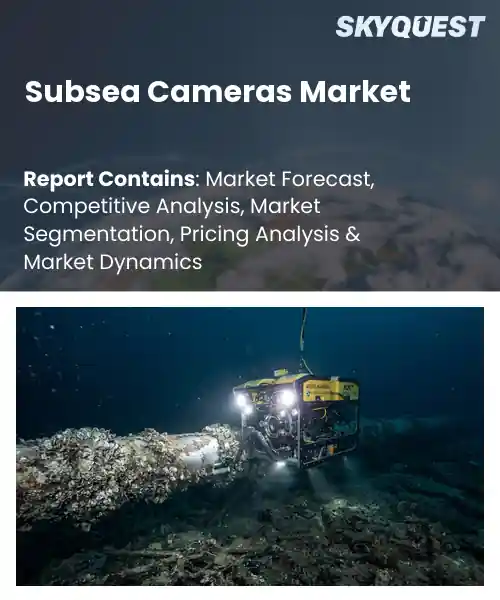
Subsea Cameras Market
Report ID: SQMIG45J2861
Report ID: SQMIG45J2861
[email protected]
USA +1 351-333-4748
Report ID:
SQMIG45J2861 |
Region:
Global |
Published Date: August, 2026
Pages:
157
|Tables:
179
|Figures:
79


Global Subsea Cameras Market size was valued at USD 487.3 Million in 2024 and is poised to grow from USD 529.21 Million in 2025 to USD 1023.92 Million by 2033, growing at a CAGR of 8.6% during the forecast period (2026-2033).
Subsea cameras constitute a specialized segment of the marine imaging industry, delivering high‑resolution visual data from depths that were once inaccessible. The market emerged in the early 2000s as oil and gas operators required reliable inspection tools for offshore pipelines, prompting manufacturers to develop pressure‑resistant housings and low‑light sensors. Over the past decade, advancements in fiber‑optic communication and solid‑state imaging have expanded applications beyond energy, enabling scientific expeditions, subsea mining, and autonomous vehicle navigation. Because these devices provide real‑time insight into harsh underwater environments, they have become essential for risk mitigation, operational efficiency, and regulatory compliance across multiple sectors globally. The principal growth catalyst for the global subsea cameras market is the convergence of digital transformation and tighter environmental regulations, which push operators toward continuous monitoring. As offshore projects move to deeper water and longer lifespans, demand for rugged AI‑enhanced imaging that detects corrosion, bio‑fouling, or leaks in real time spikes. A North Sea operator recently added edge‑computing cameras to its subsea network, cutting inspection intervals by 40 percent and lowering vessel charter costs. This cause‑effect chain technology enabling savings, which justifies further spend creates a significant feedback loop that expands the market and invites niche firms offering modular, plug‑and‑play solutions globally today.
How is AI-driven automation enhancing performance and reliability in the subsea cameras market?
AI driven automation is reshaping subsea camera performance by embedding intelligent image processing directly into the sensor package. Real time analysis filters noise and highlights features, allowing operators to make decisions without waiting for surface transmission. Predictive maintenance uses machine learning to spot wear patterns in lenses and housings, reducing unexpected failures. Adaptive lighting algorithms adjust illumination based on water clarity, improving image quality at depth. Integration with autonomous underwater vehicles enables cameras to navigate complex structures while maintaining focus, which boosts reliability and expands inspection capabilities. The market now favors solutions that combine robustness with data richness, driving rapid adoption of AI tools.Nauticus Robotics, May 2026, introduced an AI enabled camera module that automatically calibrates focus and lighting during deep sea missions, cutting operator workload and increasing data reliability, which reinforces market growth by delivering more dependable inspection results.
Market snapshot - (2026-2033)
Global Market Size
USD 487.3 Million
Largest Segment
Video Cameras
Fastest Growth
PTZ Cameras
Growth Rate
8.6% CAGR
To get more insights on this market click here to Request a Free Sample Report
Global subsea cameras market is segmented by camera type, depth rating, application, end user, mounting platform, sales channel and region. Based on camera type, the market is segmented into Still Image Cameras, Video Cameras, PTZ Cameras and Others. Based on depth rating, the market is segmented into Up to 1,000 m, 1,001–3,000 m and Above 3,000 m. Based on application, the market is segmented into Oil & Gas Exploration, Marine Research, Defense & Security and Others. Based on end user, the market is segmented into Oil & Gas Companies, Research Institutes, Defense Organizations and Others. Based on mounting platform, the market is segmented into ROV-Mounted, AUV-Mounted, Fixed Installation and Others. Based on sales channel, the market is segmented into Direct Sales, System Integrators and Others. Based on region, the market is segmented into North America, Europe, Asia Pacific, Latin America and Middle East & Africa.
Video Cameras segment dominates because operators prioritize continuous visual monitoring for complex subsea infrastructure, which demands high‑resolution streaming and real‑time analytics. The ability to integrate with control systems, support low‑light conditions, and provide reliable data links makes video solutions essential for routine inspections and emergency response. Their adaptability across diverse operational environments further solidifies their market position.
However, PTZ Cameras segment is witnessing the strongest growth momentum as flexible field‑of‑view control enables detailed inspections of confined structures without redeploying assets. Advances in servo‑driven optics and compact design lower integration costs, encouraging broader adoption in emerging deep‑water projects and accelerating market expansion for subsea imaging applications overall today.
Up to 1,000 m segment dominates because shallow‑water activities represent the bulk of offshore operations, where most inspection, maintenance, and construction tasks occur. The relatively moderate pressure and temperature conditions simplify camera housing design, allowing manufacturers to deliver cost‑effective, reliable units with proven performance. Operators therefore allocate the majority of budget to these depth‑rated solutions, reinforcing their prevailing share in the subsea cameras market. Their ease of integration with existing ROV fleets further accelerates procurement cycles.
Meanwhile, Above 3,000 m segment emerges as the key high‑growth area as ultra‑deep explorations intensify and demand resilient imaging capable of withstanding extreme pressure. Breakthroughs in titanium alloy housings and fiber‑optic illumination reduce failure rates, prompting operators to select deep‑rated cameras for strategic assets, thereby unlocking new revenue streams and expanding the market horizon.
To get detailed segments analysis, Request a Free Sample Report
The dominance of Asia Pacific stems from a confluence of advanced manufacturing expertise, substantial offshore energy activity, and a culture of rapid technology adoption. Regional manufacturers leverage deep engineering talent to deliver high‑resolution, robust imaging solutions tailored to harsh underwater environments. Strong investment in research and development fuels continual enhancement of sensor performance and integration capabilities. Government policies encouraging offshore exploration and renewable marine projects generate sustained demand, while close proximity to key maritime corridors shortens supply chains and lowers logistical barriers. Collaborative ecosystems linking component suppliers, system integrators, and end‑users further reinforce the region’s ability to innovate swiftly and meet evolving operational requirements, cementing its leadership in the subsea camera arena.
Japan Subsea Cameras Market
Subsea Cameras Market in Japan benefits from a legacy of precision optics and a strong emphasis on reliability for deep‑water applications. Leading domestic firms combine cutting‑edge sensor technology with rigorous testing protocols, ensuring equipment can withstand extreme pressures. Close collaboration between marine research institutes and industrial players accelerates the introduction of novel imaging features, while strategic partnerships with offshore operators support tailored solution development. The focus on high‑quality standards and integration with autonomous platforms positions Japan as a benchmark for performance excellence in the subsea domain.
South Korea Subsea Cameras Market
Subsea Cameras Market in South Korea is propelled by a vigorous electronics sector and a proactive approach to marine infrastructure development. The country’s expertise in miniaturized imaging components enables the production of compact, high‑definition cameras suited for complex subsea installations. Government initiatives promoting offshore renewable energy projects create a fertile environment for technology deployment, and strong ties between manufacturers and shipbuilding firms facilitate seamless system integration. Emphasis on rapid prototyping and scalable production enhances the ability to address diverse client needs across the region.
North America’s expansion is driven by robust offshore exploration activities, growing investment in subsea renewable energy, and an increasing emphasis on real‑time visual monitoring for safety and efficiency. Industry leaders prioritize sophisticated imaging systems that integrate with autonomous vehicles and advanced data analytics, fostering operational transparency. Regulatory frameworks encouraging environmental stewardship stimulate adoption of high‑resolution cameras for habitat assessment and impact mitigation. Collaborative research initiatives among academia, technology providers, and energy firms accelerate innovation cycles, while a mature supply chain ensures swift delivery of customized solutions, reinforcing the region’s fast‑paced growth trajectory.
United States Subsea Cameras Market
Subsea Cameras Market in United States thrives on extensive offshore drilling operations and a strong push toward offshore wind development. The presence of major technology firms drives continuous enhancements in sensor fidelity and low‑light performance, while partnerships with defense and research agencies expand application horizons. Emphasis on modular designs supports rapid deployment across diverse marine platforms, and a culture of open standards facilitates integration with broader monitoring ecosystems, reinforcing the United States’ leadership in advanced subsea imaging.
Canada Subsea Cameras Market
Subsea Cameras Market in Canada is shaped by its extensive coastline and active pursuit of offshore renewable projects. Indigenous expertise in cold‑water engineering informs the design of cameras capable of enduring low‑temperature environments. Collaborative ventures between oil and gas operators and research institutions promote the development of integrated visual inspection tools. Environmental monitoring requirements, particularly for marine wildlife protection, drive demand for high‑resolution, low‑impact imaging solutions, positioning Canada as a hub for specialized subsea camera technologies.
Europe strengthens its position through a blend of deep‑water expertise, stringent environmental standards, and a coordinated focus on digitalization of offshore assets. The region’s emphasis on sustainable marine operations encourages the deployment of advanced visual monitoring to minimize ecological impact. Cross‑border research collaborations and industry consortia foster the sharing of best practices and accelerate the maturation of innovative imaging platforms. Integration of artificial intelligence for anomaly detection and predictive maintenance enhances the value proposition of subsea cameras, while a mature regulatory environment ensures consistent quality and safety benchmarks across the market.
Germany Subsea Cameras Market
Subsea Cameras Market in Germany combines precision engineering with a strong automotive sensor heritage to deliver rugged imaging solutions for offshore installations. Collaborative projects between engineering firms and marine research centers advance high‑definition, low‑light capabilities. Emphasis on modular architecture facilitates seamless integration with existing subsea infrastructure, while a focus on energy efficiency aligns with broader sustainability goals, reinforcing Germany’s reputation for reliable, cutting‑edge subsea visual technology.
United Kingdom Subsea Cameras Market
Subsea Cameras Market in United Kingdom benefits from a historic maritime tradition and a vibrant offshore energy sector. Leading firms leverage expertise in optical design to produce cameras that excel in harsh subsea conditions. Partnerships with academic institutions accelerate innovation in real‑time data transmission and analytics. The United Kingdom’s commitment to offshore wind expansion further drives demand for robust visual monitoring, cementing its role as a key contributor to market advancement.
France Subsea Cameras Market
Subsea Cameras Market in France is propelled by a strong defense and research ecosystem that underpins sophisticated imaging developments. French manufacturers focus on high‑resolution, durable cameras tailored for deep‑sea exploration and environmental surveillance. Collaborative initiatives with European research programs encourage the integration of AI‑enhanced analysis tools, while a proactive stance on marine conservation fuels the adoption of low‑impact visual technologies, strengthening France’s influence in the evolving subsea camera landscape.
To know more about the market opportunities by region and country, click here to
Buy The Complete Report
Increasing Offshore Exploration Activities
Advancements In Imaging Sensor Technology
High Capital Expenditure Requirements
Stringent Regulatory Compliance Standards
Request Free Customization of this report to help us to meet your business objectives.
The subsea cameras market is shaped by intense competition as major manufacturers pursue strategic M&A to broaden sensor portfolios, forge joint ventures with offshore oil service firms to secure long‑term supply contracts, and accelerate technology innovation through high‑resolution imaging and AI‑driven analytics, exemplified by recent acquisitions of niche optics specialists and partnerships with deep‑water exploration companies to integrate real‑time video processing into subsea monitoring platforms.
Top Player’s Company Profile
Recent Developments
SkyQuest’s ABIRAW (Advanced Business Intelligence, Research & Analysis Wing) is our Business Information Services team that Collects, Collates, Correlates, and Analyses the Data collected by means of Primary Exploratory Research backed by robust Secondary Desk research. As per SkyQuest analysis the global subsea cameras market is expanding rapidly, driven primarily by the surge in offshore exploration activities that require reliable visual inspection tools, while breakthroughs in imaging sensor technology form a second major catalyst by delivering higher resolution and low‑light performance. The market faces a restraint in the form of high capital expenditure, which can delay adoption for budget‑conscious operators. Asia Pacific dominates the landscape thanks to strong manufacturing capabilities, extensive offshore projects and fast technology adoption. Within product categories video cameras hold the largest share because continuous high‑definition streaming is essential for monitoring complex subsea infrastructure. Together these forces shape a market projected to double its value by 2033.
| Report Metric | Details |
|---|---|
| Market size value in 2024 | USD 487.3 Million |
| Market size value in 2033 | USD 1023.92 Million |
| Growth Rate | 8.6% |
| Base year | 2024 |
| Forecast period | (2026-2033) |
| Forecast Unit (Value) | USD Million |
| Segments covered |
|
| Regions covered | North America (US, Canada), Europe (Germany, France, United Kingdom, Italy, Spain, Rest of Europe), Asia Pacific (China, India, Japan, Rest of Asia-Pacific), Latin America (Brazil, Rest of Latin America), Middle East & Africa (South Africa, GCC Countries, Rest of MEA) |
| Companies covered |
|
| Customization scope | Free report customization with purchase. Customization includes:-
|
To get a free trial access to our platform which is a one stop solution for all your data requirements for quicker decision making. This platform allows you to compare markets, competitors who are prominent in the market, and mega trends that are influencing the dynamics in the market. Also, get access to detailed SkyQuest exclusive matrix.
Table Of Content
Executive Summary
Market overview
Parent Market Analysis
Market overview
Market size
KEY MARKET INSIGHTS
COVID IMPACT
MARKET DYNAMICS & OUTLOOK
Market Size by Region
KEY COMPANY PROFILES
Methodology
For the Subsea Cameras Market, our research methodology involved a mixture of primary and secondary data sources. Key steps involved in the research process are listed below:
1. Information Procurement: This stage involved the procurement of Market data or related information via primary and secondary sources. The various secondary sources used included various company websites, annual reports, trade databases, and paid databases such as Hoover's, Bloomberg Business, Factiva, and Avention. Our team did 45 primary interactions Globally which included several stakeholders such as manufacturers, customers, key opinion leaders, etc. Overall, information procurement was one of the most extensive stages in our research process.
2. Information Analysis: This step involved triangulation of data through bottom-up and top-down approaches to estimate and validate the total size and future estimate of the Subsea Cameras Market.
3. Report Formulation: The final step entailed the placement of data points in appropriate Market spaces in an attempt to deduce viable conclusions.
4. Validation & Publishing: Validation is the most important step in the process. Validation & re-validation via an intricately designed process helped us finalize data points to be used for final calculations. The final Market estimates and forecasts were then aligned and sent to our panel of industry experts for validation of data. Once the validation was done the report was sent to our Quality Assurance team to ensure adherence to style guides, consistency & design.
Analyst Support
Customization Options
With the given market data, our dedicated team of analysts can offer you the following customization options are available for the Subsea Cameras Market:
Product Analysis: Product matrix, which offers a detailed comparison of the product portfolio of companies.
Regional Analysis: Further analysis of the Subsea Cameras Market for additional countries.
Competitive Analysis: Detailed analysis and profiling of additional Market players & comparative analysis of competitive products.
Go to Market Strategy: Find the high-growth channels to invest your marketing efforts and increase your customer base.
Innovation Mapping: Identify racial solutions and innovation, connected to deep ecosystems of innovators, start-ups, academics, and strategic partners.
Category Intelligence: Customized intelligence that is relevant to their supply Markets will enable them to make smarter sourcing decisions and improve their category management.
Public Company Transcript Analysis: To improve the investment performance by generating new alpha and making better-informed decisions.
Social Media Listening: To analyze the conversations and trends happening not just around your brand, but around your industry as a whole, and use those insights to make better Marketing decisions.
REQUEST FOR SAMPLE
 REQUEST FREE CUSTOMIZATION


Want to customize this report? This report can be personalized according to your needs. Our analysts and industry experts will work directly with you to understand your requirements and provide you with customized data in a short amount of time. We offer $1000 worth of FREE customization at the time of purchase.
Feedback From Our Clients


 USA (+1) 351-333-4748

